
Quick Take
- Rockalina‘s 50 years of captivity reveal astonishing resilience after a kitchen-floor life.
- Introducing Pebble to Rockalina demonstrates how social enrichment can reboot a rehabilitation trajectory.
- Contrary to common belief, box turtles are not strictly solitary; they live in colonies and can recognize members and newcomers.
- Read on to discover the moment when Rockalina and Pebble first interact and why ongoing supervision is essential.
Rockalina has become a viral sensation since being rescued in early 2025. The Eastern box turtle was in failing health, having lived in an indoor, unnatural environment for decades. Post-rescue, Rockalina continues to amaze both rescuers and fans alike with her progress. As a result of her positive strides, the decision was made to bring this remarkable box turtle some companionship. Now, Rockalina is lonely no more as she welcomes a new friend to her ever-expanding world of life and adventure.
Rockalina’s New Best Friend
Rockalina is an Eastern box turtle that was captured in the wild nearly 50 years ago. Since that time, she had never come into contact with other box turtles. Now, decades later, this amazing box turtle is getting a friend.
Chris Leone first brought attention to Rockalina about 10 months ago, when he rescued her from an environment unsuitable for box turtles. Given Rockalina’s condition, it was unclear whether she would survive the night. At that time, the idea of her interacting with other turtles was not even considered. But here she is, nearly a year later, and Rockalina is taking the step to having a small, but mighty friend.
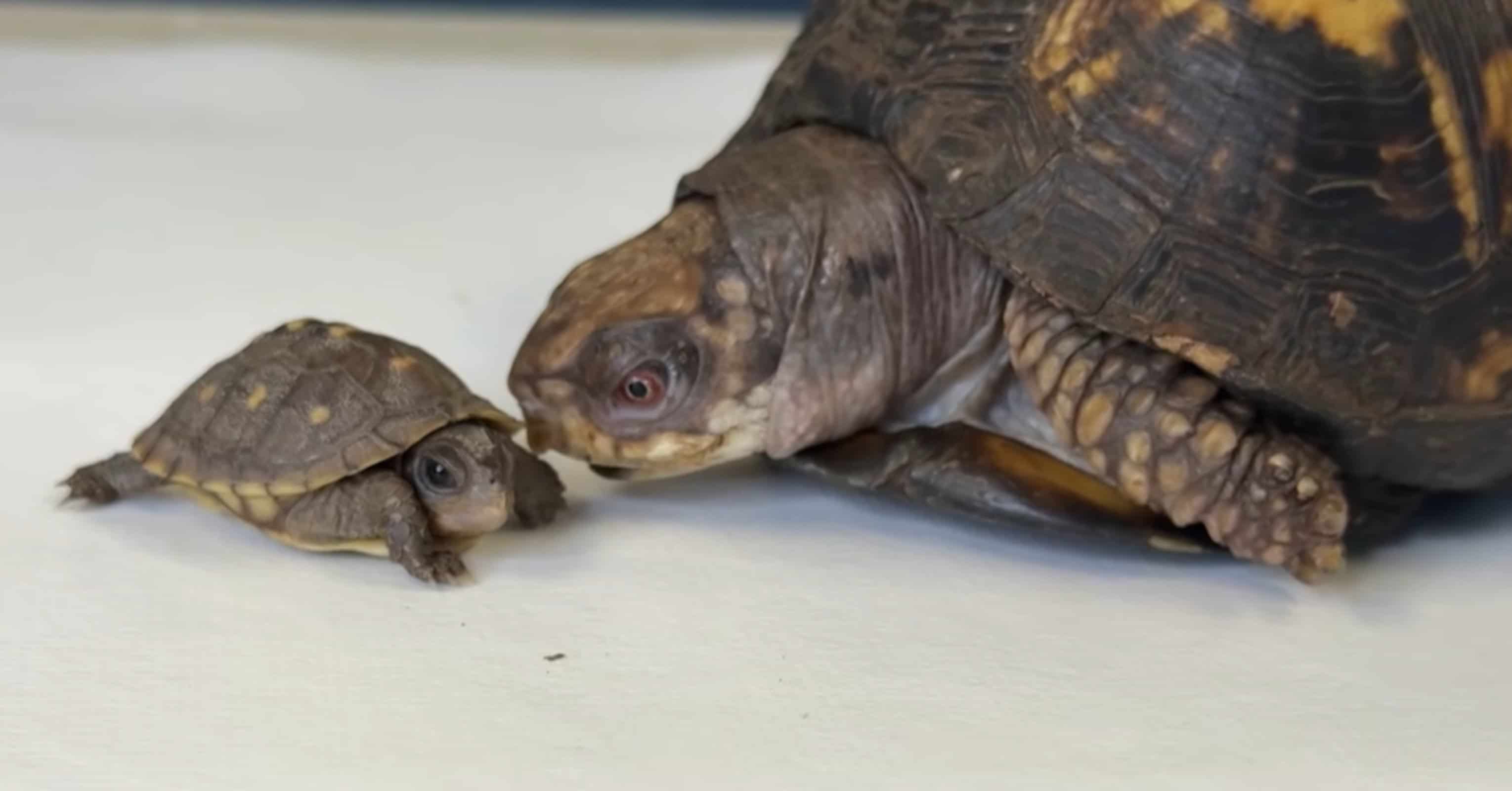
Rockalina’s new friend is Pebble, a baby box turtle. Leone, who founded Garden State Tortoise, explains that Eastern box turtles live in colonies. Therefore, the next step in Rockalina’s recovery is to get her socialized.
Rockalina and Pebble meet for the first time.
© – Original
“You will hear people say that turtles and tortoises are solitary by nature, when in fact, they occur in colonies,” Leone explains via Instagram. “This doesn’t necessarily mean that they love each other, but box turtles, in particular, are capable of using their own vision to simply recognize members of their own population or colony, which also means they can recognize a newcomer. They might see that animal as an intruder, or maybe they will welcome it.”
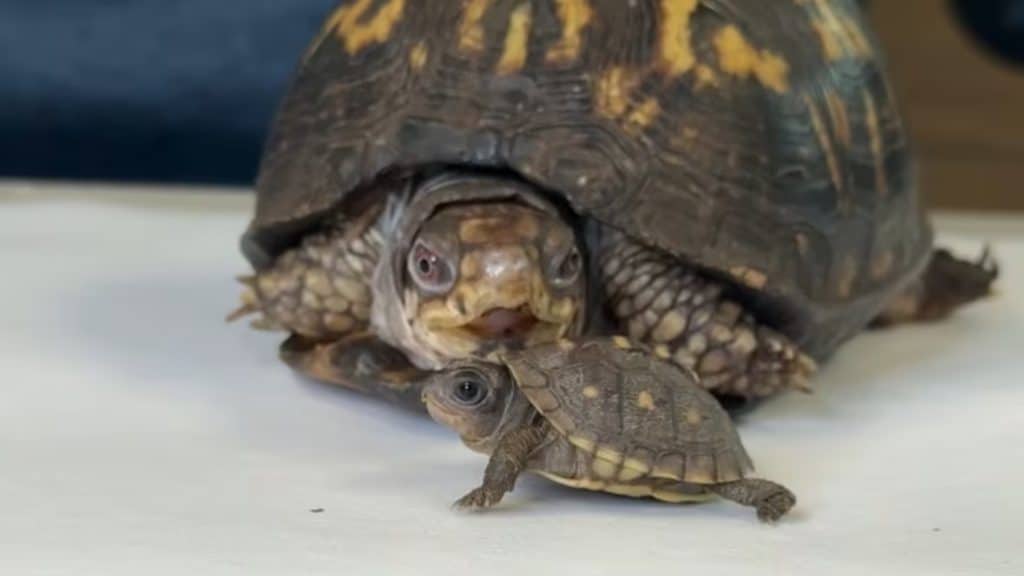
Because Rockalina had never been around other turtles of her species, it was unclear how she would react to meeting Pebble. But the best possible outcome occurred. Rockalina and Pebble were curious about one another. They ate off the same strawberry, and Rockalina was not aggressive toward the little box turtle. While there is still work to be done to build this budding relationship, it appears that Rockalina’s once bleak life is now becoming one filled with enrichment and companionship—something that seemed unattainable just months ago.
The First 50 Years of Rockalina’s Life
Rockalina’s story begins in May 1977. At that time, a young boy found her living in the wild. The young boy decided to bring Rockalina home to be his pet.
Rockalina did not have an enclosure to call her own. Instead, she was given “the run of the house,” according to a relative of the boy who brought Rockalina home. Unfortunately, with no substrate or woodland-like ground cover to walk across for over five decades, Rockalina did not live like a wild box turtle.
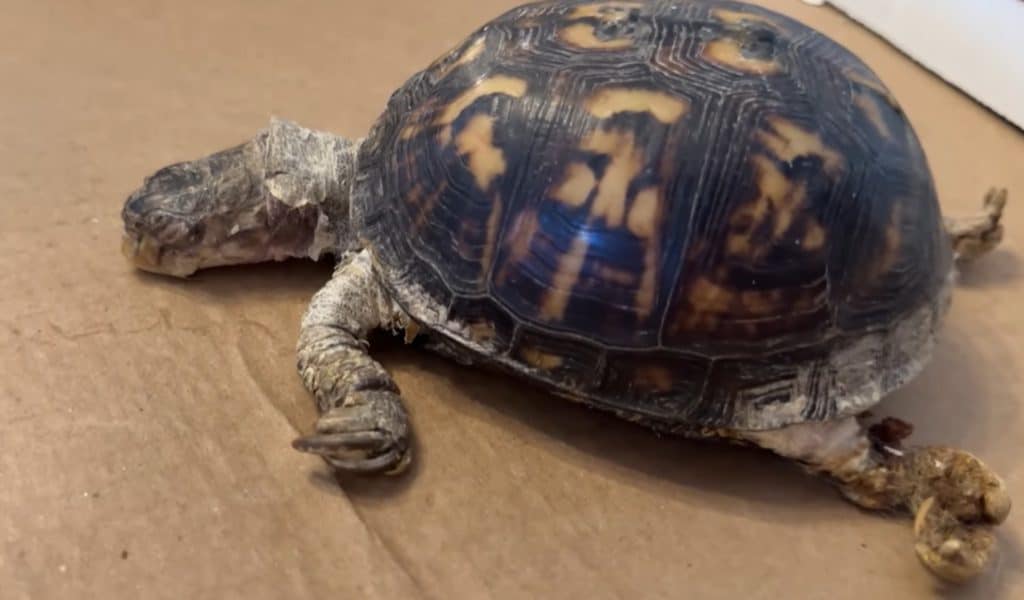
Rockalina lived on a kitchen floor, surviving on a diet of cat food and lettuce.
© – Original
Additionally, it is not known exactly what Rockalina was fed over the years, but it is believed to have been cat food. After the woman who cared for her passed away, Rockalina was fed a diet of cat food and lettuce. Neither of these foods would be available in the wild, and during the month when Rockalina was cared for by other family members, she did not eat.
These conditions were not due to intentional neglect, but rather a lack of knowledge about what Rockalina needed to thrive. Consequently, when Leone and Garden State Tortoise were reached out to, Rockalina was not in good shape.
What Was Rockalina’s Condition Like When She Was Found?
When Leone arrived at the home of a relative of the person who initially took Rockalina out of the wild decades ago, it was immediately apparent that the box turtle was in poor health. The box turtle’s skin was sloughing off, her coloration was dull, and she was lethargic.
“Here’s a recap for your guys. For 48 years, since 1977, this turtle has been living on the floor at someone’s house,” Leone explains on his YouTube video. “This was a mentally disabled person, whose parents have, unfortunately, since passed away, which is where this person came into play, who brought us the turtle. She had to help out with the family, saw the turtle, and called us right away.”
Unfortunately, according to Leone, so much time has passed with Rockalina living in “suboptimal conditions” that it was hard to tell if the turtle was going to be able to survive.
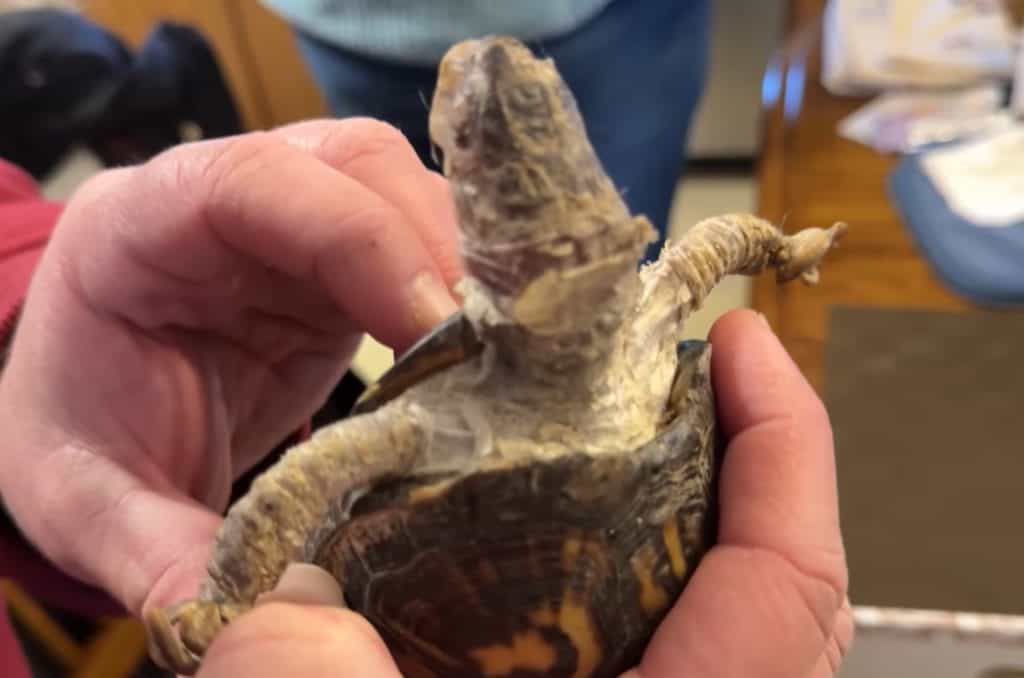
Rockalina was found in very poor condition when she was rescued earlier this year.
© – Original
“Living on the floor in a household is no life for any reptile, especially a turtle, because now her nails have grown backwards, her beak is completely overgrown, her color’s washed out, and it looks as though one of her legs is actually necrotic,” Leone says. “I mean, it is dead.”
Leone went on to point out just what living in poor conditions had done to Rockalina physically. She was unable to eat normally because of her misshapen beak. Rockalina also suffered from upturned fingers, claws, and feet.
“Not only is she dehydrated, but her skin, her nails, everything is suffering from not only metabolic bone disease, but of course, being dried out,” Leone continues. “Her skin is sloughed off and is getting stuck at the same time because there’s no humidity to help her grow and shed the way a normal turtle would.”
How Is Rockalina Doing Today?
When Rockalina was rescued in March 2025, it was uncertain whether her quality of life would justify the effort required to rehabilitate her. But Rockalina beat the odds and is thriving today.
“Rockalina is a different animal from the day we rescued her to now. This animal has a tall walk; she seems proud and really seems happy. At the risk of sounding wrong about that, I think this animal is really happy.”
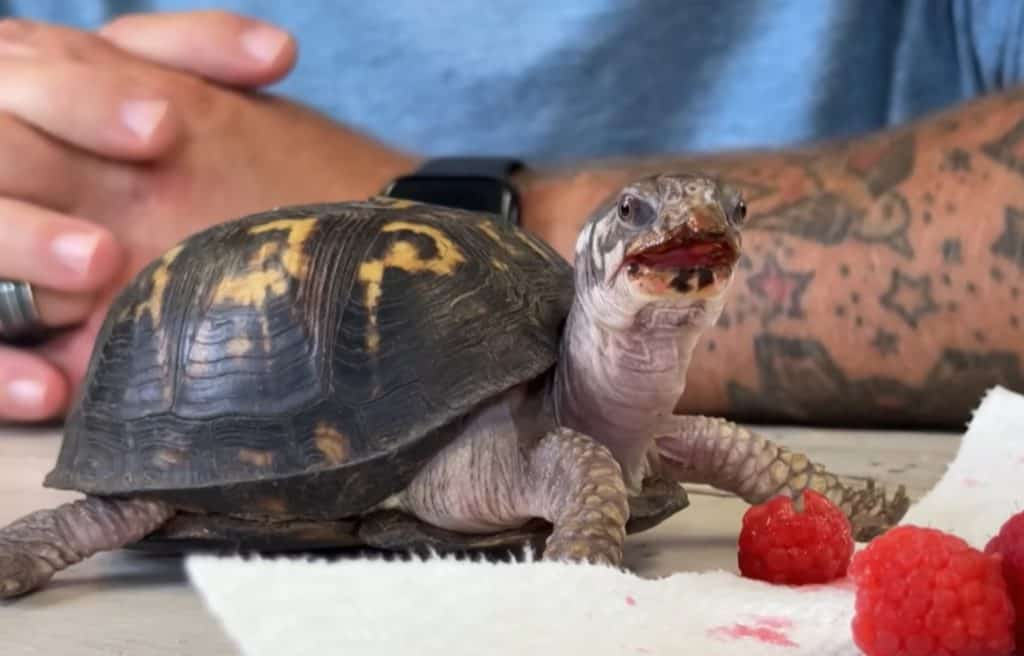
Rockalina’s recovery is nothing short of amazing, given how much she had to overcome.
© – Original
Rockalina has transitioned to living outdoors during the day to enjoy living in nature again. At night, however, she is still kept indoors, protected from the elements. This may be the lifestyle Rockalina will have for the rest of her life. Even if this is the case, she has proven that, against all odds, she is a fighter. As Leone says, “Rockalina continues to rock on,” so much so that the natural next step was to find Rockalina a friend.
Why Rockalina Couldn’t Be Introduced to Other Box Turtles After Rescue
Rockalina may be on the road to recovery since her rescue, but there are still many unanswered questions about the box turtle despite her extensive veterinary care. One of the biggest, according to Leone, is what Rockalina’s immune system can handle since her rescue.
“We have to raise one from a baby in order to do that, so she can finally have a companion and live a normal life. So what happened here is that this animal has never been around her own kind whatsoever,” Leone explains on Instagram. “Even though this turtle has had extensive veterinary attention since day one, we have no idea what her immune system is truly like and what it can handle. So that’s where this baby box turtle comes into play.”
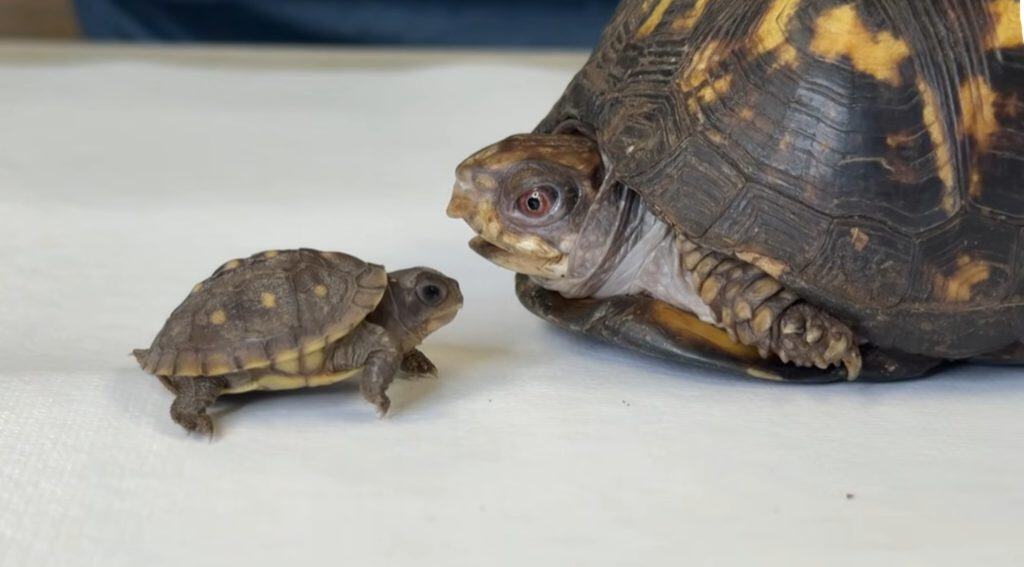
It is unclear what Rockalina’s immune system is like, which is why a baby, born in captivity, was the only option when it came to providing Rockalina with companionship.
© – Original
Leone says they hatched this turtle here from healthy adults, and that, as a result, the baby turtle is completely healthy, having never been around any other turtles before coming into Rockalina’s presence.
It is worth noting that, in normal circumstances, it is recommended that new box turtles introduced into a home already occupied by others be quarantined. Some experts say this should be done for three to six weeks, while others say three to six months. This allows the new turtle to present with any health issues it may have and get them proper veterinary care before subjecting the established turtles to diseases or parasites.
This will likely be the only way Rockalina can safely interact with another box turtle. But based on their first few meetings and the fact that both Pebble and Rockalina are interested in each other in a non-threatening way, Rockalina may have just found her first friend.
Rockalina and Pebble Have to Be Supervised When Interacting
The interaction between Pebble and Rockalina has been very positive. However, this does not mean the two can be left alone. Far from it, in fact. According to Leone, Rockalina, and Pebble need to be supervised at all times to ensure both turtles remain safe.
“These are all introductions that are going to keep happening. We’re not going to just simply throw the baby into the enclosure with Rockalina, indoors or out, once the warm weather returns,” Leone tells followers on Instagram. “This is all about observation – close observation – to make sure baby and adult are safe at all times. So, we really can’t take our eyes off them right now. We need to be able to trust both of them, but mostly Rockalina. But, so far, so good here.”
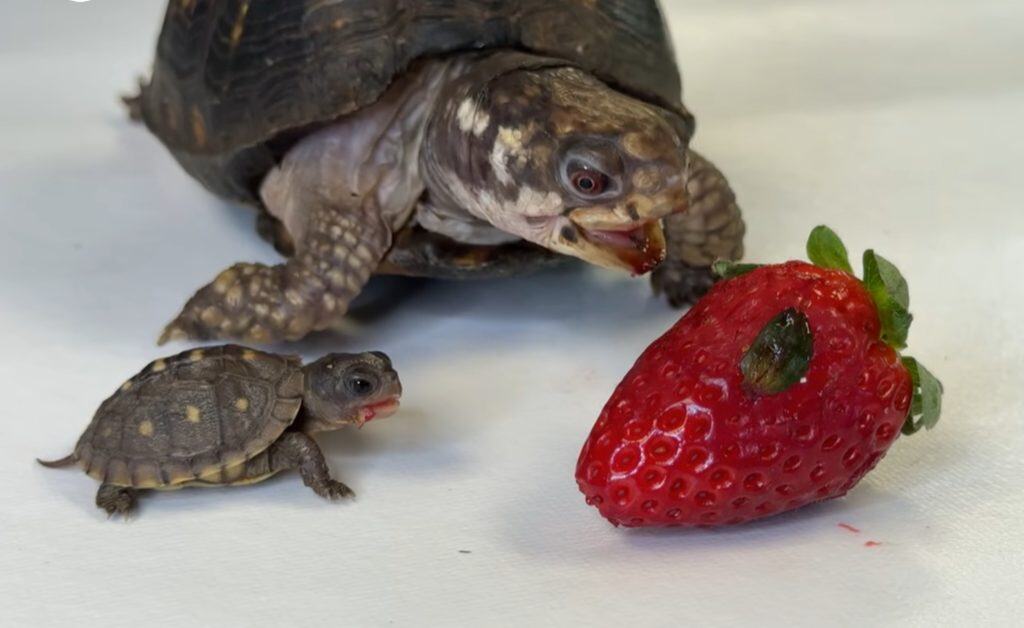
Until Pebble grows larger, she and Rockalina will have to remain supervised when they interact.
© – Original
While it has been less than a month since Rockalina was introduced to Pebble, the initial introductions have been exciting. Rockalina lived in an environment for five decades that nearly killed her. Now, this amazing box turtle, who never gave up on life, not only has a new lease on it, but may also have a future where she is no longer lonely, with baby Pebble by her side.