
Every year in the United States, collisions with glass kill hundreds of millions of birds, and recent work indicates the toll likely exceeds one billion. These deaths happen at homes, schools, offices, and downtown towers, turning ordinary windows into silent hazards. From a backyard picture window to a wall of glass on a city building, reflections of sky and trees can trick birds into thinking they see a safe habitat. Migratory and resident species alike pay the price. The good news is that people can greatly cut these losses. Understanding why birds hit windows and choosing proven fixes allows homeowners, businesses, and communities to protect wildlife while still enjoying daylight and views.
A Dog-Walking Mystery

My dog alerted me to our dead bird problem.
©Andrii Zastrozhnov/iStock via Getty Images
Walking my dogs around my apartment complex one day, I noticed the biggest one had something in his mouth and forced him to drop it. To my horror, it was a songbird. I knew he hadn’t caught it, but just found it dead on the ground. I disposed of it with regret and continued my walk. A few days later, I spotted another one, near the same place, by the big windows of the indoor pool. I assumed a stray cat was responsible and considered reporting it to the rental office.
When I found two more over the next few days, always by the window, it dawned on me: they see the palm trees inside the pool room but not the glass. We’re tempting them with a tropical paradise that is really a death trap. Knowing that covering the windows would not be an option, I wondered if there was any practical solution I could recommend to the apartment management.
How Big Is the Problem? Collision Statistics
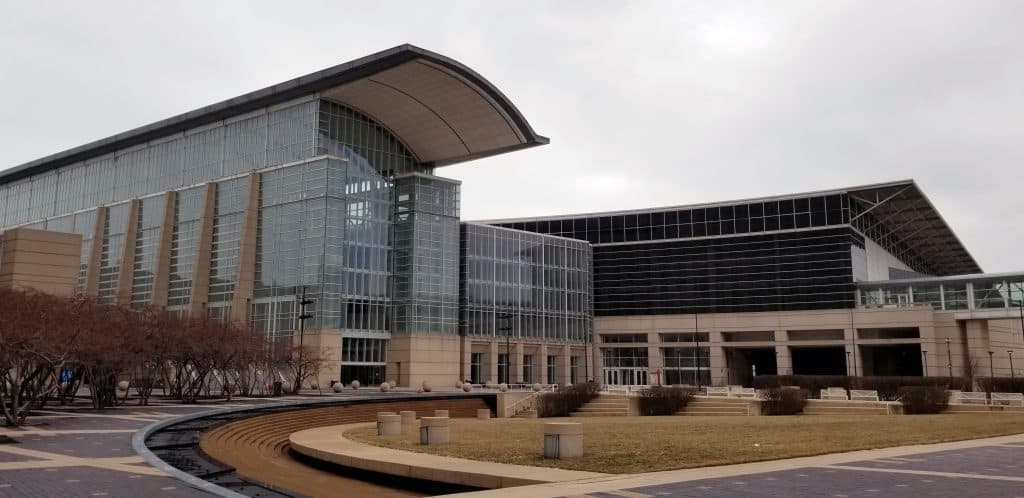
In a single night in 2023, nearly 1,000 migrating birds died, striking the windows of McCormick Place in Chicago.
©Patrick Bray/US Army Crops of Engineers, Public domain, via Wikimedia Commons – Original / License
Scientists have studied bird–building collisions for decades. Studies of rehabilitation records and carcass surveys suggest that more than half of window collisions end in death, even when a bird initially appears only stunned. A large share of those who fly away later succumb to internal injuries or brain trauma.
Older nationwide estimates suggested that 365 to 988 million birds die each year after hitting windows in the United States. Newer analyses, including year-round monitoring at many sites, point to a toll above one billion birds annually. Single nights of heavy migration can produce extreme events, such as the loss of nearly 1,000 birds at Chicago’s McCormick Place Lakeside Center in October 2023.
Why Birds Cannot See Glass

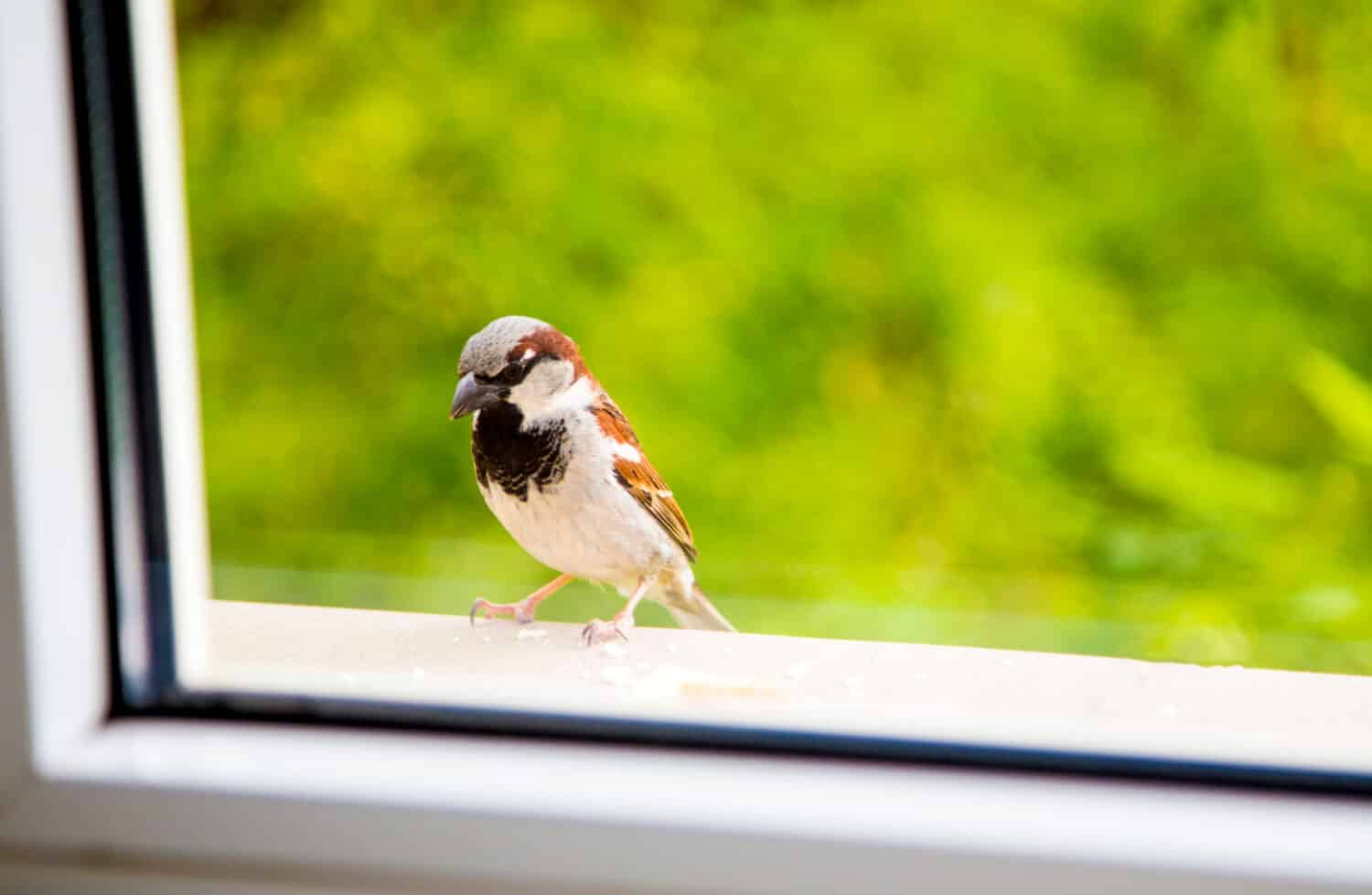
Birds cannot distinguish reflections of trees and the sky from the real thing.
©hallojulie/Shutterstock.com
Glass is dangerous because most birds do not recognize it as a barrier. Highly reflective panes mirror trees, shrubs, and open sky, so a bird in flight sees what looks like continuous habitat. Clear glass creates a different illusion, revealing indoor plants or a passageway that resembles a tunnel through the building.
During migration, tired birds travel through unfamiliar territory at high speed, which increases the chance of fatal mistakes. Many species can see ultraviolet light, and some glass products take advantage of that, but common window victims such as robins, sparrows, and doves do not rely heavily on UV cues. When feeders, baths, or nest boxes sit near untreated windows, birds move repeatedly through the danger zone, and strikes become far more likely.
Other Human-Caused Threats to Birds
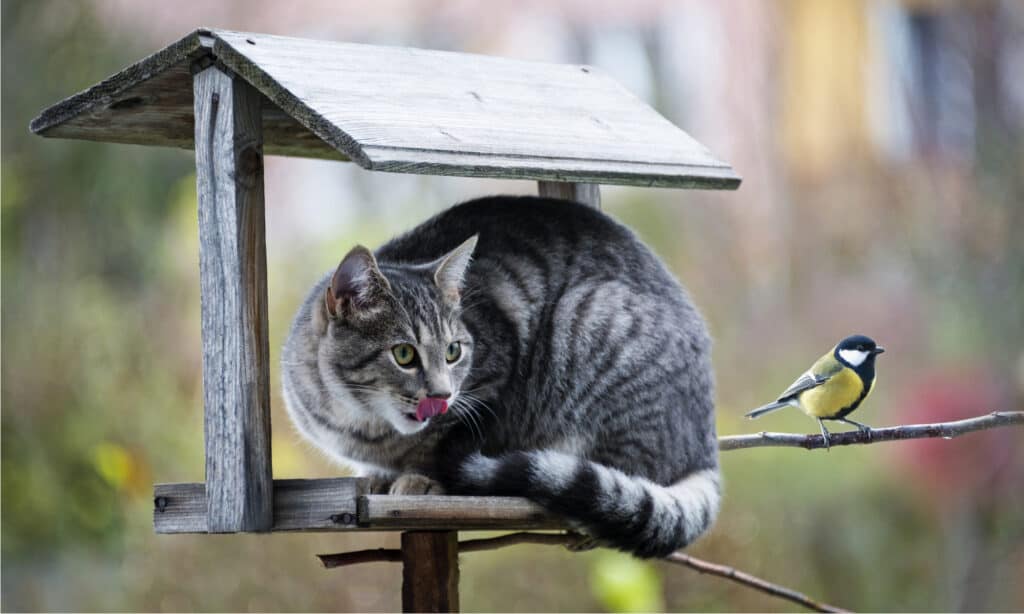
Introduced by people, the approximately 100 million domestic and feral cats in the country kill more than a billion birds a year.
©Kuttelvaserova Stuchelova/Shutterstock.com
Window collisions are only one part of the broader pressure people place on birds. In the United States, free-ranging domestic and feral cats introduced by people have killed an estimated 1.4 to 3.7 billion birds annually, far more than any other single human-related cause. Vehicles are another major problem. Federal summaries of many studies suggest that collisions with cars and trucks kill roughly 89 to 340 million birds each year nationwide. Power lines, communication towers, and oil pits add millions more deaths, through blunt impact, entrapment, or electrocution.
Wind turbines receive heavy public attention, yet current estimates place their toll far below that of cats, buildings, or vehicles, on the order of 250,000 to 1 million birds a year in the United States. Habitat loss, pesticide exposure, and invasive predators are by far the most intense pressures on bird populations.
Which Birds Are Most at Risk?
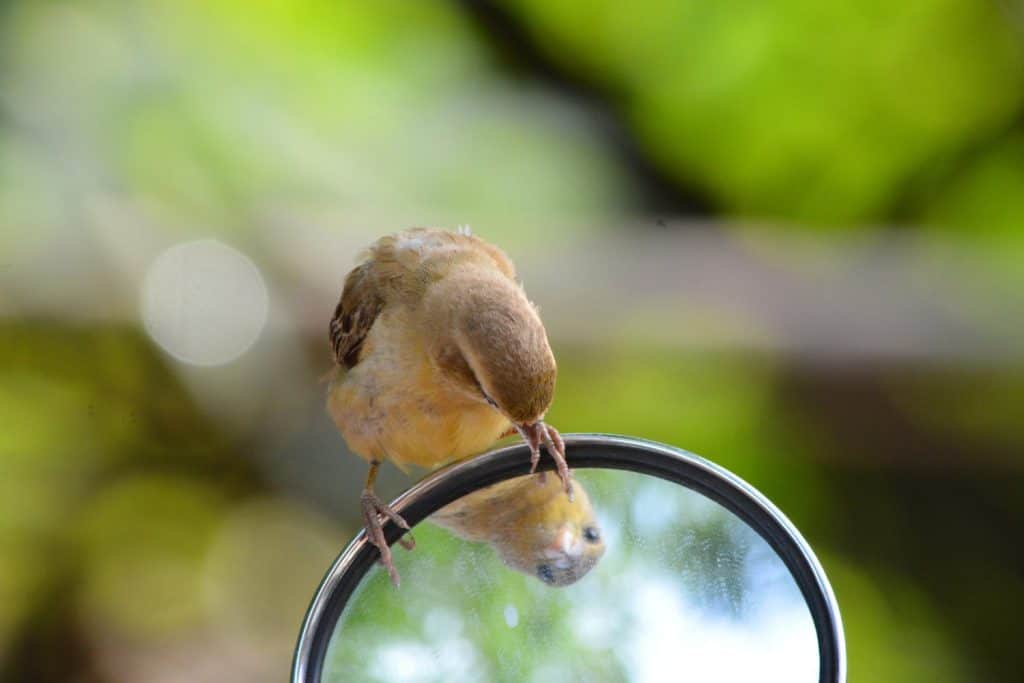
Birds sometimes hit glass by accident; other times, they may see their own image and attack it to defend their territory.
©buddhawut/Shutterstock.com
Many collision victims are the same birds people enjoy watching in parks and backyards. American robins, northern cardinals, mourning doves, and house sparrows regularly appear in monitoring programs that track dead or injured birds around buildings. Small songbirds are especially vulnerable. Their fast, agile flight leaves little time to react when a reflection or transparent pane appears in front of them.
Long-distance migrants such as warblers and tanagers often travel at night, then feed around buildings during the day, so they encounter glass in unfamiliar settings while already stressed from travel. Larger birds are not immune. Hawks may chase prey toward a reflective facade, and woodpeckers may crash into glass while defending territory from their own reflection. Young birds learning to fly face a high risk because they lack experience and often explore new areas near people.
Where and When Collisions Happen
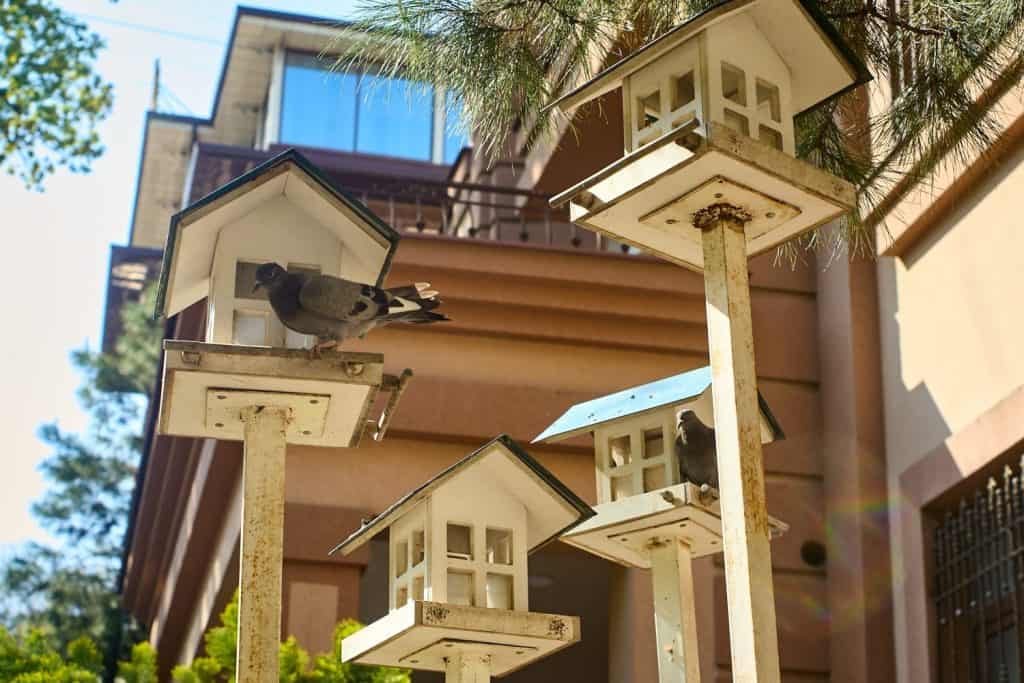
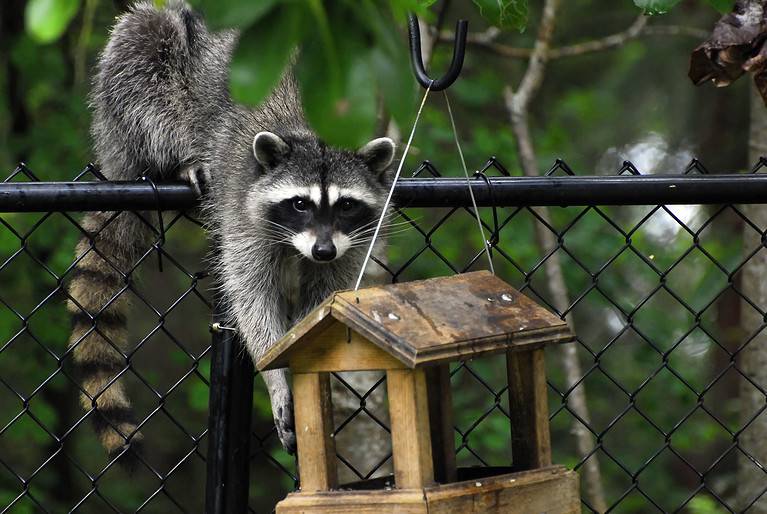
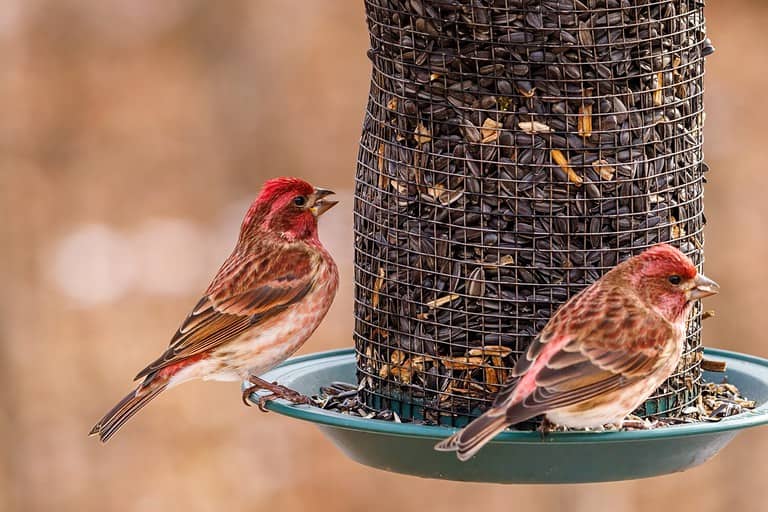
Bird feeders placed near windows can increase collisions.
©Vasiliy Konanau/Shutterstock.com
Homes and low-rise buildings cause most window-related bird deaths, simply because there are so many of them, and they often sit near trees and gardens. Studies that compared building types found that residential structures alone account for a large share of total casualties. Bird feeders are one culprit. Placed near unprotected windows, they can increase collision risk, unless the glass is treated or the feeder is positioned very close to the glass (within about 3 feet). This way, if birds are startled, they cannot gain enough speed to cause a fatal collision when flying away from the window.
Tall downtown towers, though dangerous, make up a smaller fraction of the national toll. Skyscrapers matter most in city centers that lie along major migration routes, where lit glass walls can draw in vast flocks during certain nights. Collisions peak during spring and fall migration, when waves of long-distance travelers move through towns and cities. Overcast conditions, fog, or bright urban lighting can disorient birds and concentrate them near buildings. Local patterns also matter. A single problematic facade next to a courtyard or stand of trees may account for most collisions at a site.
The Most Effective Solutions

Patterned glass can help break up reflections to make windows more visible to birds.
©Rachel Poirot/ via Getty Images
The most reliable way to prevent collisions is to make glass clearly visible to birds on the outside surface. Bird-safe films and patterned glass break up reflections with stripes, dots, or other markings that follow spacing rules tested in flight tunnels. Many products use UV-reflective patterns that people barely notice from indoors, while birds see a clearly visible barrier.
External insect screens and tensioned netting add another layer of protection by softening any impact and cutting glare. Hanging cord systems, such as Acopian BirdSavers, place vertical paracord lines a few inches apart in front of glass; field studies and testing show that such designs can reduce collisions by more than 90 percent. Densely applied decals or tape strips can also work, as long as they cover the entire pane with close spacing, not just a handful of shapes in the center.
Costs and Practical Choices
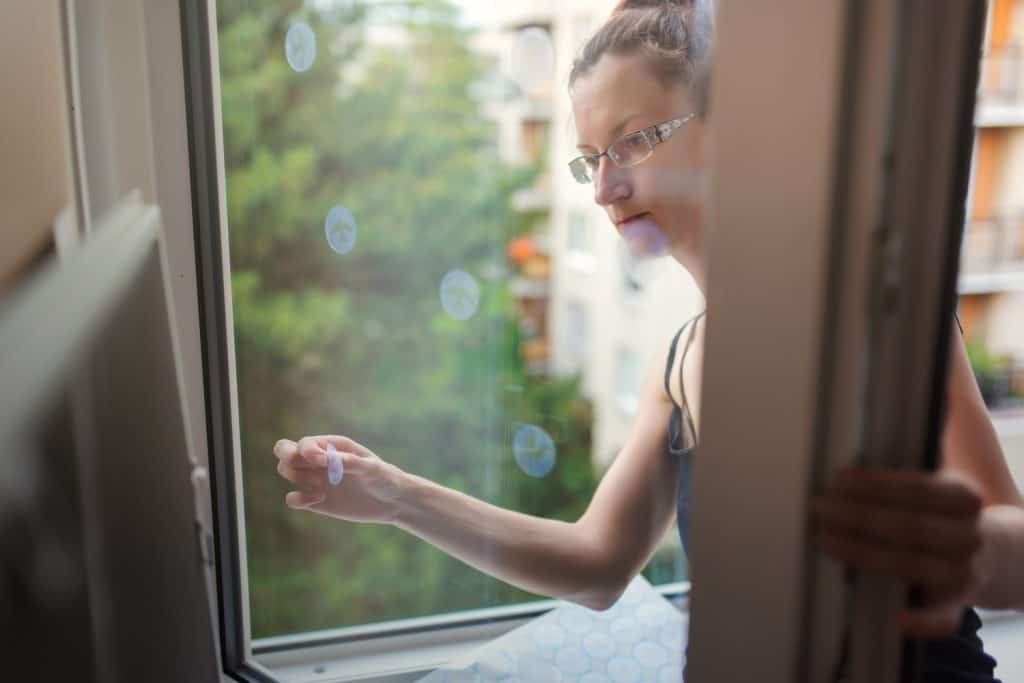
These decals have a special coating that reflects ultraviolet sunlight, which helps prevent wild birds from accidentally striking windows.
©JDzacovsky/Shutterstock.com
Costs vary widely, so homeowners and institutions often mix approaches. External bird-safe window films for retrofits typically cost around four to six dollars per square foot for materials, with labor bringing the total higher, although energy savings can offset part of that expense over time. Some films, such as certain bird-safety products tested by conservation groups, have expected outdoor lifespans of seven years or more.
External screens or netting average about $1.83 per square foot and can be attached with hooks or frames. Acopian BirdSavers, sold as “Zen Curtains,” run about $24 for a standard 24-by-32-inch window, while do-it-yourself versions that use paracord and simple hardware can cost far less per pane. Feather-patterned tapes and dot films designed for homeowners usually cost less than $10 per window. For renters, removable options like tempera paint patterns or suction-cup screens provide low-cost alternatives.
Why Solutions Have Been Slow to Spread
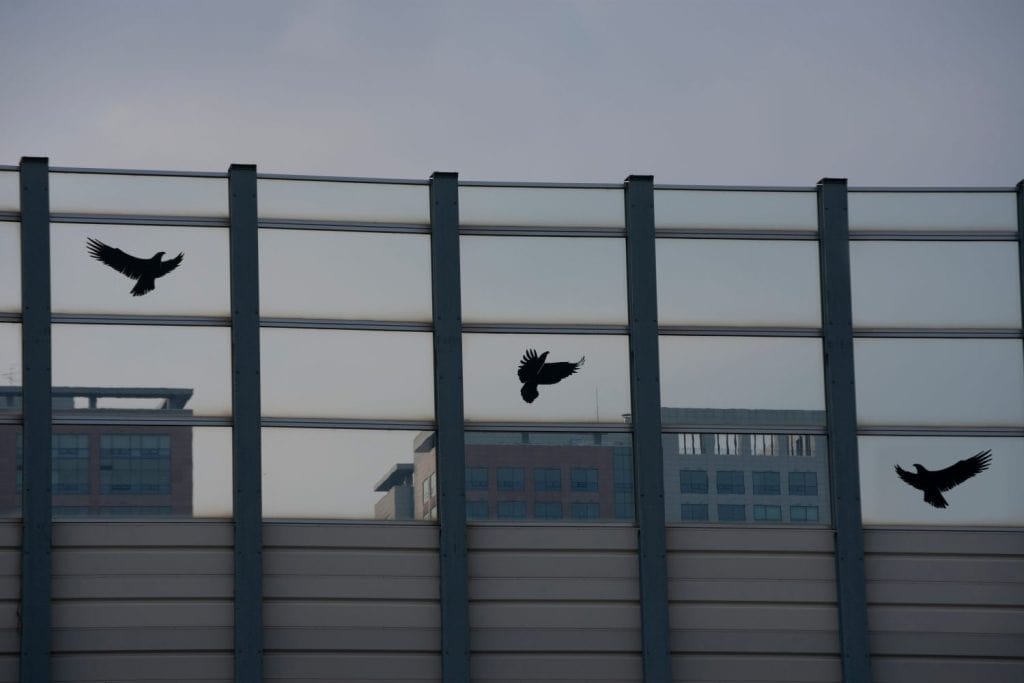
Decals with the silhouette of raptors help prevent bird strikes on this glass soundproof wall in Seoul, South Korea.
©Ki young/Shutterstock.com
Scientists and conservation groups have tested many tools that work well, yet adoption has lagged. Cost plays a major role. External films, patterned glass, or specialized coatings can cost several dollars per square foot, especially when professional installation is required. Many property owners do not realize how many collisions occur on their own buildings, because scavengers often remove carcasses before anyone notices.
In older structures, there is usually no legal requirement to retrofit existing glass. Building managers may worry about changing the appearance of an entryway or lobby, or assume that decals placed here and there are enough. Renters face their own barriers, such as lease rules that limit permanent changes. On the positive side, more cities and institutions now adopt bird-friendly standards for new construction, and high-profile success stories are helping to change expectations.
Building Bird-Friendly Communities
Cities and universities that have adopted bird-safe policies report steep drops in collision counts once problem facades are treated. Each treated window protects countless migrants over its lifetime. By choosing designs that birds can see, people help safeguard migration routes and nesting neighborhoods while still enjoying natural light and views from indoors. Small changes in thousands of buildings add up to real survival gains for many species.