
Quick Take
- A thriving tortoise colony with zero predators and unlimited food is sleepwalking toward extinction, with the threat coming entirely from within. See how females are dying →
- Scientists have a name for when a species destroys itself from the inside. Hermann's tortoises are the only animal known to be doing it right now. Understand demographic suicide →
- The males aren't fighting each other. Instead, they've turned their aggression somewhere far more destructive. Explore the male aggression cause →
- A specific year has been projected for when females will vanish entirely from the island, with the males expected to follow not long after. See the 2083 extinction projection →
Hermann’s tortoises are native to multiple Mediterranean islands. However, one island located in North Macedonia, Golem Grad, is not part of their native range. Yet, after Hermann’s tortoises were introduced there in the past, their population has exploded.
Unfortunately, despite a large population, Hermann’s tortoises are facing demographic suicide on the Macedonian island. Without intervention, the consensus is that the population will collapse.
Female Hermann’s Tortoises Are Dying at an Alarming Rate
Hermann’s tortoises are classified as “near threatened” by the IUCN. Some populations are faring better than others, though. One particular gathering of tortoises on the North Macedonian island of Golem Grad lives in a habitat with no predators, a large population, and plentiful food. The tortoises appear to be living a harmonious life, but looks can be deceiving.
According to a new study published in Ecology Letters, Hermann’s tortoises living on Golem Grad are dying at an alarming rate. Environmental pressures are not causing the tortoises to die, nor are both males and females perishing at equal rates. Instead, female tortoises are dying in larger numbers than males.
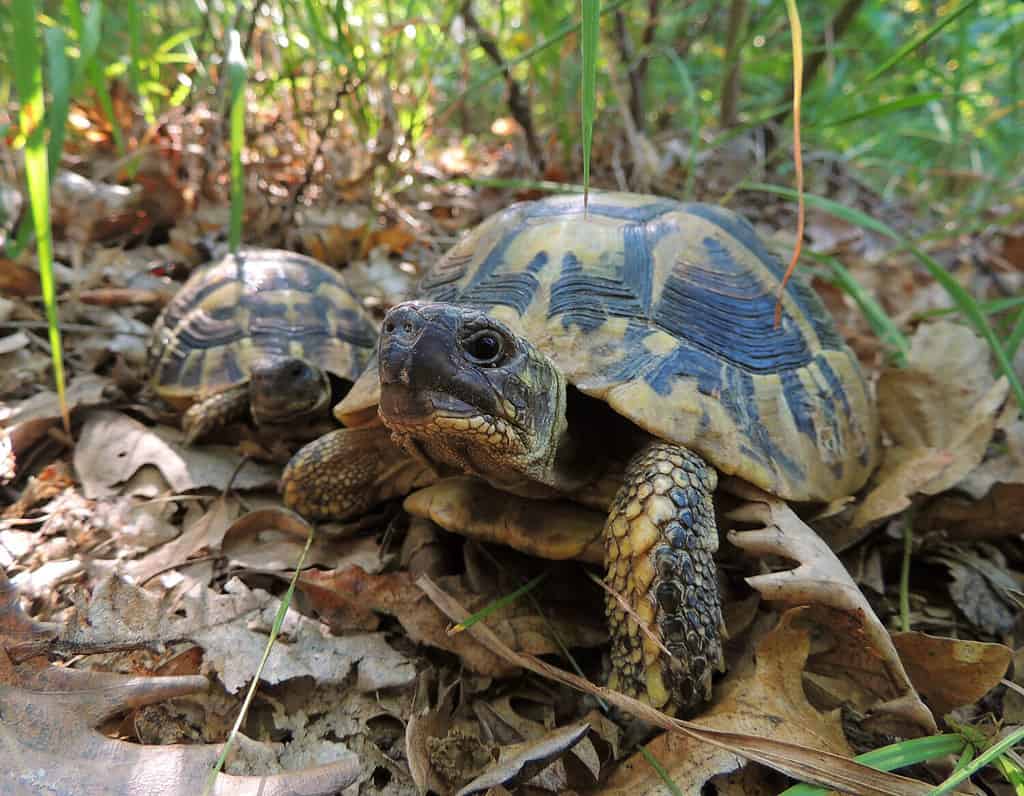
Male Hermann’s tortoises are causing the Golem Grad population to collapse by killing female tortoises.
©Predrague/Shutterstock.com
Male Hermann’s tortoises are directly responsible for the potential population collapse that the tortoises on the island may experience. In their quest to mate with females, the male tortoises are relentless in their pursuit of the opposite sex.
Female tortoises do their best to hide away from the males when they can. Many times, the males will chase the females along the island until the females are too exhausted to move. The male tortoises will then lie down beside the females for the evening, beginning the dance all over again the following day.
In their hounding of the female Hermann’s tortoises, males have even knocked the females off cliffs. Female tortoises fall to their deaths, in some cases, along with their eggs. In instances like this, not only does the current generation of tortoises perish, but future generations do as well.
What Is Demographic Suicide?
Generally, when an animal population begins to decline, there are pressures that cause it. Those that have a healthy habitat, no known predators, and plenty of food to sustain them do not begin to die off. This only happens when demographic suicide comes into play.

An imbalance of sex ratios and aggressive behavior is leading to demographic suicide of Hermann’s tortoises.
©czjonyyy/Shutterstock.com
According to the study, demographic suicide occurs when internal, rather than external, pressures cause a population to decline. In the case of Hermann’s tortoises on Golem Grad, it is the imbalance of sex ratios and self-destructive behaviors that are causing demographic suicide.
Hermann’s tortoises are the only known species currently participating in demographic suicide. Without intervention, the population on Golem Grad has no chance at long-term survival.
What Is Leading to the Destructive Male Hermann’s Tortoise Behavior?
According to the study, the population of Hermann’s tortoises on Golem Grad is close to 1,000 strong. With numbers like this, the population would appear to be stable, if not growing. However, when examined closely, the large population is exactly what is causing the destructive behavior in male Hermann’s tortoises.
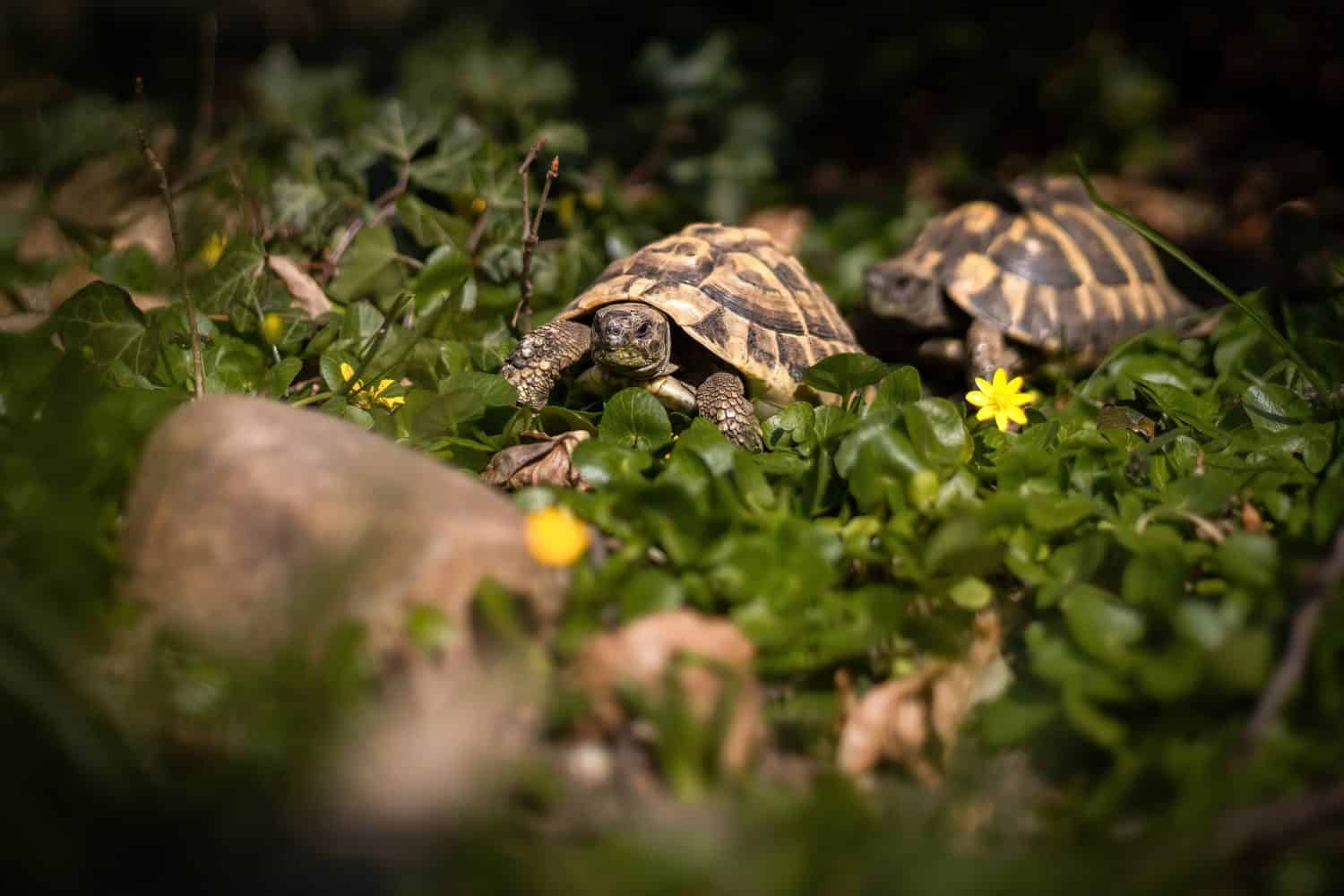
Too few female tortoises for mating has increased aggressive behavior in male Hermann’s tortoises.
©Wirestock Creators/Shutterstock.com
Of the population of tortoises, fewer than 800 are adults capable of successfully mating. If this sub-population were equal in number, aggressive male behavior would likely not occur. However, this is not the case. Instead, there are approximately 19 males vying for every one female.
With so few females capable of laying eggs on the island, males have become super competitive. Instead of being competitive with one another, they have turned that aggression on the females. In doing so, the male tortoises have only compounded the problem. Each time a female dies from being pushed off a cliff or from injuries caused by male Hermann’s tortoises, there are even fewer females available for the males to pursue.
Female Hermann’s Tortoises Could Go Extinct from Golem Grad
Given how aggressively male Hermann’s tortoises are pursuing females, there is a massive imbalance in the male-to-female ratio on Golem Grad. If this continues without outside intervention, female tortoises will go extinct from this particular population.
Currently, there is a significant age difference between male and female Hermann’s tortoises on Golem Grad, which affects the behavior of males toward females. The oldest male tortoise is 60 years old, whereas the oldest female is only 35. This has led male tortoises in search of females to attempt to mate with other males, rocks, or even immature females. This further reduces the female tortoise population, either because they are injured or killed by male tortoises or because they lay eggs before maturity, which can lead to life-threatening complications.

Hermann’s tortoises will eventually go extinct from Golem Grad as the females cease to exist.
©Leonie Victoria/Shutterstock.com
The life expectancy of Hermann’s tortoises is between 50 and 100 years. However, no female tortoises on Golem Grad are anywhere near this age. The females are not expected to reach old age either, given the current behavioral climate of males. Consequently, according to the study, without change, female Hermann’s tortoises are expected to go extinct from the Golem Grad population by 2083.
If this occurs, the males will continue to live until old age. The conditions on the island are such that there is plenty of food and no predators. What will not be there are females. As a result, in the decades after the last female disappears from Golem Grad, the remaining males will eventually die off. With no offspring being produced, the once large population of Hermann’s tortoises on Golem Grad will disappear, all because intense male mating behavior drove the population out of balance.