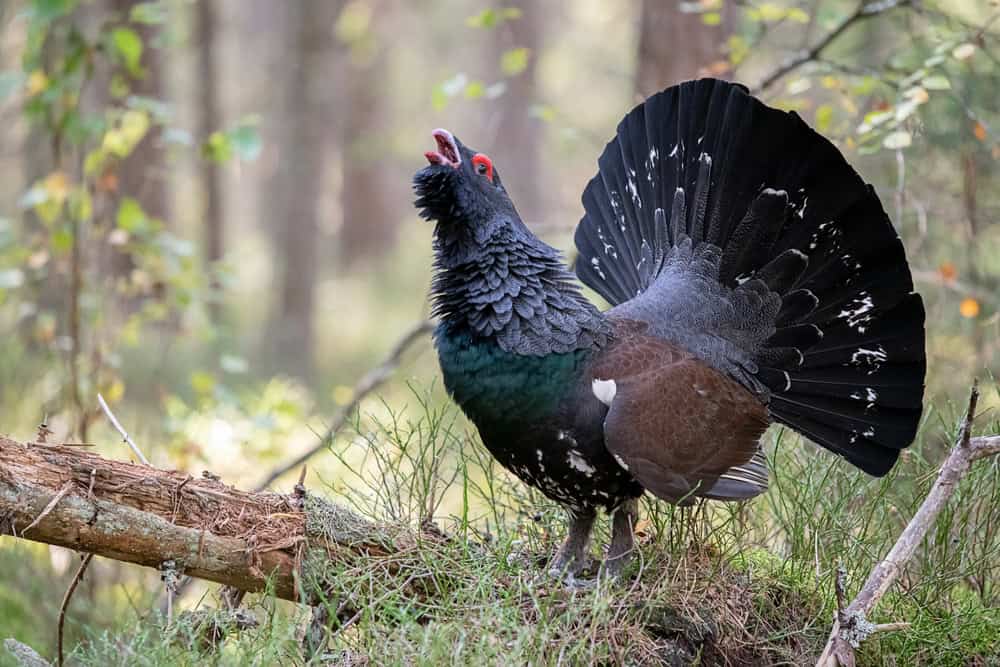

The rare bird in this video clip is clearly not impressed with human company. While the wildlife photographer is delighted with this sighting, the bird has very different opinions. Read on to find out more about the capercaillie and why this video clip is so rare.
What Are Capercaillie?
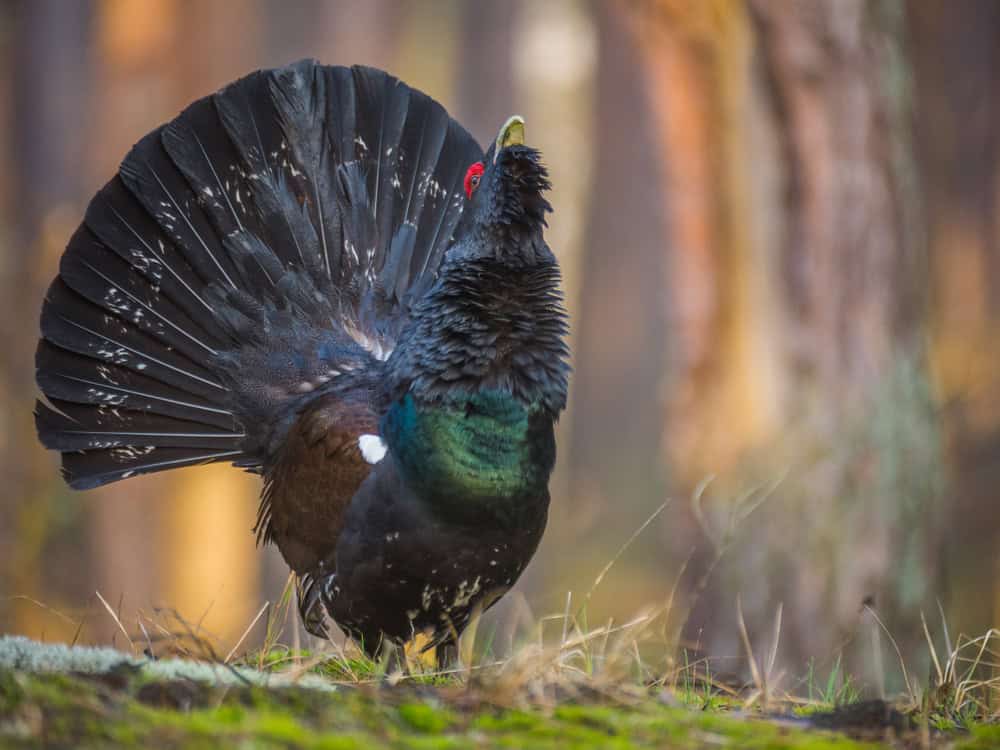
Capercaillie are large grouse.
©Mikhail Rodionov/Shutterstock.com
The capercaillie (Tetrao urogallus) is the world’s largest grouse. Their name is derived from the Gaelic word ‘capall-coille’, which means horse of the forest. They are also known as the wood grouse, heather cock, and cock-of-the-woods.
Males weigh around 8.5 to 9 pounds, while females weigh about half as much. The individual in this clip is a male, as he has glossy black feathers with a green tinge on his chest and red eye markings. These birds breed across the northern parts of Europe and the Palearctic. In the United Kingdom, however, they are only found in the native pinewoods of northern Scotland.
They spend most of their time on the ground where they feed on buds, shoots, and berries of pines, bilberries, and grasses. They are occasionally seen in trees, but this is rare. In truth, the chances of you seeing one at all are very low, as there are so few of them and they tend not to enjoy human company! You are more likely to hear them during the mating season. This is when the males make distinctive gulping, whistling, and clicking sounds.
Why Are They So Rare?
The capercaillie became extinct in the UK in 1785 due to over-hunting. During the 19th century, capercaillie from Sweden were reintroduced. However, their numbers are in decline again. Their numbers have declined due to a combination of habitat loss and fragmentation, as well as climate change, which increases chick mortality during wet and cool weather. Others are killed when they fly into deer fencing. They are currently classified in the UK as a red-listed species under the Birds of Conservation Concern review.
Recent estimates suggest just over 500 capercaillie remain in Scotland’s fragmented pine forests, with the population continuing to decline. The Royal Society for the Protection of Birds Scotland is working with private landowners, the Scottish Government, and corporate partners to protect them. Measures include reducing the threat posed by fences in core areas and minimizing the impacts of mammalian predators through diversionary feeding. Pine martens and foxes are known to take eggs and chicks. If you do see one, the best thing you can do is leave it alone!