
Quick Take
- The wasp goes beyond simply paralyzing its prey by performing a two-part neurological procedure that targets a specific brain region to achieve something far more calculated than paralysis. See the two-step sting →
- The cockroach is larger than the wasp, yet it ends up being led somewhere on a leash, and what gets used as that leash is the strangest part. How the roach gets led →
- The larvae follow a precise consumption sequence that keeps their host from dying too soon, and the order in which organs disappear is grimly strategic. Inside the consumption sequence →
The natural world can be beautiful and transcendent. It can also be downright merciless, and almost medieval in its strategies for extracting resources. The emerald jewel wasp and its method of feeding its larvae is a good example. Scientists have repeatedly observed that these solitary wasps meticulously attack cockroaches, paralyzing them just enough so that they can be led back to a burrow and used as hosts for growing larvae.
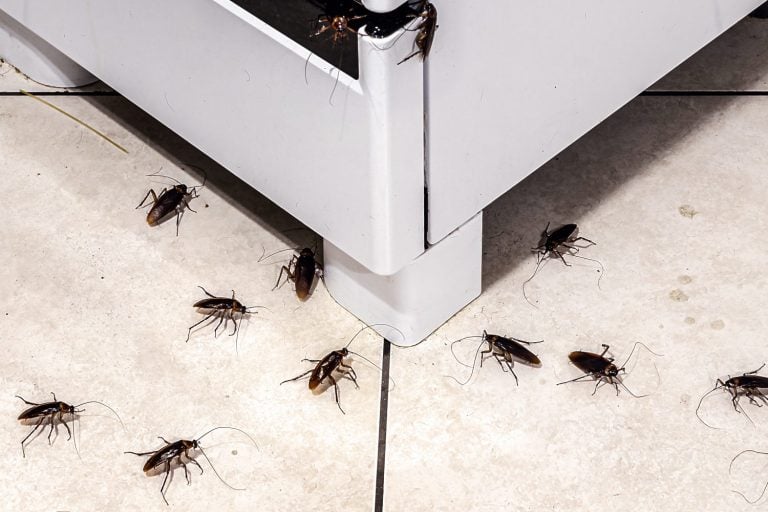
Although roaches are bigger than wasps, the wasps’ precise attacks leave their victims pliable enough that their antennae can be used as a leash. While many venomous creatures use live prey to feed their young, emerald jewel wasps are unique in their ability to suppress a cockroach’s escape response. The roach remains alive and functioning but unable to flee its fate as a host. Let’s learn more about this vibrant-looking wasp and how it uses surgical precision to claim a living host for its larvae.
The Deadly Jewel
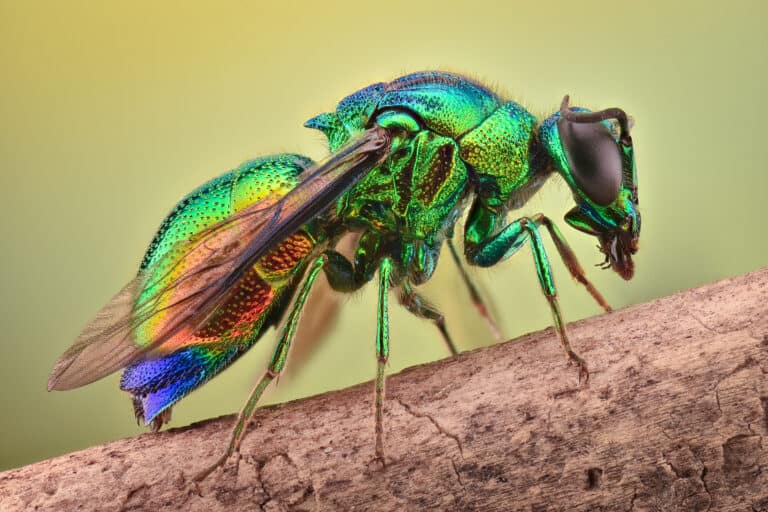
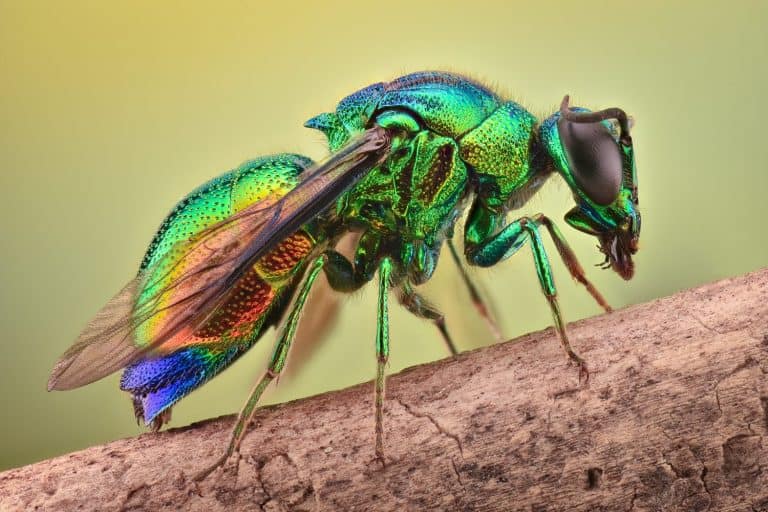
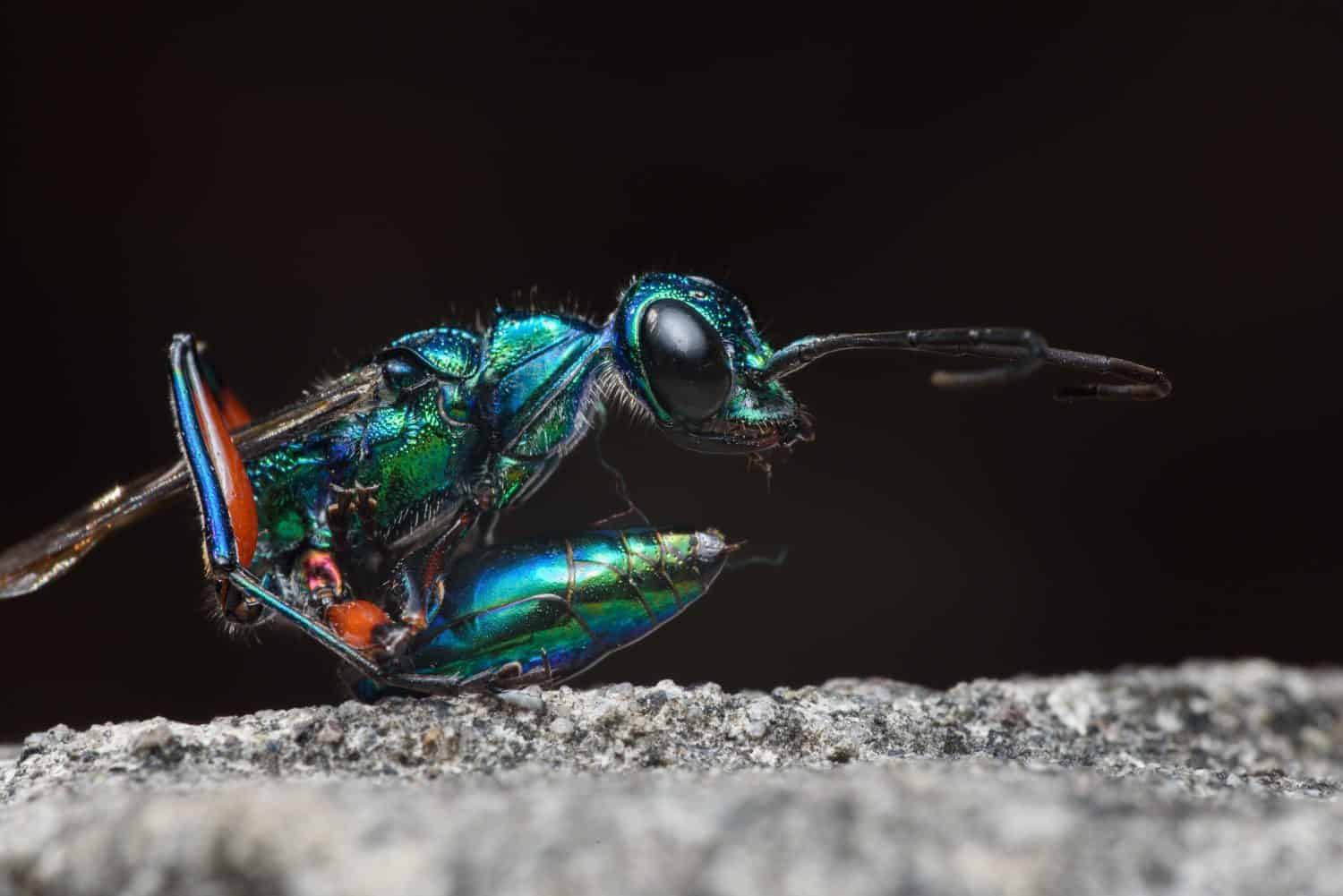
The emerald cockroach wasp, also called the jewel wasp (Ampulex compressa), belongs to the family Ampulicidae. It is a solitary wasp found in tropical regions, including Africa, Southeast Asia, and the Pacific Islands. Emerald jewel wasps are characterized by vibrant and metallic blue-green bodies with red coloration on the second and third pairs of legs. Females of this species are considerably larger than males. All emerald cockroach wasps undergo four larval stages.
These larval stages are notable because they require a living cockroach as a host, technically classifying emerald jewel wasps as entomophagous parasitoids. Many venomous creatures feed live prey to their young, but these wasps use expert surgical precision to stun a cockroach and lead it back to their burrow. There, the wasp larvae hatch and begin feeding on the stunned host until nothing is left.
A Steady Sting
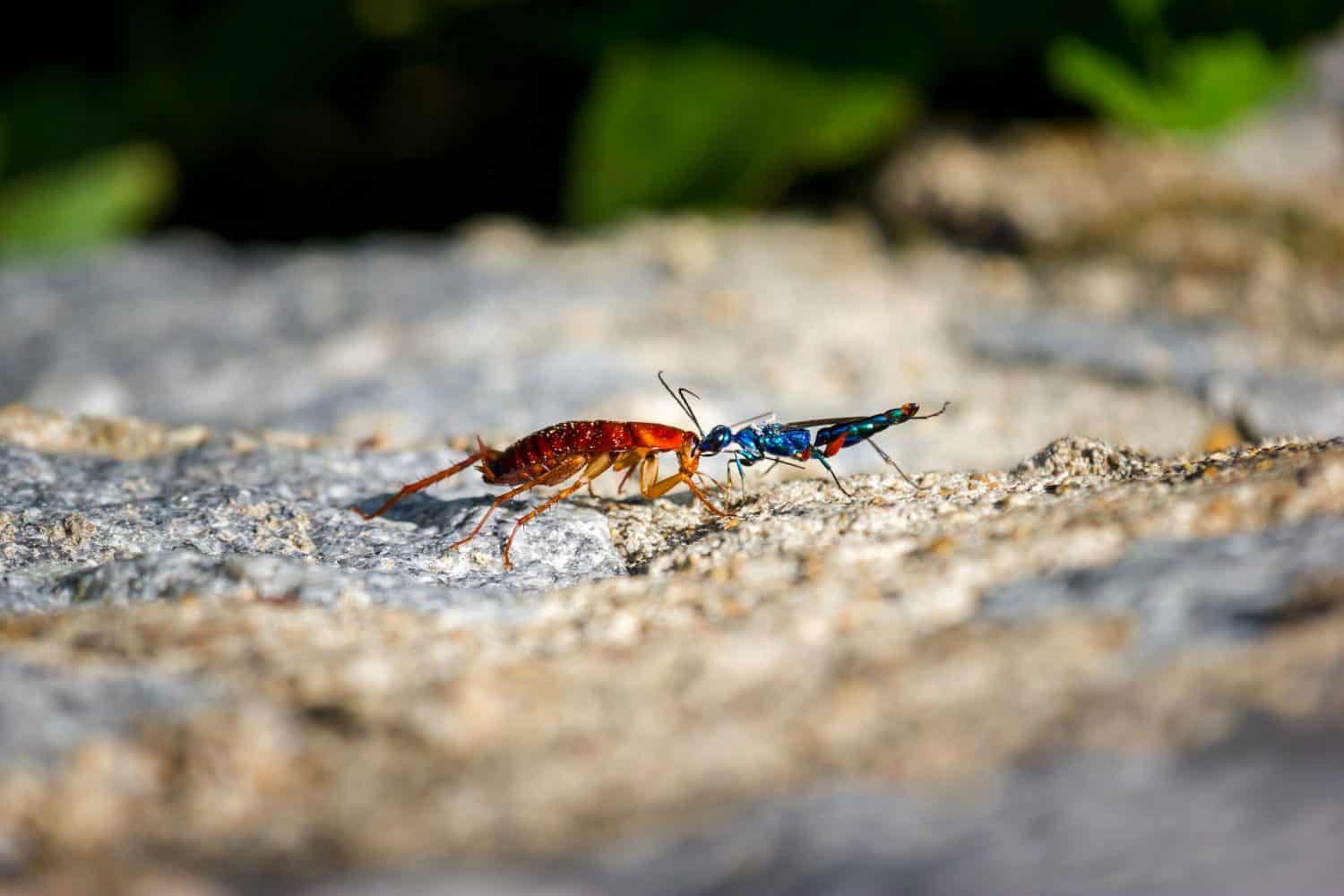
Emerald jewel wasps lead cockroaches back to their burrows by pulling their antennae like a leash.
©Glass and Nature/Shutterstock.com
When a female emerald jewel wasp encounters a potential cockroach host, it springs into action. First, it strikes by stinging the cockroach’s thoracic ganglion and injecting only a small amount of venom. This partially paralyzes the roach. As the temporary paralysis spreads, the wasp delivers a second, more precise sting to the part of the roach’s brain that controls escape reflexes. This disrupts the roach’s nervous system, causing it to groom itself frantically before becoming lethargic and losing all escape reflexes.
Once the roach is sufficiently debilitated, the wasp chews off half of its antennae and feeds on the hemolymph (the insect’s blood-like fluid) that flows out. Roaches are often much larger than their wasp predators, so the wasps pull on the roach’s antennae like a leash to lead them back to their burrow. There, the female wasp lays one or two eggs between the roach’s legs. With her job done, the wasp leaves the burrow and fills the entrance with debris to ensure that nothing disturbs the hatching process.
Parasitic Nurture
For the next three days, the captive roach, lacking escape reflexes, remains in the burrow until the wasp eggs hatch. The larvae begin feeding on the roach, chewing their way into its abdomen. Over the next week or so, they consume all of the roach’s organs, ultimately killing it.
Once the roach has died, the larvae enter the pupal stage inside a cocoon within the roach’s body cavity. After this stage is complete, adult wasps emerge from their once-living host. Remarkably, only one mating session is required for female wasps to seek out and paralyze several dozen roaches to serve as hosts. It may be a gruesome affair, but for jewel wasps, it’s simply an ordinary part of creating the next generation.