
Deserts are one of the most extreme habitats on the planet. It is estimated that around one-third of Earth’s land surface is desert. However, not all deserts are hot and covered in sand. A desert is any land that receives less than 10 inches of precipitation a year. So, the polar regions are also classified as deserts. We often picture deserts as barren wastelands, but there is a wide variety of wildlife adapted to live in these dry regions. Read on to discover the largest animals that live in deserts, ranked by weight.
9. Caribou
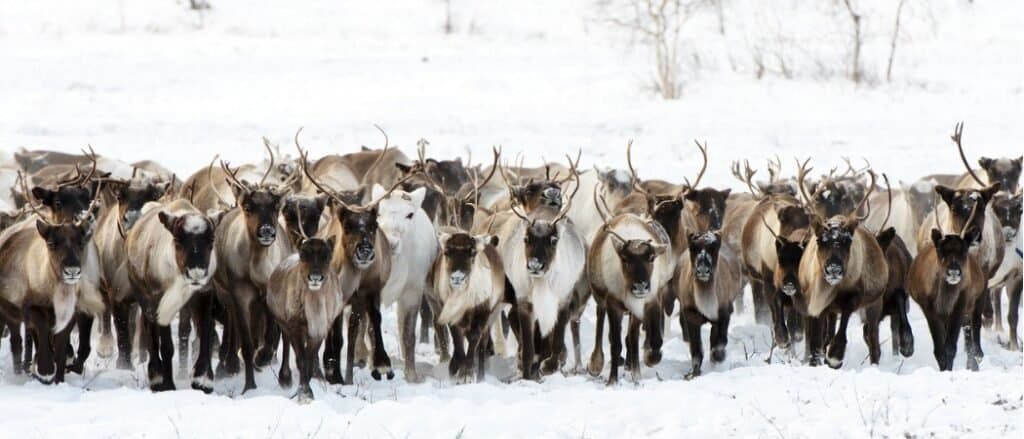
Not all deserts are hot. Caribou live in the tundra of the Arctic, which is a polar desert.
©longtaildog/Shutterstock.com
| Height | Length | Weight |
|---|---|---|
| Up to 5 feet | 6-7 feet | 350-500 pounds |
Caribou (Rangifer tarandus), also known as reindeer, live in the Arctic tundra regions found in the U.S., Canada, Greenland, Scandinavia, and Russia. The tundra receives less than 10 inches of precipitation per year, so it is considered a polar desert or cold desert. Caribou can reach up to 5 feet at the shoulder, 7 feet in length, and up to 500 pounds.
They have a dense undercoat with an outer coat of hollow guard hairs that trap air to provide insulation. They have short ears and tails to minimize surface area and reduce heat loss. Caribou have specialized bones in their nostrils that can heat and humidify the cold air they inhale. It also helps them retain moisture from the air they exhale. Caribou get water from snow and ice, as well as the plants they eat.
8. Wild Burros
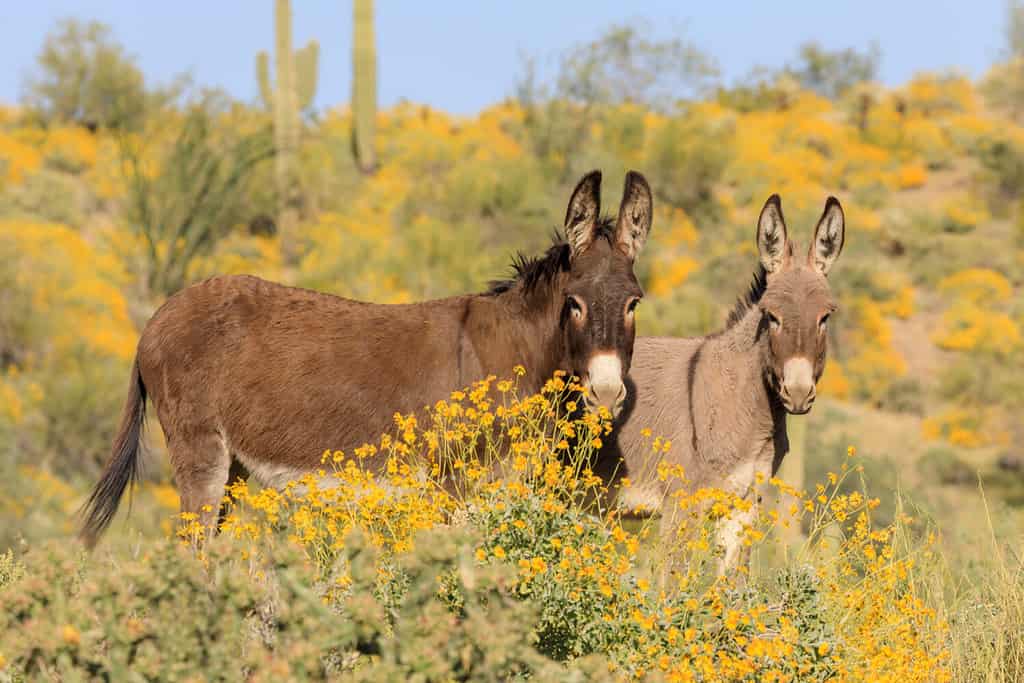
The American West is home to thousands of wild burros.
©Tom Tietz/Shutterstock.com
| Height | Length | Weight |
|---|---|---|
| 3.6-4 feet on average | 3-4 feet | 350-500 pounds |
Wild burros (Equus asinus), or donkeys, live in a variety of desert habitats across the American West, including the Sonoran Desert and Death Valley. Populations occur in Arizona, Nevada, California, and parts of Utah and Oregon. These donkeys are native to northern Africa and are well adapted to the dry conditions of the desert. Donkeys vary in size, with the largest of them reaching up to 500 pounds. They reach up to 4 feet in length and 4 feet at the shoulder on average, but some individuals may grow taller.
Donkeys have large ears and short, sleek coats that help them dissipate heat. They are said to need less water per pound than other domesticated animals, except for camels. Donkeys can survive up to three days without water. They can tolerate losing 20%-25% of their body weight due to dehydration, recovering quickly when they locate water. Wild burros are known to dig holes with their hooves to access underground water.
7. Desert Lions
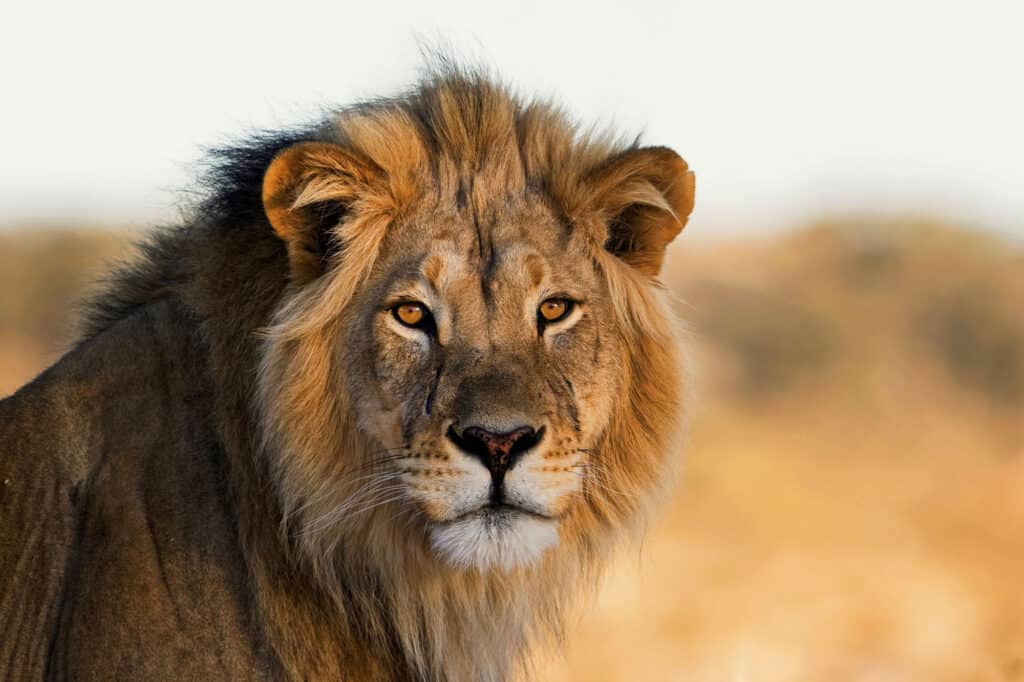
A desert lion is an African lion that has adapted to life in the Namib and Kalahari Deserts.
©SeymsBrugger/Shutterstock.com
| Height | Length | Weight |
|---|---|---|
| Up to 4 feet | Up to 10 feet with a 2-3 foot tail | 330-550 pounds |
Desert lions are not a separate species; they are African lions (Panthera leo) that have adapted to live in a desert habitat. They are some of the largest cats in the world and are a very adaptable species. Lions typically live in savannas, grasslands, thick brush, open plains, scrublands, and forest habitats. However, some lions have adapted to live in the African deserts. Desert lions primarily live in the Namib Desert in Namibia and the Kalahari Desert in Botswana, Namibia, and South Africa. Lions stand 4 feet tall at the shoulder and can grow up to 10 feet in length with a 2-3-foot tail. Male lions can reach up to 550 pounds.
Desert lions have lighter coats, longer legs, and larger paws compared to other lions, which helps them reflect sunlight away from their bodies, travel longer distances, and negotiate hunting in the sand. These lions also have larger home ranges and smaller prides in order to successfully cope with lower prey availability. They can go for long periods without water because they get most of the moisture they need from the blood and tissues of their prey.
6. Muskoxen
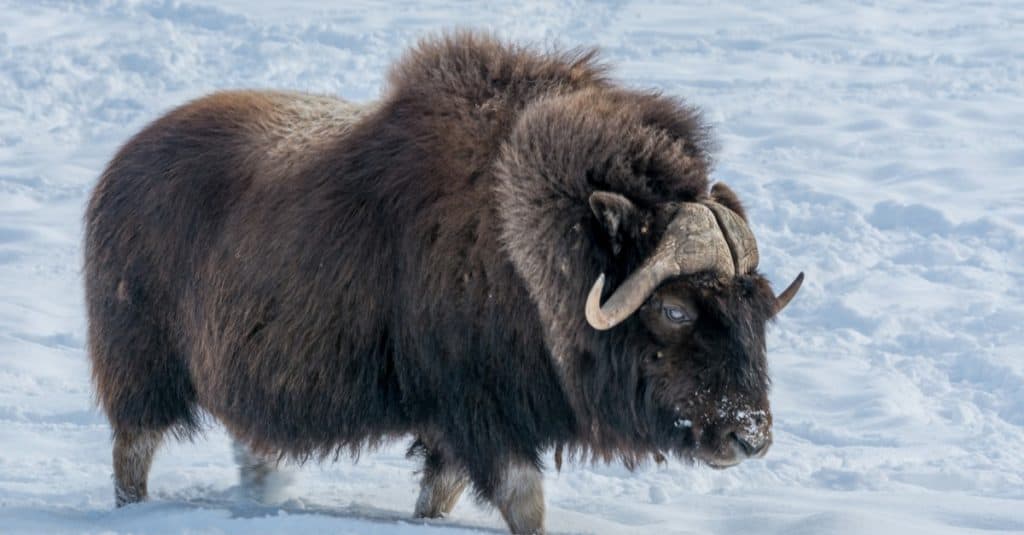
Muskoxen can be found across the Arctic regions of Alaska, Canada, Greenland, Russia, and Scandinavia.
©Fitawoman/Shutterstock.com
| Height | Length | Weight |
|---|---|---|
| 5 feet | 6.5-8.2 feet | 600-900 pounds |
The muskox (Ovibos moschatus) is a hooved bovine found in the Arctic regions of Alaska, Canada, and Greenland. They have also been introduced in Russia, Siberia, and Norway, with some individuals crossing over into Sweden. Muskoxen stand 5 feet tall at the shoulder, reach up to 8.2 feet long, and weigh up to 900 pounds.
Muskoxen have short, fine undercoats for warmth, with long, coarse overcoats that repel water and protect them from snow and ice. They also have a thick layer of body fat, which provides insulation and also acts as an energy reserve when resources are scarce. Muskoxen have stout, barrel-shaped bodies, short legs, short tails, and small ears that help to minimize heat loss. They rely on snow and ice, as well as the plants they eat, for hydration.
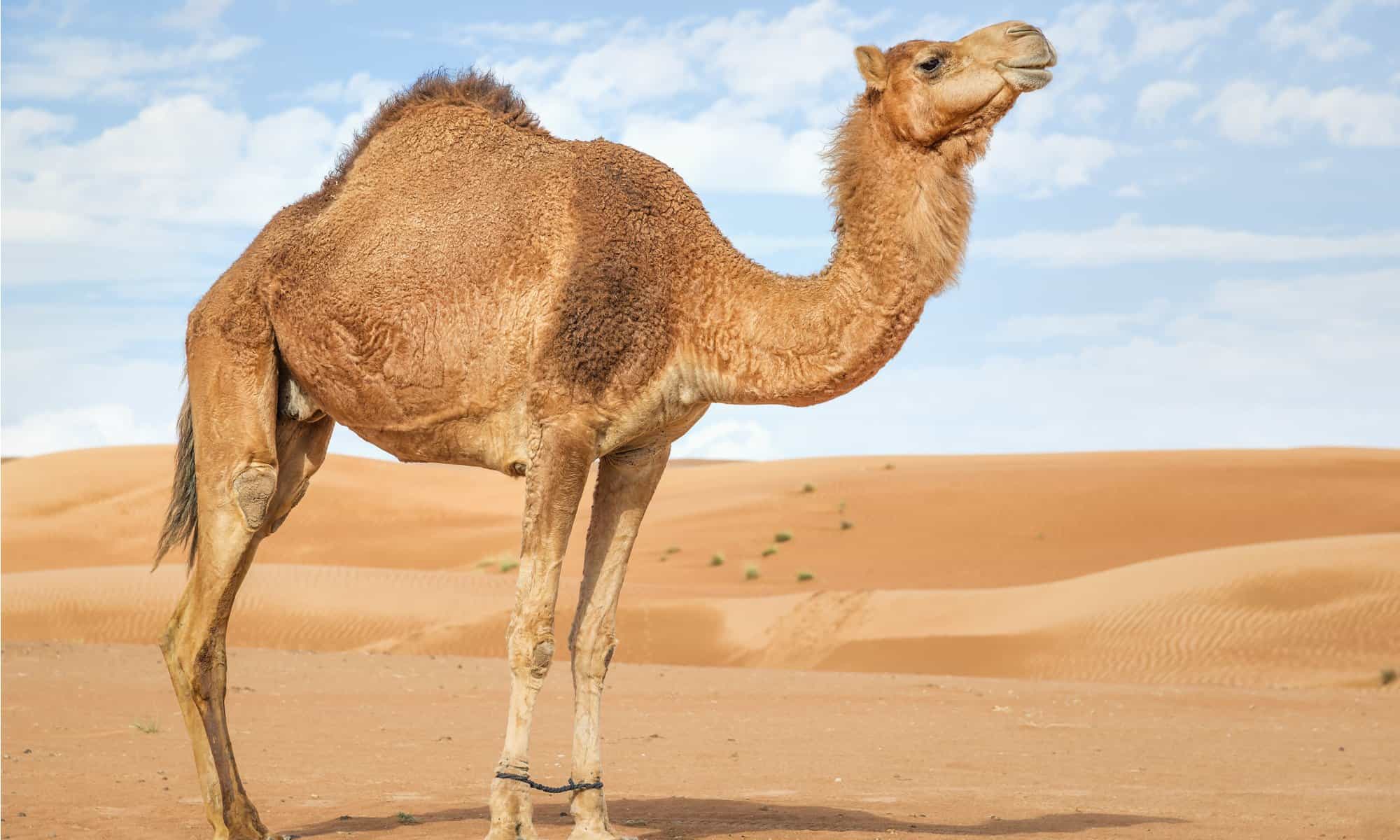
5. Camels
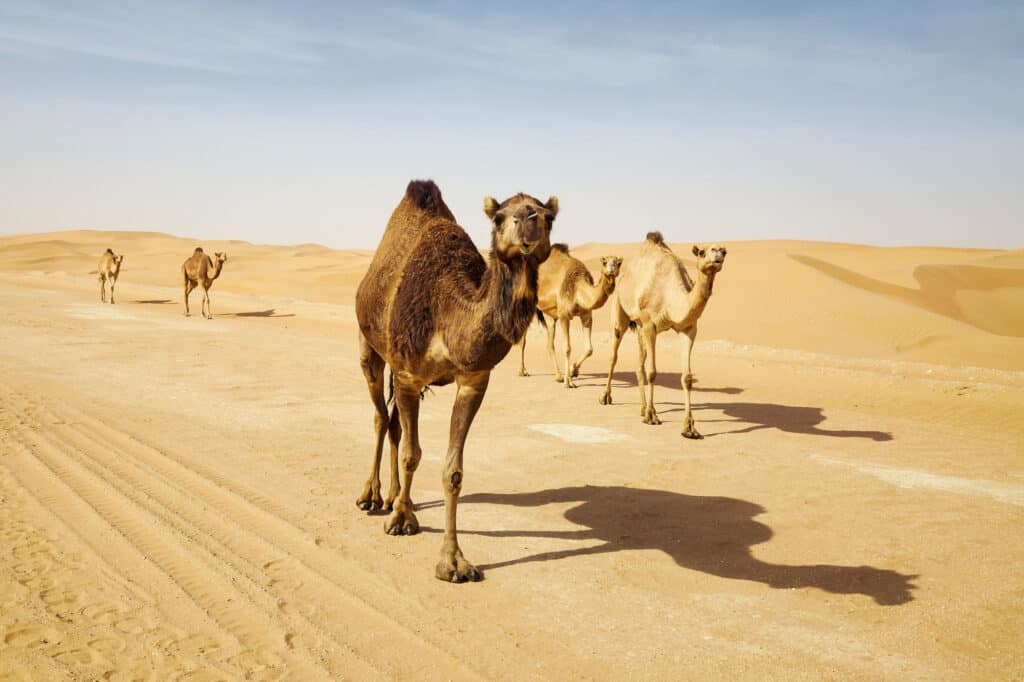
Dromedary camels have one hump and are found across North Africa and the Middle East.
©iStock.com/Chalabala
| Height | Length | Weight |
|---|---|---|
| 6.5 feet (dromedary camels) Up to 6 feet (Bactrian camels) | 11.2 feet (dromedary) 11.5 feet (Bactrian) | Up to 1,300 pounds (dromedary) 2,200 pounds (Bactrian) |
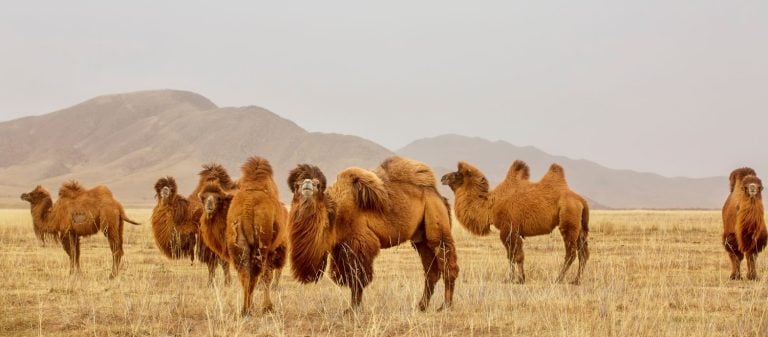
Camels are one of the first animals people think of when thinking of the desert, and they are also one of the largest animals that live in dry habitats. There are two camel species, the Bactrian camel (Camelus bactrianus) with two humps, and the dromedary camel (Camelus dromedarius) with one hump. The most common camel is the dromedary camel, which makes up around 90% of the camel population on Earth. Bactrian camels are shorter, stockier, and heavier than dromedary camels.
Dromedary camels are common throughout North Africa and the Middle East. Bactrian camels inhabit the Gobi Desert in Asia, specifically Northwest China and southwestern Mongolia. Camels are well adapted to harsh desert environments and can travel long distances without water. The humps of a camel are not used to store water, but to store fat. Storing fat provides them with energy when food is scarce. Camels actually store water in their bloodstream and can go without water for up to 15 days in certain conditions. When water is available, camels can drink up to 20 gallons at a time.
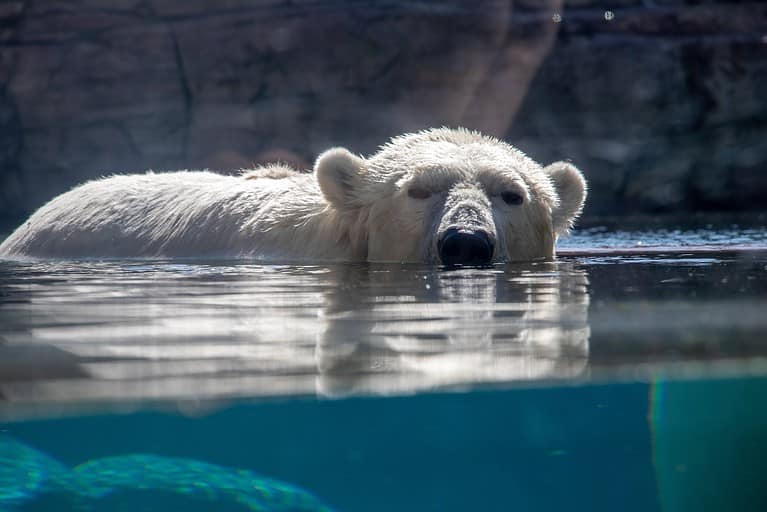
4. Polar Bear
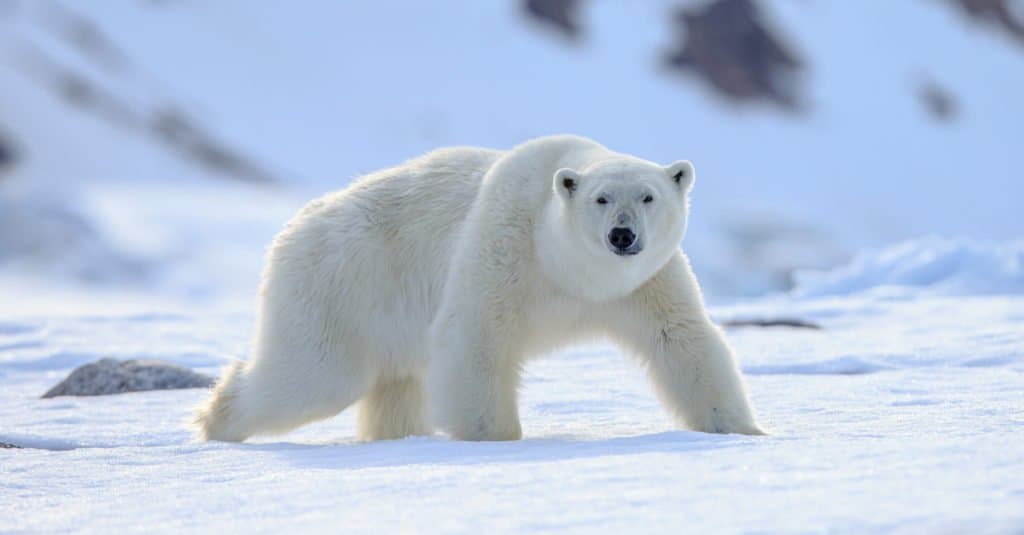
The polar bear is the largest land carnivore.
©Vaclav Sebek/Shutterstock.com
| Height | Length | Weight |
|---|---|---|
| Up to 5 feet at the shoulder | 8-10 feet | 600-1,300 pounds on average; largest males can exceed 1,700 pounds |
Polar bears (Ursus maritimus) live throughout the polar deserts of the Arctic, including Alaska in the U.S., as well as the polar regions of Russia, Norway, Canada, and Greenland. They typically stay close to the pack ice so they can use it as a platform for hunting seals and other marine mammals. Polar bears are the largest terrestrial carnivores, reaching up to 10 feet long, standing 5 feet at the shoulder, and weighing upwards of 1,700 pounds.
Polar bears have a number of adaptations to allow them to live in some of the coldest, driest places on the planet. They have a thick layer of blubber plus two layers of fur, including a dense, fuzzy undercoat and longer guard hairs that help repel water. These hairs appear white, but they are actually clear and hollow. Their hollowness helps to trap warm air and aids in buoyancy while swimming. Polar bears also have small ears and tails to minimize surface area from which heat can escape. They get the water they need from their food. The fat and muscle of their prey contain water. They also obtain water as a chemical byproduct when their bodies break down fat.
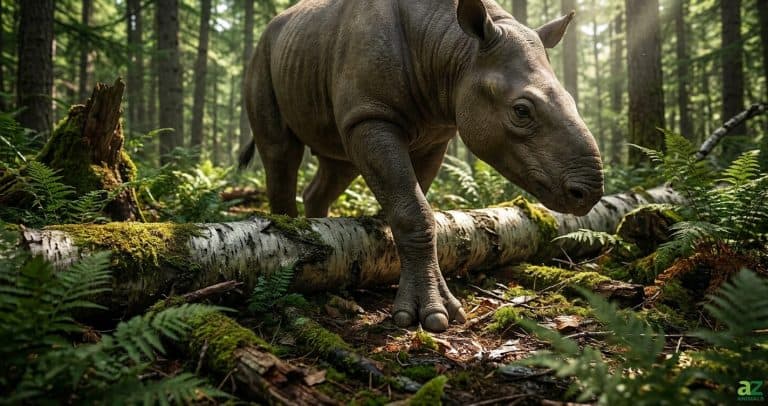
3. Desert Rhino
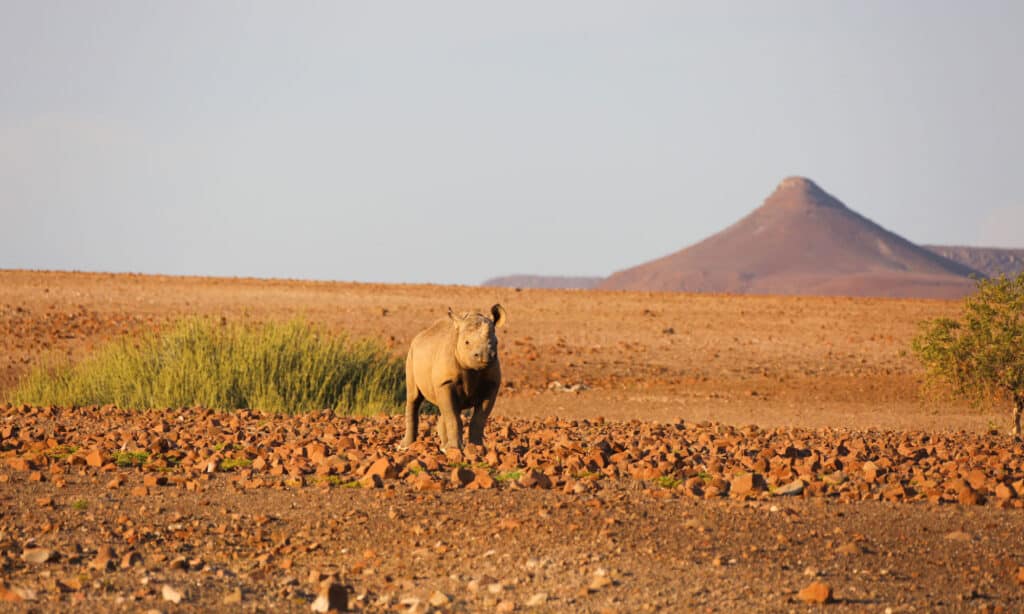
A desert rhino is a type of black rhino that lives in the Namib Desert of Namibia.
©Shantelle Borges/Shutterstock.com
| Height | Length | Weight |
|---|---|---|
| Up to 5.5 feet | Up to 12 feet | 1,750-3,000 pounds |
Desert rhinos are black rhinos (Diceros bicornis) that have adapted to live in the Namib Desert in Namibia. While desert rhinos are just as large as other black rhinos, they have adapted traits and behaviors to help them live in a desert habitat. These rhinos stand up to 5.5 feet at the shoulder and can reach lengths of about 12 feet. Desert rhinos weigh as much as 3,000 pounds.
These rhinos are able to go 2 to 3 days without water. They are typically nocturnal and crepuscular, which means they are active at twilight, to avoid the heat of the sun. Desert rhinos will also find mud holes to wallow in, which helps protect their skin. Unlike other black rhinos, desert rhinos can digest the Damara milk-bush, which is toxic to other animals. They get moisture from the plants they eat and will also search out natural springs. Desert black rhinos are also more nomadic than other rhinos, as they must travel longer distances to find food and water.
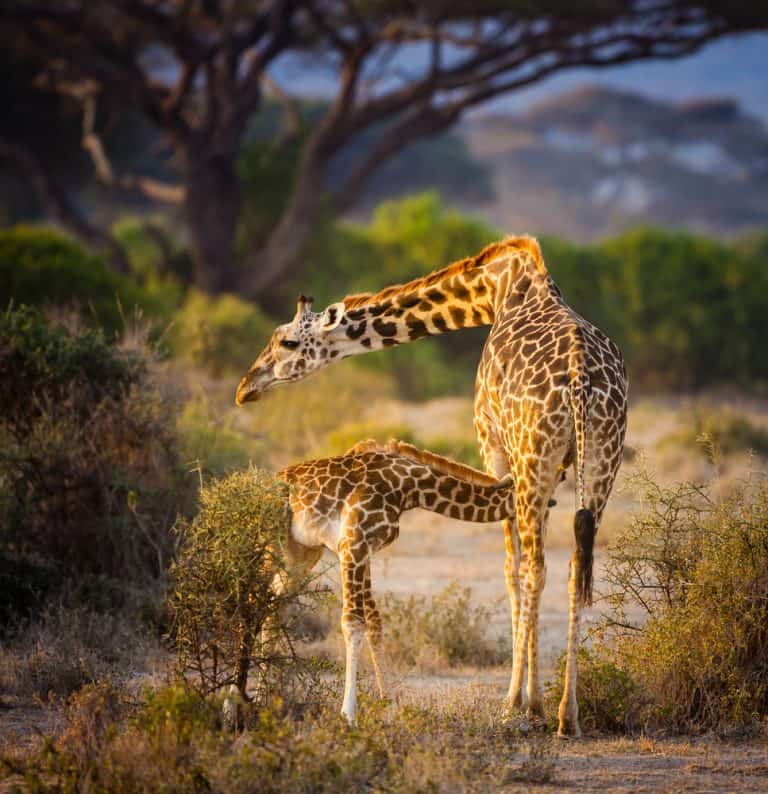
2. Angolan Giraffe

Angolan giraffes have paler coats, with backgrounds of light tan or cream and light brown patches.
| Height | Length | Weight |
|---|---|---|
| 14-18 feet | 7.5-8.5 feet | 2,500-4,200 pounds |
The Angolan giraffe (Giraffa giraffa angolensis), also known as the Namibian giraffe, is a subspecies of Southern giraffe. The Angolan giraffe is adapted to the desert habitat of northern Namibia and parts of Botswana, Zambia, and Zimbabwe. They reach the same size as other giraffes, growing up to 18 feet tall, over 8 feet long, and weighing up to 4,200 pounds.
Due to their dry habitat and sparse resources, Angolan giraffes require large home ranges to forage for food. They have home ranges of nearly 4,500 square miles, which are the largest recorded for any giraffe species. Their diets are flexible with the seasons and they have highly efficient digestive systems, so they can extract most of the water they need from the plants they eat. They also get water from dew. Angolan giraffes have paler coats than other giraffes, with backgrounds of light tan or cream with light brown patches. The lighter colors are said to better reflect sunlight.
1. African Bush Elephant
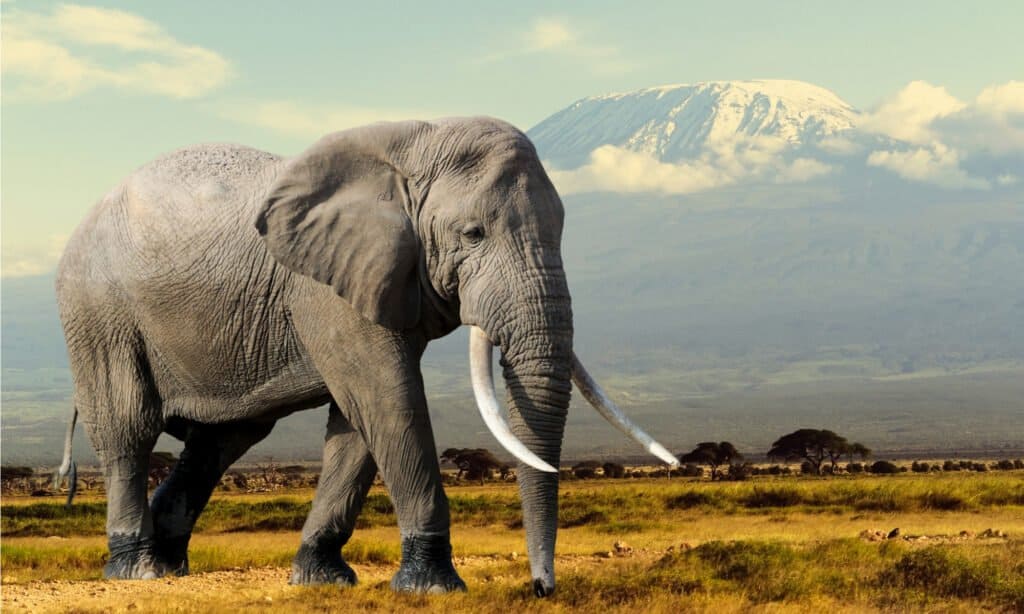
The African bush elephant is the largest animal that lives in a desert.
©Volodymyr Burdiak/Shutterstock.com
| Height | Length | Weight |
|---|---|---|
| 8.2-13 feet | 18-24 feet | 6,000-13,000 pounds |
African bush elephants (Loxodonta africana) are the largest animals that live in deserts and the largest land animals on Earth. These desert-adapted elephants are not a separate species. They are a population of African bush elephants that are found in the Namib Desert in Namibia and parts of Mali. African bush elephants stand up to 13 feet tall and reach 24 feet in length. They can weigh up to 13,000 pounds, although larger individuals have been recorded.
African bush elephants have large ears that play a crucial role in thermoregulation. Scientists believe that flapping their ears can meet 100% of their heat loss needs. These elephants also have special abilities that help them thrive in their desert habitat. They dig holes with their feet to unearth underground springs, which not only provides water for the herd, but also for other animals in the ecosystem. They forage and roam at night, when it is cooler. These elephants also only eat the shoots of plants instead of tearing out the entire plant. This allows the plant to continue growing, which provides a more sustainable food source. African bush elephants also store water in the pharyngeal pouches in their throats to spray water and cool themselves down.