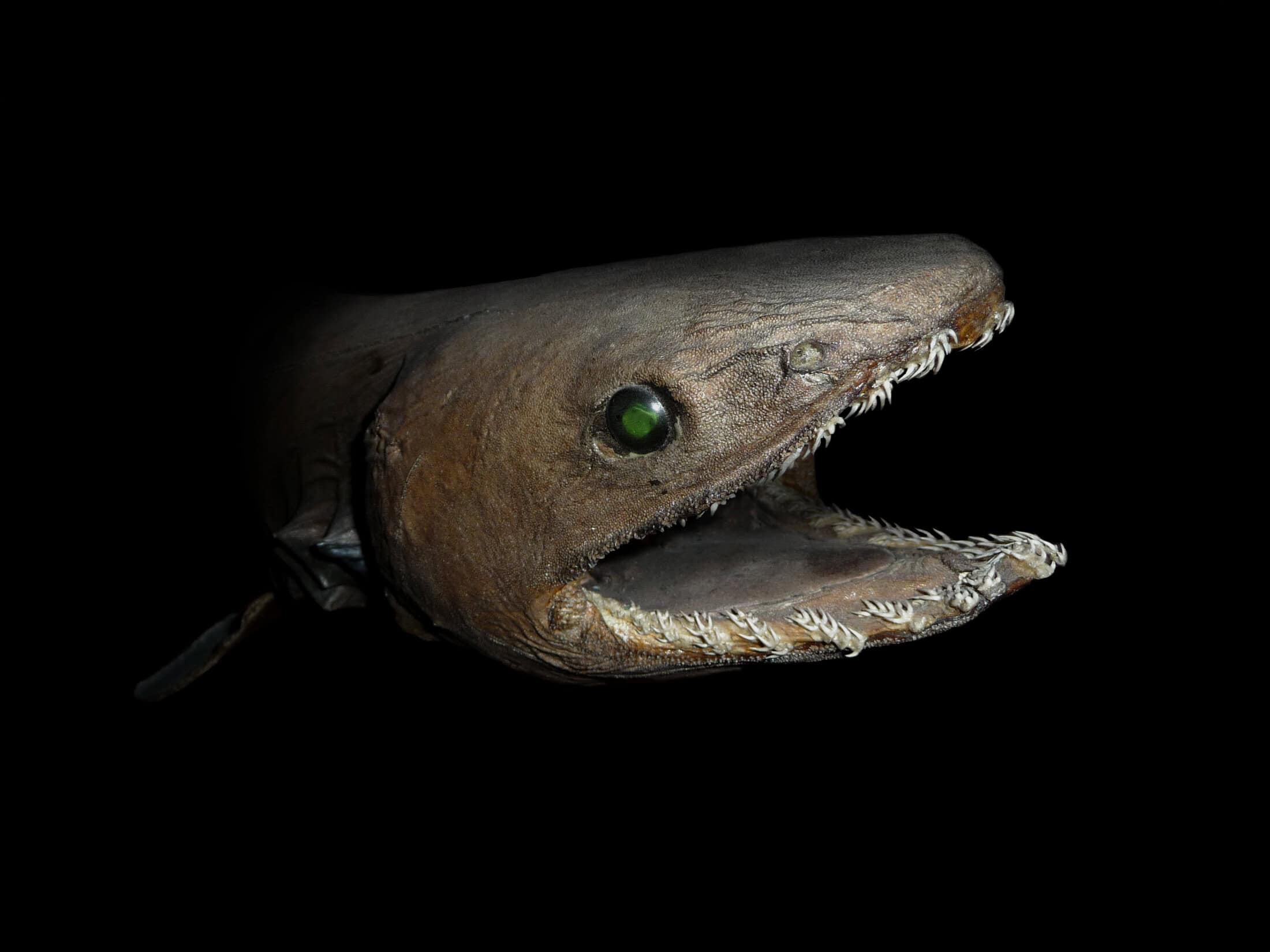

Sharks have existed for longer than dinosaurs walked on Earth. Although modern-day sharks have evolved in appearance and behavior, there are species of deep-sea sharks that resemble primitive creatures. Frilled sharks (Chlamydoselachus anguineus) can be traced back to 80 million years ago. Because they live so deep in the ocean, scientists still have much to learn about these fascinating animals. From their 300 teeth to their amazingly wide jaws, let’s take a look at some fascinating facts about frilled sharks.
1. Frilled Sharks Are Living Fossils
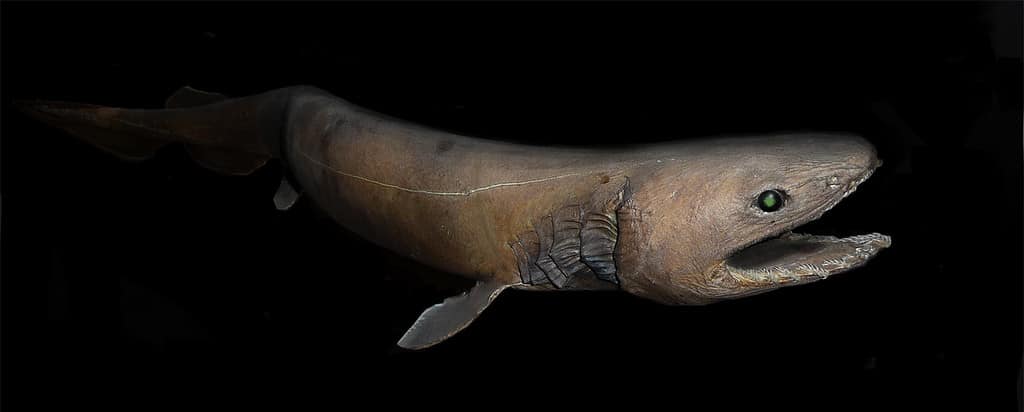
Frilled sharks are known as living fossils because they have evolved very little over millions of years.
©Citron / CC-BY-SA-3.0 / Wikimedia Commons – Original / License
Living fossils are animals that have changed very little over millions of years. Frilled sharks closely resemble ancient sharks that swam in the ocean around 80 million years ago. Frilled sharks have six gill slits, unlike the five in most modern sharks. Their gills wrap around their throat, looking like a frilly collar, which is where they get their name. They grow to about 6.5 feet long and have an eel-like body. Their dorsal, pelvic, and anal fins are small, and as they move, they sway side to side, like an eel.
2. Frilled Sharks Swim in Deep Ocean Waters
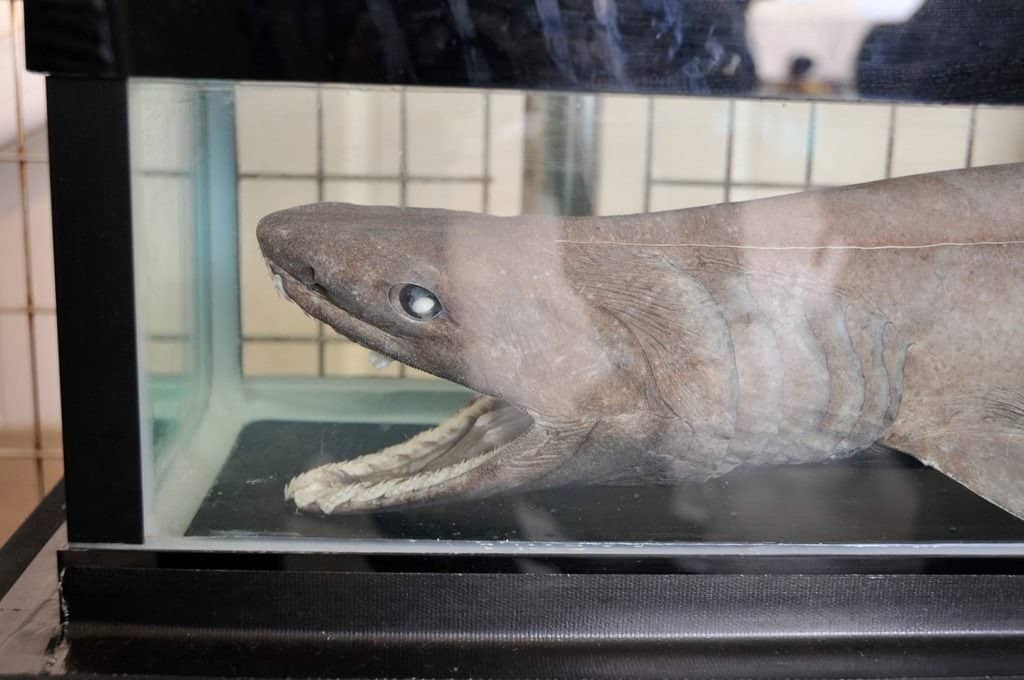
These ancient sharks have been found living deep in the ocean, at a range of 400 to 4,200 feet deep.
©saname777 from Tokyo, Japan / CC BY 2.0 – Original / License
Frilled sharks are found in the Atlantic and Pacific Oceans between 400 and 4,200 feet deep. The surface layer of the ocean is called the sunlight zone, and it extends to 660 feet. Frilled sharks are often found much deeper and can swim to depths of 4,200 feet. At 4,200 feet, we are in the bathypelagic zone, or midnight zone, where the sun never reaches.
Frilled sharks pose no threat to humans because they don’t swim in the same waters. They are usually only seen when filmed by scientists operating submersibles or when caught as bycatch from deep-sea fishermen.
3. Frilled Sharks Hunt and Swallow Their Prey, Similar to Snakes
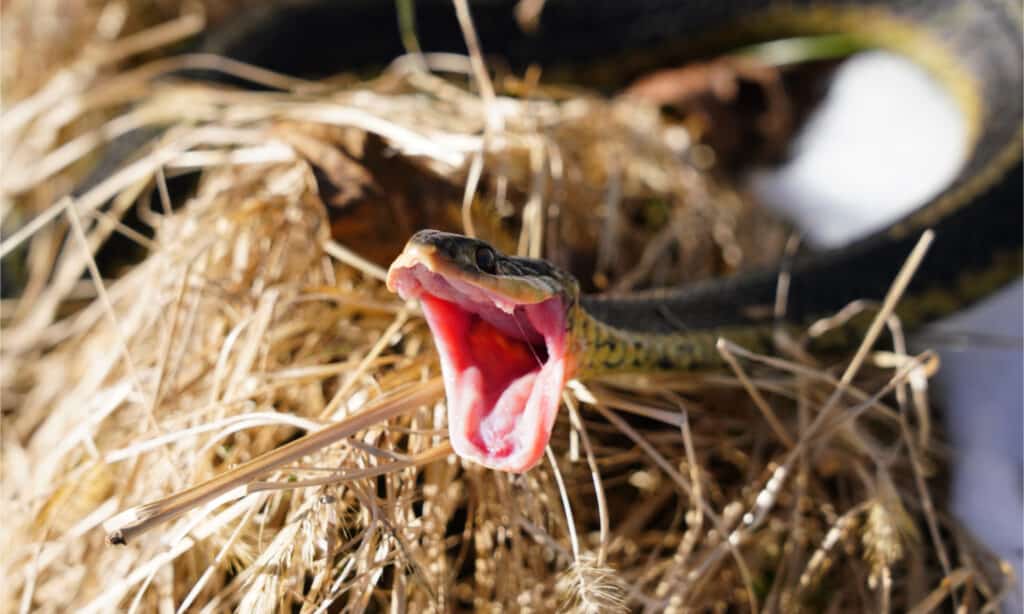
Similar to snakes, frilled sharks ambush their prey, swallowing their food whole.
©Aaron of L.A. Photography/Shutterstock.com
While many sharks use their sharp teeth to tear apart prey that may be larger than themselves, frilled sharks swallow their food whole. They open their jaws one-third to one-half the size of their own body length, which is wider than most other sharks in relation to size.
In addition to swallowing their food whole like snakes, frilled sharks also ambush their prey by lunging at it, a hunting method similar to that of snakes.
4. Frilled Sharks Have 300 Needle-Sharp Teeth
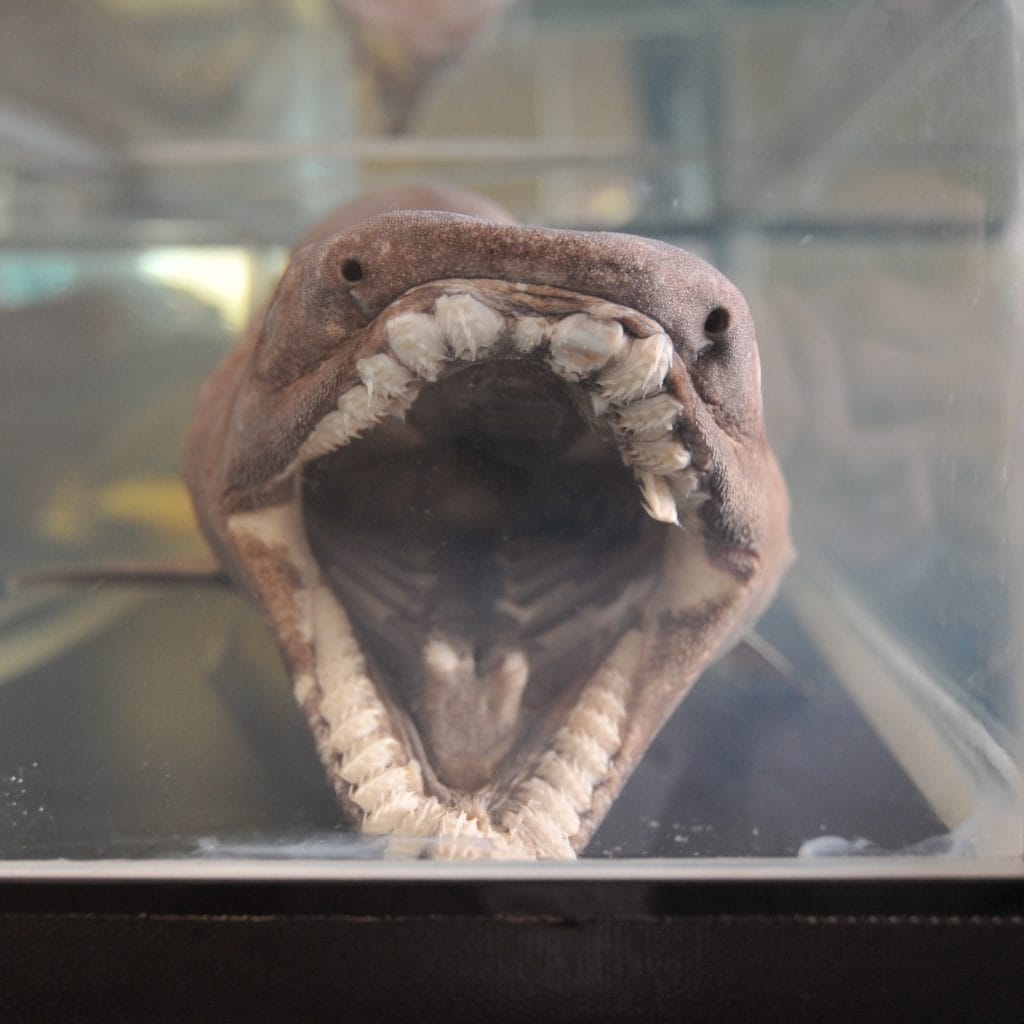
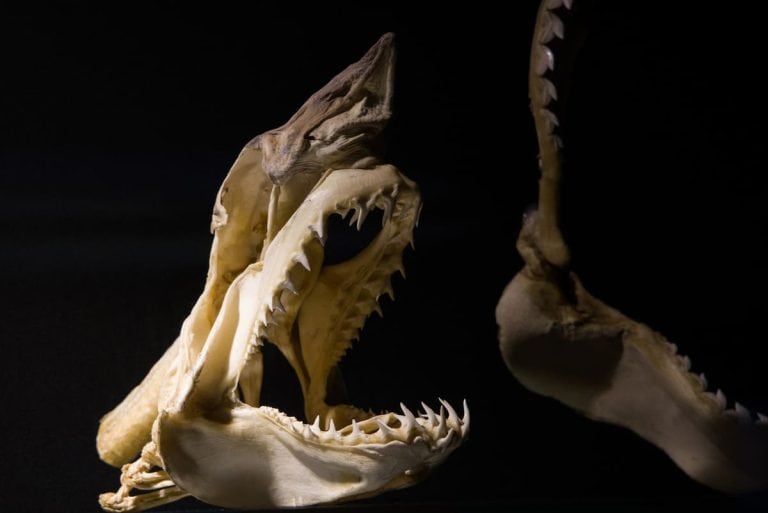
The mouth of a frilled shark contains about 300 needle-sharp teeth.
©saname777 from Tokyo, Japan, CC BY 2.0, via Wikimedia Commons – Original / License
Before swallowing their prey whole, frilled sharks use their sharp teeth to grasp the animal. They have 25 separate rows of teeth on their upper and lower jaws, which total around 300 teeth. The teeth are designed to trap prey, like squid and octopus. Each tooth has three sharp points that curve inward and act like a hook to trap their food.
5. Frilled Sharks Have the Longest Pregnancies on Earth
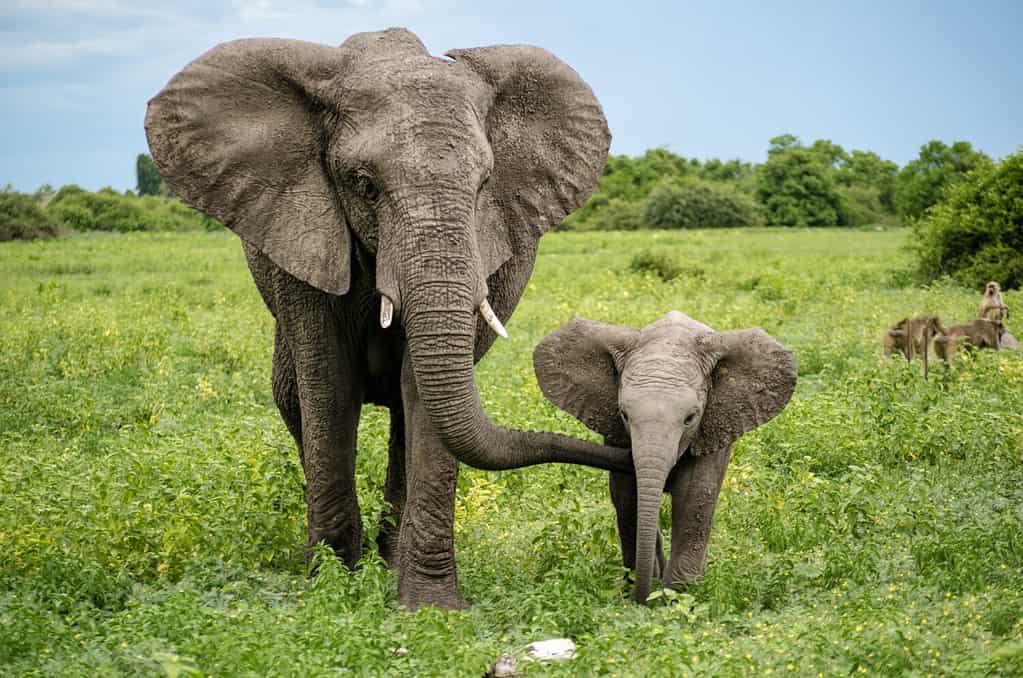
Frilled sharks (42 months) have longer pregnancies than even the African elephant (22 months).
©Aelice/Shutterstock.com
African elephants have the longest gestational period of any land animal. Their pregnancies last an average of 22 months. However, this is nothing compared to a frilled shark. Japanese scientists discovered that frilled sharks have a gestational period of 42 months. Scientists believe this may be due to the depths at which frilled sharks live. Because the water is so cold, deep-sea animals have lower metabolisms, which may slow their gestation period.
6. Frilled Sharks Are Rarely Seen Alive
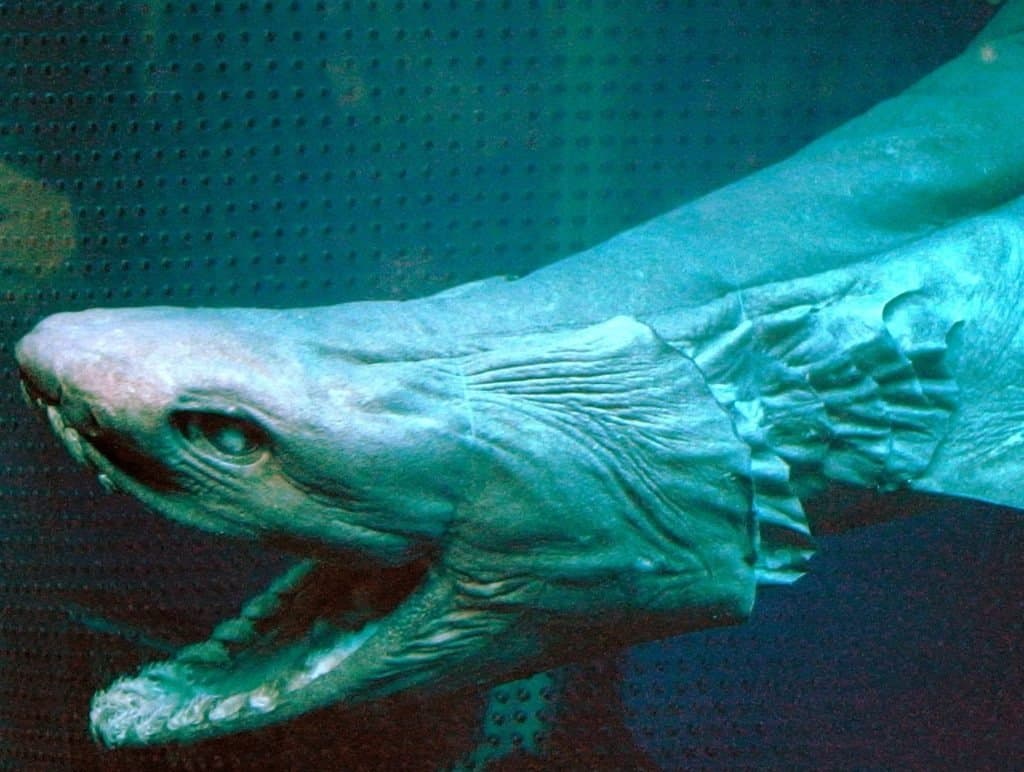
Frilled sharks swim deep in the ocean and are often only filmed by scientists operating deep-sea subs or caught by deep-sea fisheries as bycatch.
©OpenCage / CC BY-SA 2.5 / Wikimedia Commons – Original / License
The first time a frilled shark was filmed swimming live in its natural habitat wasn’t until 2004. Because they live in such deep waters, people don’t often encounter frilled sharks. In fact, we didn’t get the first live footage of a frilled shark until August 27, 2004. On that date, the ROV Johnson-Sea-Link II filmed a frilled shark swimming on the Blake Plateau near the United States.
7. Frilled Sharks May Be the Inspiration for Sea Serpent Myths
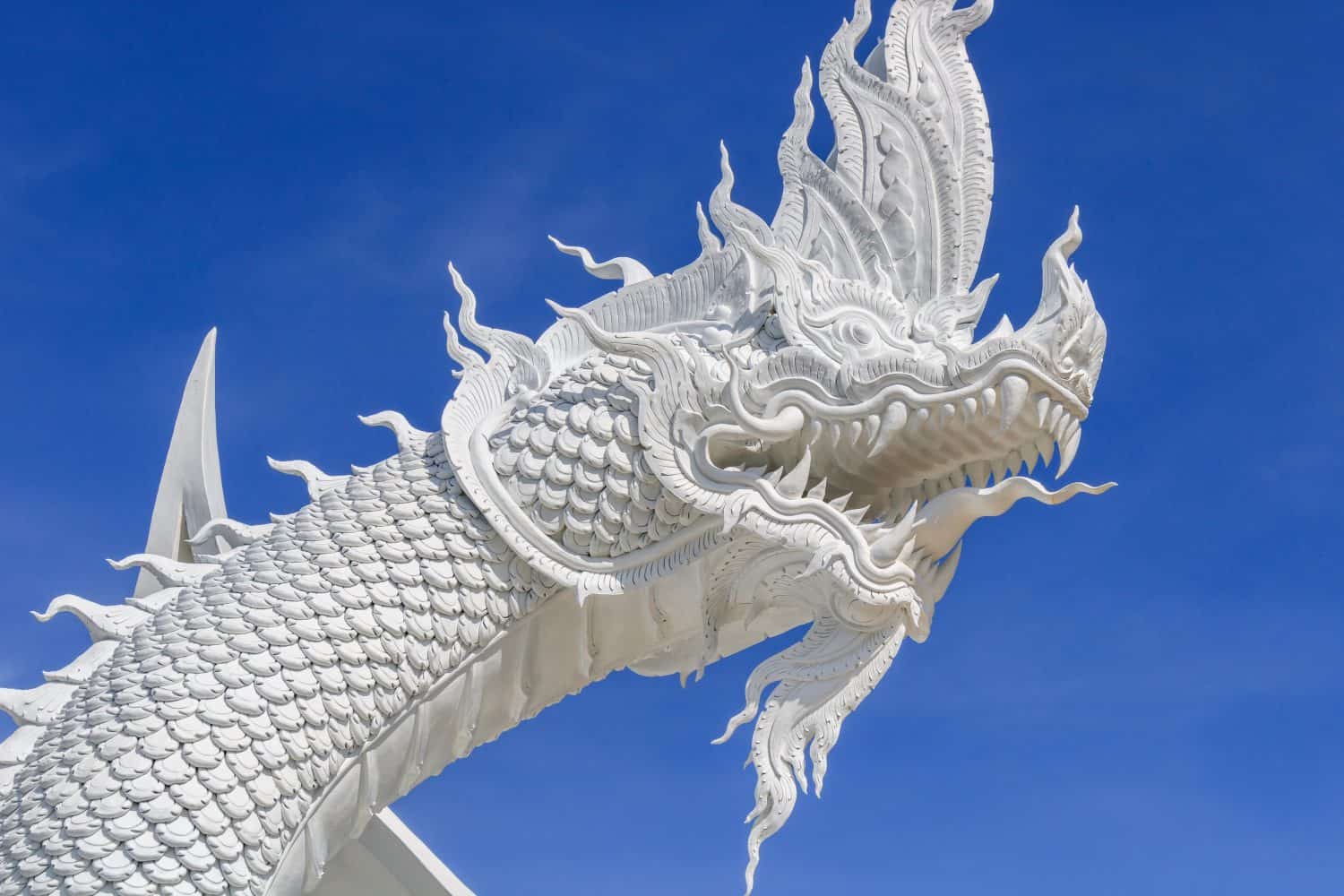
Experts think frilled sharks may have been the inspiration for some of the ancient tales of mythological sea serpents.
©NamPunch/Shutterstock.com
We know mermaid sightings were really manatees, and the mythical Kraken was likely a giant squid. Frilled sharks may have a role to play in the mythology of the sea serpent. Sailors may have mistaken frilled sharks for sea serpents. Frilled sharks are indeed rare sights, and if a sailor long ago spotted one, he would have had no idea what he was seeing. With many rows of sharp teeth, a snake-like body, and unique frilled gills, a frilled shark closely resembles descriptions of ancient sea serpents.
8. A Trawl Once Caught 34 Frilled Sharks

Deep water trawls sometimes capture unintentional bycatch, such as frilled sharks.
©Matthew Troke/iStock via Getty Images
Scientists cannot estimate the number of frilled sharks that live in the ocean, but they are rarely caught. In 2003, a trawl in the Atlantic Ocean near Portugal caught 34 frilled sharks (15 males and 19 females) as bycatch. Experts speculate that the large number of frilled sharks caught together may have been due to a mating event.