
Quick Take
- The paper nautilus isn't actually a nautilus, and what looks like its shell isn't a shell at all. Discover what she really is →
- She builds her casing using a body part no other octopus has, and no two casings are ever the same. See how the casing is built →
- To control her depth in open water, she pulls off a trick that works exactly like a piece of scuba gear. See her buoyancy trick →
- She can brood a staggering number of eggs at once, a feat made possible only because her 'shell' does something no true shell can do. Explore her floating nursery →
For thousands of years, sailors and naturalists believed the paper nautilus (Argonauta) skimmed the ocean like a miniature sailboat — raising its webbed arms like sails and using its limbs as oars. While this romantic myth inspired its name, the reality is far more impressive.
The paper nautilus isn’t actually a nautilus, nor is its delicate casing a true shell. Unlike true nautiluses, which inherit heavy shells from birth, the female paper nautilus crafts her own lightweight structure from scratch. By transforming her bodily secretions into both a floating nursery and a precise buoyancy tank, she has developed one of the most remarkable survival strategies in the open sea.
A Shell-Building Ocean Drifter
Unlike true nautiluses, which grow thick, permanent shells, female paper nautiluses are born without one. Instead, the female crafts a paper-thin, calcified casing of her own.
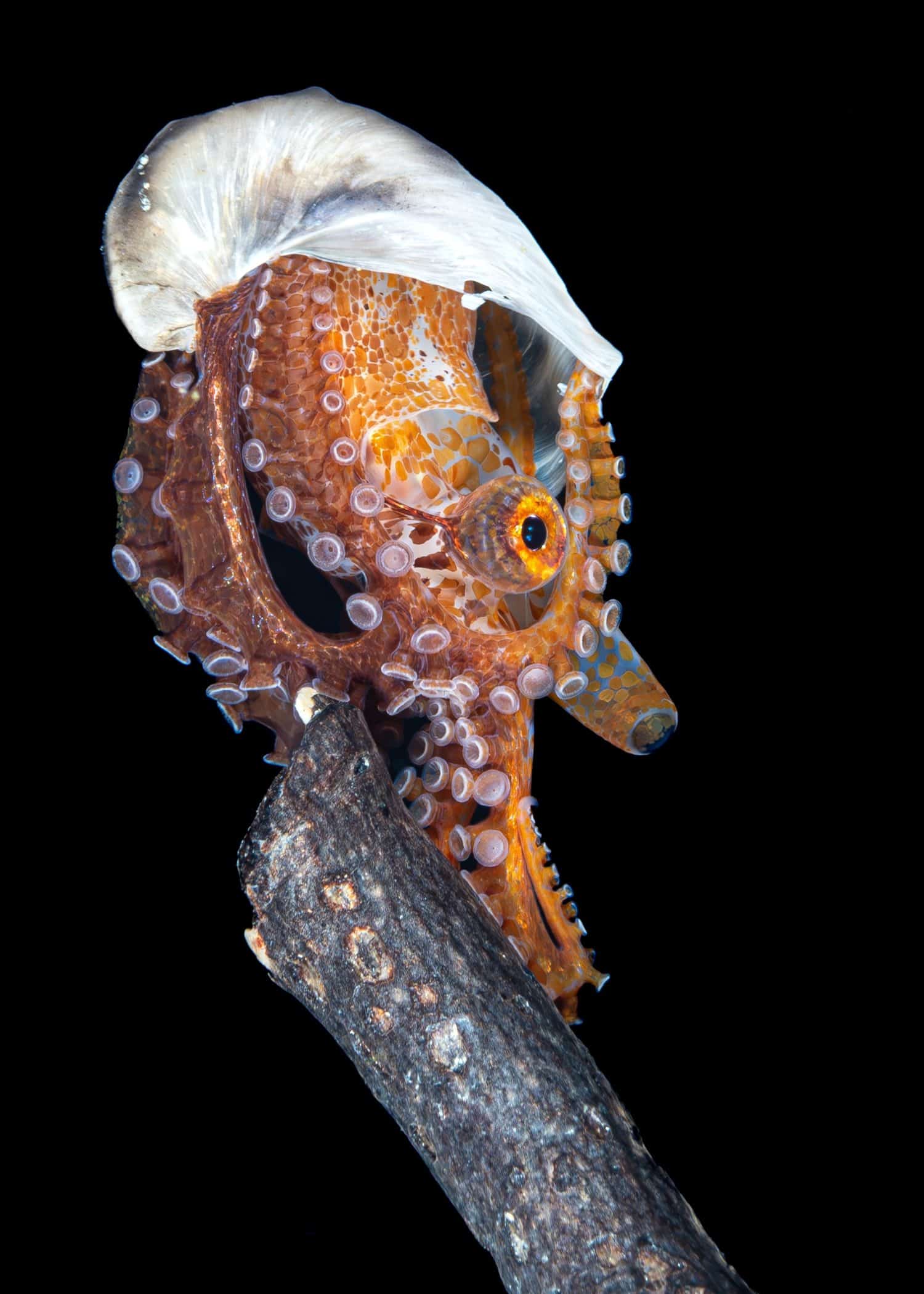
Female paper nautiluses are 600 times heavier than males.
©Kim_Briers/Shutterstock.com
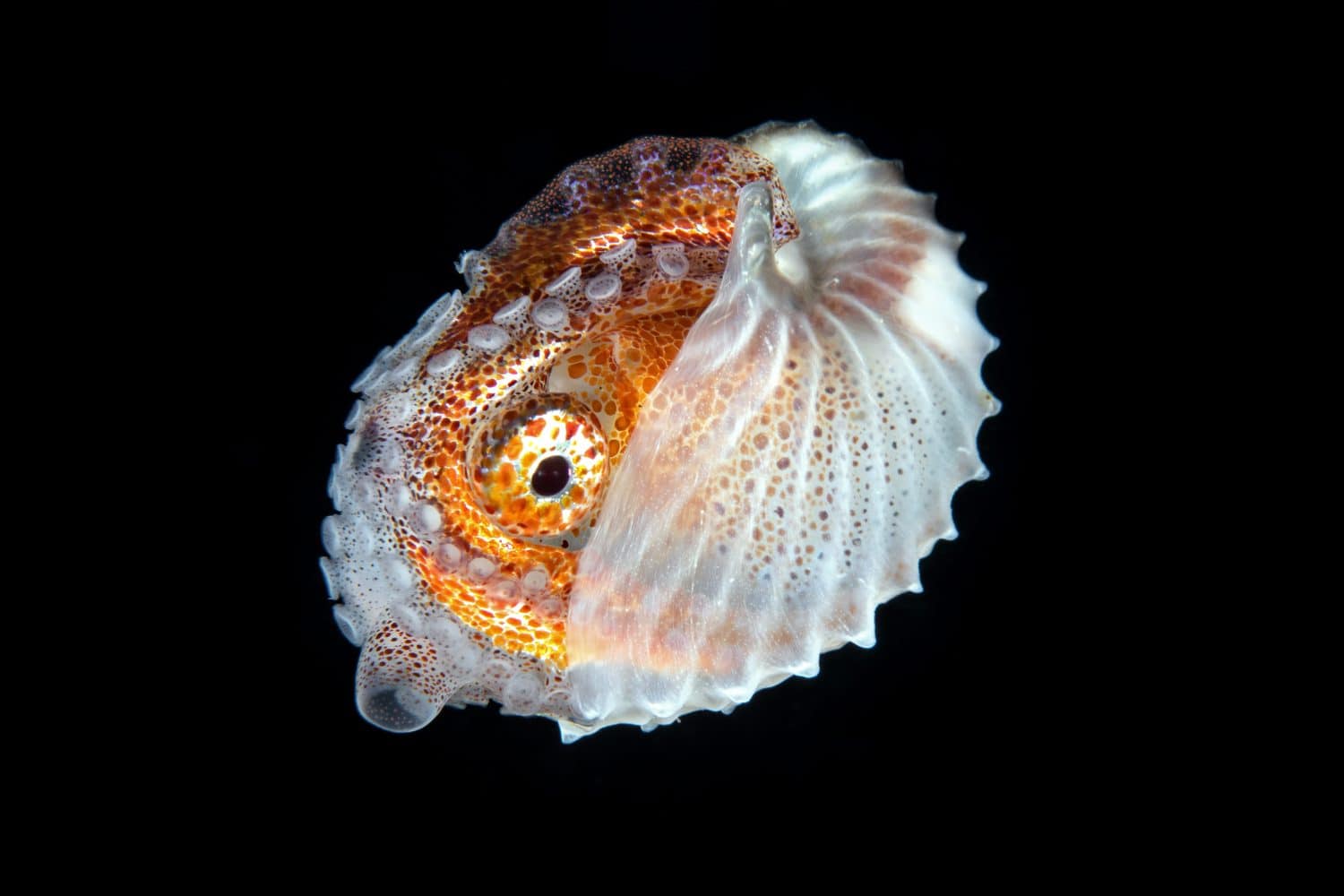
Traditional mollusk shells, such as those of clams, snails, and true nautiluses, are produced by an organ called the mantle. While the paper nautilus’ structure looks very similar to these true shells, it isn’t one at all. It is actually a delicate egg case that she molds using webbed membranes on her upper two arms.
To build her floating nursery, the female secretes layers of calcite and proteins from these arm membranes, which contain unique calcium structures not found elsewhere in octopuses. Rather than growing heavy, rigid armor, she creates a lightweight shell that she can reshape throughout her life. Because each female continuously shapes her own casing, no two are ever identical. Each egg case features a distinct pattern of ripples, folds, thickness, and form.
Genetic studies confirm this structure evolved completely independently from true mollusk shells.
A Floating Nursery and Personal Submarine
The egg case does far more than protect the octopus — it functions as both a mobile nursery and a sophisticated buoyancy tank.
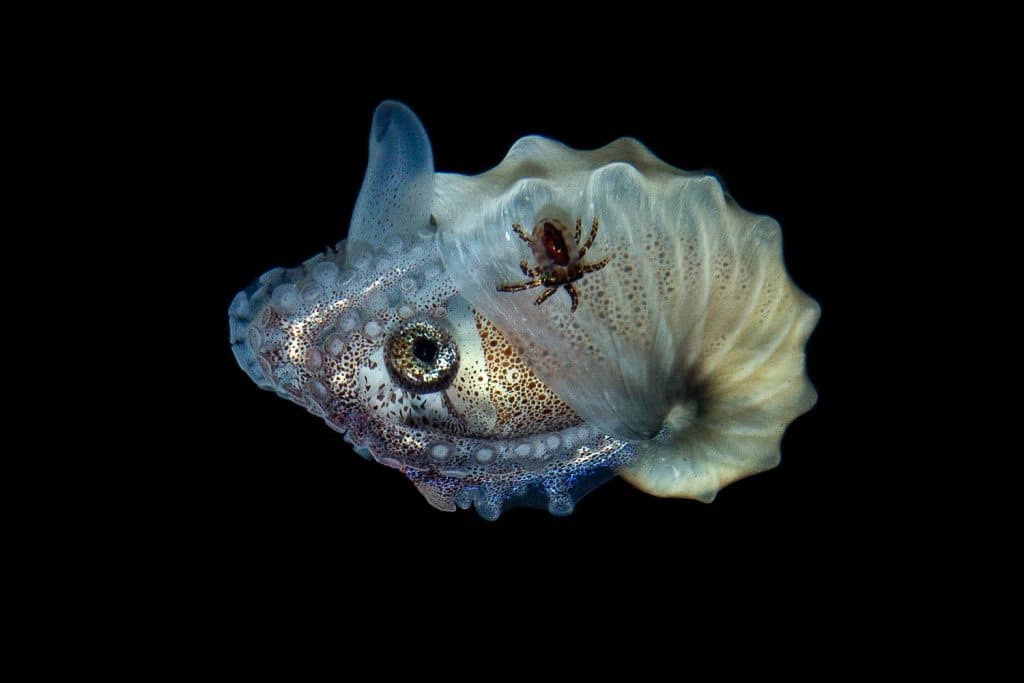
A female’s eggcase can grow up to 12 inches long.
©Sam Robertshaw/Shutterstock.com
Because female paper nautiluses live in the open ocean far from the seafloor, they have nowhere to hide their developing eggs. Instead, they carry them inside their portable shelter. A single female can brood over 170,000 eggs at once, expanding the case during breeding season to accommodate her growing offspring.
Beyond housing her young, this unique structure also gives the octopus precise buoyancy control — a rare advantage in open water. To control her depth, the octopus swims up to the surface, traps a pocket of air inside the top of her case, seals it in, and then dives back down. Much like a scuba diver adjusting a buoyancy vest, she uses this trapped air bubble to achieve near-neutral buoyancy, allowing her to hover effortlessly at any depth without expending extra energy to swim.
Built for Life in the Open Ocean
While the paper nautilus’s “boat” isn’t meant for sailing, it is perfectly designed for life in the open ocean. As the female propels herself through the water with jet propulsion, she often wraps her webbed arms around the outside of the casing, holding fast to this remarkable evolutionary adaptation that serves as both a protective nursery and a portable buoyancy chamber.
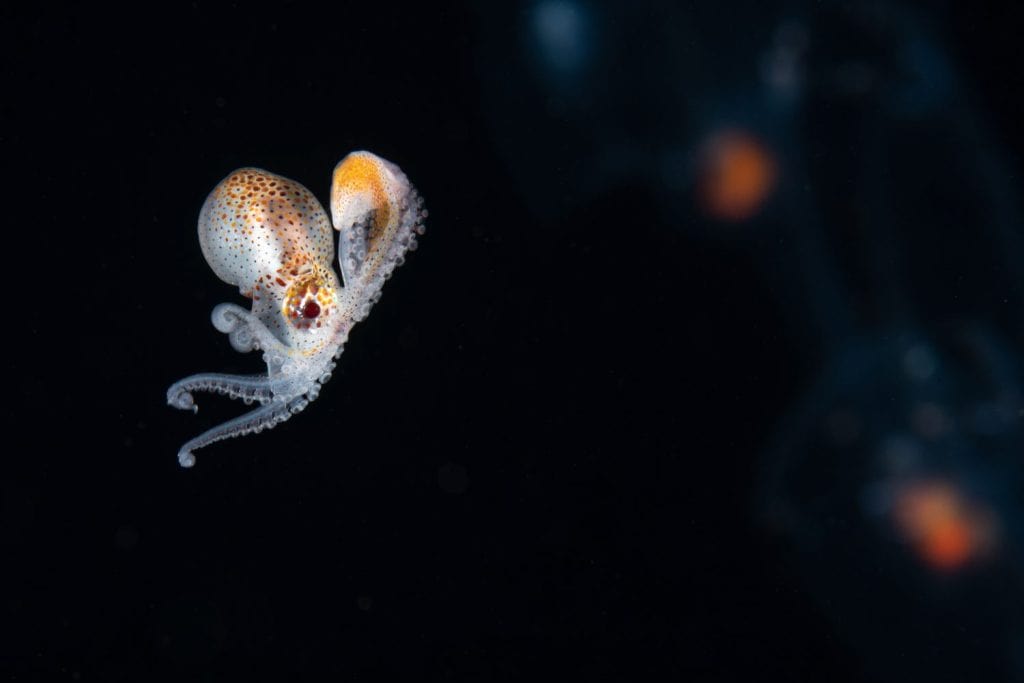
Male paper nautiluses are less than an inch long, while females can reach up to 15 inches or more in length.
©Andre-Johnson/Shutterstock.com
Only female paper nautiluses build these unique structures. The males, in contrast, measure less than an inch long and never construct a case of their own.