
Quick Take
- Parakeets test the water before making friends, ramping up their behaviors from being near each other to grooming each other
- This behavior can be relatable for humans
Making new friends can feel awkward, uncertain, and—at times—a little risky. As it turns out, humans are not the only ones who experience this social tightrope. A new study published in Biology Letters reveals that monk parakeets, small green parrots known for their lively personalities, also rely on a cautious, step-by-step strategy when meeting strangers.
Researchers from the University of Cincinnati found that these birds ease into new relationships by “testing the waters,” beginning with harmless, low-risk behaviors, such as simply being nearby before progressing to physical contact, grooming, food sharing, or even mating.
Lead author Claire O’Connell, a doctoral student in UC’s College of Arts and Sciences, said she sees a clear parallel between their behavior and our own. “When we introduced groups of monk parakeets who had never previously interacted before, we found that stranger parakeets, but not familiar parakeets, escalated the type of interaction from relatively low-risk behaviors to high-risk behaviors,” she tells A-Z Animals. “Stranger parakeets tended to approach one another and share space before eventually escalating to riskier affiliative, or friendly, behaviors, like perching shoulder-to-shoulder, beak touching, or social grooming.”
For these small green parrots, friendship is not casual. It is carefully built. And perhaps this strategy is one we humans could use to our advantage.
A carefully controlled first meeting
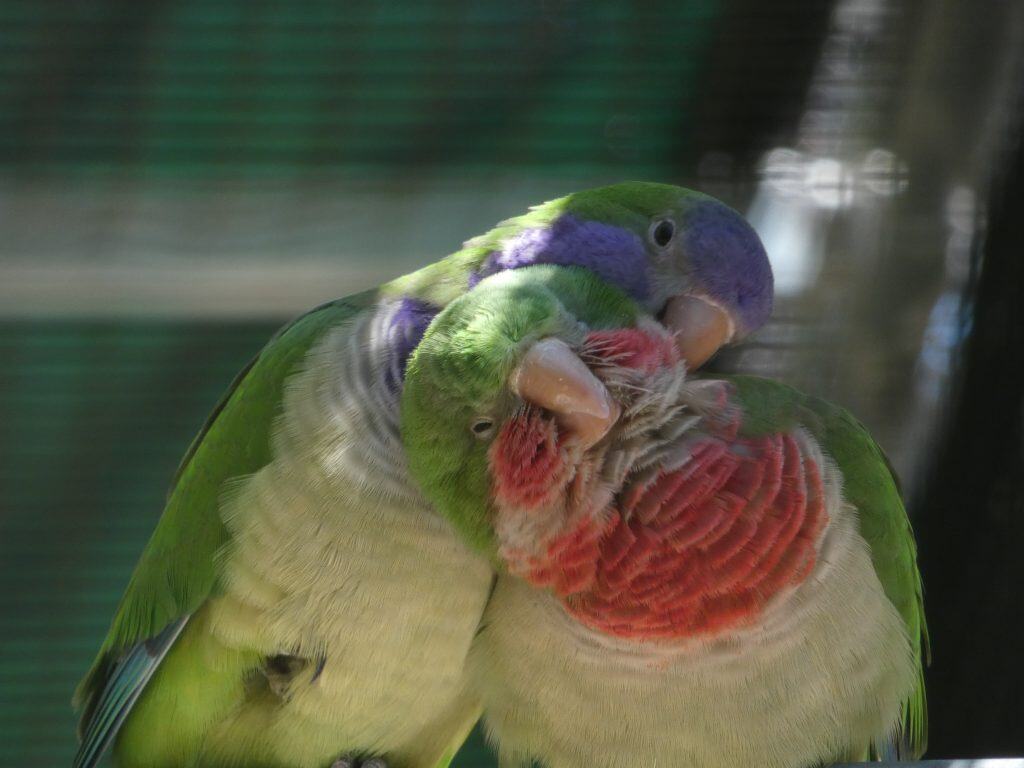
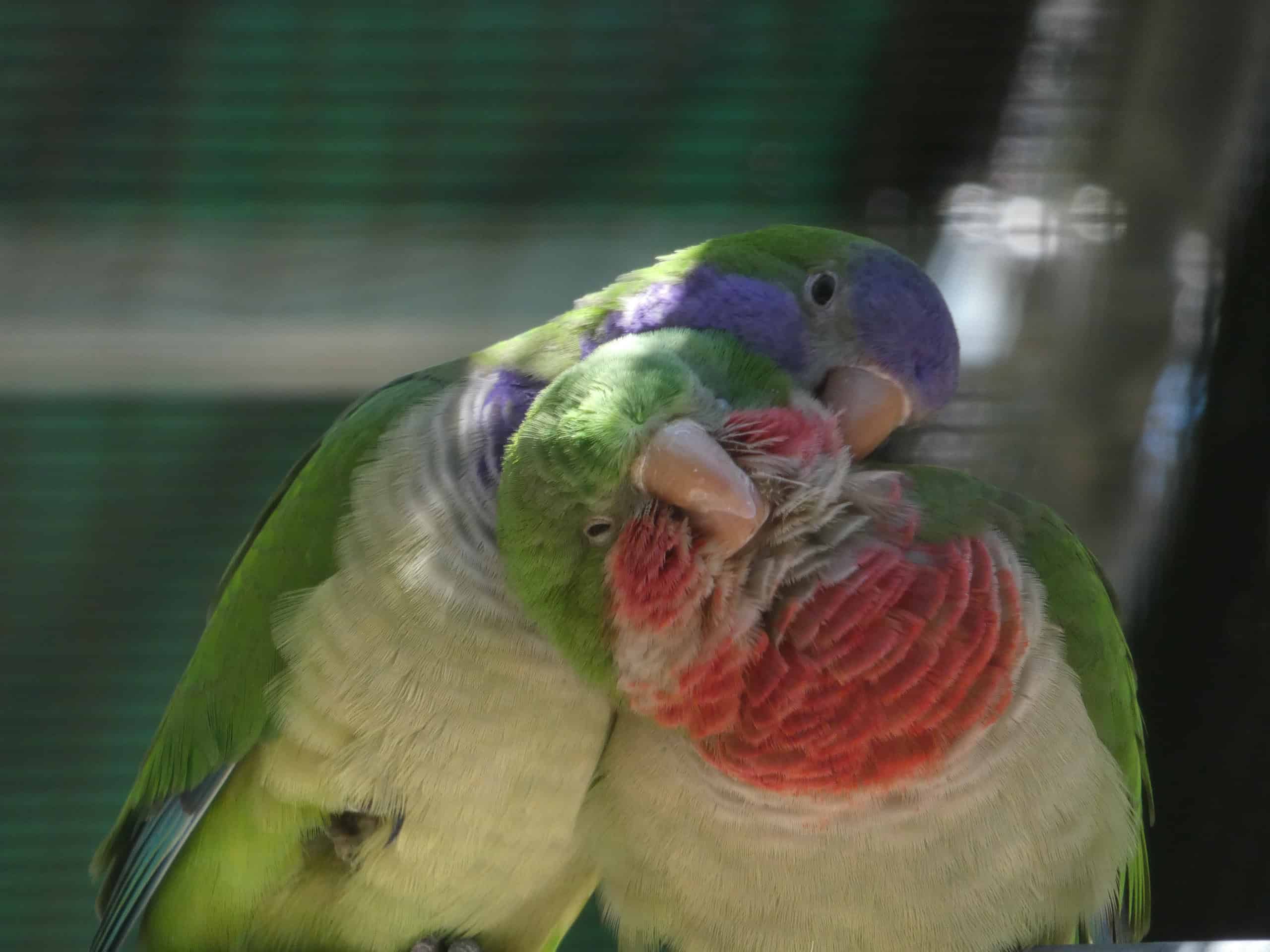
According to O’Connell: “An image showing Purple-Purple-Purple, who we affectionally refer to as Purple, allopreening their partner, Green-Orange-Orange, or GOO.”
To understand how these new bird relationships form from scratch, the research team created what was essentially a parakeet social experiment.
They captured 22 feral monk parakeets from four different locations in Florida. During a quarantine period, birds from the same capture site could see each other, but those from different places were blocked from visual contact. That meant that by the time the experiment began, some birds were “familiar,” while others were strangers to each other.
All 22 birds were then released simultaneously into a large semi-natural outdoor flight pen. Inside, there were perches, trees, food, and plenty of room for the birds to move, choose where to sit, and decide who to spend time with.
From blinds around the pen, observers spent more than 130 hours recording exactly how the birds behaved. They tracked who perched near whom, who touched beaks, who groomed each other, who shared food, and which pairs eventually escalated their interactions into deeper, more vulnerable behaviors. The result was a detailed record of 179 potential relationships between stranger pairs and dozens of relationships among familiar birds.
Stranger parakeets tended to approach one another and share space before eventually escalating to riskier affiliative, or friendly, behaviors, like perching shoulder-to-shoulder, beak touching, or social grooming.
Claire O’Connell, lead author of a doctoral student in University of Cincinnati’s College of Arts and Sciences
How did the birds go from sharing space to being friends?
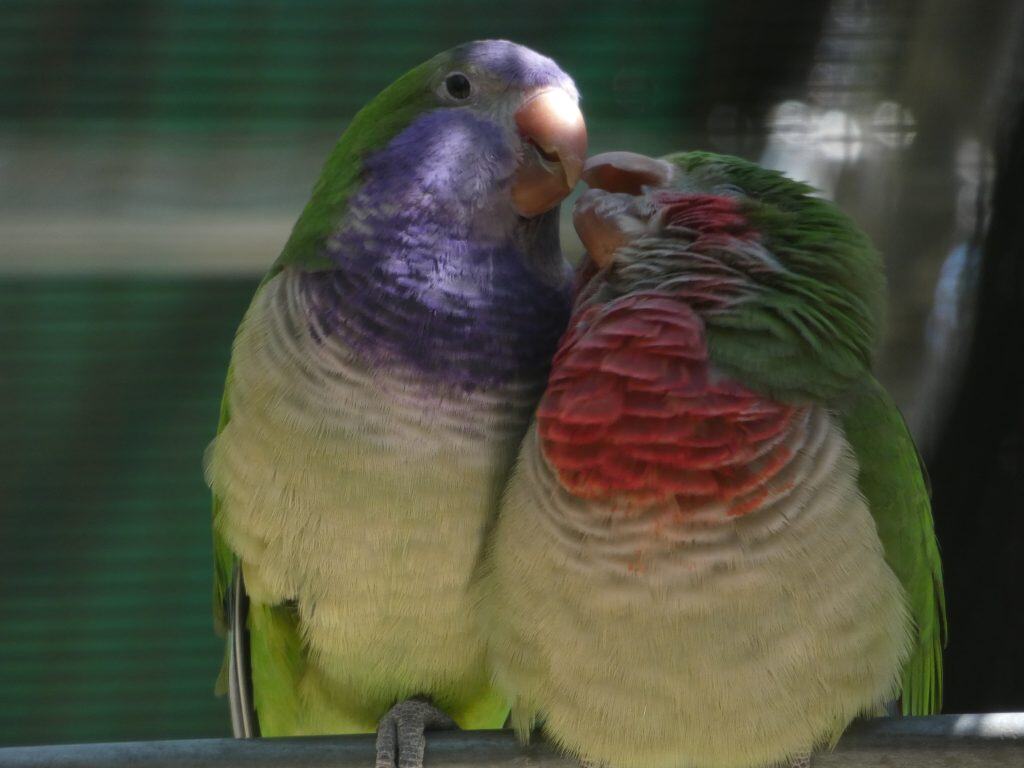
Parakeets Purple and GOO touching beaks.
When the researchers dug into the data, they saw a remarkably consistent sequence in how relationships developed between strangers. At first, unfamiliar birds played it safe. They spent time simply near each other, perched within about 3 feet of each other but not touching. These low-risk encounters allowed each bird to watch the other, read its body language, and retreat easily if things felt tense. Nearly every stranger pair used this strategy.
Only later did some of those pairs escalate to behaviors the team considered moderate risk. That included shoulder-to-shoulder perching, beak-to-beak contact, or allopreening, in which one bird gently grooms another. These actions require more trust and expose a bird to potential aggression or social fallout if things go badly.
Fewer pairs went this route, and fewer still reached the most intimate stage. High-risk behaviors such as food sharing or mating were rare among strangers in such a short time frame. When they did occur, they almost always followed birds that had already spent time together and engaged in low- and moderate-risk behaviors.
O’Connell said the clarity of this pattern surprised her. “I think the most striking result was that we observed a very clear sequence, not just from sharing space to any affiliative contact interaction, but we also detected a sequence of escalation across different types of affiliative behaviors,” she says. “Not only was the pattern very clear, but we also observed the sequence frequently among stranger parakeets. Our results indicate that Testing the Waters could be an important process for forming new relationships for these parakeets.”
In other words, they are not just becoming friendly at random. They are following a social script that helps them navigate the risks of interacting with a stranger.
The emotional side of bird friendships
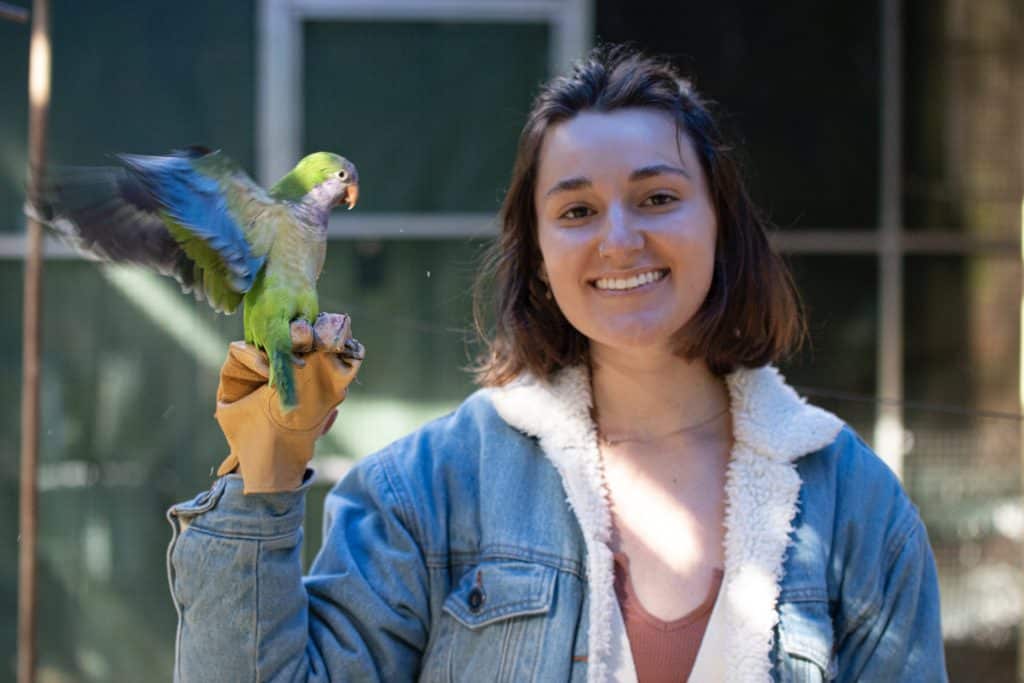
Doctoral student Claire O’Connell with one of the monk parakeets.
For O’Connell, the results felt deeply familiar. “Making new friends can be daunting!” She admits. “It is an inherently uncertain process, and it can be difficult to put yourself out there or put your trust in someone who may be unreliable or unkind. Personally, I find Testing the Waters very relatable. When we form new friendships, we often don’t jump straight into deep intimacy. Instead, we start by hanging out in the same space or social group for a while before deciding if we want to progress the relationship further through more direct interaction. We found that the stranger parakeets are doing a very similar thing by sharing space before they invest in more vulnerable affiliative behaviors.”
Her description makes these birds feel less like distant study subjects and more like feathered reflections of our own social anxieties and strategies. They do what many of us do: watch from a distance, slowly test whether someone is kind, safe, or compatible, and only then allow themselves to get closer.
What about fighting?
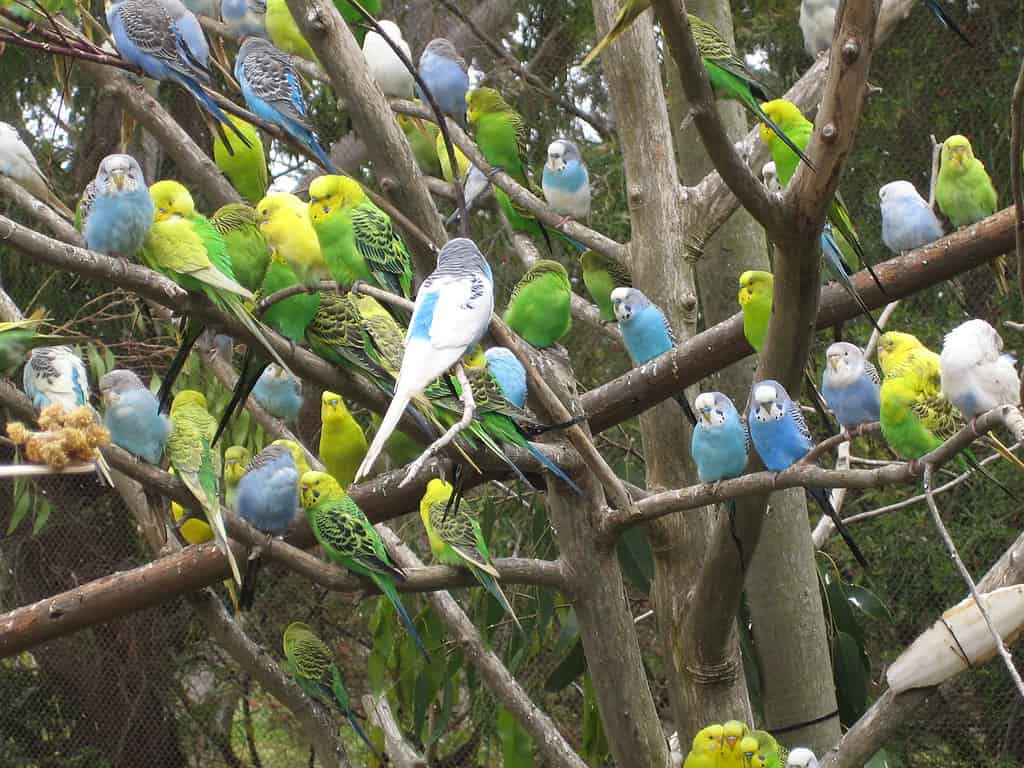
Parakeets are flock creatures, preferring to congregate with others, though fights can break out.
Monk parakeets are not peaceful pushovers. They squabble a lot. But that does not mean their social world is dangerous in the way we might expect.
“While these parakeets fight with each other constantly, it is extremely rare to see any kinds of injuries,” says co-author Dr. Elizabeth Hobson, an associate professor in the Department of Biological Sciences at the University of Cincinnati. “Most fights are more along the lines of squabbling.”
So, if serious injuries are rare, why are these birds so cautious when forming new friendships?
“I think one striking thing we found is that these birds are still pretty tentative in initially forming those friendlier connections, even though injuries from aggression are extremely rare,” Hobson adds. “Their tentativeness in reaching out to new birds could be an indication that making friends is still a risky process, and one worth being careful about undertaking.”
That risk is not just physical. In complex social groups, choosing the wrong partner or misreading a situation can have long-term consequences. A bad interaction can change how others see you, affect your social rank, or alter who supports you in future conflicts.
Hobson notes that monk parakeets appear to be thinking hard about these tradeoffs. “Our work with monk parakeets more generally has provided multiple sources of evidence showing that they are likely using a lot of cognitive power to navigate their social worlds,” she explains. “On the aggression side, they use their own fight outcomes and the fights of others to infer their ranks within dominance hierarchies and choose their future opponents. This new analysis shows that they might be thinking just as hard about who, when, and how to pursue new friendships within their groups.”
Choosing friends, not just tolerating neighbors
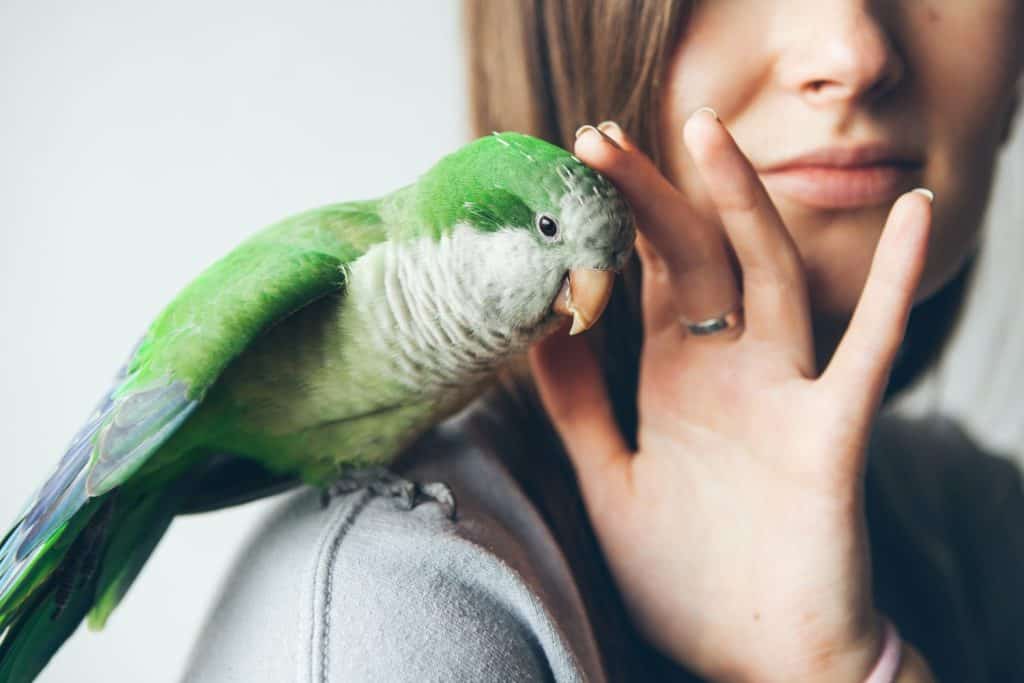
Understanding parakeet social behavior can be helpful for parakeet owners.
©Veera/Shutterstock.com
One of the key results in the study is that birds who eventually made friendly contact spent more time near each other beforehand than they did with strangers they never touched. That suggests these relationships are not accidental. The birds are not just perching wherever space is available and seeing what happens. They keep returning to particular individuals.
By spending time in no-contact proximity first, they may be gathering information about a potential partner’s personality, reliability, and behavior. Are they aggressive? Calm? Consistent? Do they respond positively to close approaches?
The researchers suspect that this “evaluation phase” is a crucial part of how friendship-like relationships form in many social animals, not just parrots.
What does this mean for animal behavior?
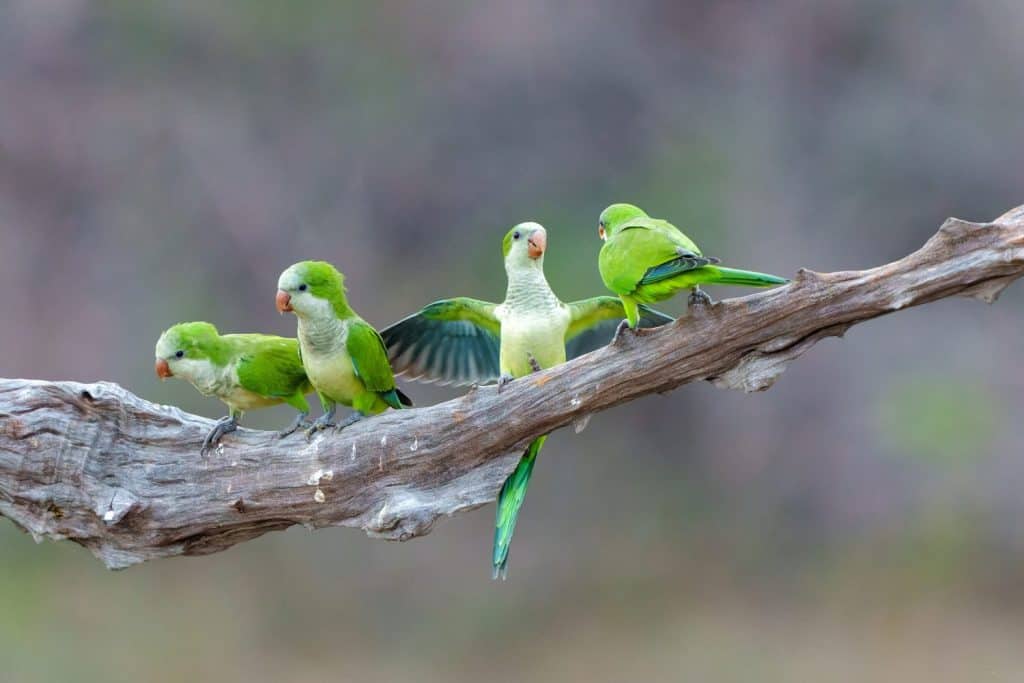
What can this behavior tell us about animal social behavior in general?
©Henk Bogaard/Shutterstock.com
O’Connell sees this work as part of a bigger story about how animals manage the risks and rewards of social life. “These studies show us how important friendly relationships can be in animal social groups, even among unrelated individuals,” she notes. “It also highlights a very interesting ability for animals to navigate both friendly and aggressive social contexts which tells us more about the cognitive demand of sociality in animals. Ultimately, studies like ours show that social processes, like Testing the Waters, are not always unique to humans. They can be effective solutions for managing the risks and rewards of social life, whether you are a parakeet or a person.”
Hobson is especially intrigued by what this might reveal about animal minds. “This Testing the Waters process shows that the parakeets didn’t just launch themselves into new relationships with strangers – relationships were built more gradually,” she adds. “This gradual process might give them enough time to test out which birds they really click with. For me, one of the exciting pieces is the potential cognition involved in this evaluation phase, where parakeets may be using their experiences to decide which birds to build relationships with. That’s where I think comparing across different species is especially exciting, because we could use processes like Testing the Waters to try and infer how much of sociality is carefully considered cognitive decision-making, and how much might be based on simpler, much less cognitively complex rules.”
Whether you are a parakeet or a person, one thing is clear: it seems that sometimes the best way to make a new friend is to simply test the waters first.