
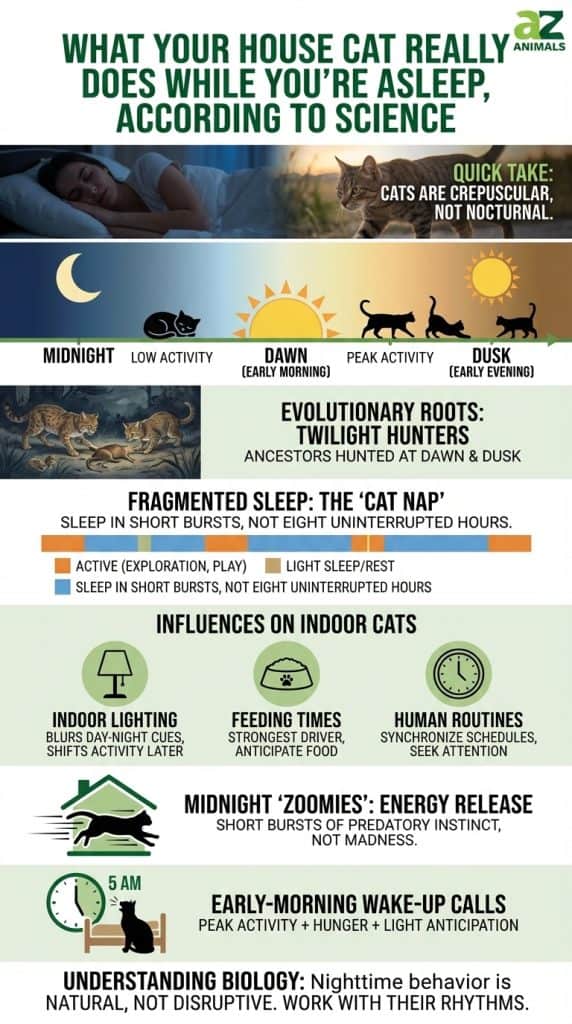
Quick Take
- Domestic cats are crepuscular, with peak activity at dawn and dusk, not nocturnal.
- Artificial lighting blurs natural day-night cues and shifts cat activity later into the evening.
- Feeding times are among the strongest drivers of daily activity.
- Read on to discover which routine tweaks most effectively reduce pre-dawn meows.
As cat owners, we’ve all wondered—usually after being woken by a sudden thump, a sprint down the hallway, or an inexplicable yowl at 3 a.m.—what exactly our cats are doing while we sleep? Are they prowling the house like miniature panthers, hunting things only they can see? Quietly sleeping, waiting for you to wake up and serve their breakfast? Are they lounging on the couch, snacking, and scrolling through the Netflix menu?
Understand the scientific reasons behind your house cat’s crepuscular activity patterns and common nighttime behaviors.
©A-Z Animals
Well, as it turns out, there is solid science behind their nighttime antics. Research on feline circadian rhythms, activity tracking, and light-driven behavior shows that domestic cats are not truly nocturnal, as is often believed. They actually follow a crepuscular pattern, meaning they are most active around dawn and dusk. This rhythm is shaped by their evolutionary past as hunters, but it’s also heavily influenced by indoor lighting, human schedules, and the modern home environment. Understanding what your cat does at night can help explain everything from midnight zoomies and changing sleep locations to their tendency to meow in your face forty-five minutes before your alarm goes off—and what you can do about this particularly disruptive habit.
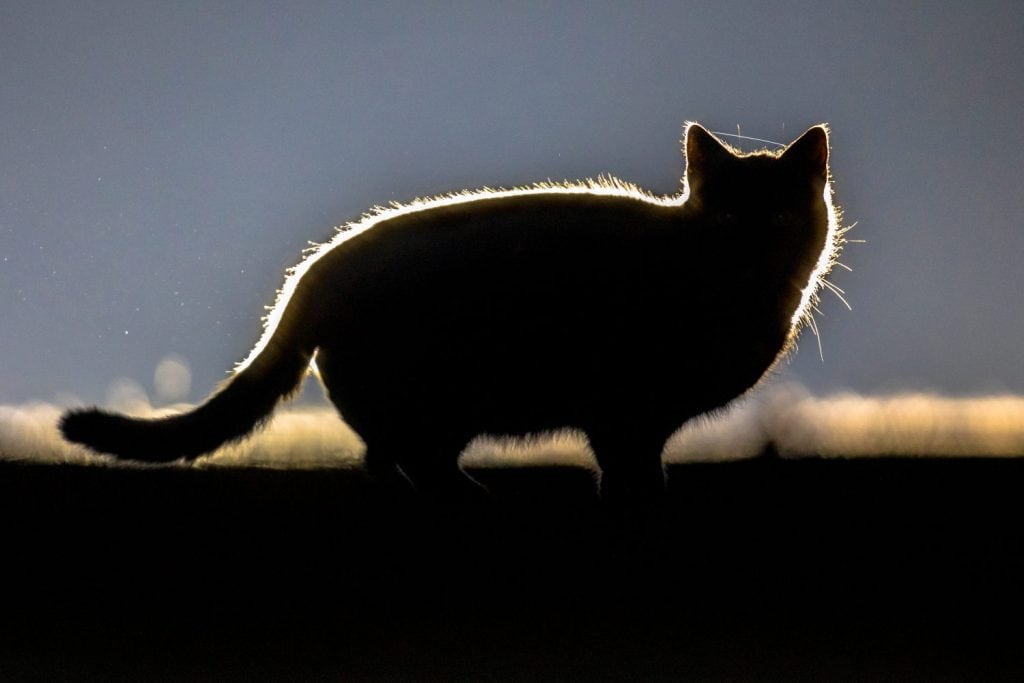
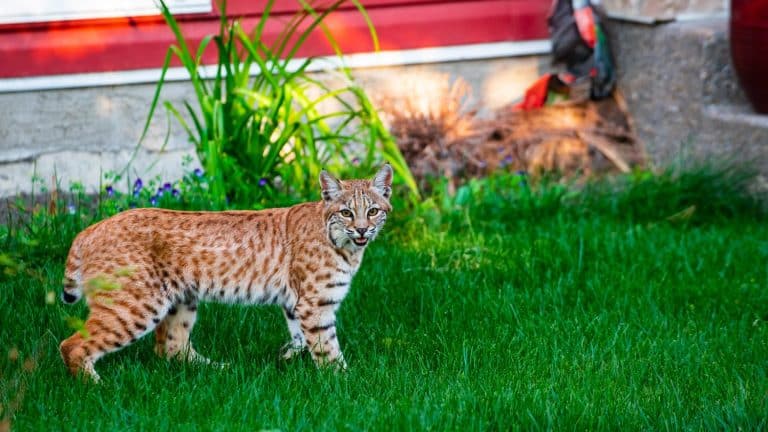
Cats are most active at dawn and dusk, a pattern inherited from ancestors that hunted twilight prey.
©Rudmer Zwerver/Shutterstock.com
One of the most persistent myths about cats is that they are nocturnal animals. In reality, both wild and domestic cats tend to be crepuscular. Studies tracking feline activity consistently show peaks in movement during the early morning and early evening, rather than the middle of the night.
Viewed through an evolutionary lens, this pattern makes sense. Small wildcats, the ancestors of modern house cats, hunted prey such as rodents and small birds that are themselves most active at dawn and dusk. Hunting during these low-light periods offered advantages: there was enough light to see movement, but not so much that prey could easily spot a stalking predator. Over time, cats evolved visual and sensory systems well-suited to twilight conditions, including excellent low-light vision and acute hearing.
Activity-monitoring studies of domestic cats support this history. When cats wear motion-tracking collars or are observed over long periods, researchers see clear increases in movement around sunrise and sunset, with lower but still present activity overnight. Even indoor-only cats, who never need to hunt for food, retain this inherited rhythm. So when your cat starts pacing, playing, or demanding attention at 5 a.m., it’s not trying to be difficult—that’s just an unintended consequence. From a biological standpoint, that’s just when their internal clock is telling them they should be the most active.
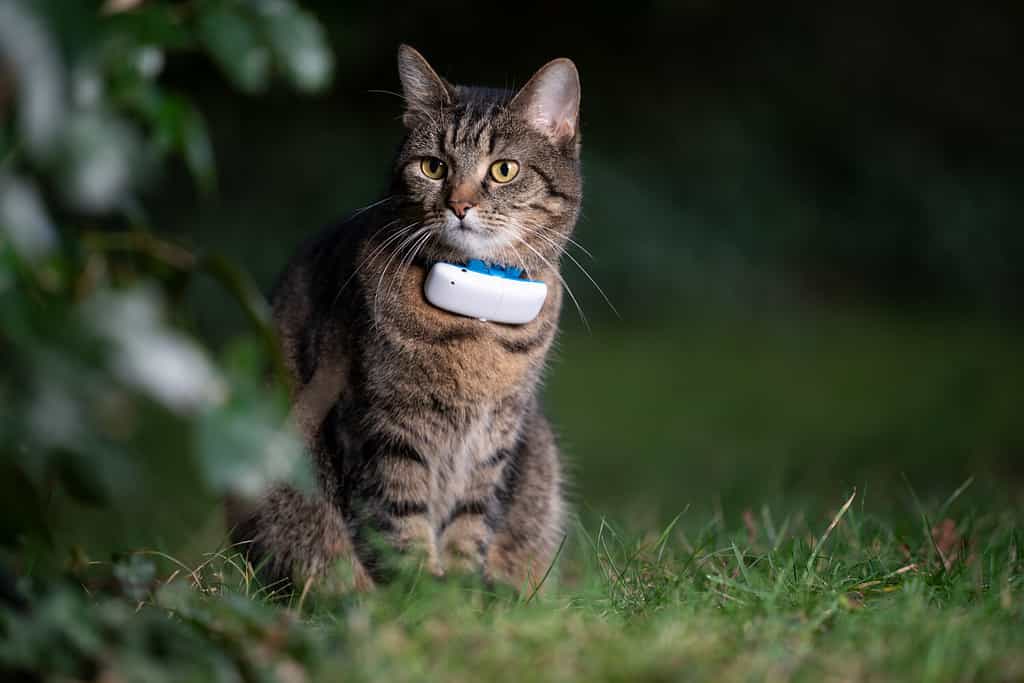
Motion-tracking studies show cats sleep in short bursts, with brief nighttime activity rather than constant wakefulness.
©Nils Jacobi/Shutterstock.com
Modern research has benefited from the same technology used to study human sleep and fitness. Activity trackers attached to collars allow scientists to measure when cats move, rest, or sleep over days or weeks. These studies show that cats sleep a lot, often more than half the day, but their sleep is fragmented rather than consolidated into one long stretch.
There’s a reason the term “cat nap” is so common in our language. Instead of sleeping eight uninterrupted hours the way humans tend to do, cats take frequent naps, ranging from a few minutes to a couple of hours. At night, this means a cat may sleep while you do, wake briefly to explore or play, and then settle down again.
A SUNY Canton study of indoor cats found that although nighttime activity was lower overall than daytime activity, it never dropped to zero. Small bursts of movement were common, especially during the early night and just before morning. These bursts often correspond to exploratory behavior, short play sessions, or social interactions, such as checking on sleeping humans. This activity is not random. It follows a predictable pattern tied to the cat’s internal clock. This is especially true when cats have access to windows or experience changes in ambient light, in which case their activity tends to align even more closely with natural sunrise and sunset times.
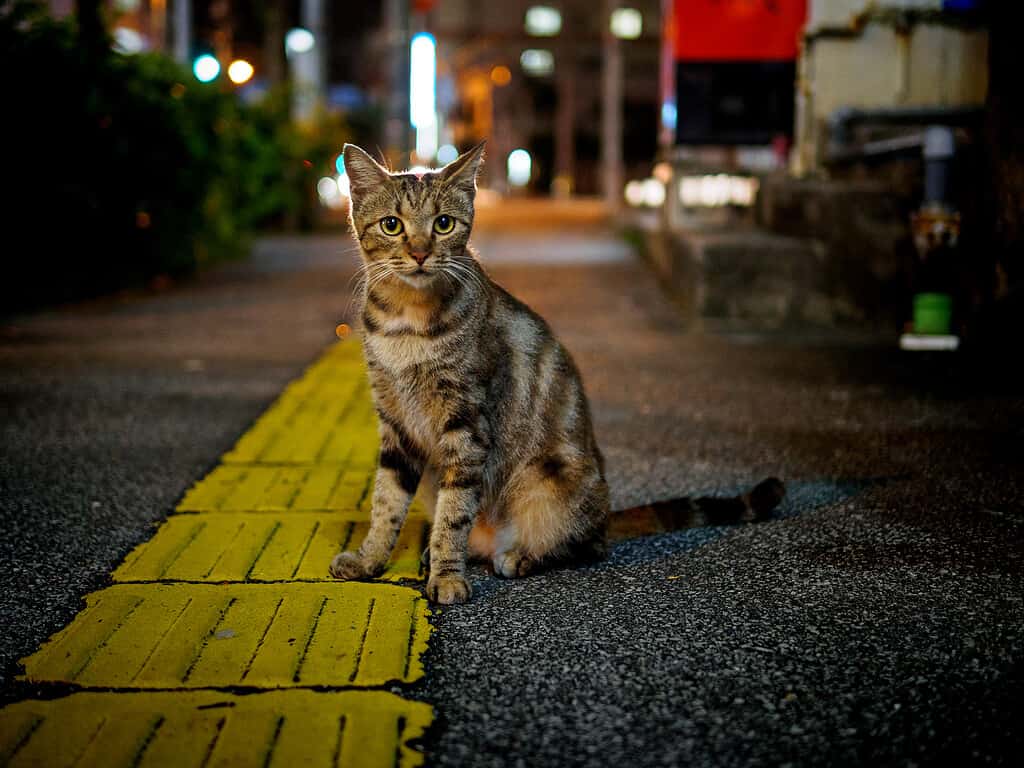
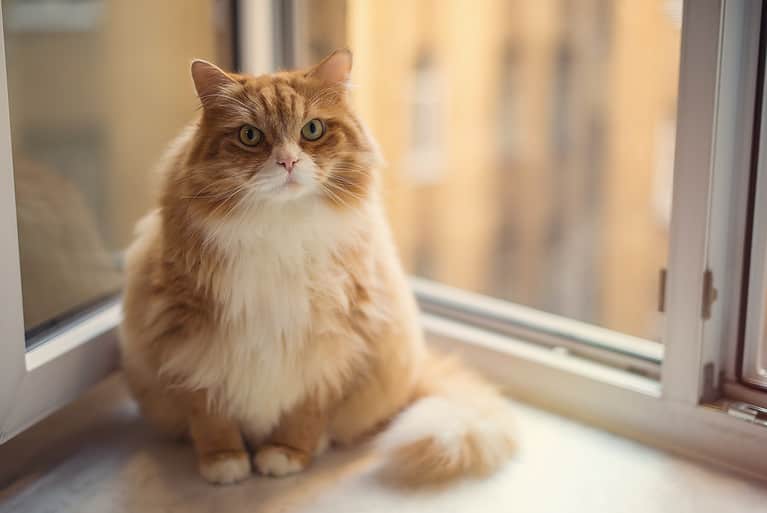
Artificial lighting can blur natural day-night cues, shifting feline activity later into the evening.
©Pierre Aden/iStock via Getty Images
Light is one of the strongest signals controlling circadian rhythms in mammals, and cats are no exception. Research into light-based behavior shows that changes in brightness affect when cats become active or rest, even when food availability stays the same.
In a natural setting, decreasing light at dusk signals the beginning of an active period, and the increasing light at dawn triggers another surge in movement. Indoor cats, however, live in an environment where artificial lighting can blur these cues. Lamps, televisions, and overhead lights extend what cats perceive as daytime well into the evening.
The SUNY Canton study explores how artificial light may affect the circadian rhythms of cats, potentially altering their natural activity patterns. Cats in brightly lit homes may stay active longer in the evening and show less distinction between day and night behavior. Conversely, cats in darker environments or homes that closely follow natural light cycles tend to align their activity more strongly with sunrise and sunset.
This helps explain why two cats in different households can behave very differently at night. A cat in a home where lights stay on late, people are active until midnight, and food is offered at irregular hours may appear more nocturnal. Another cat in a quieter, dimmer home may sleep soundly through most of the night.

Feeding times, play, and human routines strongly influence when indoor cats choose to sleep or wake.
©VAKS-Stock Agency/Shutterstock.com
Cats are highly adaptable, especially when it comes to social routines and expectations. While their internal rhythms are rooted in biology, they are also influenced by the habits of the humans they live with. Research on indoor cats suggests that feeding times are among the strongest drivers of daily activity. Cats quickly learn when food is likely to appear and adjust their wakefulness accordingly. If breakfast is served early, cats may become increasingly active before that time, regardless of whether it is still dark outside.
The same applies to play and attention. Cats that receive most of their interaction in the evening may stay alert longer at night. Cats that nap alongside their owners during the day may be more energetic at night. Over time, many cats synchronize their schedules with their humans, at least partially. This does not erase their crepuscular nature, but it does modify how it shows up. A cat may sleep more deeply at night if it has been stimulated and exercised in the evening, or if it knows nothing interesting happens after the lights go out.

Sudden nighttime sprints reflect a predator’s biology built for short bursts of intense movement.
©Nils Jacobi/Shutterstock.com
Those sudden bursts of speed, often called zoomies, are one of the most noticeable signs of nighttime cat activity. While it may look like your cat has gone off the deep end, from a scientific perspective these episodes are not a sign of madness or even boredom. They reflect normal patterns of energy release and motor behavior.
Cats are ambush predators built for short, intense bursts of movement rather than sustained endurance. In the wild, a successful hunt might involve long periods of waiting followed by a few seconds of explosive action. Even well-fed indoor cats who’ve never had to rely on predation retain this physical wiring. If you’ve ever seen a cat hide behind the sofa, wait for another cat to walk by, and then pounce seemingly out of nowhere, it’s because of these natural instincts.
When cats sleep for extended periods, especially during the day, energy accumulates. At night, particularly during their natural activity windows, that energy may be released through running, jumping, or mock hunting behavior. Chasing toys, pouncing on shadows, or sprinting through the house all serve as outlets for these instincts.
Studies observing indoor cats note that these bursts are often brief and followed by rest. They are not signs that a cat is unhappy, but rather that it is expressing normal, instinctual behavior in an environment without actual prey.
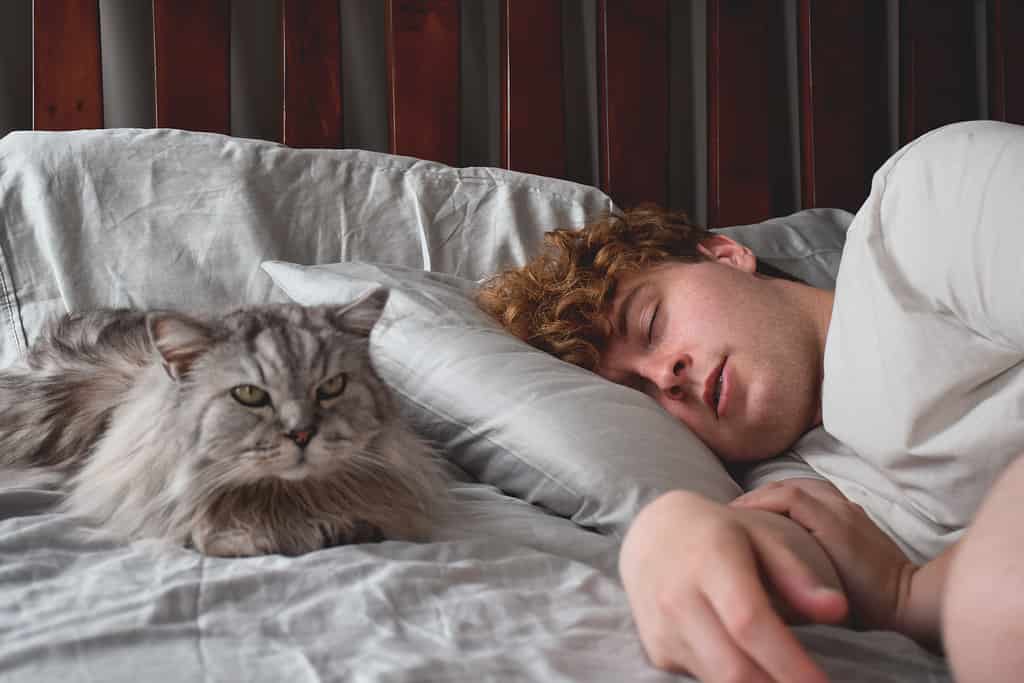
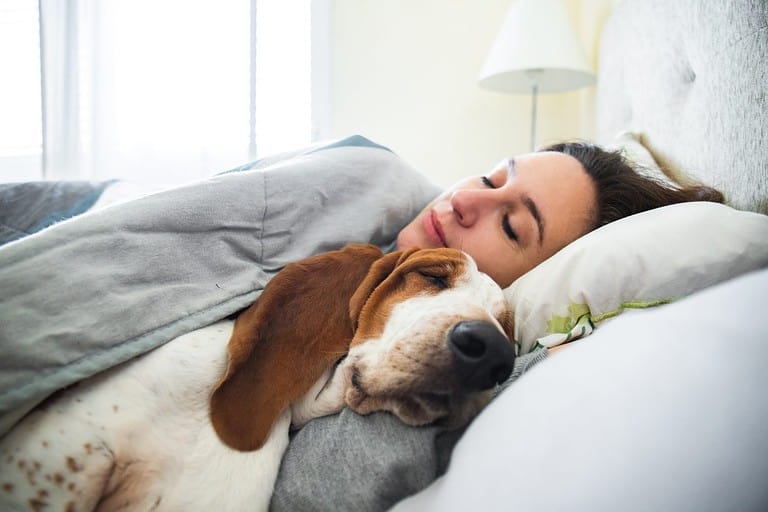
Much of the night is spent resting lightly, with cats changing sleep spots as conditions shift.
©JulieAlexK/iStock via Getty Images
Not all nighttime behavior is dramatic. In fact, most of it isn’t. Much of what cats do while humans sleep is quietly rest themselves. Activity trackers show long stretches of low movement overnight, indicating light sleep or relaxed wakefulness.
Cats often choose sleeping spots near their owners, even if they are not fully asleep themselves. This proximity may offer warmth, security, or social comfort. From an evolutionary standpoint, resting near a trusted group member provides protection against threats.
It is also common for cats to change sleeping locations during the night. A cat may start on the bed, move to a couch, then return before morning. These shifts are usually linked to temperature changes, noise, or subtle disturbances rather than any specific goal.
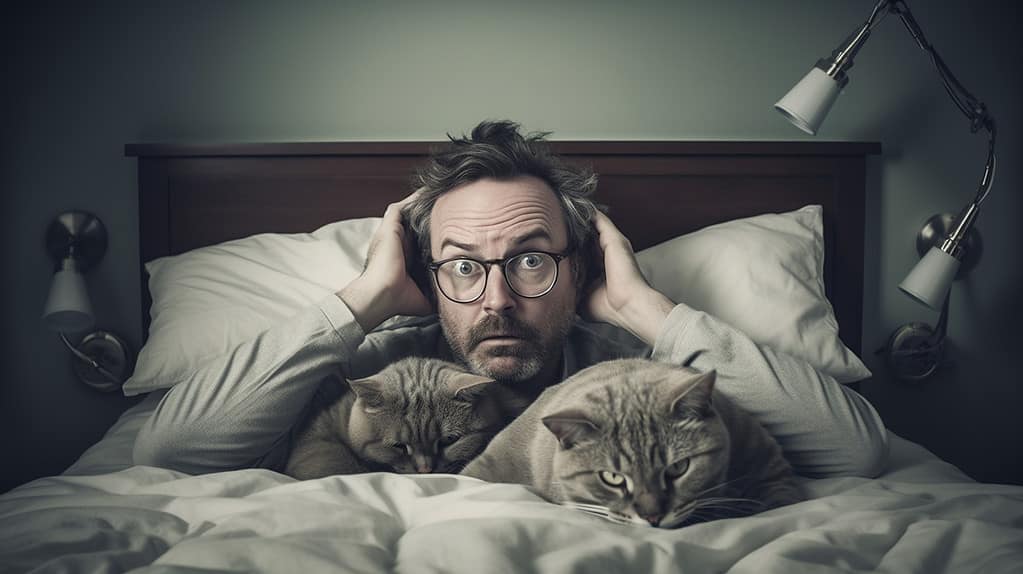
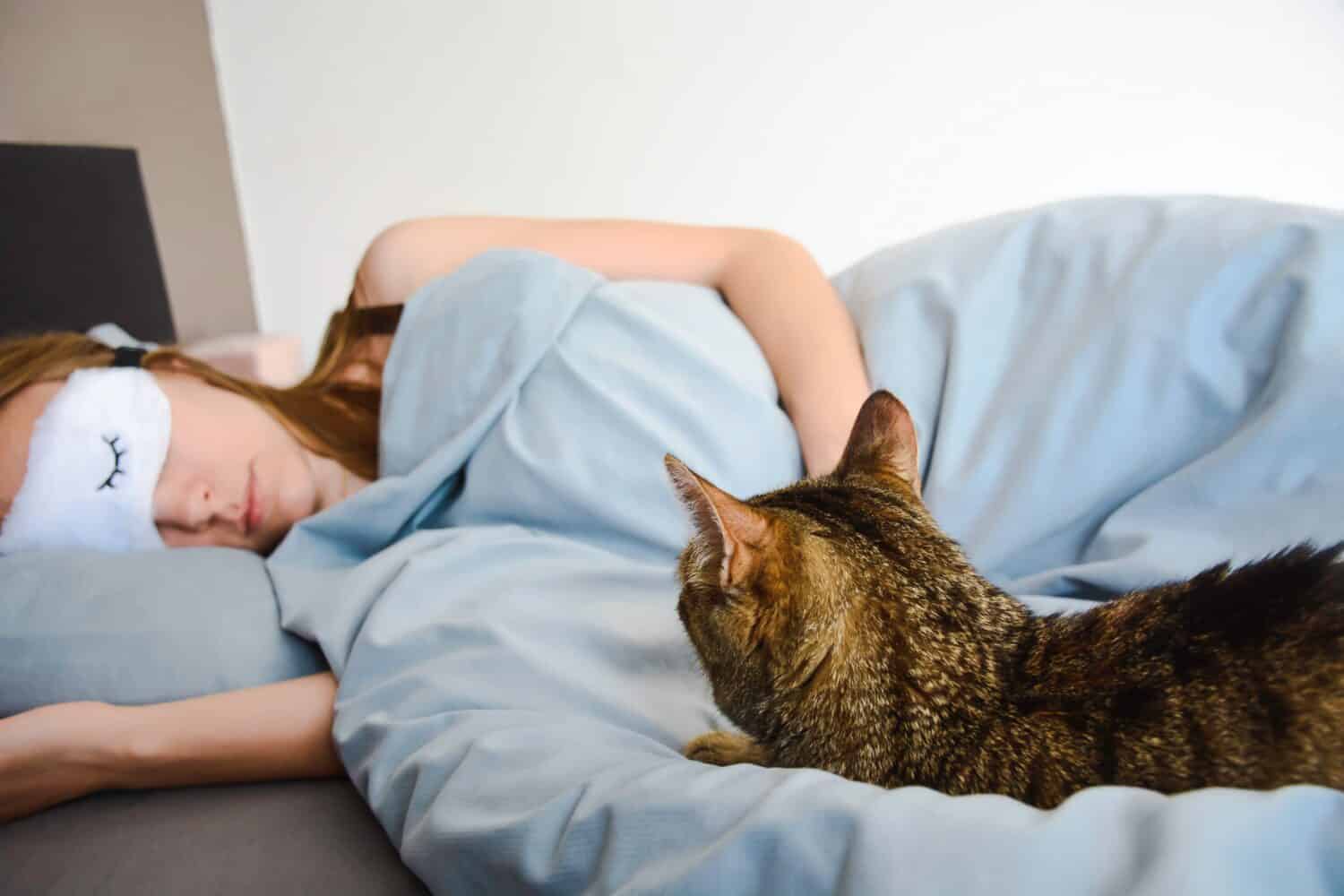
Early-morning wakeups coincide with a natural activity peak tied to rising light and feeding expectations.
©A-Z-Animals.com/
One of the most frustrating aspects of feline nighttime behavior is the early-morning wake-up call. Science offers a clear explanation for this phenomenon. As discussed, dawn is one of the primary activity peaks for crepuscular animals. As light levels begin to rise, a cat’s internal clock signals that it is time to move, explore, and hunt. If food has historically appeared around this time, anticipation adds to the motivation.
Indoor cats may amplify this behavior because there is nothing to hunt. The sleeping human—you—becomes the most reliable source of stimulation and food. Vocalizing, pawing, or knocking objects off surfaces are all effective ways to prompt a response. Studies suggest that consistent routines can help moderate this behavior. Cats that are fed and played with on a predictable schedule, especially later in the morning, may gradually shift their expectations and reduce pre-dawn disturbances.
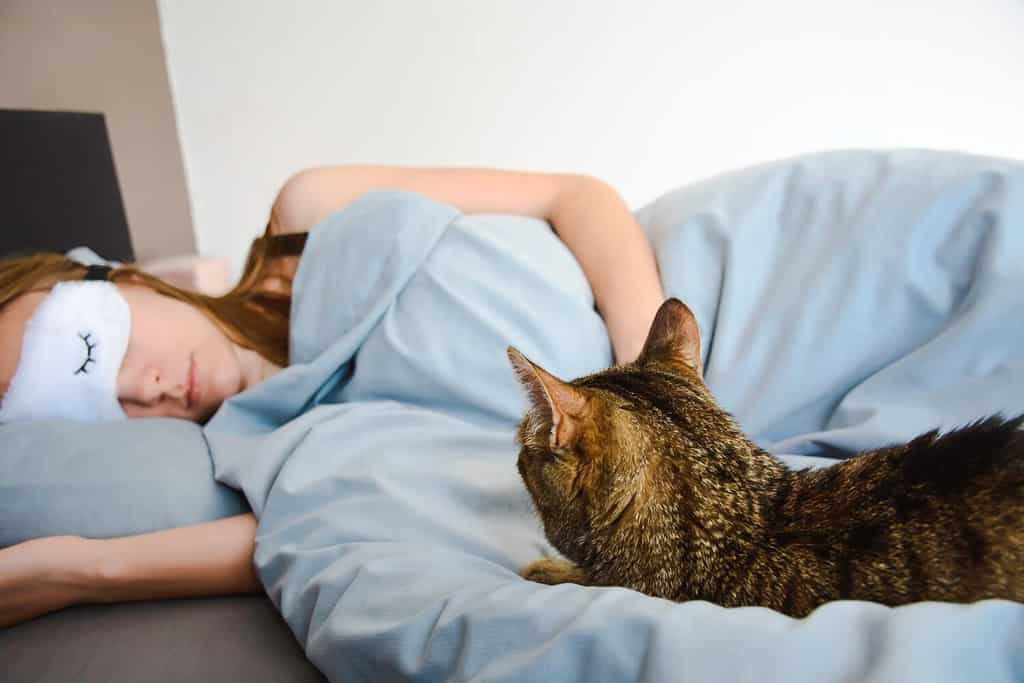
Understanding crepuscular biology explains nighttime behavior and helps owners work with, not against, feline rhythms.
©Ellyy/Shutterstock.com
What your cat does at night is not mysterious once biology enters the picture. Domestic cats are crepuscular animals shaped by thousands of years of hunting at dawn and dusk. Even indoor cats follow these rhythms, alternating between rest and short bursts of movement throughout the night. In other words: you can take the cat out of the jungle, but you can’t take the jungle out of the cat.
Those midnight sprints, early-morning meows, and quiet hours curled up nearby are all expressions of a flexible but deeply rooted behavioral pattern. Rather than trying to force cats into a strictly human sleep schedule, understanding their natural rhythms allows owners to work with them. With thoughtful lighting, consistent routines, and appropriate play, the nighttime life of a cat can become less disruptive and more predictable. So the next time you wonder what your cat is doing while you sleep, the answer is surprisingly simple. Your feline friend is being exactly what evolution designed it to be: a twilight hunter navigating a modern, well-lit world.