
Quick Take
- Baby copperheads are born late summer to early fall and often appear in yards and trails.
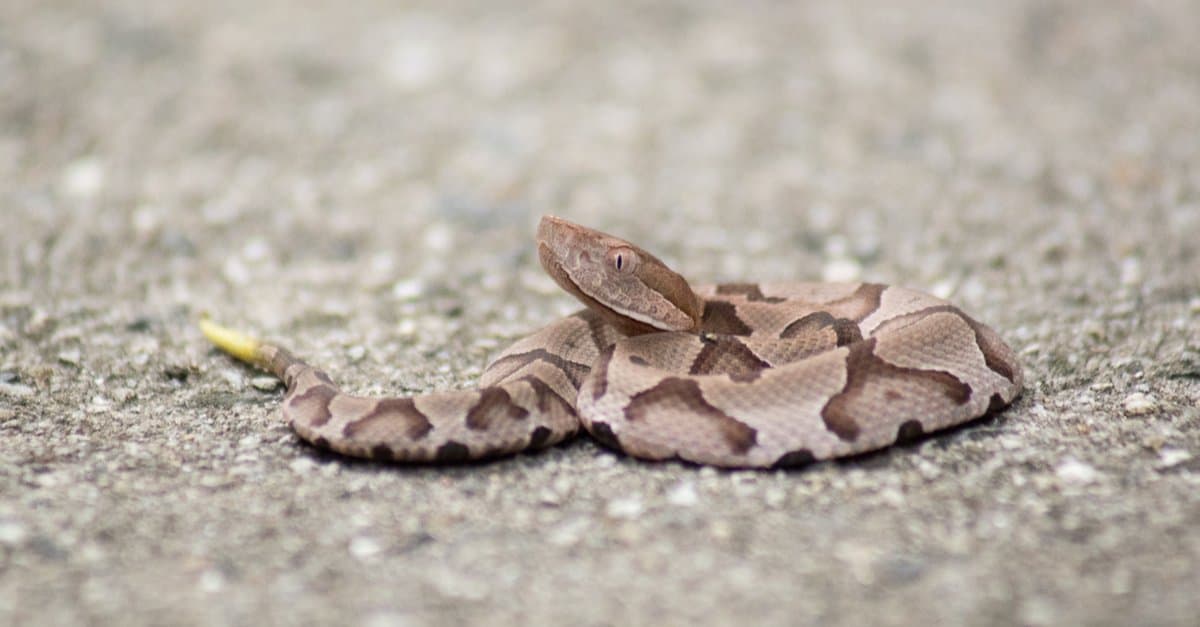
- They are small, well-camouflaged, and identifiable by bright yellow tail tips.
- Juveniles are venomous but not more dangerous than adults.
- Simple awareness and precautions greatly reduce risk of bites.
If you live anywhere in copperhead country, you may hear people warn that “baby copperhead season” is coming as summer winds down. Across most of the eastern and central United States, pregnant copperhead females give birth from mid‑August into early October, so late summer and early fall are when tiny, camouflaged snakes begin turning up in yards, parks, and along hiking trails.
These small pit vipers blend almost perfectly with fallen leaves and soil, which means a barefoot step in the wrong place can bring a painful surprise even in familiar spots like your driveway or garden bed. Knowing when baby copperheads are on the move helps you protect yourself, your kids, and your pets without overreacting to similar harmless snakes that are just trying to survive.
Meet the Copperhead (Agkistrodon contortrix)
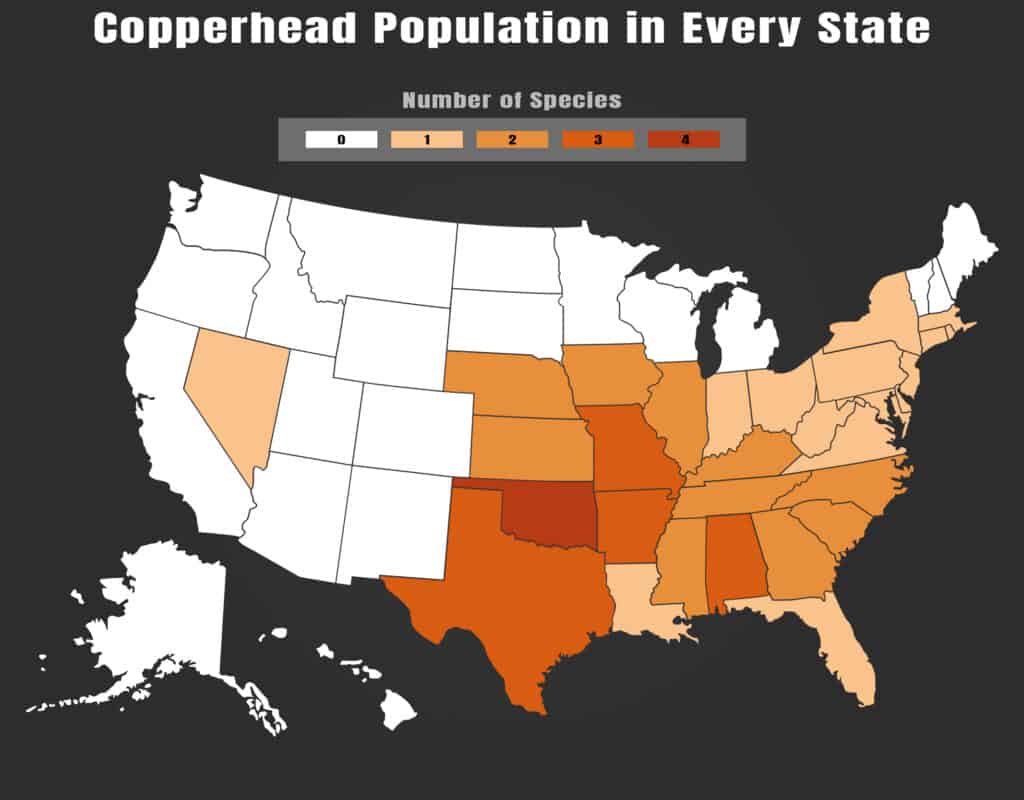
The copperhead is a stout, medium‑sized pit viper found across much of the eastern United States, from the New England states south through the Carolinas and west into parts of the Midwest and Great Plains. Adults usually measure about 2 to 3 feet long, though some individuals grow longer, with bodies marked by hourglass‑shaped crossbands that are narrower across the back and wider along the sides. Their heads have a solid coppery or tan color that gives the species its common name, and their eyes have vertical, cat‑like pupils typical of many venomous snakes.
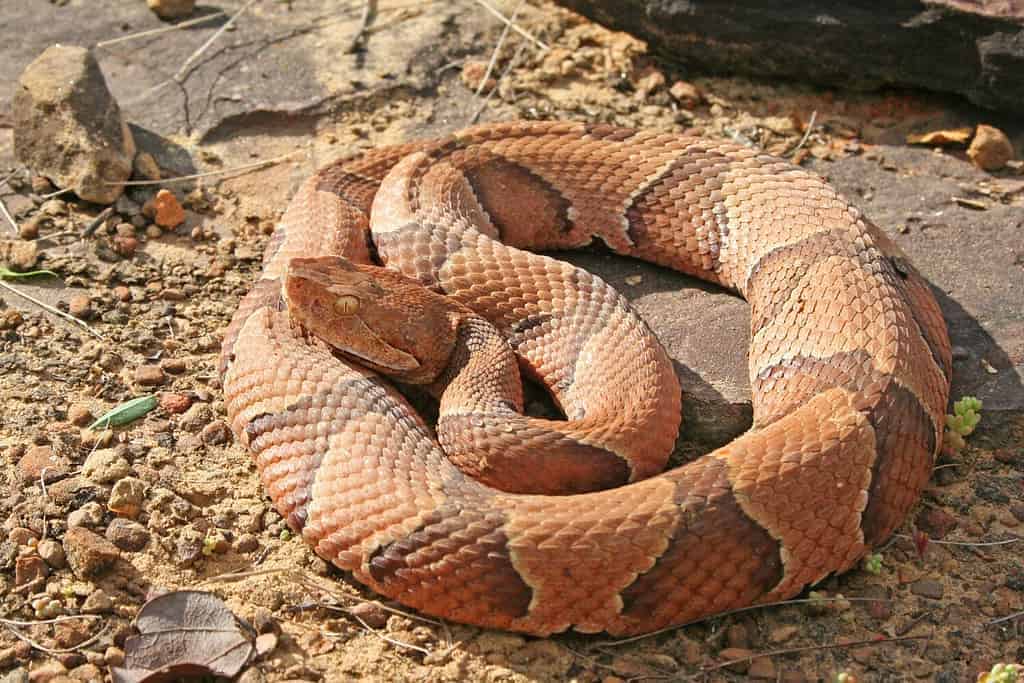
Copperheads get their name from their coloration.
©Creeping Things/Shutterstock.com
Copperheads use heat‑sensing pits on their faces to detect the body warmth of prey such as rodents, frogs, lizards, and large insects, striking in ambush from leaf litter or other cover. Because their camouflage is so effective and they often freeze instead of fleeing, people may step on or near them without noticing, which is one reason copperheads are responsible for many venomous snakebites in the U.S.
Where Copperheads Live in the U.S.
Copperheads occupy a wide range of habitats, but they generally favor areas with cover, such as forests, rocky hillsides, and brushy edges along streams. In the Appalachian and northeastern states, they are often found in deciduous woodlands with rock outcrops, hilly terrain, and plenty of downed logs or brush piles. On the southern Coastal Plain, including parts of the Carolinas and Georgia, copperheads can live in low, moist woodlands and along swamp margins, where dense vegetation offers shade and hiding places.
They also adapt surprisingly well to suburban neighborhoods, using stone walls, stacked firewood, and ornamental plantings as cover while hunting mice and other small animals attracted to bird feeders or garbage. They are widespread in the eastern and southern United States and the Midwest.
Mating Season and Timing of Births
Copperhead courtship and mating usually happen in spring, when temperatures rise enough for snakes to become active after winter. In some northern populations, adults may also mate again in late summer or early fall, with females storing sperm until the following year. After mating, females carry developing embryos inside their bodies for several months; copperheads are ovoviviparous, meaning the eggs develop and hatch internally so that the young are born live rather than laid in nests.
In the United States, most litters arrive between mid‑August and late September, although births can occur as late as early October depending on weather and local conditions. Warmer regions or particularly hot summers may shift the timing slightly earlier, while cooler mountain or northern areas can push births toward the end of the season.
Regional Differences in Baby Copperhead Season
Although late summer and early fall is baby copperhead season almost everywhere, the precise window varies somewhat by region.
- In many parts of North Carolina, herpetologists report that the majority of copperhead births often peak around late August and early September, with a smaller number of litters arriving from mid‑August through early October.
- In Tennessee and neighboring states within the Tennessee Valley, wildlife officials commonly describe August through October as the main period when baby copperheads appear on trails and in gardens.
- Farther west, in states like Missouri, copperheads tend to be most active in spring and fall, so people are more likely to encounter newborns during the same late‑summer to early‑fall window when adults are also moving to and from wintering sites.
- Even at the northern edge of their range, such as in parts of Massachusetts, copperheads remain tied to warm months, and the short growing season there keeps birth timing concentrated in late summer.
Where Baby Copperheads Are Born
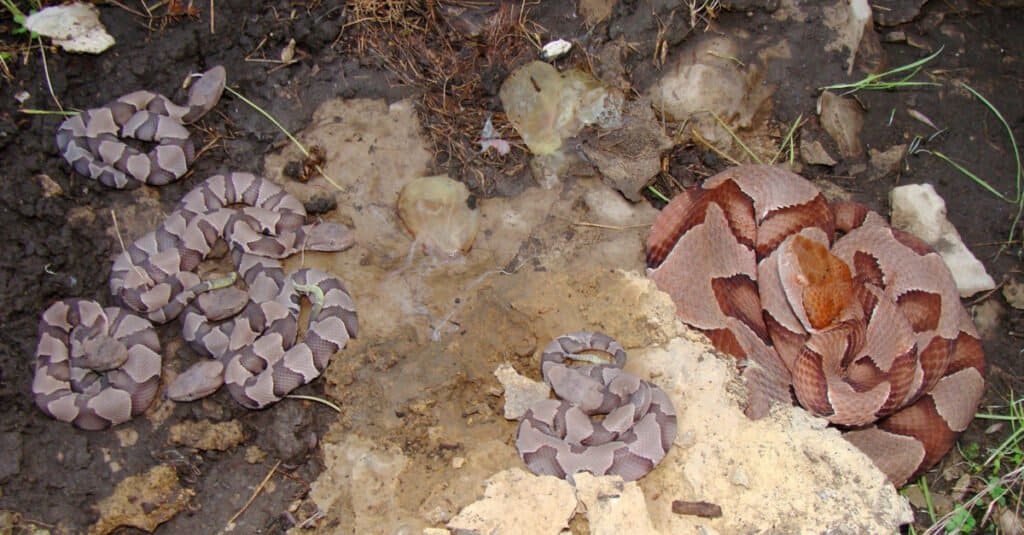
A mother copperhead with her babies.
©Matt Jeppson/Shutterstock.com
Because copperheads give birth to live young, typically 3 to 14 at once, there are no true “nests” full of eggs the way you might see with some other reptiles. Instead, pregnant females choose sheltered spots called gestation or parturition sites, which can include rock crevices, hollow logs, downed stumps, and even old building foundations
Multiple females may return to the same general area year after year, creating loose communal gestation sites where several snakes share warm, secure basking and birthing sites. After giving birth, females and neonates may remain near the shelter for a short period before dispersing into surrounding habitat such as forest edges, stream banks, and weedy yards.
Most females reproduce only once per year or once every two to three years, investing considerable energy in developing the embryos and finding safe gestation sites. Because mortality is high for young snakes due to predators, weather, and human activity, relatively few babies survive to adulthood.
Where People Are Most Likely to Encounter Babies
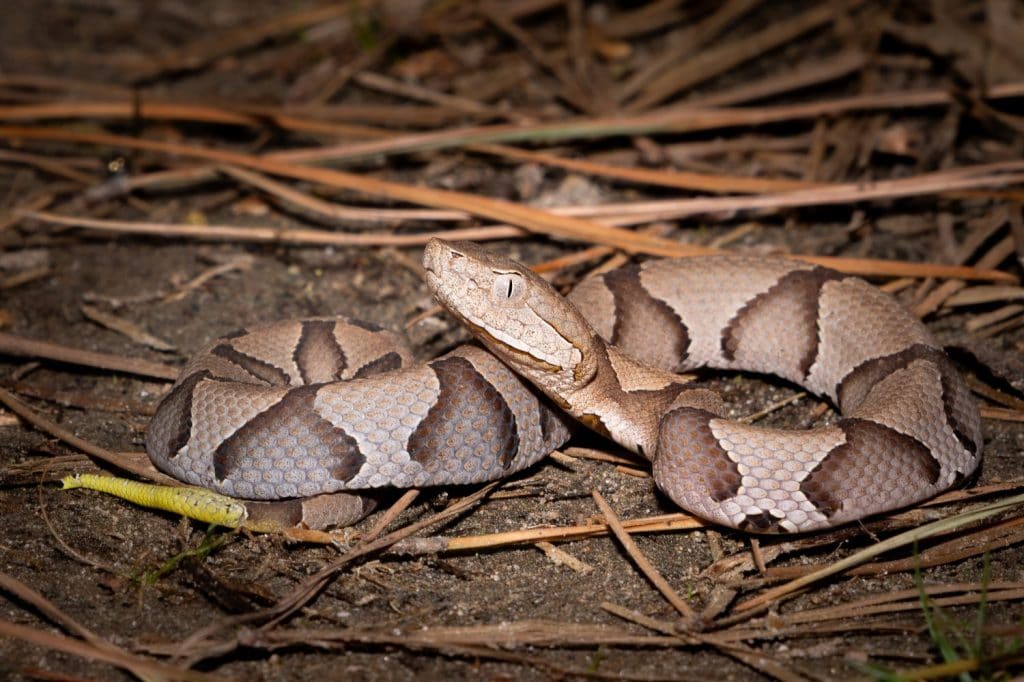
Baby copperheads have a bright greenish-yellow tail tip that they use to lure prey.
©Clint H/Shutterstock.com
Baby copperheads prefer many of the same hiding spots as adults, but their small size allows them to squeeze into places people might not expect. Yard owners and gardeners may find them under flowerpots, tarps, or low shrubs where damp soil and leaf litter provide cover and prey. Hikers are most likely to encounter them along rocky trails, on south‑ or west‑facing slopes with scattered boulders and logs, and near stream banks where small amphibians are abundant. Around homes, they can shelter in stacked firewood, rock walls, or piles of boards or old building materials, especially if those spots are close to overgrown vegetation or areas that attract rodents.
Because baby copperheads are well camouflaged against fallen leaves, they may be almost invisible on forest floors or in leaf‑covered driveways, so wearing shoes and watching where you place your hands is especially important during late summer and fall.