
Most of us associate ants with productivity. You probably imagine them digging tunnels, laying down pheromone trails, hauling food back to their nest, or, of course, maintaining their characteristic massive ant hills. These tiny insects are building machines; in fact, certain species of ants are literally called “carpenter” ants. We all know ants are amazing and incredibly capable creatures, but you might be surprised to discover they can construct complex architecture using their bodies in lieu of materials. Check out this Instagram post to see an example of this extraordinary ability!
The Impressive Structure
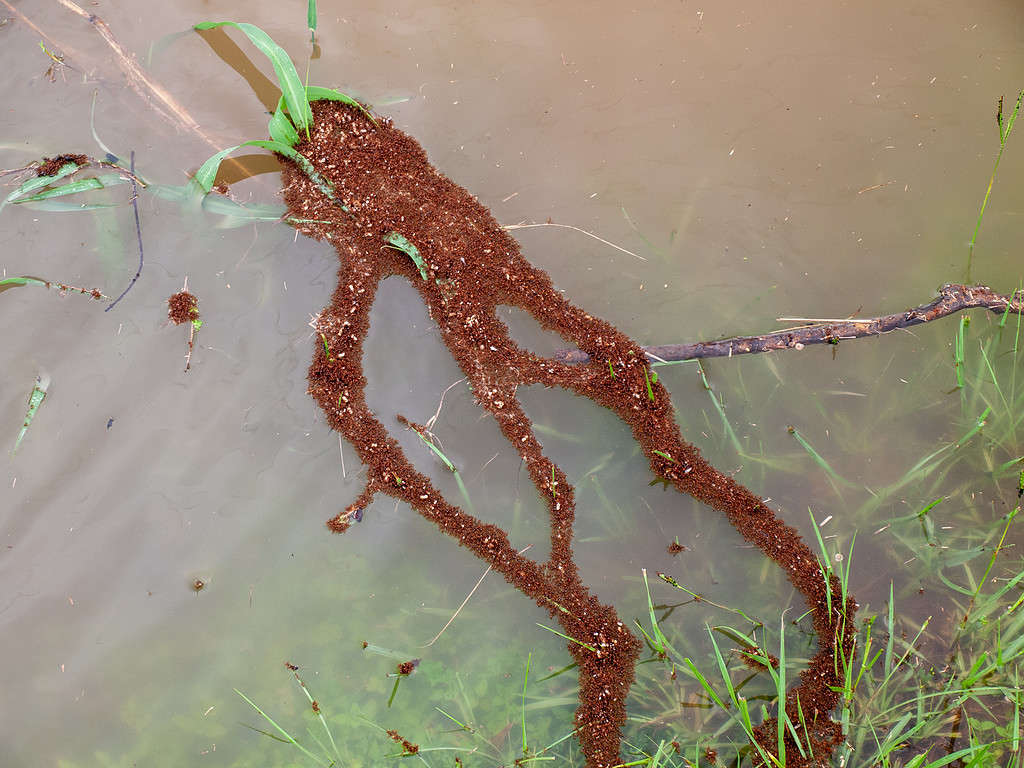
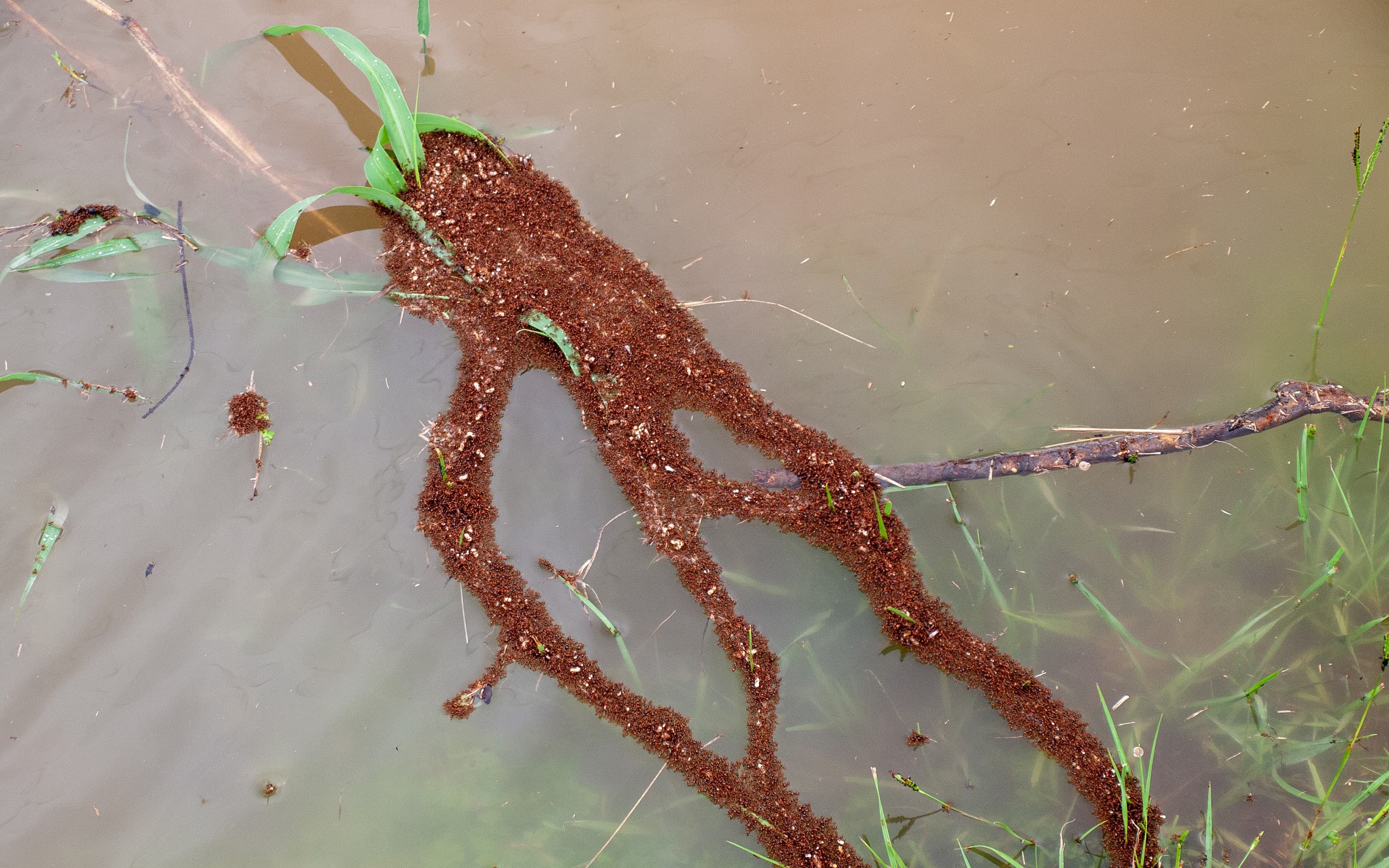
Fire ants interlock legs, claws, and mandibles to create living structures across water.
©Tim Bingham/iStock via Getty Images
Fire ants build living “relocation” bridges through simple, instinctive rules followed by individual workers, which collectively produce a complex structure. There is no leader—no foreman directing construction, each ant simply joins the structure when it’s their turn, and detaches when the bridge, and specifically their role in creating it, has served its purpose. When ants encounter a gap they can’t cross, the first few workers physically anchor themselves to the substrate by gripping edges with their mandibles or claws. Other ants then climb onto them and interlock their legs, mandibles, and claws with the ants already in place. As traffic builds up behind the obstruction (in the case of this reel: a body of water), more workers add themselves to the growing chain, extending the structure outward until it spans the gap. Each ant grasps multiple neighbors, creating a dense, flexible mesh that distributes weight and withstands shifting loads. The result is a self-assembling, self-adjusting, load-bearing bridge made entirely of live ants!
This architecture is so fascinating and effective that it’s been studied by researchers at Texas A&M University for the field of robotics. (Technically, researchers were studying fire-ant rafts, a phenomenon in which ants bond together to make a giant floatation device out of their bodies to survive a flood, but the bonding method used is the same as with a bridge.) Researchers looked at the way the ants linked their bodies in order to replicate the strategy through design materials and robotics that self-assemble, reconfigure, and disassemble in response to environmental cues. Who’d have thought one of nature’s tiniest creatures could inspire complex robots?
The reasons why ants form these impressive bridges are fairly simple. When the colony needs to maintain connectivity, the workers sacrifice individual mobility by linking together, thus providing a continuous pathway for the rest of the colony. In other words: “we” not “me.” Colonies may need to stay connected for several reasons. They might be maintaining colony movement across difficult terrain when migrating or escaping a flood. Alternatively, they may use a bridge to connect their nest to their foraging and/or trail systems when the terrain is irregular, obstructed by roots, water channels, or debris. Either scenario could be the impetus for the bridge seen in that reel. Regardless of why they’re constructed, these bridges are tools of mobility and survival for the colony.
How the heck did they learn how to do this?
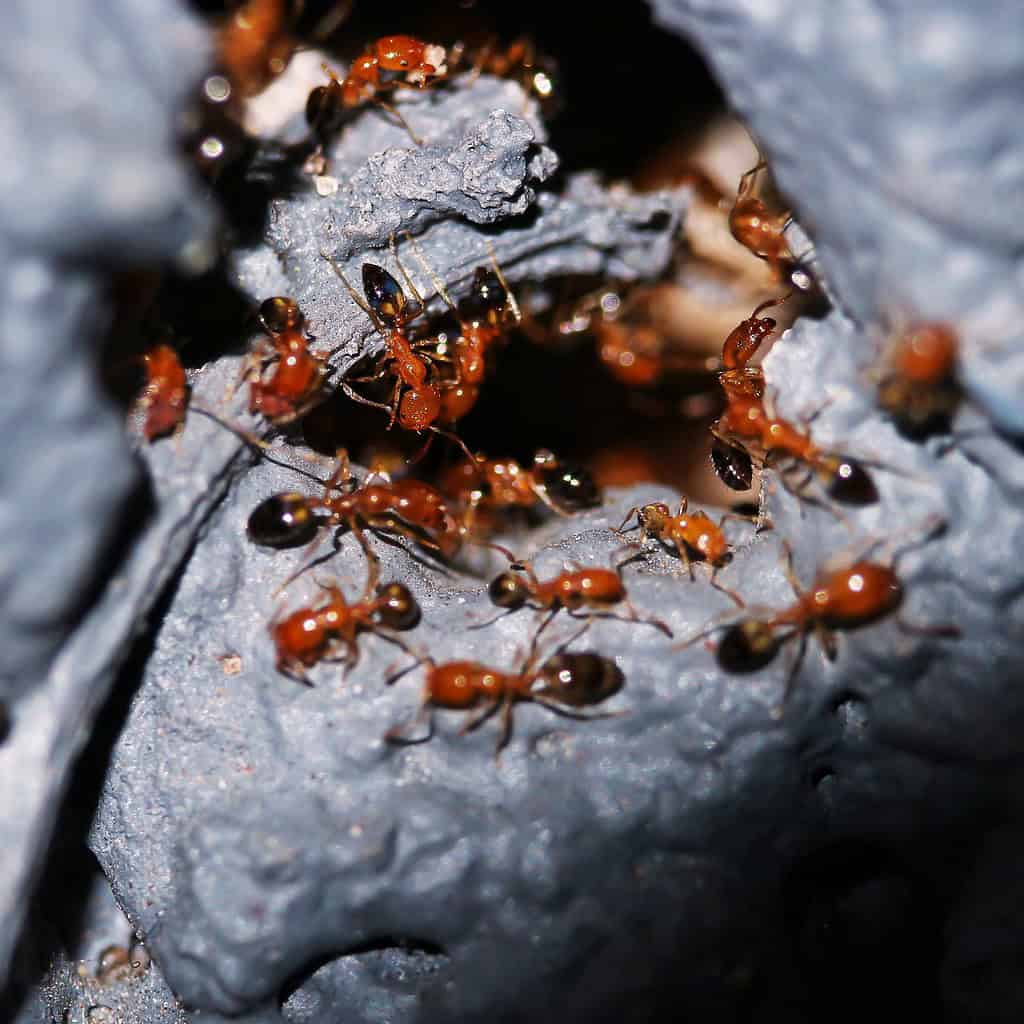
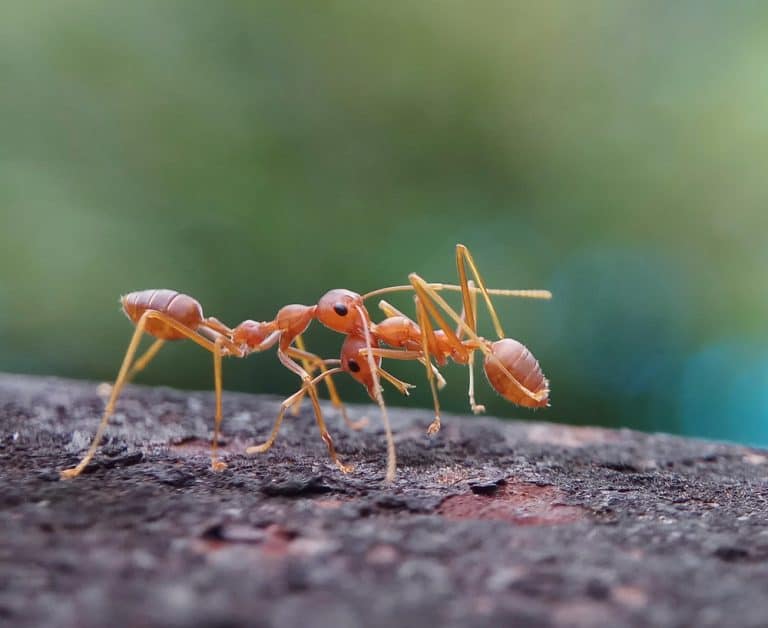
Each ant follows just two simple rules, but when thousands of ants all follow these same two simple rules at the same time, amazing things happen.
©Setiani Antari/Shutterstock.com
It’s unlikely that individual ants “learned” in the sense of training. This is more likely an evolved collective behavior built on simple rules that ants tend to follow. 1) They join a structure if traffic above them is high, and 2) they leave when traffic falls. That’s it. But when thousands upon thousands of ants follow these rules, the result can be a bridge like the one in the reel (similar behavior also leads to the aforementioned ant rafts formed during flooding).
But let’s break down the rules a bit more finely.
Rule #1) Joining a structure when traffic is high. When an ant reaches a small gap or awkward spot on the trail, it may pause. Often, this will lead to many ants crowding behind it or stepping across its body. The stopped ant interprets the heavy traffic as a signal that it’s blocking the flow. In response, it anchors itself in place and becomes part of a living bridge. As more ants encounter the same traffic jam, they add themselves to the structure, extending the bridge in the direction the colony needs it most.
Rule #2) Leaving when the traffic falls. Living bridges aren’t permanent. When the colony no longer needs them, like when the traffic flow drops or the ants shift to a new foraging route, the ants making up the structure begin to sense fewer footsteps, fewer bumps, and fewer ants passing overhead. With the pressure gone, they receive the opposite cue: staying locked in place no longer helps the colony. One by one, they unlock their legs and mandibles, detach from the structure, and resume normal duties. As more and more leave when traffic falls, the bridge automatically dissolves.
How big and long can these bridges be?
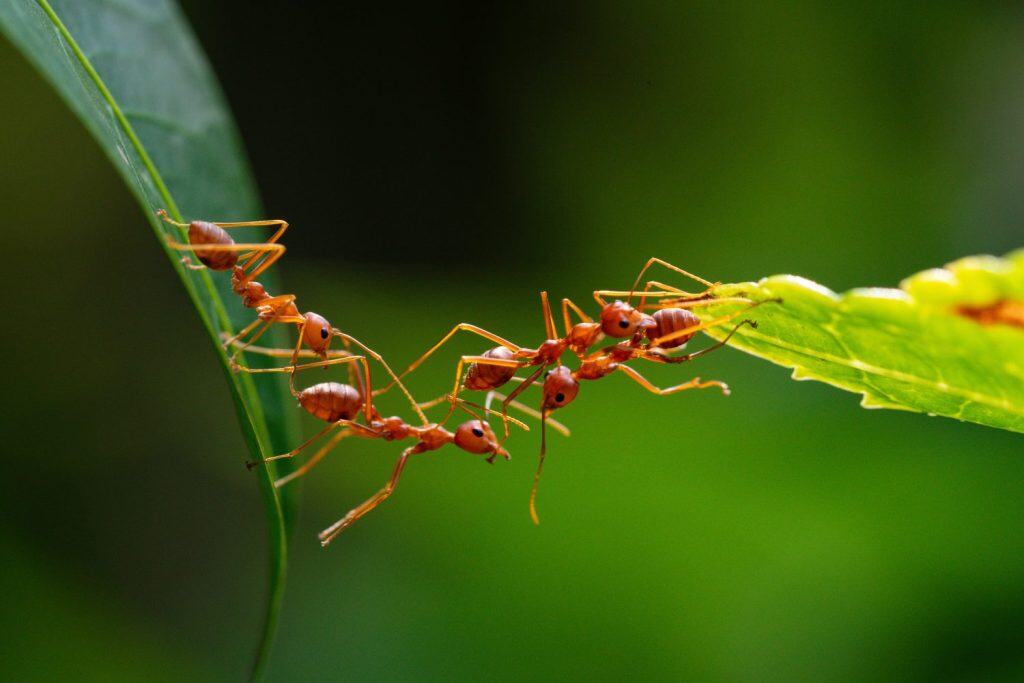
When scientists refer to an “ant bridge,” they are usually referencing something like this.
©frank60/Shutterstock.com
The specific bridges created by fire ants, the species in the reel, hasn’t been exhaustively documented or researched. However, they use a similar “architecture” to build rafts, which have been far more researched. Studies have shown dramatic numbers, suggesting these living flotations can involve tens to hundreds of thousands of fire ants when flooding conditions demand it, with some sources suggesting the structures can exceed 100,000 individual ants. That number of ants is sure to spoil anyone’s picnic!
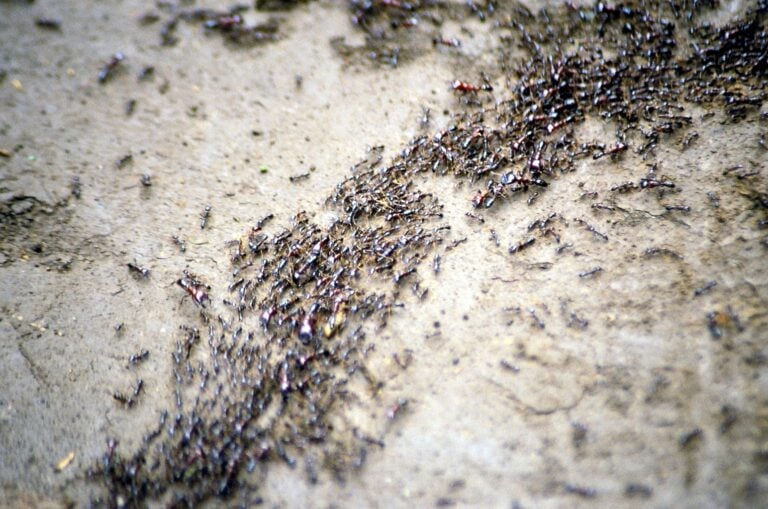
But fire ants aren’t the only type of ant to possess this skill; army ants and weaver ants are known to make bridges as well. The best-studied example is a species of army ant called Eciton hamatum. These ants build living bridges across gaps in the forest floor for their massive foraging columns. Their bridges lengthen, widen, and migrate in response to traffic and geometry. These bridges typically measure in the range of 5-12 centimeters.
But hold on; I know what you’re thinking. The bridge in that video looked MUCH longer than 12 centimeters. Very true. Viral videos like that one often show fire-ant bridges that are much longer or more dramatic than the compact spans described in scientific studies. The difference comes down to a matter of semantics. Scientists use the word bridge to describe the tiny, optimized structures army ants build to shorten their foraging trails, but the massive construction in this reel is a special, rarely seen type of bridge. Researchers call this a colony-migration bridge, which is a sprawling, multi-layered living structure that can stretch horizontally across water as the entire colony relocates. Instead of being a neat shortcut only a few centimeters long, this kind of bridge is made from thousands of workers linking legs and mandibles, forming broad chains that merge into a thick band wide enough to hold steady as the ants ferry food, workers, and even the queen to safety. Because survival—not efficiency—is the goal, these relocation bridges can potentially reach tens of centimeters to several meters, far surpassing the small “ant bridges” described in traditional research, but they are also less secure.
Not all ants build bridges
Fire ants must survive periodic floods in their native wetlands, so they benefit from rafts and bridging over water and/or land. Other species, like the aforementioned army ants, travel in large columns across complex terrain and benefit greatly from bridges. But other ants with more stable nest locations and simpler terrain may not need such extreme structures or even have the ability to create them. Fire ants have the ability to lock limbs, mandibles, and bodies securely, which is not a feature in every type of ant. Also, many groups of ants are stationary nest-builders, focusing more on tunnel and nest architecture rather than live body-bridges.
Some of the most innovative builders in the animal kingdom

It’s astonishing what this little guy can do with thousands of his friends.
©Dafi Yasin Addafi/Shutterstock.com
Fire ants are famous for their ingenuity, but their living structures reveal just how extraordinary their cooperation truly is. Whether forming rafts to survive floods, towers to climb out of danger, or sprawling bridges to cross open water, each ant follows only simple local rules, yet together they create complex, adaptive architecture that rivals human engineering—so much so that robotics researchers actually look to them for ideas! Their bridges aren’t just shortcuts; they’re lifelines that allow an entire colony to move as a single organism. The structure in the video is certainly astonishing, but it’s only one example of the remarkable, emergent intelligence that makes fire ants some of the most innovative builders in the animal kingdom.