
Quick Take
- Reaching a 5,000-pound mass remains the ultimate biological achievement for Deep Blue, the largest shark ever recorded.
- The 1,644-pound mass of Scot creates specific detection problems for Florida researchers monitoring the Gulf Coast.
- Research confirms human anatomy is counterintuitively too bony to satisfy great white dietary preferences.
- Executing the OCEARCH scouting process was necessary to identify apex predators lurking near Florida shorelines.
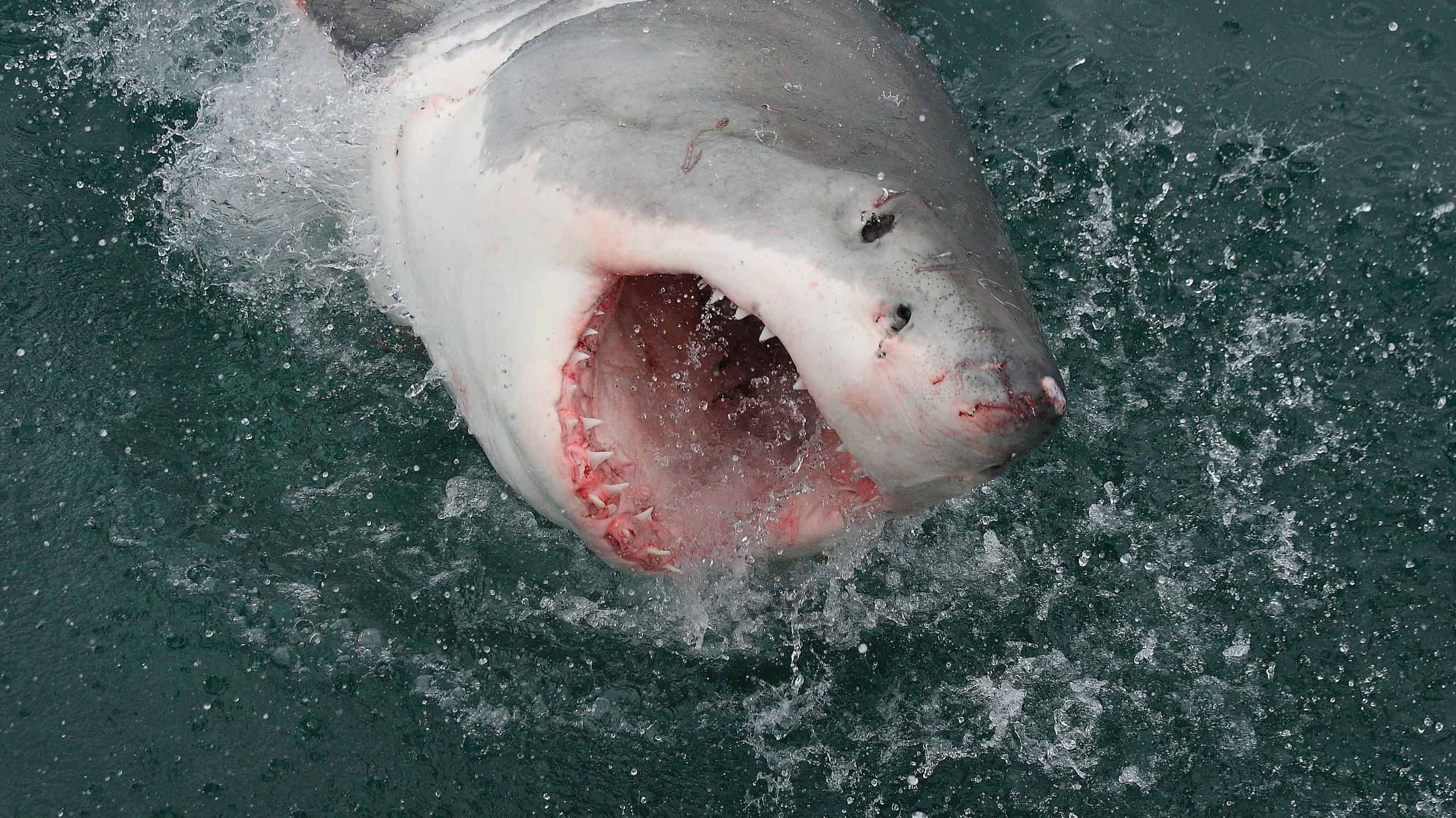
The eerie movie Jaws (1975) by Steven Spielberg was inspired by the dreadful reputation of the great white shark. It is the only living shark species in the genus Carcharodon, and it belongs to the family of mackerel sharks, Lamnidae. Florida waters are home to more than 50 shark species, and the great white shark forms an important part of the marine ecosystem.
At an average length of up to 15 feet (sometimes more), it is undoubtedly the largest, most powerful, and most dangerous predatory fish on Earth! How big are the largest individuals of this species ever encountered in Florida waters? The great white shark’s size is unbelievable.

What is the largest great white shark in the world? Let’s find out.
How to Identify Great White Sharks
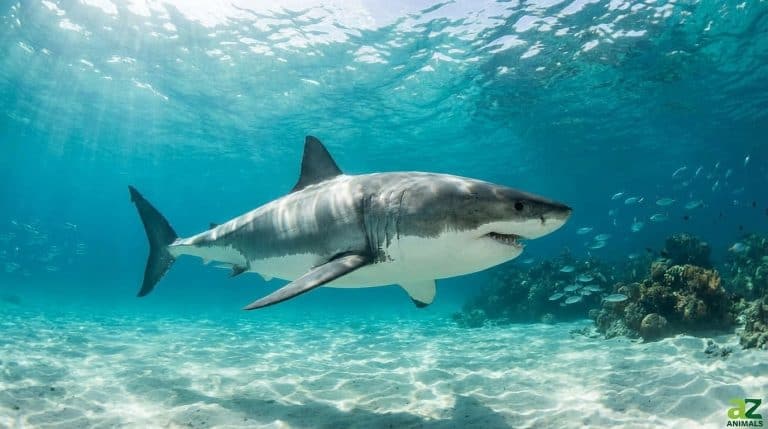
Noted for its formidable size, the great white shark is hard to miss. This species is named for its white underside and gray upper body. The darker shade of its back blends with the sea from above; in contrast, it displays a slight silhouette against sunlight from below.
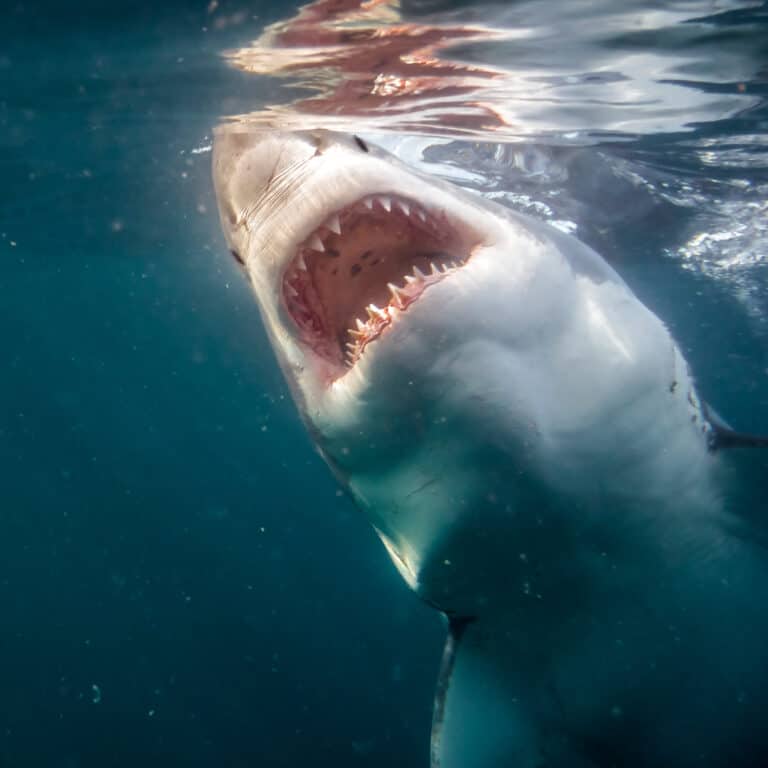
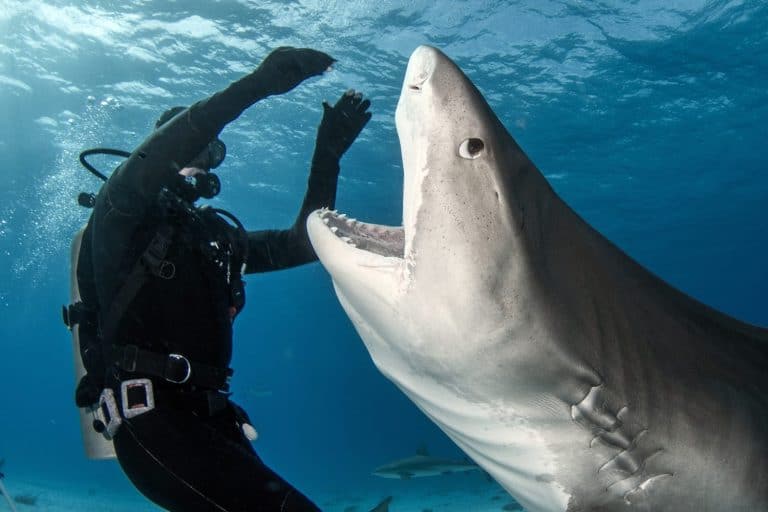
Like many other sharks, a great white shark’s mouth has up to 300 serrated teeth arranged in several rows. Compared to other shark species, they have larger eyes in proportion to their body size, with the iris of their eye being deep blue instead of black. This huge shark has a robust, large, conical snout and an exceptional sense of smell to detect prey.
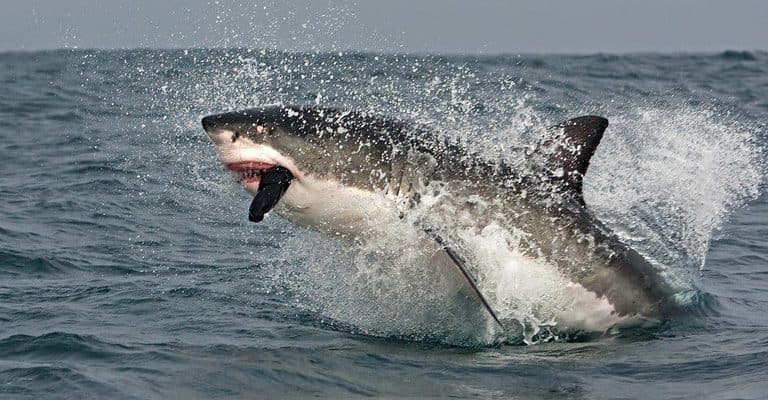
Great whites are torpedo-shaped excellent swimmers with powerful tails that can propel them through the water at a speed of up to 35 miles per hour.
Where Do Great White Sharks Live?
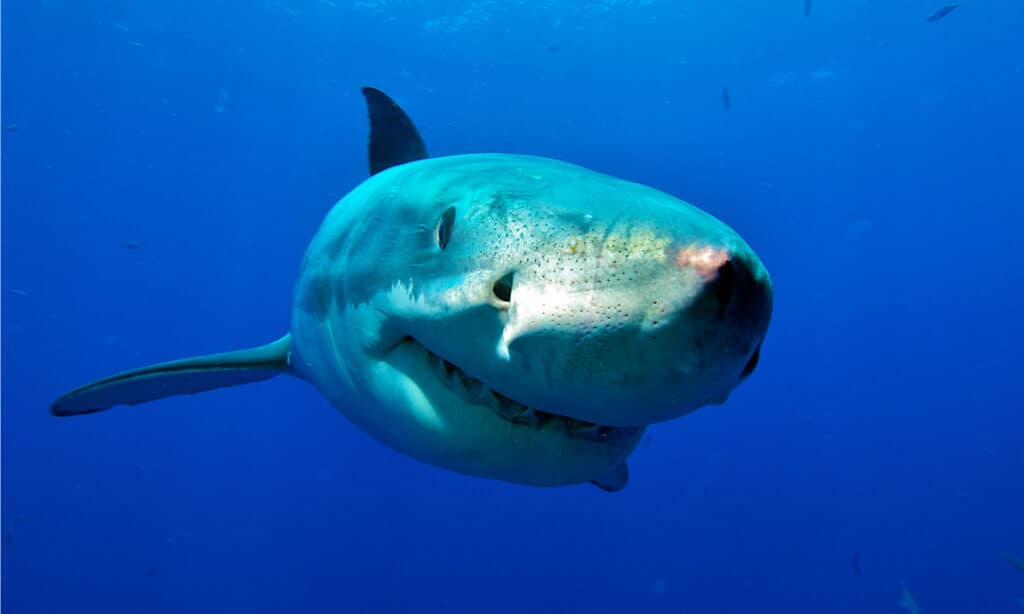
A large concentration of great white sharks can be found around Dyer Island in South Africa.
©Stefan Pircher/Shutterstock.com
The biggest great white sharks are found in almost all coastal and offshore waters with temperatures between 53.6 and 75.2°F (12 and 24 °C). They can live in both sub-tropical and temperate waters and are also known to move closer to the shores during the spring and summer seasons, making April and October the months of the highest shark activity.
The great white shark is an epipelagic species, therefore it’s spotted mostly in favorable feeding environments close to coastlines where there’s a large prey population, such as seals and sea lions. Larger populations of this species are found in the United States, especially in the northeast and California, Japan, South Africa, Chile, Oceania, and the Mediterranean.
A large concentration of great white sharks — perhaps one of the largest ever known — can be found around Dyer Island in South Africa.
How Big Are Great White Sharks?
True to their name, great white sharks are gigantic creatures. The great white shark’s size varies according to gender. Females are generally larger than males, on average, measuring 15 to 16 ft (4.6 to 4.9 m). Meanwhile, males are 11 to 13 ft (3.4 to 4.0m) long.
Great white sharks are also heavy-bodied. While mid-sized adults often weigh between 1,151 – 1,700 lb (522-771 kg), large mature females can easily exceed 4,000 lbs (1,800+ kg).
The Largest Great White Shark Found in Florida Waters
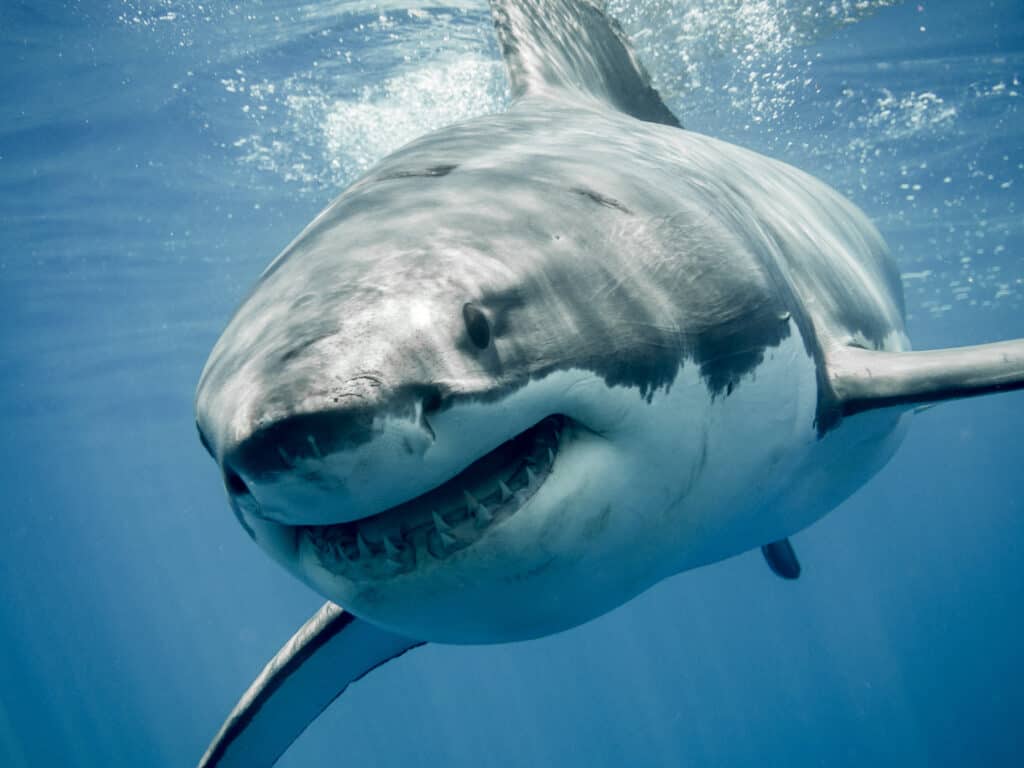
The largest great white shark pinged off the Gulf Coast of Florida waters was an individual named Scot, weighing up to 1,644 pounds.
©Ramon Carretero/Shutterstock.com
Florida waters are home to much marine wildlife. From the bull shark and dolphins to a variety of turtles, this coastline has a vast array of creatures both large and small but nothing can compare to the largest shark found in these waters, the great white.
What is the largest great white shark found in Florida waters? OCEARCH is a non-profit group that collects data on sharks by ‘tagging’ them in the ocean so that when a geo-tagged shark swims close enough to the surface of the water, its tracker will “ping” to disclose its location.
What is the largest great white shark found in Florida waters? OCEARCH is a non-profit group that collects data on sharks by ‘tagging’ them. According to OCEARCH, various massive great whites have been spotted off Florida waters, including:
- Nukumi: A massive female measuring 17 feet 2 inches and weighing 3,541 pounds. She is one of the largest sharks ever tagged by OCEARCH and has been tracked in the waters off the Florida coast.
- Unama’ki: Another legendary female weighing over 2,000 pounds and measuring 15 feet 5 inches, who was tracked visiting the Florida Keys and the Gulf of Mexico.
- Scot: A male weighing 1,644 pounds and measuring 12.3 feet in length, pinged off the Gulf Coast in March 2022.
- Breton: Located about 13 miles off Port St. Lucie on June 6, 2022, weighing 1,437 pounds and about 13 feet long.
- Sable: An 11.5-foot-long great white shark found along Florida’s coast, weighing approximately 900 pounds.
Florida Beaches With the Most Shark Attacks and Sightings
Florida is known for its numerous beaches along the Atlantic Ocean and Gulf of Mexico. Among these beaches, there are five that have experienced the highest number of shark attacks.
Topping the list is New Smyrna Beach, located in Volusia County, with close to 200 recorded shark attacks since 1882. However, it is important to note that most bites in this area are from smaller species like blacktip sharks, not great whites.
Daytona Beach, also in Volusia County, follows with about 46 shark attacks. Ponce Inlet, a small town with a population of just over 3,200, has had nearly 40 shark attacks. Cocoa Beach in Brevard County has recorded over 30 shark bite incidents, while the Florida Keys, part of Monroe County, have seen more than 20 shark attacks.
Despite these numbers, the likelihood of encountering a shark — especially a great white shark — and being bitten is extremely low, and it shouldn’t deter visitors from enjoying Florida’s beautiful beaches.
What is the Largest Great White Shark Ever Recorded?
The largest great white shark ever documented in the history of the world is a female shark named Deep Blue, in reference to her majestic beauty. She is estimated to be nearly 20 ft long and weigh approximately 4,500 to 5,000 pounds. Researchers believe Deep Blue is about 50 years old. Because great whites can live up to 70 years or more, she could potentially live for several more decades.
Another legendary shark was caught off Canada’s Prince Edward Island in 1983, measuring 17.2 feet (5.2 m) long. This one was listed as one of the world’s five most legendary sharks by the Discovery Channel.
Megalodon Vs. Great White
©Sammy33/Shutterstock.com
Great White Shark vs. Megalodon: Which is Bigger?
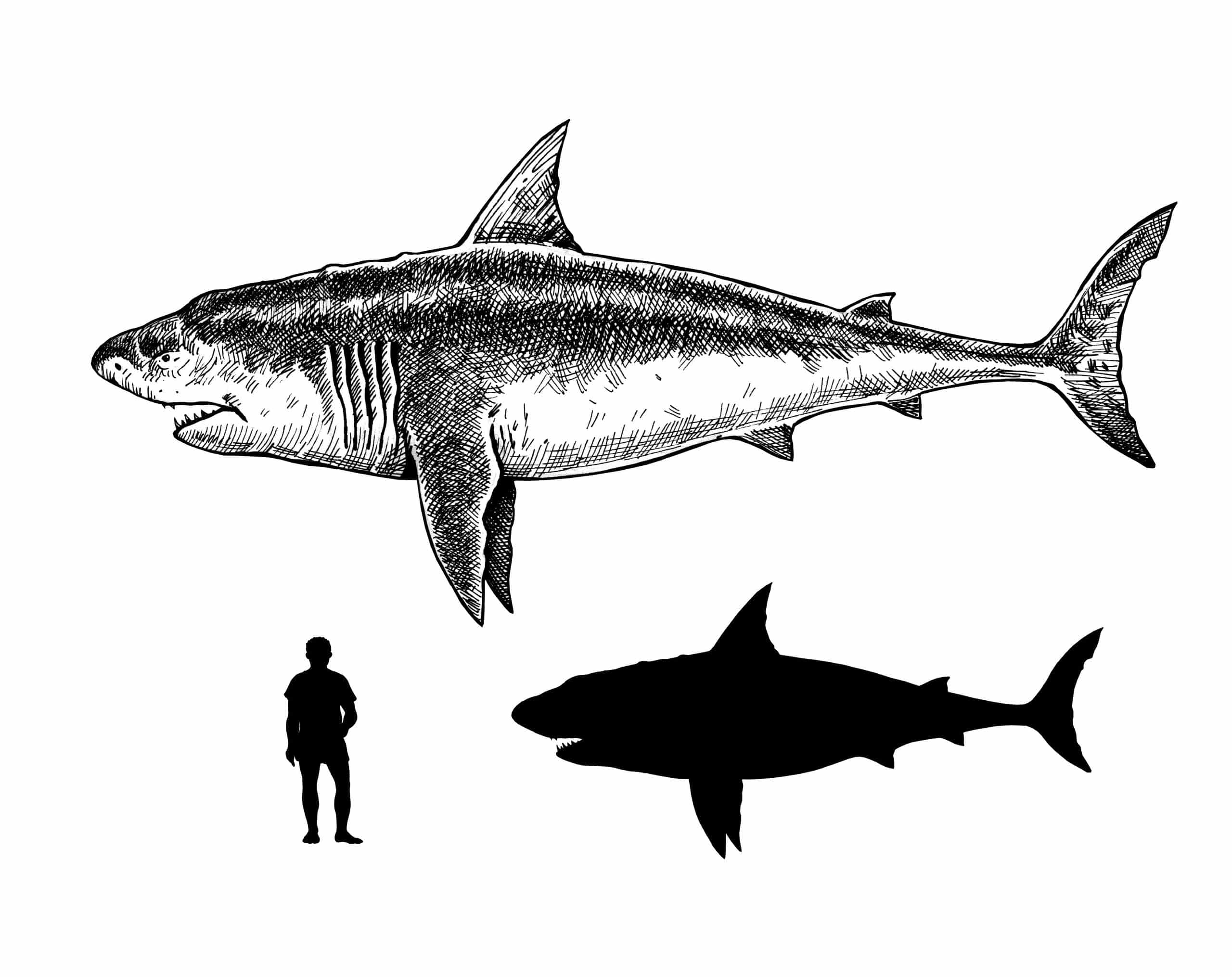
Even though Deep Blue is enormous, she is not the largest shark specimen in history. That title is held by the prehistoric Megalodon (Otodus megalodon). It lived approximately 2.3 to 3.6 million years ago. While often compared to the great white, scientists now believe it had a bulkier, more distinct body shape. It reached lengths of 50 to 60+ feet and weighed between 100,000 and 200,000 pounds.
The megalodon has also been described as having a single tooth the same size as a human hand and large jaws that could easily fit a whole person. Unlike the great white shark, which attacks prey from its soft underside, it uses its strong jaws to break through the chest and puncture the heart and lungs of its prey.
What Do Great White Sharks Eat?
The great white shark is currently considered the world’s largest-known predatory fish and is one of the primary predators of marine mammals, including prey as large as baleen whales. It also preys on other marine animals such as seabirds, seals, dolphins, and smaller whales. The biggest great white is an apex predator, whose only real predators are orcas.
Contrary to what was depicted in the popular novel Jaws by Peter Benchley and its film adaptation by Steven Spielberg, great white sharks are not ferocious man-eaters.
Do Great White Sharks Attack Humans?
Despite their fearsome reputation, great white shark attacks on humans are rare because humans are not their preferred prey. But of all shark species, the great white shark is responsible for the highest number of recorded human shark bite incidents, both non-fatal and fatal – about 333 documented unprovoked bite incidents on humans today, most of which were non-fatal. Nevertheless, there have been 52 fatal bite incidents. Most deaths were caused by victims losing blood from the initial shark bite rather than from whole consumption by great whites or critical organ loss.
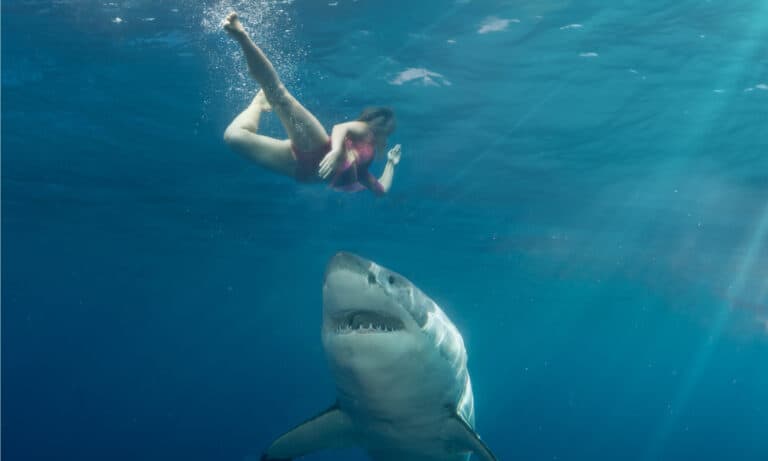
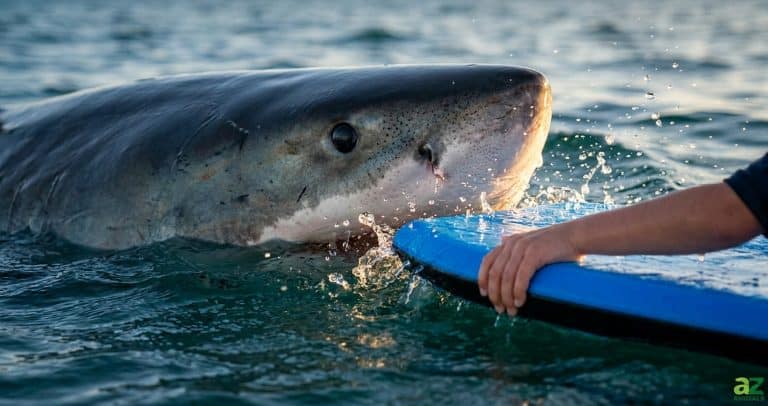
Many great white shark bite incidents are often the result of a “test bite” or “exploratory” bite. This species test-bites an unfamiliar object to identify what it is, so this may cause it to grab a human or surfboard that comes its way. Bites may also occur due to low water visibility or other situations that may distort the shark’s senses. In actuality, research has shown that because great white sharks prefer prey that is fat and rich in protein, like seals, humans are too bony for their liking and not considered worth predating on.
Great White Shark Lifespan
Recent scientific research has estimated the lifespan of great white sharks to be as long as 70 years or more, making this species one of the longest-lived cartilaginous fishes. In addition, research also shows that while male great white sharks take 26 years to reach sexual maturity, females take 33 years.
Great white shark pups are born between 2 and 12 at a time. While still young, these shark pups are mostly able to eat fish and small crustaceans. It’s only after they are fully grown that they are able to take down the large aquatic game that mature great white sharks are known for devouring.
Are Great White Sharks Endangered?
According to the IUCN, very little is known about the great white shark’s actual status or population numbers. However, this species is listed as “vulnerable,” just one step away from being endangered. Great white sharks have suffered a significant population decline from the 1970s until now, and the biggest threats are indiscriminate sport fishing and accidentally getting caught in fishing nets. The great white shark is included in Appendix II of CITES, meaning that international trade of the species requires a permit.