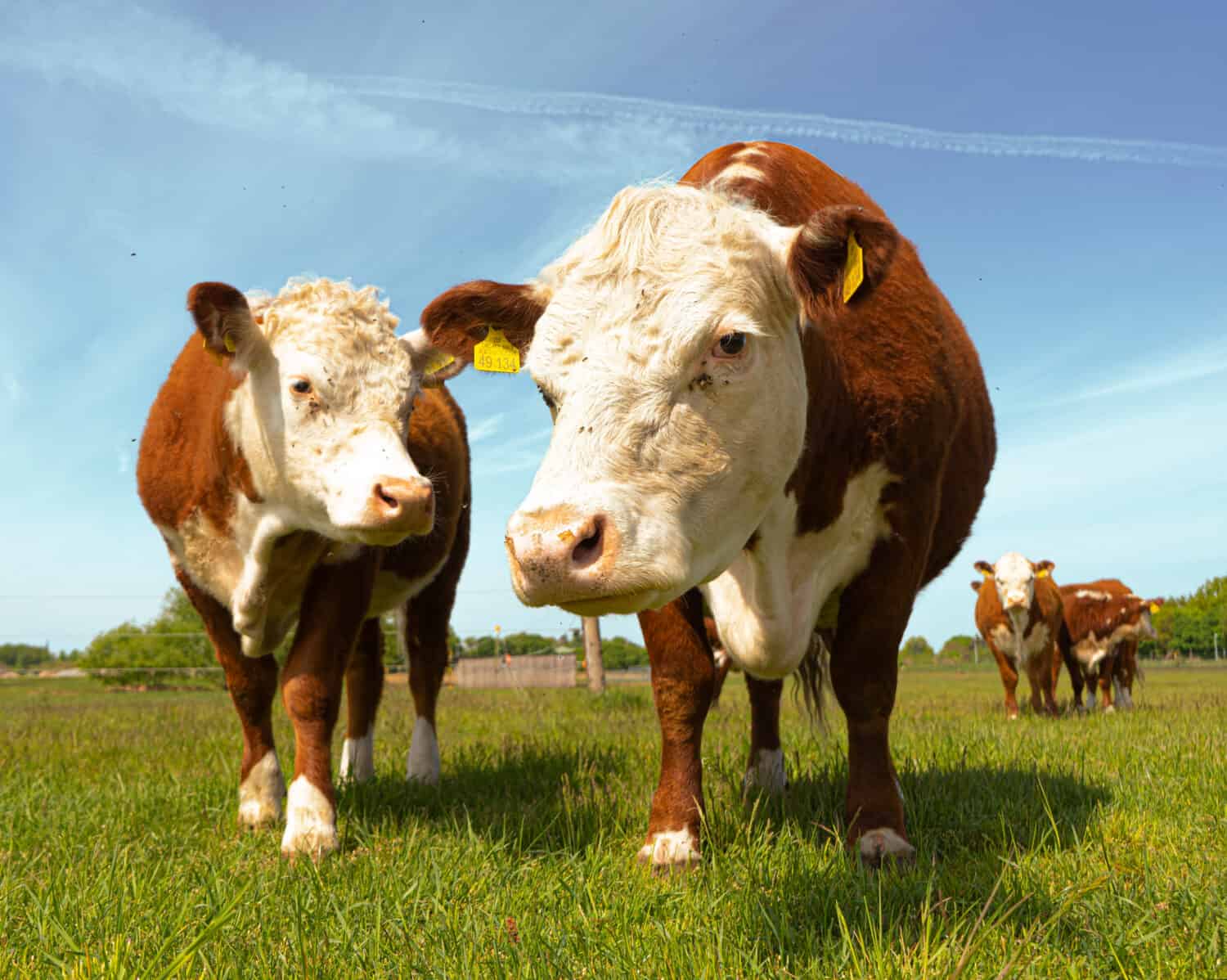

Have you ever been driving down a country road and noticed a cow with incredibly eye-catching colors? There are many, many kinds of cow colors across their breeds. In this article, we’ll be covering some of the most common and rare types — there may be a few medium ones that slip through the cracks! Regardless of those, this guide is meant to be as comprehensive as possible so that you can become as informed as possible about the many visual differences between cow breeds.
What Influences the Coat Colors of Cows?
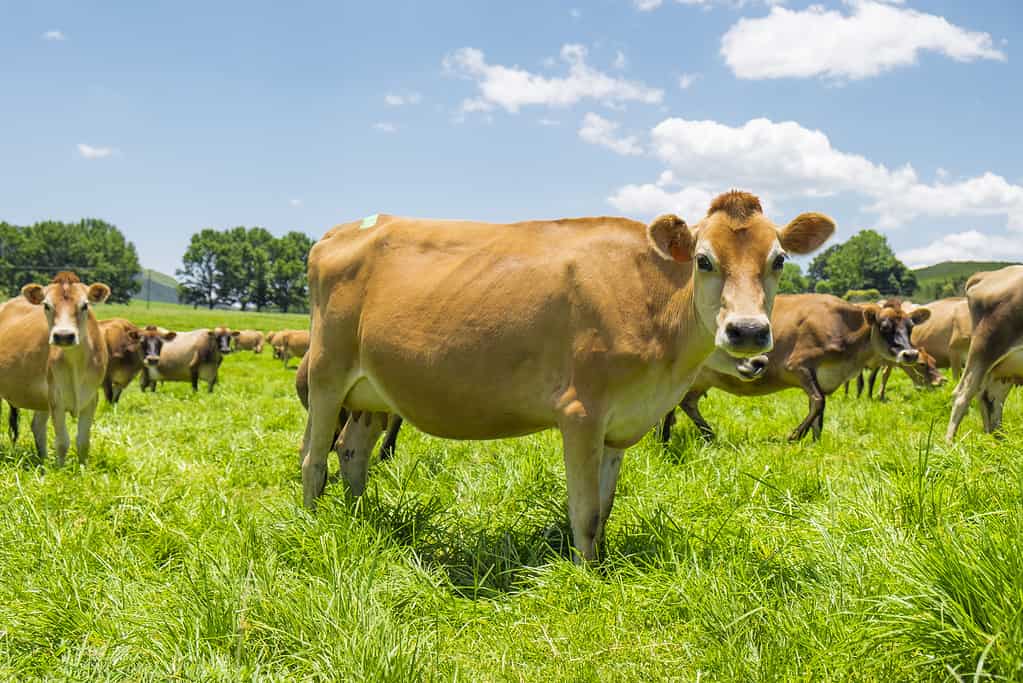
The primary influence behind the color of a cow’s coat is genetics.
©Cameron Watson/Shutterstock.com
There are dozens upon dozens of cattle breeds, each with their own distinct set of characteristics. And each, of course, has its own coat color. But how do these coat colors emerge? What factors create new tones and shades, and how does genetics play a role? Let’s get into it.
Every cow’s coat color is determined by its genetic makeup. Just as genes determine human hair and eye color, they dictate the shade and pattern of a cow’s coat. These genes come in pairs, with one inherited from each parent. Depending on the dominance or recessiveness of these genes, various cow colors can emerge (say that five times fast)!
While traditional breeding and genetics play a significant role, mutations are nature’s wildcard. Occasionally, spontaneous changes in genes can result in entirely new and sometimes unexpected coat colors. These genetic mutations can be passed on to the following generations, leading to the development of new color variations over time.
That said, the environment the cows are raised in can also play a role in how their colors turn out and are passed on. This means things like nutrition, sunlight, and weather can actually impact the physical appearance of a cow’s coat. For example, if a cow is in a colder climate, it might develop quite a thick coat.
Common Cow Colors
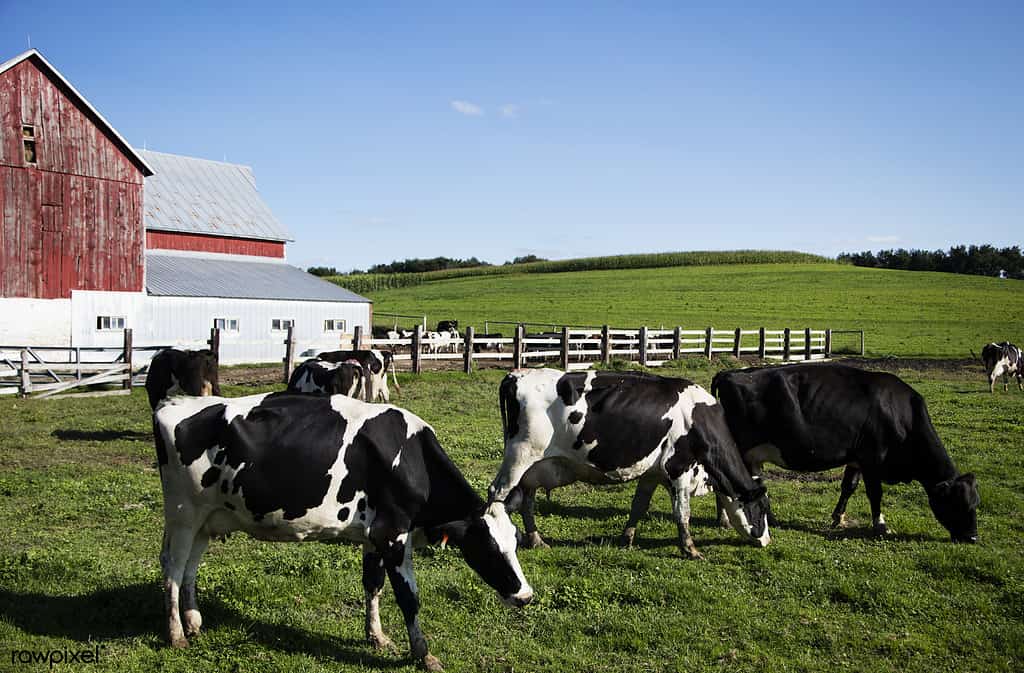
One of the most common cows are Holsteins, known for their black and white spotted coats.
Generally speaking, cow coats can be broken down into three main colors: Black, red, and white. This means that nearly any breed and subsequent coat pattern is going to be a mixture of these three essential tones in some way. Of course, though, there are some breeds that are far more common than others. Before we go into the uncommon and rare types of coats, we should run through the basics. Here are some of the most common coats!
Holstein: Black and White
Holsteins are easily recognizable with their distinctive black and white spots. These patches can be large or small, and no two Holsteins have the same pattern. Although they’re originally from the Netherlands, Holsteins are now the most popular breed in the U.S. for dairy farming. The reason Holsteins are so sought after by farmers is that they have incredibly high rates of quality milk production.
Angus: Black or Red
Angus cattle come predominantly in two colors: solid black or red. Usually, Black Angus is more common than Red Angus. Angus cattle are now commonly spotted worldwide, but they’re originally from Scotland. These cows have become renowned for the quality beef they produce. In fact, they are usually marketed as a premium product.
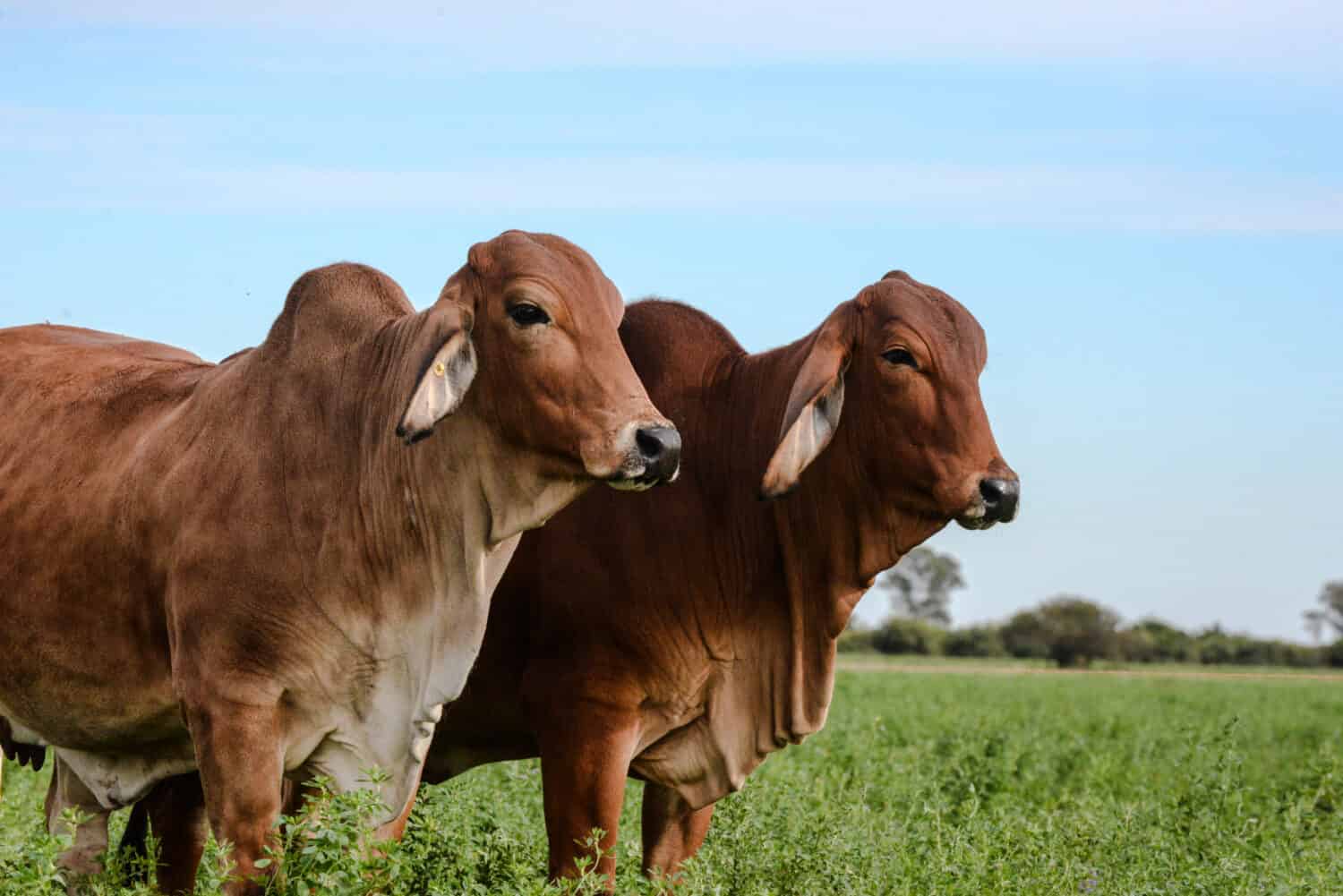
A Brahman cow has floppy ears and a hump among its distinguishing characteristics.
©mifotodigital.club/Shutterstock.com
Brahman: Light Grey to Almost Black
Brahman cattle have a distinct hump over their shoulders and large, floppy ears. Their color can vary from a light grey to a deeper, almost black shade. Since they’ve been bred to be resilient toward hot temperatures, you can usually find Brahman cows in areas with tropical climates. Bred in the US, they were developed from Indian breeds.
Friesian: Almost Always Black
Friesians have a nearly solid black coat, with sometimes a white face or minimal white markings. They hail from the same country as Holsteins (the Netherlands) and are also known for their ability to produce quality milk. Despite their similarities, though, they are two distinctly different species!
Jersey: Light Brown to Dark Fawn
The last of our common cows, Jerseys, are smaller dairy cattle with a distinct light brown to dark fawn coat. Their faces often have a white muzzle, and their eyes are usually encircled with a white band, giving them an expressive (and adorable) appearance. Native to the Channel Island of Jersey, these cattle are now globally recognized for the quality of their milk! Their creamy milk is high in butterfat, and the cows themselves have a very calm demeanor, making them a common choice for farmers.
Uncommon and Rare Cow Colors
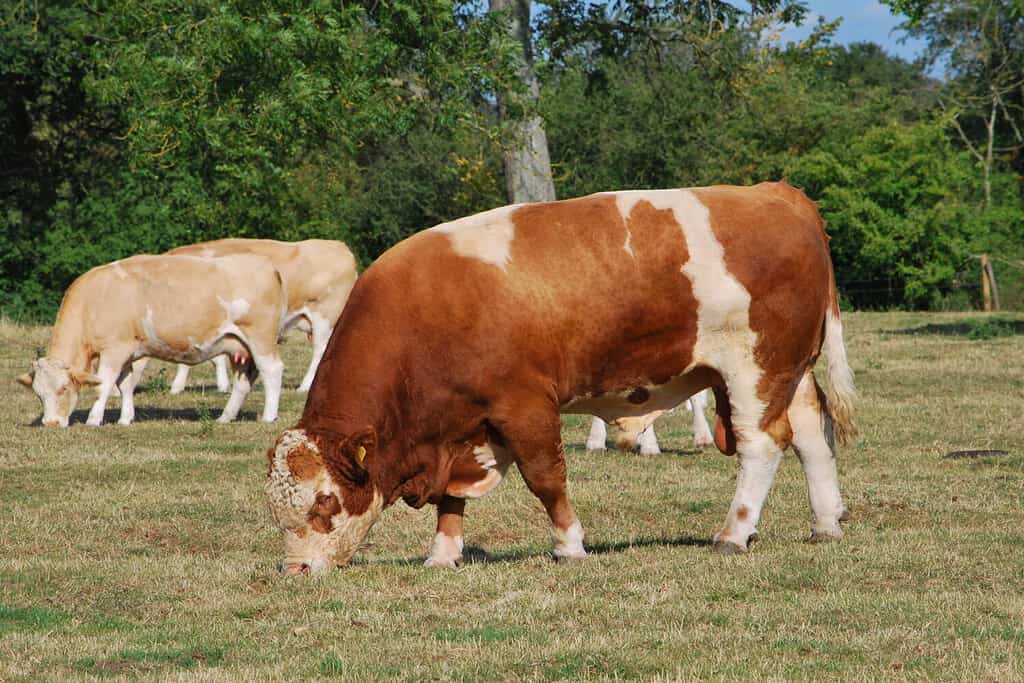
Simmental cows have an uncommon red and white coat.
©wolfman57/Shutterstock.com
Now that we’ve covered all of the common cow colors, we can finally get into the rare ones! Below are five of the most rare/uncommon coats for cows, alongside the breed they belong to. They’re arranged in ascending order, from least rare to most rare! You might be shocked at some of the cows listed, so be sure to read until the end.
Charolais: White
Charolais cattle are recognized for their creamy white to straw-colored coats. They have a muscular build with a blocky appearance, which gives them a reputation for being pretty strong. Though they’ve become popular worldwide, they hail originally from the Charolles area of France. While their color might seem delicate, Charolais are known for their combined fast growth rate and high meat yield.
Simmental: Red and White
Simmentals have a mix of red and white on their coat, which can vary from pale gold tones to a darker rust. The distribution of these shades varies from cow to cow, with very few sharing the same pattern. These cows originate from the Simme Valley of Switzerland and are among the oldest, most versatile cattle around! Their history dates back to the Middle Ages, and they’ve been crucial in both dairy and beef production. You can see the influence that their genes have had on many modern cow breeds.
Ayrshire: Red and White
At first glance, Ayrshires might resemble Simmentals with their red and white coat. But don’t be fooled because the red in Ayrshires often appears in more distinct patches. The shades can also vary from a light orange-red to a deep mahogany. As the name suggests, Ayrshire cattle come from Ayrshire in Scotland. Over the years, they’ve spread to other parts of the world, especially areas with heavy amounts of dairy farming.
White Park: White with Black Points
White Park cattle are mostly white but have distinct black points – notably on their ears, nose, feet, and the tips of their horns. These long horns have an upward curve, making them very distinguishable. They’re believed to have British roots, and they’re linked to several old cultural traditions and rituals.
Vechur: Dwarf Cattle With Unique Coloration
Our final rare cow color is that of the Vechur, a kind of dwarf cattle. In fact, they’re known as one of the smallest types of cattle in the world. They have unique coat colors that can range from light grey to black, and some even have spotted patterns. They are native to the state of Kerala in India, and despite facing near-extinction in the past, they have bounced back due to conservation efforts!
How the Coat Colors of Cows Impact the Farm Industry

Understanding different cow breeds and coat colors can be very helpful for farmers.
©Alena Mozhjer/Shutterstock.com
There are a few ways in which cow colors and their respective breed identifications, can directly impact the farming industry. Firstly, different breeds of cows have different functions. They can be bred to have, for instance, particularly high milk production. When farmers can use things like coat color to identify these high-value breeds, it helps their business.
Modern tagging is helpful, but there’s nothing better to identify a cow than a glance at a unique color pattern. If there is a distinct coat color, then they’re much easier to recognize from a distance. Oddly enough, having an understanding of a cow’s coat can help in managing their health. Certain coat colors and patterns might be more prone to specific health issues or skin diseases. Being aware of these can help in early detection and treatment.
The other way that color specifications can help farmers is the marketing aspect. You see, some people associate different cow breeds/colors with quality. Angus cows, for example, are believed by the public to have better meat. The imagery of cows, especially those with distinctive coat colors, can be effectively used in promotional materials and help attract audiences. It might sound silly, but people enjoy associative patterns. Linking a certain colored coat with a certain product can help with its sale!