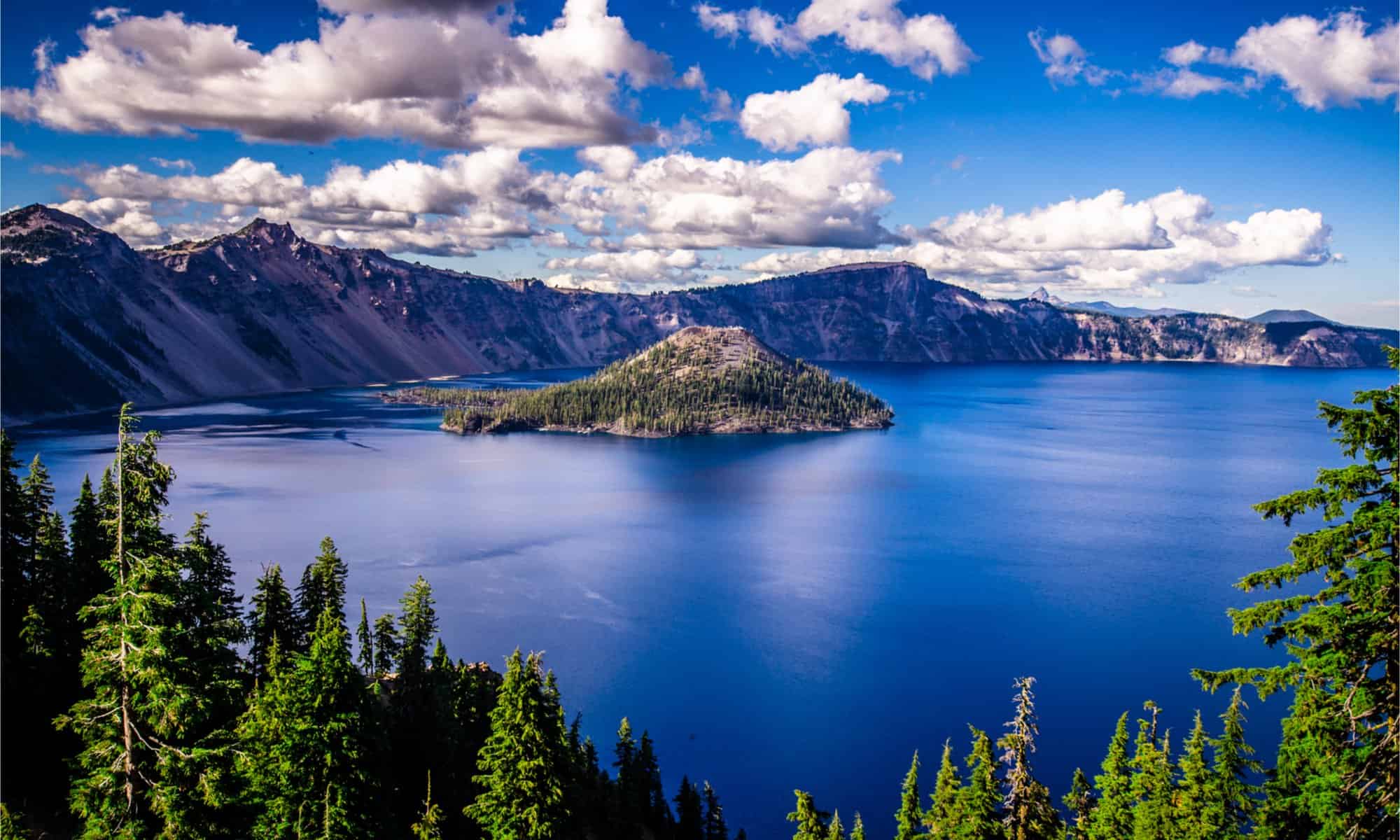

Imagine 4.6 trillion gallons of water in one big bowl, 4,000 feet deep. Add 20 to 70 feet of snow every year, in and around the bowl. Is it any wonder the deepest lake in the United States is a national park? Crater Lake is not only the deepest lake in the country (nearly 1,950 feet), but it is also one of the cleanest. The Crater Lake Institute reports, “It’s not pure water, but it’s close…with no sediments, algae, pesticides, or pollution.”
Crater Lake’s unique geography in the caldera of a collapsed volcano protects it from many pollutants, in part because no waterways feed into the lake. As visits to national parks grew during the COVID-19 pandemic, Crater Lake became increasingly subject to human-caused pollution. A special designation established in 2021 will allow for more protection moving forward.
Causes of Water Pollution in Lakes
Pollution in lakes and rivers can come from any number of sources, including warm water (a threat to species living there), contaminants (like e. coli or nitrates), algae blooms, and invasive species introduced via contact with boats that have visited other waterbodies. Crater Lake is famous for its clarity, in part because many of the above pollutants are not present. The clarity of a lake signifies, in part, how clean that lake is.
Lake Baikal in Russia (the deepest lake in the world) and Oregon’s Waldo Lake are other significantly clear lakes. Contrast this with Oregon’s Upper Klamath Lake, which has struggled with pollution for 50 years or more. Seasonal algae blooms release microcystin toxins that threaten both drinking water and recreational users. These toxins harm primarily the liver, but can also affect the reproductive system and the kidneys.
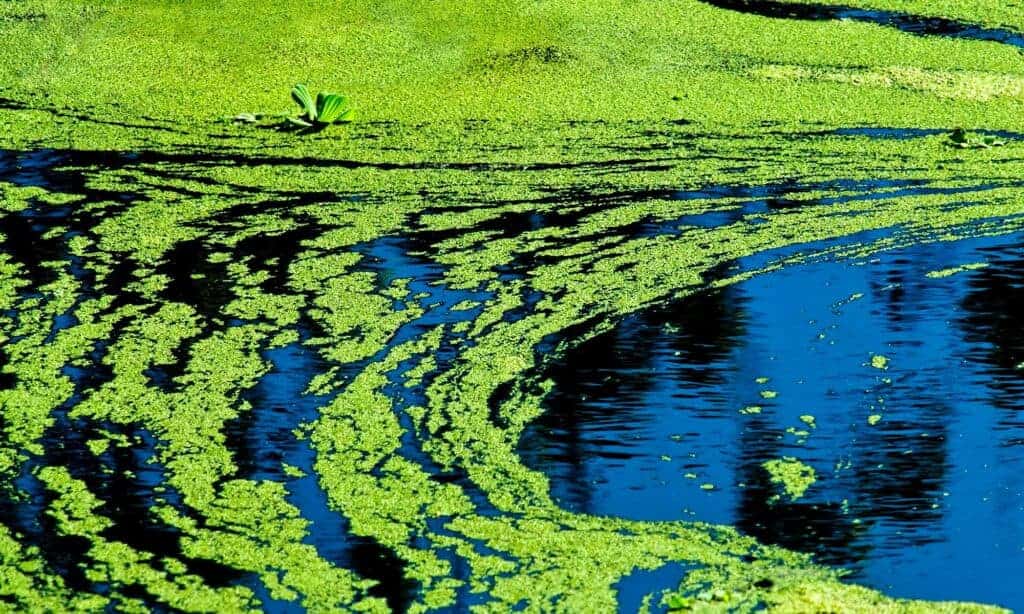
Blue-green algae, or cyanobacteria, is a form of water pollution that is toxic to humans and pets.
©iStock.com/Alexlky
History of Pollution Concerns at Crater Lake
A man got hepatitis from water he drank at Crater Lake in 1975, but the problem was in the drinking water system, not the lake. In 1998, Crater Lake created a new fuel line to provide gasoline for tour boats that take visitors to Wizard Island. There had been a concern about potential pollution from the previous fueling system. This system involved a storage tank on the lake’s rim and an exposed gasoline pipeline leading down to the dock.
Beyond those incidents, in 2010, a car fell into Crater Lake when the driver did not set the emergency brake. No car had fallen into the lake since 1922. Amazingly, the car in the lake did not cause much pollution. The gas tank was only half full, and a helicopter removed the sections of the car from the lake within days.
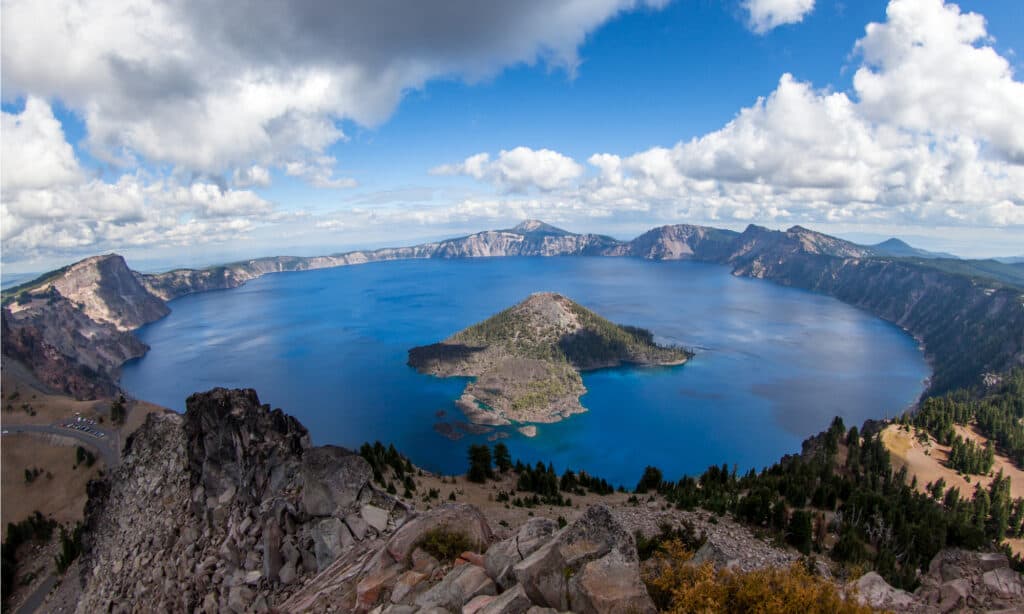
You can take a tour boat out to Wizard Island in Crater Lake
©Tami Freed/Shutterstock.com
What Important Legislation Was Created to Protect Water Quality?
Nationwide Legislation — Federal Clean Water Act (FWCA)
1972’s Federal Clean Water Act (FCWA) aimed to ensure fishable and swimmable waters nationwide by 1983. Advocates boldly promised the complete elimination of pollution in all navigable waters in the country by 1985. The FCWA provided for investments in wastewater treatment plants. It also required regular reports on the condition of every state’s rivers, streams, and lakes.
In Oregon, these “Integrated Reports” involve collaboration between multiple state agencies. The Department of Environmental Quality (DEQ) and the state Laboratory and Environmental Assessment Division partnered on Oregon’s 2022 Integrated Report. The DEQ funds water infrastructure projects and water-quality activities. Requiring states to report on their water quality every two years should yield accountability. Any waterbody that does not meet the standards set forth by the FCWA is added to a “List of Impaired Waters.” If your waterways are on that list, you must make a plan to improve water quality.
Oregon’s Impaired Waterways
Any body of water is considered impaired if it is too polluted for swimming, recreation, aquatic life, fish consumption, or safe drinking. The Environmental Integrity Project — a Washington, D.C., nonprofit — published a report in 2022. It said Oregon has the worst pollution in the country for aquatic life to survive. Oregon was also second only to Indiana for having rivers and streams impaired for swimming and recreation.
When we look at waterways “impaired for any use,” Oregon has twice as many miles of impaired rivers and streams as second-place California. Oregon’s lakes are considered 97% impaired for any use. Designated uses for lakes are water-contact recreation, public drinking water, and fish consumption.
What Influences Impaired-Waterway Status?
The Potomac River benefited significantly from the FCWA. “Today, fishing tournaments, kayak rentals, and waterfront restaurants are now common along Washington’s waterfront,” notes the Environmental Integrity Project report. “A half-century ago, there were fetid algae blooms and lifeless waters.” Farther west, the successes of the FCWA are less clear. This may relate to how many bodies of water there are in any state. More waterways mean more chances to be listed as impaired.
How sweeping the pollution legislation is in each state also affects designations of impaired waterways. If any pollution advisory is statewide, all lakes and waters in that state are listed as impaired for fish consumption. Mountainous states in the Pacific Northwest, including Oregon and Washington, have comparatively high rain and snowfall levels. The very water that makes Oregon such a place of beautiful lakes and rivers, however, also carries pollution into those waterways.
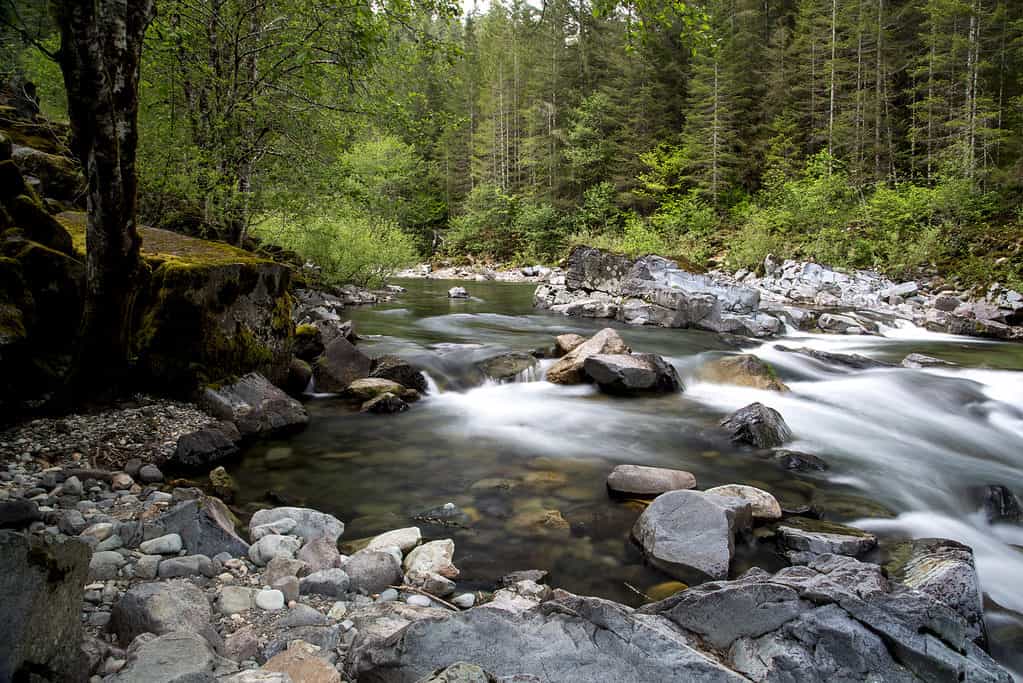
Oregon’s beautiful waterways, like Quartzville Creek, can carry pollutants from place to place
©Bureau of Land Management Oregon and Washington / CC BY 2, Flickr – Original / License
Statewide Measures to Address Water Pollution
Point and Nonpoint Sources of Pollution
Pollution may originate in “point sources,” where pollution is linked to one place. It may also come from “nonpoint sources,” where pollutants are carried from place to place. Oregon regulates point sources of pollution (e.g., wastewater and stormwater drains) through a permitting system. This sets “allowable discharged concentrations” of pollutants.
Oregon’s nonpoint pollution sources, DEQ says, “Are often linked with agricultural, forestry, urban, and rural residual land-use activities where rain and snow runs [sic] off to surface waters. As the runoff moves, it picks up and carries away natural pollutants and pollutants resulting from human activity, finally depositing them into lakes, rivers, wetlands, coastal waters, and groundwater.”
Oregon is known for agriculture, forestry, and recreational outdoor activities; it is not surprising that pollution from these uses flows into state waterways. Oregon has a Nonpoint Source Management program and process. This will prevent and/or control nonpoint source pollution, according to the Integrated Report.
Water-Quality Strategy in Oregon
In 2021, Oregon’s DEQ established a three-year plan prioritizing several water-quality projects. In this plan, Crater Lake and Waldo Lake (a second very clear lake in Oregon) received designations as Outstanding Resource Waters. The supporting documentation notes, “Outstanding Resource Waters are high quality [sic] waters that constitute an outstanding state resource due to their extraordinary water quality or ecological values, or where special protection is needed to maintain critical habitat areas.”
Special protection in Crater Lake’s case might require the state to “limit activities that would degrade the current water quality.” Crater Lake is a state resource and also Oregon’s only national park. The National Park Service has its own program to monitor lakes for short- and long-term changes. This program recommends mitigation possibilities for any human-caused detrimental changes. Oregon DEQ has also set forth a vision and strategy for water quality out to 2035.