
If you are ever visiting the mountainous and beautiful state of Idaho, you can’t leave without sneaking a peak at the iconic bighorn sheep that call the state home. Sadly, this once abundant animal is in decline due to a pneumonia-like disease. Nevertheless, bighorn sheep remain of great interest to wildlife enthusiasts, tourists, and hunters.
For many hunters, bagging a bighorn sheep is a dream realized, but only a select few get the opportunity. Idaho Department of Fish & Game offers 98 controlled hunt tags each year (although the number of available tags is evaluated periodically, so it does change). These tags permit awardees to harvest one California and one Rocky Mountain bighorn sheep in their lifetime. There is an annual lottery and auction of two of the total tags available, and winners are exempt from the lifetime rule.
Since this is such an iconic animal in Idaho and the West, let’s learn more about the bighorn sheep and the largest bighorn sheep ever harvested in the Gem State.
About the Bighorn Sheep
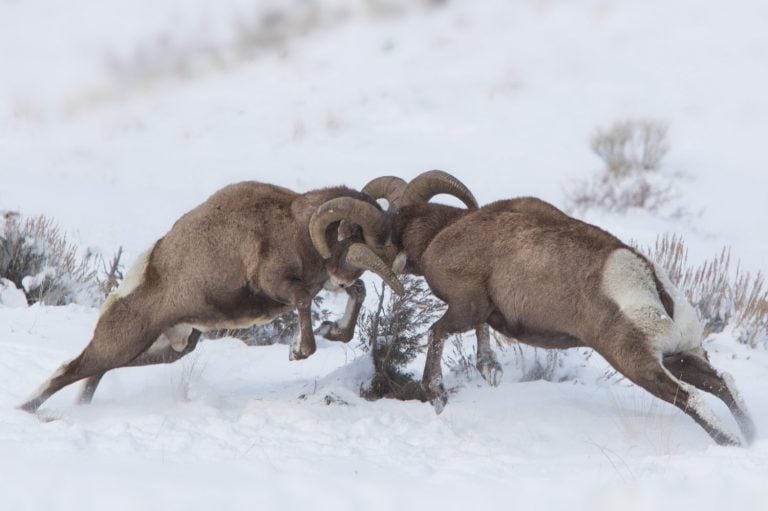
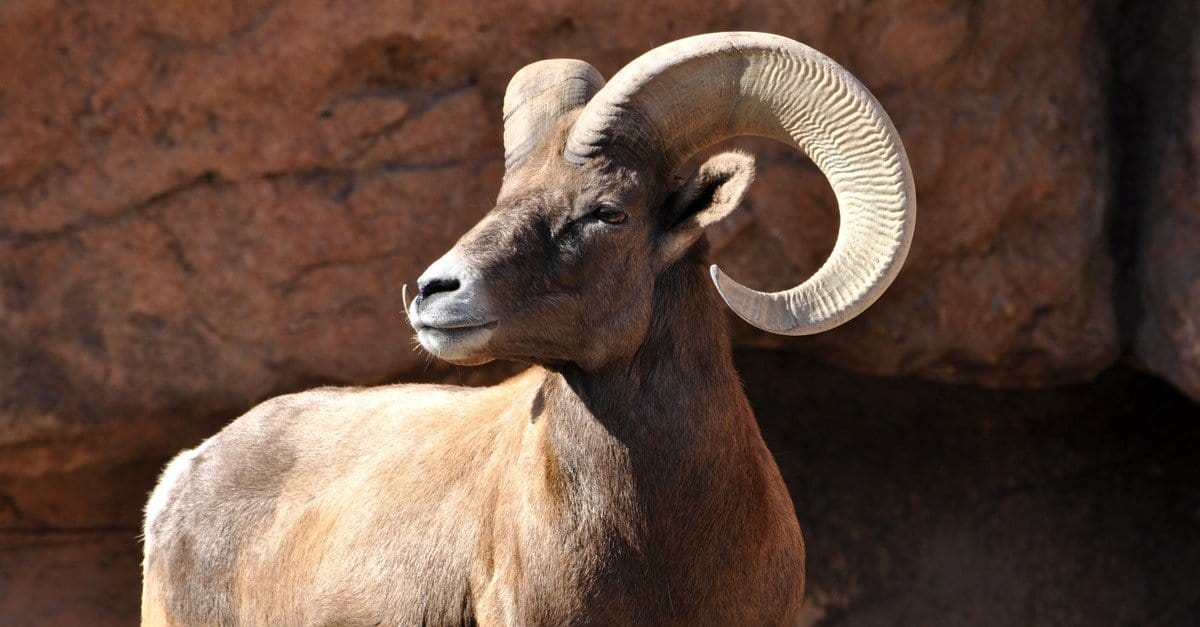
Bighorn sheep are native to North America. They get their names from their large horns. Bighorn sheep are thought to be originally from Siberia but crossed the Bering Land Bridge to North America. There are three subspecies, however, one is endangered. In North America, there used to be millions of bighorn sheep at its peak, however, now there are only thousands.
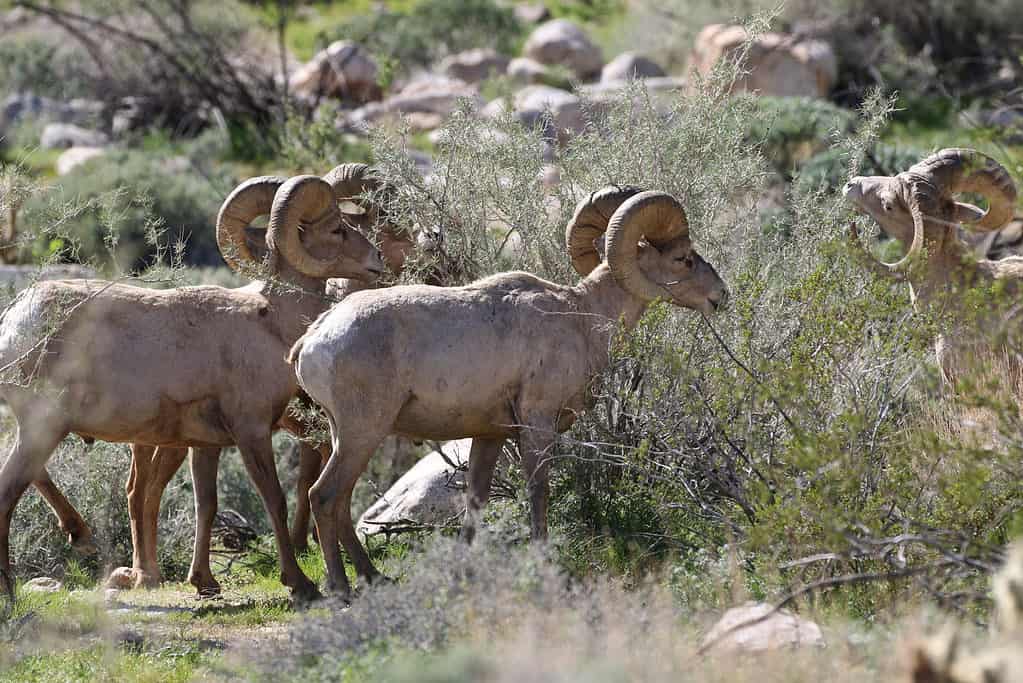
Bighorn sheep get their name from their large horns.
©Randy Bjorklund/Shutterstock.com
Appearance and Size
Male bighorn sheep have large curved horns, while female sheep have smaller horns with less curvature. Their coats are typically white, brown, or gray. Interestingly, male bighorns have adaptations that help them survive and withstand heavy impacts. Bighorn sheep range in size and weight, however, an average male bighorn sheep weighs between 128 to 315 pounds. While this is true, bighorn sheep living in the Rocky Mountains are larger than those living in Nevada, males can sometimes surpass 500 pounds. Female bighorn sheep are slightly smaller, weighing about 75 to 200 pounds. The smallest bighorn sheep by region is the Sierra Nevada bighorn, which barely weighs past 198 pounds.
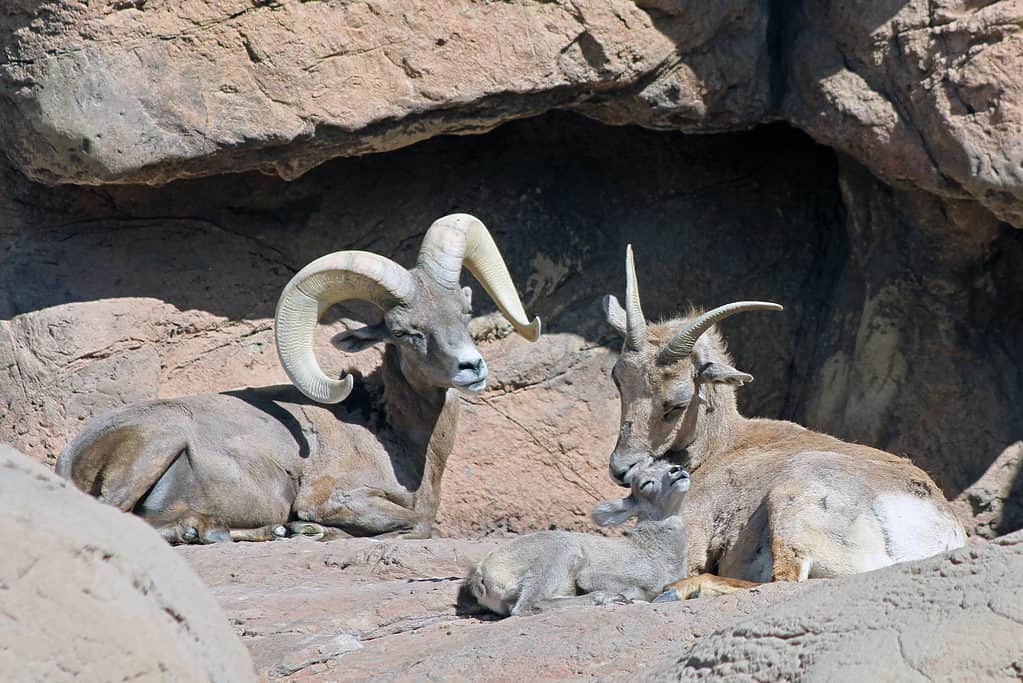
Male bighorn sheep have large curved horns, while female sheep have smaller horns with less curvature.
©iStock.com/Rainbohm
Diet
Bighorn sheep are grazers. They mainly eat grass and shrubs. However, the exact plants they eat vary from region to region. Still, during winter, bighorn sheep need more minerals and look for saltlicks. While female bighorn sheep graze, they also walk which protects them from predators.
Predators
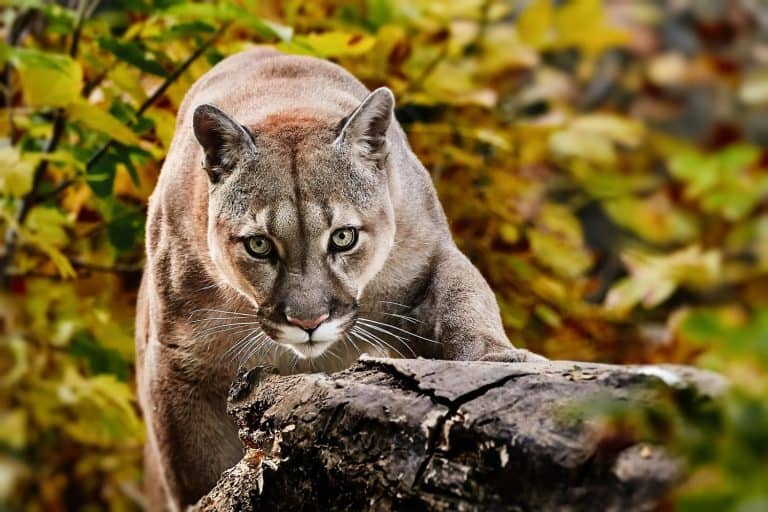
These mountain-loving sheep have many predators including black bears, grizzly bears, mountain lions, and wolves. However, young bighorn sheep are the most vulnerable to predators. These small sheep are hunted by coyotes, bobcats, golden eagles, lynxes, ocelots, and jaguars. When running and hiding from a predator, bighorn sheep climb steep terrain and look for hard-to-reach places.
The Largest Bighorn Sheep Ever Harvested in Idaho
How Records Are Calculated
In 1887, with growing concerns over the possibility of losing hunting privileges and wildlife populations such as bison and elk being hunted to the brink of extinction, Theodore Roosevelt and others founded the Boone and Crockett Club for the purposes of conservation and wildlife management. This group also sets guidelines for and maintains trophy hunting records for big game animals, including the bighorn sheep.
When it comes to determining what garners a trophy record for bighorn sheep, the focus is not on the body size or weight of the animal but rather on its horns. Measurements are taken of the individual elements on the horns:
- Greatest spread
- Tip-to-tip spread
- Length of both horns
- Circumference of the base of both horns
- Circumference of the first, second, and third quarters of both horns
These measurements are calculated according to a formula outlined on the score chart to provide a final score. A score above 180 is in all-time record territory.
Consequently, hunters do not always report an animal’s weight as it is not a factor taken into account by Boone & Crockett for the organization’s trophy hunting records.
The Largest Bighorn Sheep Ever Harvested in Idaho
In September 2016, Nez Perce tribe member Gary J. Sublett shot the record-setting bighorn sheep after a three-day hunt in Hells Canyon, a 10-mile-wide canyon on the Idaho and Oregon border. The score? A 201-5/8, a score that not only put him in the Boone & Crockett record books but also at No. 26 in Boone & Crockett’s U.S. and Canada list for largest Rocky Mountain bighorns.
Getting recognition in Idaho for the record has eluded Sublett, however. While the Boone & Crockett Club recognizes the record as legitimate, the State of Idaho does not. The state’s Department of Fish and Game says that “the ram was shot in violation of state hunting regulations.” The area where the beast was harvested had been closed to hunting by Fish and Game, but it is also within what is known as the tribe’s “ancestral lands.” Per an 1855 treaty between the Nez Perce and the federal government, tribe members retain rights to hunt and fish on the 7.5 million acres of land they ceded to the U.S. government, even though the current Nez Perce reservation is a fraction of that size today.
Idaho Fish & Game, of course, recognizes the treaty, but the reason for not recognizing the record boils down to the fact that hunts “have to be in accordance with our fish and game laws,” said Idaho Fish and Game spokesman Roger Phillips.
The Largest Bighorn Sheep in the World
The world record for bighorn sheep has a twist, too. Between 2016 and 2017, three of the world’s five largest Rocky Mountain bighorn sheep were found—yes, just picked up—on the largest island west of the Mississippi River in a landlocked state.
They turned up in Montana, Idaho’s neighbor to the east, on Wild Horse Island State Park, a 2,164-acre island on the western side of Flathead Lake, the largest natural freshwater lake west of the Mississippi River. Hunting is not permitted on the island.
The largest of the horns scored 216-4/8 inches. The other two were 209-0/8 and 205-2/8. The Montana Department of Fish, Wildlife & Parks owns all three horns.
Where Is Hells Canyon, Idaho Located on a Map?
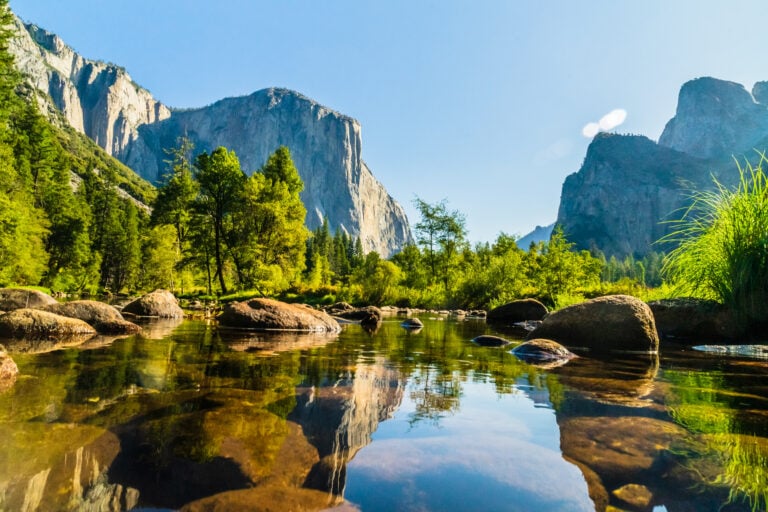
Hells Canyon, the deepest gorge in North America, forms part of the Idaho-Oregon border and is in the Nezperce and Payette National Forests area, which is in the northwest region of Idaho. Idaho is located in the Pacific Northwest region of the United States. It is bordered by Washington and Oregon to the west, Montana and Wyoming to the east, Utah and Nevada to the south, and the Canadian Province of British Columbia to the north.
Common Animals In Idaho
Idaho has one of the most diverse wildlife and environments in the United States. There are at least 300 species of animals and over 100 species of fish. Listed below are some of the most common animals in Idaho.
American Bison
American bison are found year-round in Idaho. They are very common in Yellowstone National Park. American bison are very large and look similar to buffalos. They can weigh between 880 and 2,800 pounds. American bison are also tall, adults stand at 6 feet and 7 inches. European bison are taller, but weigh less on average. These large animals are ruminants and eat a wide variety of plants.
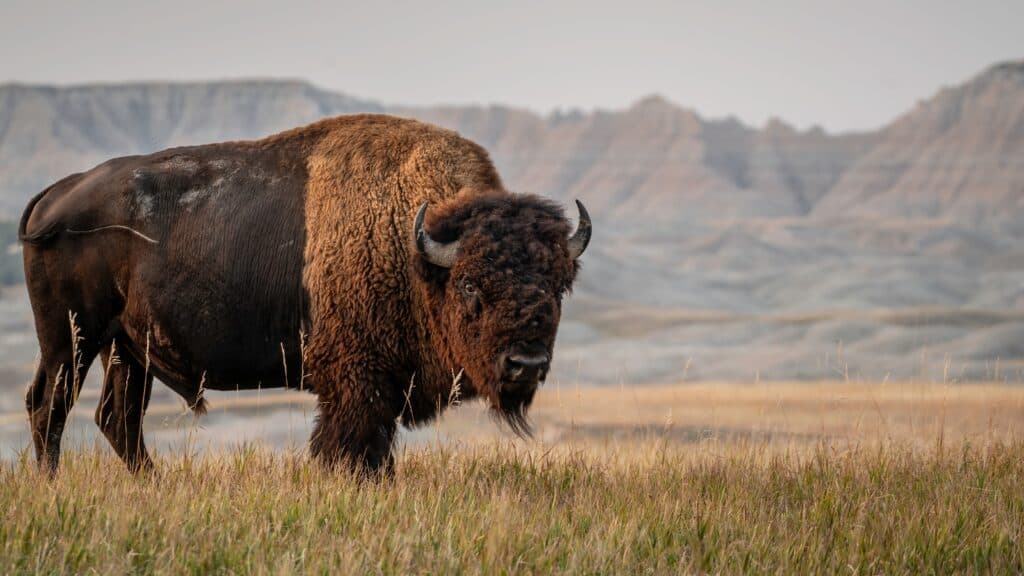
American bison are found year-round in Idaho and can weigh between 880 and 2,800 pounds.
©Tim Malek/Shutterstock.com
Common Yellowthroat
Common yellowthroats are pretty and small yellow birds. They are common in Idaho throughout spring. These tiny birds weigh about 0.34 ounces. They are nicknamed the yellow bandit and can be found from southern Canada to central Mexico. Common yellowthroats have many predators, frequently falling prey to other carnivorous birds. They are quick birds. Female common yellowthroats build their nests in 4 to 5 days. However, some yellowthroats have been observed building their nests in as little as 2 days.
Milk Snake
Milk snakes are one of the most common snakes in North America. There are about 24 subspecies. Many of these snakes are bright and colorful with rings or stripes around their bodies. Milk snakes are about 2 to 3 feet long. Some subspecies are taken as pets. In a controlled environment as a pet, they can live over 20 years. However, milk snakes have a 15-year lifespan in the wild. Milk snakes are nonvenomous, but often mistaken for copperheads or coral snakes.
Black-tailed Jackrabbit
Another common animal in Idaho is the black-tailed jackrabbit. They are the most common in the western United States and Mexico. Most black-tailed jackrabbits are about 2 feet long and weigh 3 to 6 pounds. While this might sound small, they are one of the largest North American hares. Black-tailed jackrabbits don’t migrate or hibernate. Instead, they stay in their homes all year round. They are quick and run from predators, but also have many predators, like hawks.