Quick Take
- An emu's kick looks almost comical, yet experts say there is good reason you should never underestimate it. See how dangerous kicks are →
- The sheep kept approaching after being pecked and kicked, and the reason it didn't care is more interesting than you'd expect. Find out why the sheep didn't care →
- Australia once deployed machine guns against emus, and the birds won. Read about the Great Emu War →
- Male emus have a parenting strategy so extreme that it costs them something surprising, and this is what makes them far more dangerous to approach. Discover their extreme parenting →
Some animals just don’t understand personal space. In this amusing encounter, a curious sheep keeps following an emu around, apparently determined to make a new friend. Unfortunately for the sheep, the towering bird doesn’t seem nearly as interested in the relationship.
As the sheep continues following, the emu turns and pecks at its head before lashing out with one of its powerful legs. But the sheep barely seems bothered. Instead of taking the hint, it continues hanging around the bird as though nothing happened.
The encounter makes for a funny video, but it also offers a glimpse at how emus can respond when another animal gets too close. These enormous Australian birds have powerful legs, sharp claws, and a defensive kick that shouldn’t be underestimated.
Watch This Emu Lose Patience With a Persistent Sheep
Watch the clip below to see the sheep repeatedly approach the emu and the bird’s increasingly physical response. Fortunately, neither animal appears to suffer any obvious injury during the encounter.
Why Would an Emu Kick at a Sheep?
Although it’s tempting to interpret the emu’s behavior as simple annoyance, we can’t know exactly what the bird was thinking. Emus can use pecking, kicking, and other defensive movements when they feel threatened, crowded, or uncomfortable with another animal’s presence.
In this case, the sheep repeatedly approaches the emu despite receiving some fairly obvious physical signals. The bird’s response could be an attempt to establish distance rather than an effort to seriously injure the sheep. Without knowing more about the animals or the circumstances surrounding the recording, it’s difficult to say for certain.
What makes the footage particularly entertaining is the sheep’s apparent indifference. While the emu seems increasingly unwilling to tolerate its companion, the sheep continues behaving as though this is a perfectly ordinary interaction.
How Dangerous Is an Emu’s Kick?

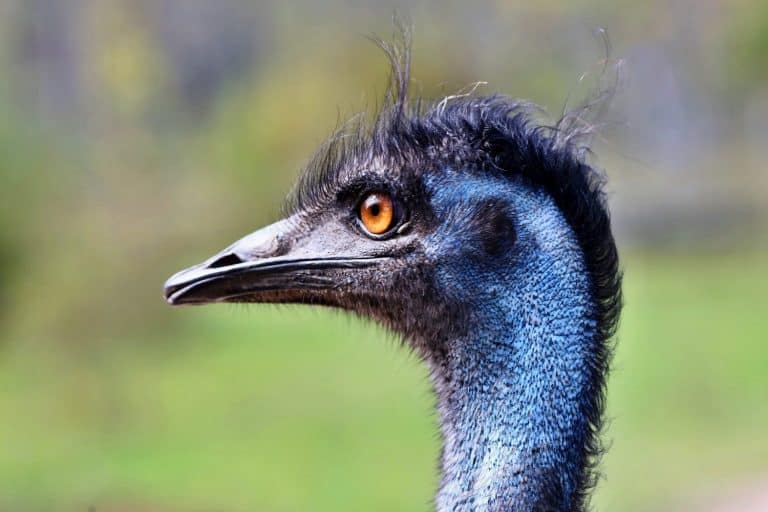
Emus are Australia’s tallest native birds and use their powerful legs for running and defense.
©samvaltenbergs/ via Getty Images
Emus might look a little awkward when they’re wandering around, but their legs are anything but weak. These flightless birds can stand more than six feet tall and run at speeds approaching 30 miles per hour. They’re the second-tallest living birds in the world, surpassed only by ostriches.
Each foot has three forward-facing toes equipped with sturdy claws. When threatened, an emu can strike with its legs, potentially causing painful cuts or other injuries. Although serious attacks on people are uncommon, these birds deserve plenty of space, particularly when they’re frightened or protecting their young.
That makes the sheep’s persistence in the video a little more remarkable. The encounter appears relatively harmless, but repeatedly approaching a large, defensive bird isn’t necessarily a good idea. A more forceful kick could have produced a very different outcome.
Do Emus Normally Get Along With Other Animals?
Emus are native to Australia, where they inhabit grasslands, open woodlands, and other environments. They’re naturally curious birds, but their reactions to other animals vary depending on the situation and the individual bird.
On farms and wildlife properties, emus may share space with sheep, goats, and other livestock. Some become accustomed to their neighbors, while others may react defensively when another animal approaches too closely. Simply living together doesn’t guarantee that every interaction will be friendly.
The emu in this video seems willing to tolerate the sheep’s presence only up to a point. Whether the bird was startled, irritated, or simply attempting to create some distance, its body language suggests the sheep wasn’t particularly welcome at that moment.
Male Emus Are Surprisingly Dedicated Fathers

Male emus incubate the eggs and care for their chicks after hatching.
©JohnCarnemolla/ via Getty Images
Emus have another fascinating behavioral trait: the males handle most of the parenting. After females lay their eggs, the male takes responsibility for incubation, spending roughly eight weeks sitting on the nest. During this period, he eats and drinks very little and can lose a substantial amount of body weight.
Once the chicks hatch, their father continues caring for them, protecting them and helping them find food for several months. Young emus may remain with their father for around five to seven months, sometimes longer.
Male emus can become especially defensive around their offspring. Although there’s no indication that the bird in this video was protecting chicks, their strong parental instincts are another reason to give these large birds plenty of room.
Australia Once Sent Soldiers After Thousands of Emus
Perhaps the strangest chapter in emu history unfolded in Western Australia in 1932. Large numbers of emus were damaging crops, prompting the government to deploy soldiers armed with machine guns in an effort to reduce their numbers.
The operation became known as the Great Emu War, although it wasn’t an actual war. The birds proved difficult targets, scattering across the landscape and frustrating efforts to control them. Despite killing hundreds of emus, the military campaign failed to provide a lasting solution to the farmers’ problems.
The incident has since become an enduring piece of Australian history, often jokingly described as a military defeat at the hands of flightless birds. Emus remain widespread across much of mainland Australia today.
Sometimes Even a Sheep Needs to Take a Hint
Fortunately, the sheep in this encounter appears to escape without any obvious injuries, and the emu never seems to escalate beyond a few defensive movements. It’s a funny reminder that animals don’t always interpret each other’s signals the same way.
The sheep may have been looking for company, but the emu certainly didn’t appear interested in making a new best friend. Sometimes, the best way to get along with your neighbors is to give them a little space.