
Quick Take
- Orangutan mothers raise their young for nearly a decade, yet the real secret to survival isn't what mom teaches them directly. Meet the mothers →
- Individual learning sounds safer than copying others, but young orangutans who do it alone face a risk that most people don't consider. See the hidden risks →
- Scientists discovered a third type of learning that's neither purely social nor purely individual, and it may be the most powerful of all. Discover the third type →
- An orangutan's diet can span 250 items, and how well a juvenile masters that list predicts something far more consequential than just what's for dinner. See the survival stakes →
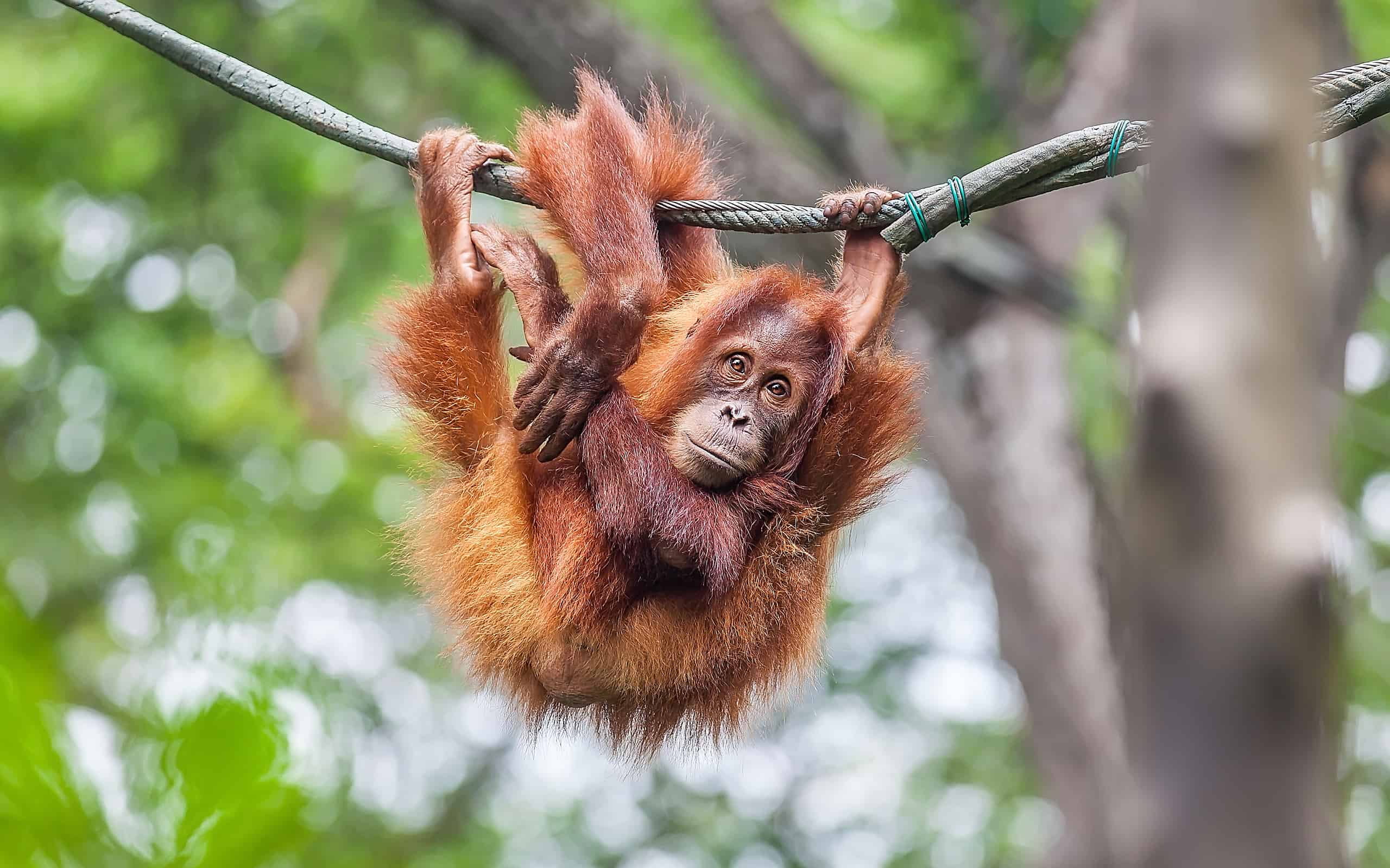
All young animals must eventually learn how to survive in the world around them. While some species attain independence at birth, others spend years with their parents. During this ‘childhood’ period, they pick up knowledge and skills from their older peers. In animals with long development periods, such as humans and apes, this is especially important. A new study has revealed that young orangutans use two types of learning to figure out what they can and cannot eat. This life skill dictates how likely they are to survive.
Meet the Orangutans
The study focused on one ape species, namely the Sumatran orangutans (Pongo abelii). As their name suggests, they live on the island of Sumatra, in Indonesia. They are the largest non-human primates in Asia and have distinctive long, fine red hair on their bodies and faces.
The female orangutans devote 8 or 9 years to raising their offspring. Males do not play a role in offspring care. Mothers provide young orangutans with food until they have learned to distinguish different types of food. Their food choices vary seasonally but is mainly made up of fruit (60 percent). Figs make up a large part of their diet. As well as fruit, they can also eat young leaves, flowers, bark, insects, and occasionally eggs. The young orangutans must figure out where to find food, what is nutritious, and what is toxic.
Individual vs. Social Learning
Individual learning is when an animal learns through their own efforts, such as targeted exploration. Social learning involves observing, interacting, and imitating others. The process of social learning is often referred to as culture and was once thought to be exclusively human. However, it is now acknowledged as widespread in the animal kingdom and has been observed in many animals, from insects to birds. The term culture describes how information originating from individual learning (innovations) gets transmitted to others via social learning.
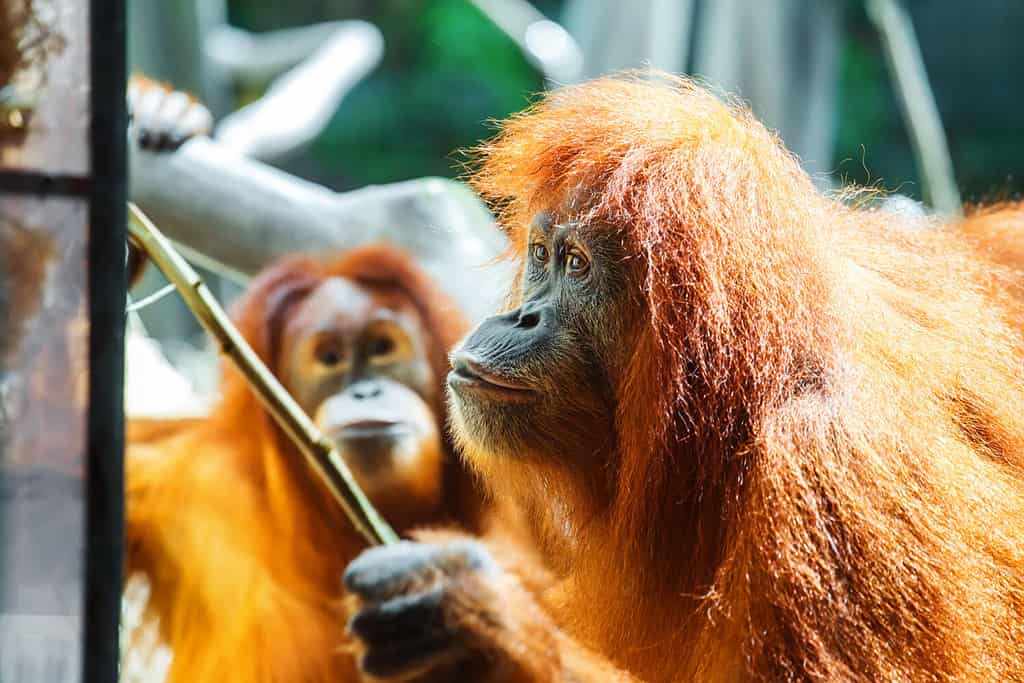
Orangutans use two types of learning.
©Funny Solution Studio/Shutterstock.com
On the whole, individual learning is regarded as less efficient and risky. The animal may risk predation or getting poisoned by trying out a new food source! On the plus side, they are trying it out for themselves so the information they glean is more reliable and up-to-date. Therefore, relying on social learning alone is not a good idea.
When it comes to complex skills, such as handling tools, individual learning is also crucial. There are likely multiple steps that can only be mastered with independent practice.
Investigating Orangutan Learning
Scientists studied how young orangutans learned to find food. An adult orangutan’s diet can comprise 250 food items! Somehow, the young apes need to learn what they can eat from the thousands of potential food items in their forest habitats. They need to learn what they can eat, where and when they can find it, and whether it needs any type of processing (including with tools) before they can eat it. Those young orangutans that develop a broad diet are considered more ecologically competent and are more likely to survive.
Scientists examined 1700 hours of detailed direct observation of 21 immature orangutans during 12 years at the Suaq Balimbing research area. To assess social learning, they recorded how the young apes closely observed other orangutans (peering) and calculated a peering rate (number of events/hour). They also measured ‘exploration’ as a measure of individual learning and calculated an exploration rate.
How Do Young Orangutans Learn?
The researchers found that social learning varies greatly among young orangutans, much as it does among human children. This could be down to genetic differences, different parenting, and different reliability of social information. We know that maternal behavior varies a lot in orangutans, so this could be a major factor.
Secondly, the distinction between individual and social learning is not absolute. In reality, peering (social learning) triggers a lot of exploration (individual learning). So, the two are linked. The researchers have called this ‘socially initiated learning’. By practicing a recently observed activity, the juvenile can perfect their skills.
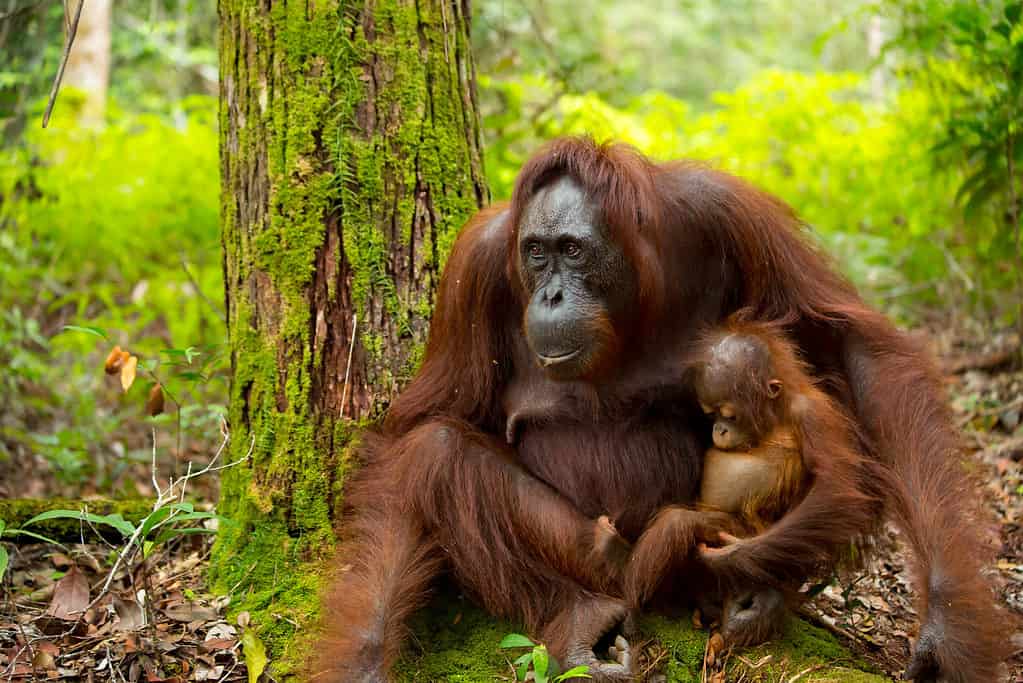
Orangutan mothers teach their offspring about food.
©Katesalin Pagkaihang/Shutterstock.com
Finally, young orangutans with heightened social and individual learning developed the broadest diet profiles. This is likely linked to the best chance of survival. No matter how much individual learning the young orangutan did, social learning led to enhanced ecological competence (the ability to source and process a good diet). However, in those orangutans who did not engage in so much individual learning, the effect of social learning was greater. It is as if social learning compensates for their lack of individual learning.
Why this Matters
This is the first study that has demonstrated how important cultural learning is amongst orangutans. These primates clearly use it to become mature independent foragers. It also reveals the crucial interplay between individual and cultural learning. Let’s not forget that orangutans and humans share a common ancestry. It’s likely that the way in which we learn is actually built on ancient evolutionary foundations.