O
Species Profile

Orangutan

Pongo

Red apes, rainforest architects
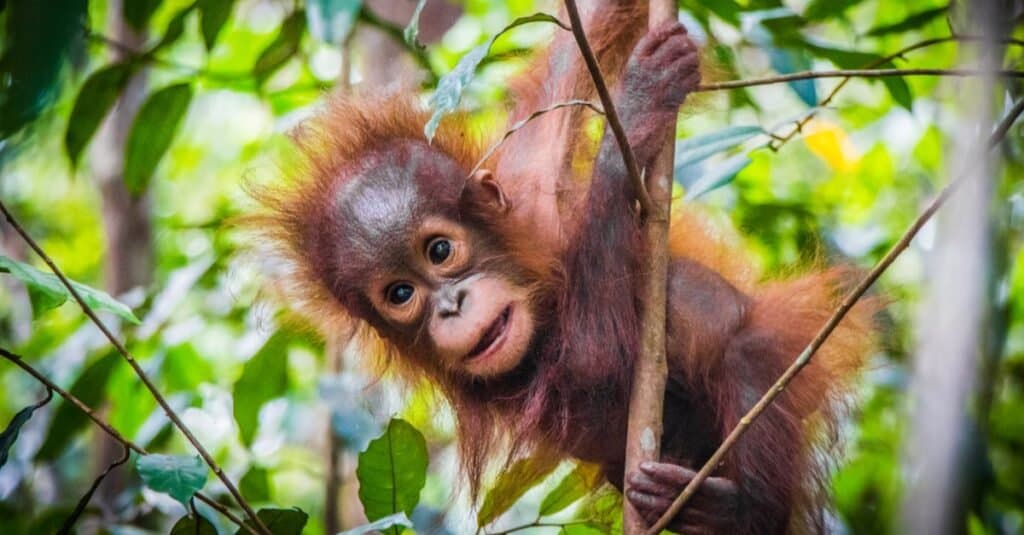
Wendy Bird - Copyright A-Z Animals

Orangutan Distribution

Click a location to explore more animals from that region

Endemic Species
Loading map...

Size Comparison

Human 5'8"
Orangutan 4 ft 3 in

Orangutan stands at 75% of average human height.

At a Glance

Genus Overview This page covers the Orangutan genus as a group. Stats below are general traits shared across the genus.
Also Known As orang hutan, orang-utan, man of the forest, forest person, red ape
Diet Omnivore
Activity Diurnal+
Lifespan 40 years
Weight 100 lbs
Did You Know?

All orangutans are Asian great apes-found only on Borneo and Sumatra-and each species has a different, shrinking range.

Scientific Classification

Genus Overview "Orangutan" is not a single species but represents an entire genus containing multiple species.

Orangutans are large arboreal great apes (family Hominidae) in the genus Pongo, characterized by long arms, reddish-brown hair, and strong adaptations for life in the forest canopy. They are among the most intelligent primates and are notable for tool use and complex foraging behavior.

Kingdom
Animalia
Phylum
Chordata
Class
Mammalia
Order
Primates
Family
Hominidae
Genus
Pongo

Distinguishing Features

  • Large-bodied arboreal ape with very long arms and hook-like hands/feet adapted for climbing
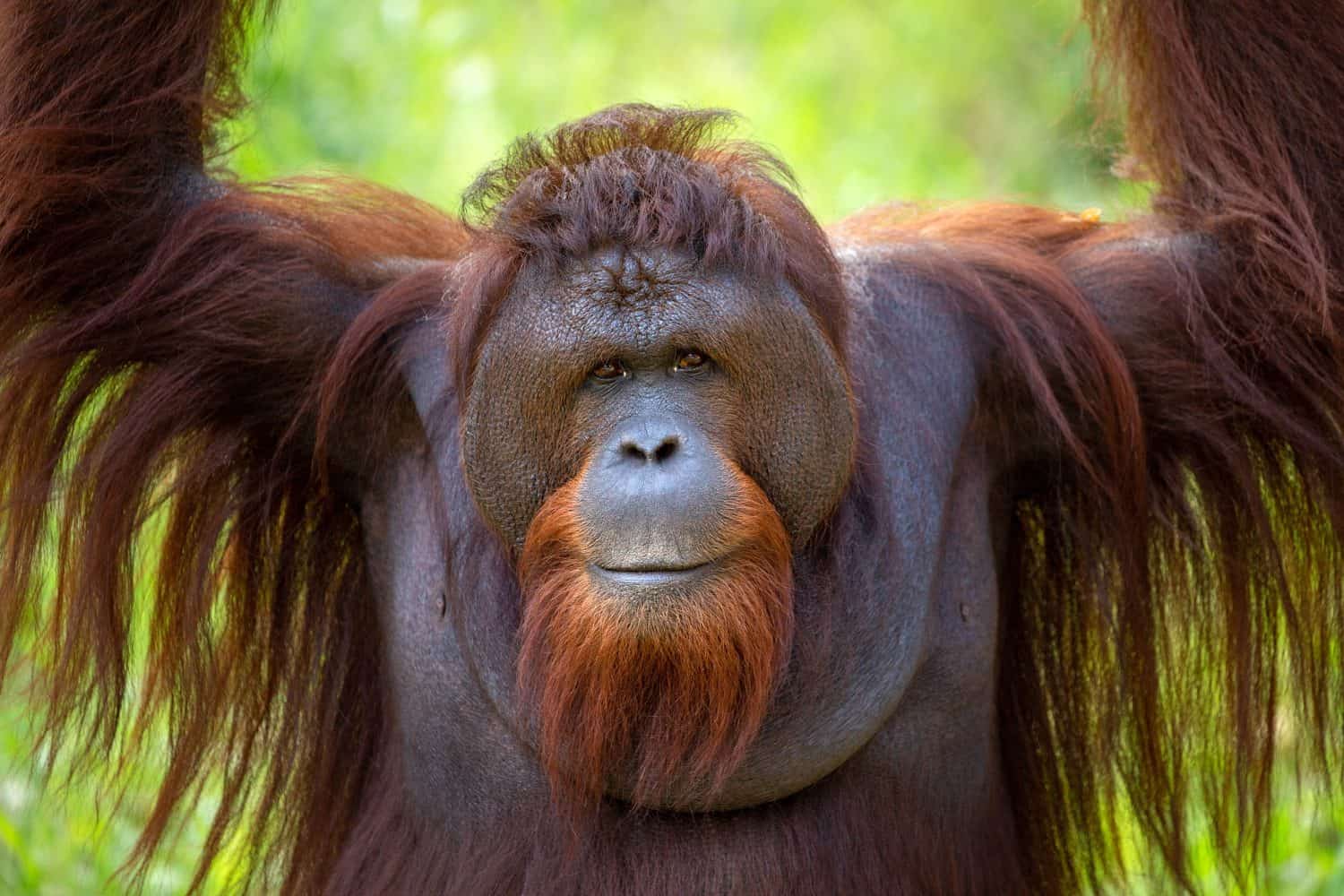
  • Reddish-brown coat; adult males may develop prominent cheek pads (flanges) and a throat sac
  • Slow life history (late maturity, long interbirth intervals) contributing to vulnerability
  • Primarily frugivorous but flexible diet; frequent nest-building in trees for resting/sleeping

Physical Measurements

Males and females differ in size

Height
1 in (0 in – 1 in)
3 ft 7 in (3 ft 2 in – 4 ft 1 in)
Weight
165 lbs (110 lbs – 243 lbs)
88 lbs (55 lbs – 121 lbs)
Top Speed
6 mph
running

Appearance

Primary Colors
Secondary Colors
Skin Type Mammalian skin with long, coarse shaggy hair; face, ears, palms/soles largely bare, dark and leathery; sparse facial hair with age-related thinning in some individuals.
Distinctive Features
  • Genus-level size range: body length ~0.97-1.5 m; arm span ~2.0-2.4 m; mass ~30-120 kg across sexes and species.
  • Lifespan range: commonly ~30-45 years in the wild; up to ~50-60 years in captivity.
  • Very long arms and curved fingers for slow, deliberate arboreal climbing and suspension.
  • Shaggy hair often longest on arms and shoulders; length and coarseness vary among species/populations.
  • Adult males may develop large cheek flanges and a throat sac; expression and size vary widely.
  • Face typically dark-skinned with pronounced brow ridge; infant/juvenile faces appear smoother and less robust.
  • Arboreal, mostly solitary foragers; nightly tree nests are built from bent branches and leafy mattresses.
  • Diet broadly frugivorous with leaves, bark, flowers, and insects; fallback foods increase in lean seasons.
  • Tool use and cultural behaviors occur genus-wide; reported frequency/complexity often higher in Sumatran populations than many Bornean sites.
  • Distribution limited to Borneo (P. pygmaeus) and Sumatra (P. abelii, P. tapanuliensis); Tapanuli has the smallest, most restricted range.
  • Major threats across the genus: forest loss/fragmentation (including plantations), hunting, and conflict; conservation status is severe for all species, with particularly acute risk for the range-restricted Tapanuli orangutan.

Sexual Dimorphism

Males are much larger and may become flanged, developing broad cheek pads and a throat sac used for long calls. Females are smaller, lack flanges, and have subtler craniofacial features; male morph (flanged vs unflanged) varies among individuals and populations.

  • Much greater body mass and overall robustness; larger canines and skull.
  • Flanged males: large cheek pads (flanges) and prominent throat sac; frequent long-calling.
  • Unflanged adult males exist: large-bodied but lacking full cheek pads; more mobile and less conspicuous.
  • Smaller, more gracile build with narrower face and no cheek flanges.
  • More consistent body form across adulthood; prominent mammary glands during nursing.

Did You Know?

All orangutans are Asian great apes-found only on Borneo and Sumatra-and each species has a different, shrinking range.

They build a fresh sleeping nest almost every night (and often a day-rest nest too), weaving branches into a stable platform.

Adult males can follow two developmental paths: some become "flanged" males with cheek pads and a throat sac, others remain "unflanged" for years.

Their arms are so long that arm span can exceed 2 m, enabling slow, controlled canopy travel and "hand-over-hand" climbing.

Orangutans are among the most skilled nonhuman tool users; tool use is especially frequent in some Sumatran populations, but varies widely across the genus.

They have one of the slowest life histories of any mammal: interbirth intervals commonly ~7-9 years, so populations recover very slowly.

Despite their size, they are primarily arboreal; ground travel happens more when forests are fragmented or food trees are far apart.

Unique Adaptations

  • Extremely long forelimbs and powerful shoulder joints adapted for canopy climbing and suspension; hands and feet are both grasping for "four-limbed" climbing.
  • Curved fingers/toes and strong grip suited to holding branches for long periods; movement is typically deliberate to avoid branch breakage.
  • Advanced spatial memory for locating seasonally fruiting trees across large home ranges-crucial in forests where fruit availability fluctuates.
  • Flexible diet and digestive strategy for coping with boom-bust fruit seasons; ability to exploit tough plant parts when needed (with variation among habitats).
  • Flanged-male features (cheek pads and throat sac) support long-distance vocal communication and social signaling; not all adult males express these traits at the same time.
  • Thick, shaggy reddish hair and relatively slow metabolism help conserve energy during periods of low fruit availability (extent can vary with ecology).

Interesting Behaviors

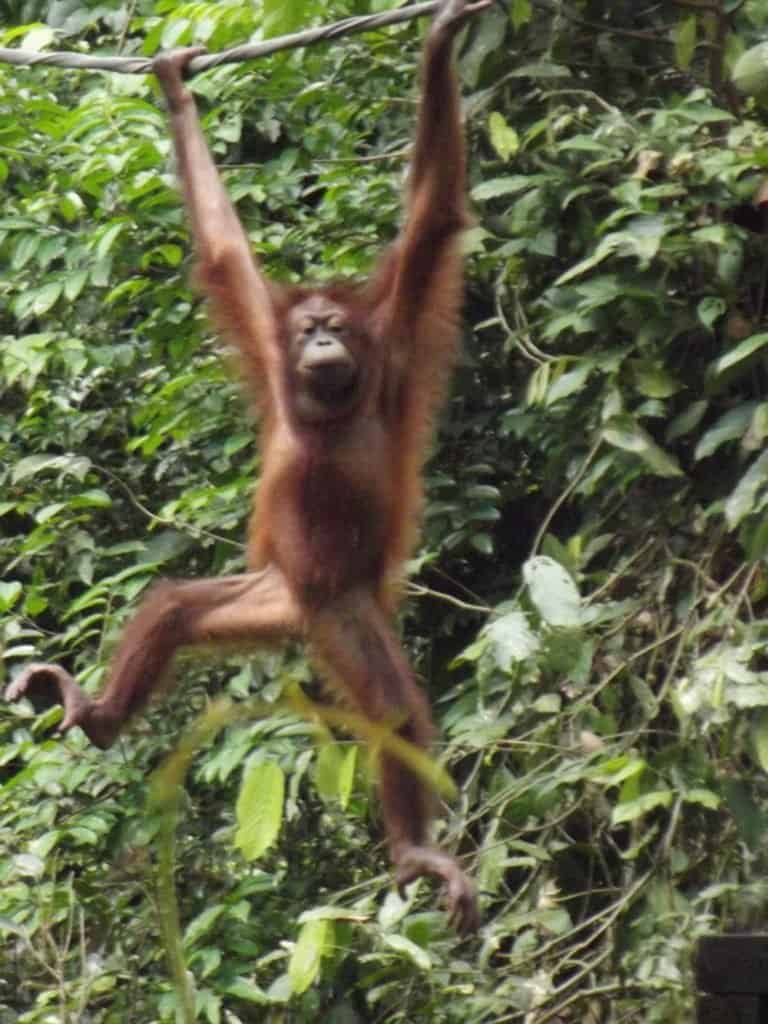
  • Arboreal locomotion with diverse techniques: climbing, cautious branch-walking, and suspensory movement; degree of terrestrial travel varies with habitat structure and disturbance.
  • Daily nest construction: selecting a site, bending and interlacing branches, then adding a "mattress" of smaller twigs/leaves; nests may include rain covers in wet conditions.
  • Frugivory with flexible fallback diets: when fruit is scarce they switch to leaves, bark, pith, flowers, and insects; specific fallback foods differ by forest type and island.
  • Tool use and extractive foraging: using sticks to probe holes or pry, and leaf tools (e.g., as gloves/napkins or to handle spiny/irritating foods); frequency and techniques vary across populations and species.
  • Sexual dimorphism and male bimaturism: flanged males produce long calls that carry far to advertise presence and attract females; unflanged males are more mobile and may use different mating tactics.
  • Loose, fission-fusion tendencies: generally solitary, but individuals may forage in proximity at rich fruit trees; Sumatran orangutans are often observed in more tolerant associations than many Bornean populations.
  • Long maternal care: infants cling for years, learning complex forest routes and food knowledge; the extended learning period is a hallmark across Pongo.

Cultural Significance

In Borneo and Sumatra, orangutans (Pongo) are called "forest people" and appear in stories and taboos. They are key symbols for rainforest conservation in Indonesia and Malaysia. All species face habitat loss, hunting, fragmentation, and conflict; Sumatran and Tapanuli have much smaller ranges than Bornean orangutans.

Myths & Legends

Malay and Bornean folktales often portray orangutans as 'people of the forest'-humans who retreated into the jungle and chose not to speak, sometimes said to remain silent so they won't be forced into labor.

In parts of Borneo (including Dayak/Iban oral traditions recorded by ethnographers), orangutans are sometimes treated as near-kin or transformed humans, leading to taboos or reluctance to harm them.

Traditional naming and lore: local names meaning "forest people" reinforce the idea of a humanlike being of the forest, reflected in stories that emphasize their intelligence and family bonds.

Historical anecdote shaping European imagination: the word 'Pongo' entered European natural history from early travel accounts and was later adopted in scientific naming, contributing to centuries of stories that blurred boundaries between apes and humans.

Conservation Status

CR Endangered to Critically Endangered (species-level: Bornean orangutan Pongo pygmaeus is Endangered; Sumatran orangutan Pongo abelii and Tapanuli orangutan Pongo tapanuliensis are Critically Endangered; population trends are decreasing)

Facing an extremely high risk of extinction in the wild.

Population Decreasing

Protected Under

  • CITES Appendix I (all orangutans)
  • Indonesia: Law No. 5/1990 on Conservation of Living Resources and Ecosystems; protected species regulations (orangutans protected nationwide)
  • Malaysia (Peninsular): Wildlife Conservation Act 2010
  • Sabah (Malaysia): Wildlife Conservation Enactment 1997
  • Sarawak (Malaysia): Wildlife Protection Ordinance 1998

You might be looking for:

Bornean orangutan

45%

Pongo pygmaeus

The most widespread orangutan species, native to Borneo; occupies lowland and swamp forests as well as upland areas.

View Profile

Sumatran orangutan

35%

Pongo abelii

Native to northern Sumatra; typically associated with wetter, more continuous rainforest habitats.

View Profile

Tapanuli orangutan

20%

Pongo tapanuliensis

A distinct, recently described species restricted to the Batang Toru ecosystem in Sumatra; extremely range-limited.

View Profile

Life Cycle

Birth 1 infant
Lifespan 40 years

Lifespan

In the Wild
30–50 years
In Captivity
40–60 years

Reproduction

Mating System Polygyny
Social Structure Solitary
Breeding Pattern Transient
Fertilization Internal Fertilization
Birth Type Internal_fertilization

Across Pongo, adults are largely solitary; males range widely and can mate with multiple females. Dominant flanged males may monopolize receptive females, while unflanged males use opportunistic tactics. Female-only maternal care; no lasting pair bonds.

Behavior & Ecology

Social Party Group: 1
Activity Diurnal, Crepuscular
Diet Omnivore Ripe, sugar-rich fruits-especially figs (Ficus); in some regions/years also durian and other mast fruits (varies across Borneo vs. Sumatra and by habitat).

Temperament

Generally calm and deliberate; low day-to-day aggression compared with many primates
Highly intelligent, curious, and flexible in foraging strategies; strong individual preferences
Typically tolerant at feeding trees but avoids close proximity; personal space is important
Adult males can be assertive or aggressive during mating competition; flanged males often dominant
Cautious and risk-averse in unfamiliar situations; strong reliance on learned routes and trees

Communication

long calls (adult males), advertising presence and spacing across the forest
grunts and soft contact calls during close-range interactions
kiss-squeaks and other alarm sounds, sometimes modified with leaves as tools
squeals/whimpers and distress calls, especially from juveniles
tooth-clicks and other short threat or agitation sounds
facial expressions and gaze direction; subtle in close-range communication
gestures (reaching, offering, pushing) used in mother-infant and social contexts
tactile contact such as embracing, grooming, and play More common in immatures
branch shaking and canopy movements as displays or spacing signals
nest building and nest choice as indirect social cues E.g., proximity to others
scent-related cues (urine/secretions) and rubbing behaviors that may aid spacing and signaling

Habitat

Biomes:
Tropical Rainforest Wetland
Terrain:
Coastal Hilly Island Mountainous Riverine Valley
Elevation: Up to 5905 ft 6 in

Ecological Role

Primarily arboreal frugivore-leaning omnivores that function as key canopy consumers and major seed dispersers, with secondary roles as seed predators and occasional insect/egg predators; the balance of these roles varies with fruit seasonality, habitat type, and population traditions.

Long-distance seed dispersal for many rainforest trees (especially fig and other fleshy-fruited species) Maintenance of forest regeneration dynamics via selective feeding, seed handling, and occasional seed predation Influencing plant community composition through seasonal reliance on fallback foods (leaves, bark, pith) Microhabitat creation through feeding damage (e.g., broken branches, opened fruit) that can benefit other organisms Trophic linkage between canopy plant productivity and insect populations via opportunistic insect feeding

Diet Details

Main Prey:
Other Foods:
Forest fruits Seeds and unripe fruit Young leaves and leaf shoots Flowers and buds Bark and cambium Pith and stems Tree sap and resins Fungi Honey +3

Human Interaction

Domestication Status

Wild

Orangutans (genus Pongo, including Bornean, Sumatran, Tapanuli) are wild great apes and have never been domesticated. People hunt them, take them for illegal pets, cut their forests for logging, oil palm, and roads, or rescue, care for, and return them to the wild. They appear in research, ecotourism, zoos, and sanctuaries; all species are threatened.

Danger Level

Moderate
  • Severe bite and laceration risk if threatened, cornered, or handled in captivity (very strong jaws and limbs)
  • Injury risk during rescues/translocations or when habituation leads to close contact
  • Zoonotic disease transmission risk in both directions (human-to-ape and ape-to-human), especially with close contact
  • Unpredictable behavior in stressed or improperly kept captive individuals; risks increase with maturation (especially adult males)

As a Pet

Not Suitable as Pet

Legality: Orangutans (Pongo) are not pets and are heavily protected (often CITES Appendix I). Owning or trading them is usually illegal except with strict permits for approved zoos, rescues, education, or research; private owners rarely can meet care and safety rules.

Care Level: Expert Only

Purchase Cost:
Lifetime Cost: $250,000 - $1,500,000

Economic Value

Uses:
Ecotourism and wildlife viewing Scientific research and education Ecosystem services (seed dispersal, forest regeneration) Conservation funding and NGO employment Human-wildlife conflict costs (crop loss mitigation, enforcement, rehabilitation)
Products:
  • tourism revenue (guiding, lodging, park fees)
  • media/documentary value and educational programming
  • research outputs (behavioral ecology, cognition, conservation science)
  • restoration/conservation initiatives tied to forest protection

Relationships

Predators 5

Sumatran tiger
Sumatran tiger Panthera tigris sumatrae
Sunda clouded leopard Neofelis diardi
Saltwater crocodile Crocodylus porosus
False gharial Tomistoma schlegelii
Reticulated python
Reticulated python Malayopython reticulatus

Ecological Equivalents 5

Animals that fill a similar ecological role in their ecosystem

Siamang Symphalangus syndactylus Large-bodied, highly arboreal primate of Sundaic forests. Overlaps in canopy locomotion, frugivory and folivory, and reliance on intact forest structure, although siamangs are more social and more strictly brachiating.
Bornean gibbon Hylobates muelleri Arboreal, canopy-dwelling frugivore/folivore and important seed disperser in Borneo; shares vertical forest use and fruit-tracking behavior, but differs in being much smaller and in exhibiting pair-living territoriality.
Southern pig-tailed macaque Macaca nemestrina Forest primate of Sundaland that tracks seasonal fruit and uses fallback foods; overlaps in feeding ecology and some habitats, but is more terrestrial and lives in larger, cohesive groups.
Helmeted hornbill Rhinoplax vigil Large canopy frugivore and seed disperser in the same forests; shares dependence on large fruiting trees and forest continuity despite being avian and much more mobile.
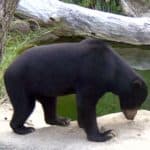
Sun bear
Sun bear Helarctos malayanus Forest omnivore that heavily uses fruit, insects, and honey. Overlaps in food resources (mast fruit years, insect foraging) and is similarly impacted by forest loss, though it is more terrestrial.

Classification

The orangutan is one of the largest primates in the world and is the only member of the great ape family that is found outside of Africa. There are three species of orangutan found in the steamy jungles on the islands of Borneo and Sumatra, which are the Bornean orangutan, the Sumatran orangutan, and the Tapanuli orangutan. The Bornean orangutan is more numerous and widespread than its cousins on Sumatra, with three distinct sub-species of Bornean orangutan found in differing geographic regions on the island. Orangutans are one of the closest living relatives to modern humans, and we share 96.4% of our DNA with these forest-dwelling apes. The three species are actually so similar in both behavior and appearance that their name Orang Hutan in their native Malaysian communities literally means “Person of the Forest.” All three species of orangutan are today severely affected by human activity in their native habitats and are listed by the IUCN on their Red List as Critically Endangered.

Orangutan infographic
There are only 119,346 orangutans left in the wild.

Evolution

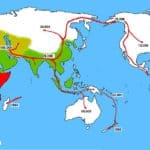
The exact process of orangutan evolution remains largely unknown because there is a lack of fossil and sub-fossil evidence. However, studies have shown that the divergence between orangutans and humans occurred approximately 12 to 15 million years ago. Orangutans used to inhabit much wider areas than they do now, spreading as far north as northern India and southern China and south to Java. Fossils such as Sivapithecus and Ramapithecus from the Siwalik hills in Pakistan provide some insights into what their ancestral species may look like. At the end of the Pleistocene era (approximately 12,500 years ago), orangutans’ range diminished significantly; they were only found on two islands: Borneo and Sumatra. It is estimated that at this time, Bornean and Sumatran populations began diverging from each other, which happened around 0.6 – 2 million years ago.

Are Humans Mammals

The divergence between orangutans and humans occurred approximately 12 to 15 million years ago.

Anatomy and Appearance

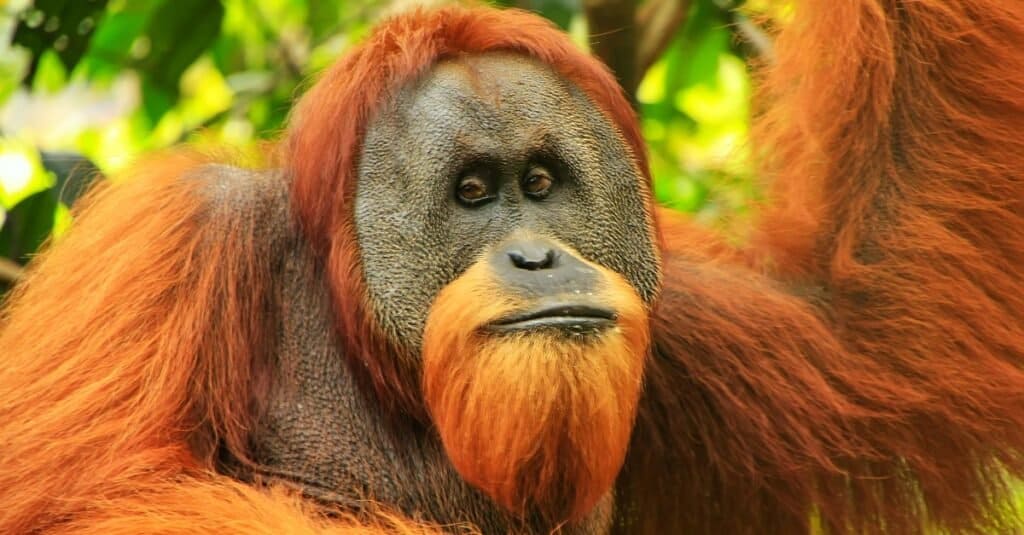
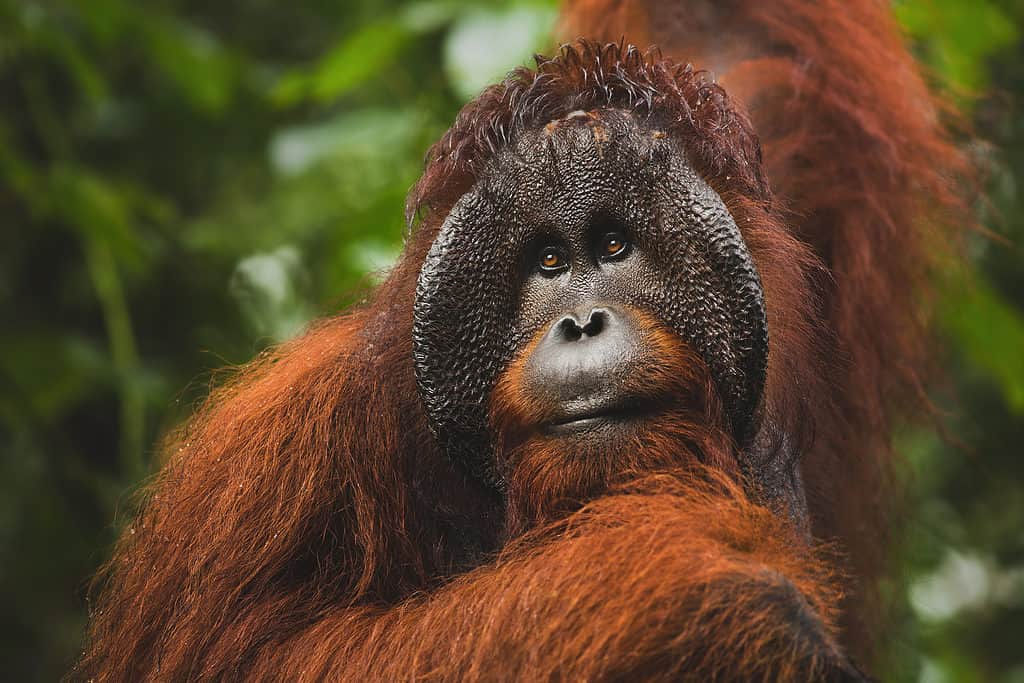
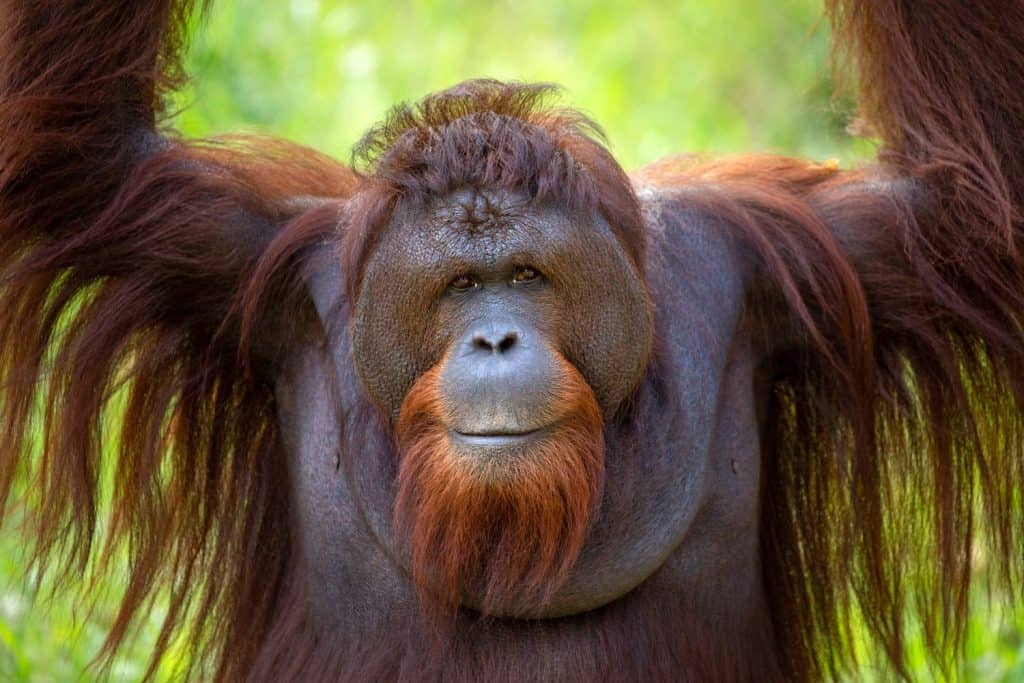
The orangutan is a large arboreal animal which means that it spends the majority of its life high in the trees and therefore has evolved some very special adaptations to make living in the forest easier. As the orangutan is too heavy to leap like a monkey, they use their long arms to swing on the tree branches until they can get close enough to grab onto the next one. The hands and feet of the orangutan are both equally effective at grasping onto branches, and their opposable thumbs also make their nimble digits very dexterous. The Bornean orangutan tends to be slightly larger in size than the Sumatran orangutan, which is more lightly colored, along with having a longer beard than its cousin. Tapanuli orangutans are similar in appearance to the Sumatran orangutan but have frizzier hair, smaller heads, and flatter faces. Male orangutans develop fleshy cheek pads as they mature, but these are much more pronounced on the faces of male Bornean orangutans, and all three species also have a throat pouch that is used to make deep calls that echo through the forest.

Adult female orangutans weigh 82-110 pounds. Males typically weigh twice as much as females, coming in at 160-285 pounds. Females are between three and a half and four feet tall when standing on their feet. Males stand between four and a half and five feet tall.

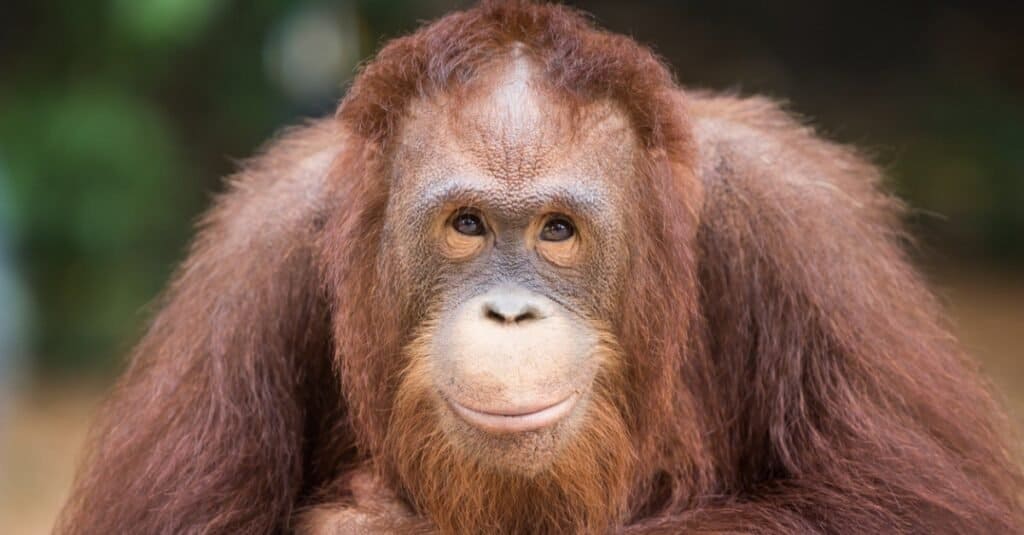
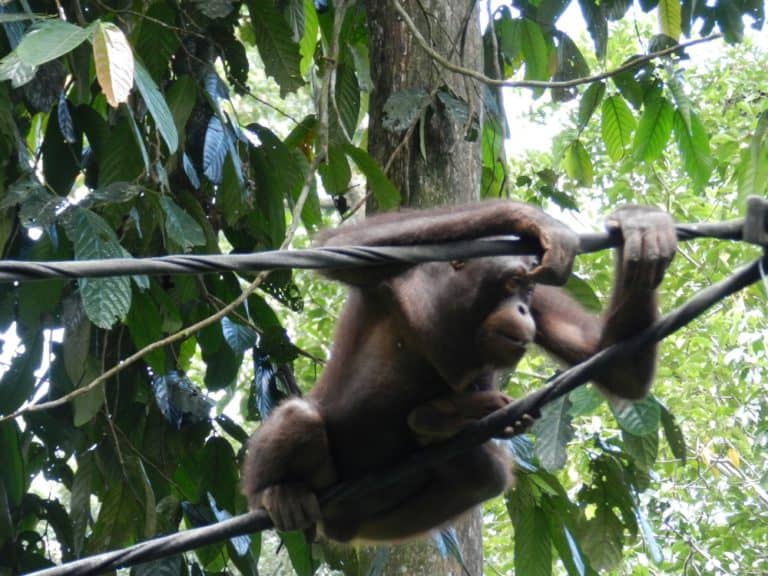
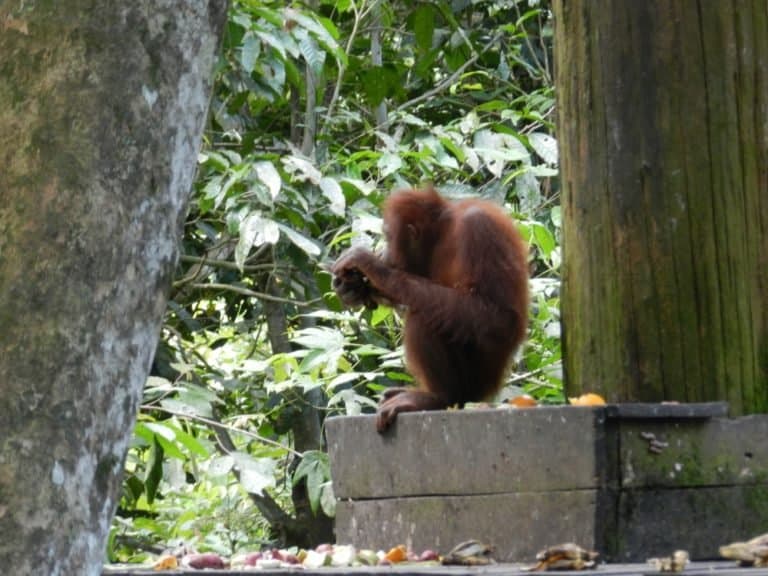
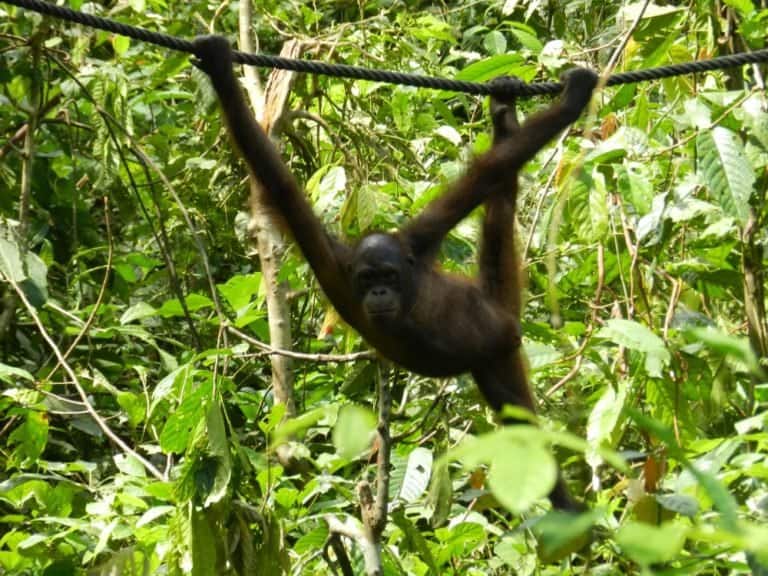
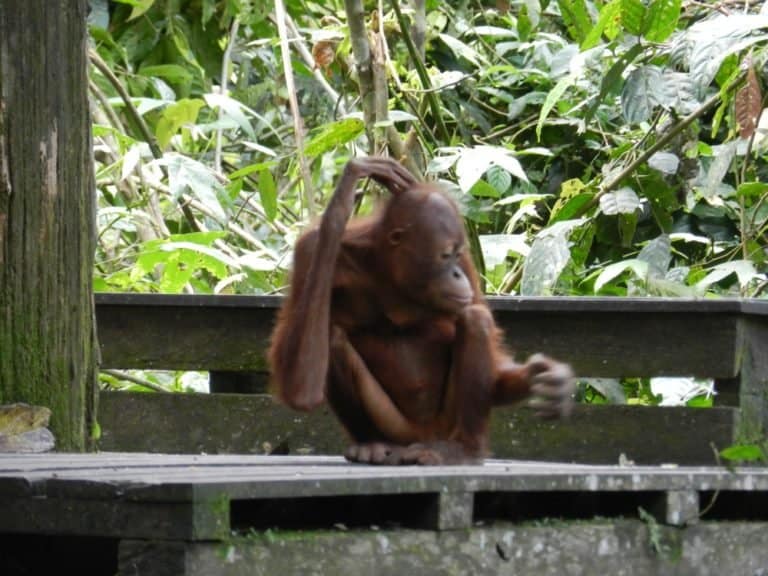
Bornean Orang-utan at Sepilok Orangutan Rehabilitation Centre, Sabah

Distribution and Habitat

Although orangutans would have once been found on a number of the forested, tropical islands in Indonesia, today, they are confined to just two, which are the islands of Borneo and Sumatra. Their tree-dwelling lifestyle means that orangutans prefer dense tropical forests in the lowlands where there is an ample and varied supply of food. Along with also being found in hillside forests, in valleys, and around peat swamps, there are a number of isolated populations on both islands that are found in the high mountain jungles at much higher altitudes. The Bornean orangutan is found in three remaining locations on Borneo, but the Sumatran orangutan now only inhabits the very northern tip of Sumatra, with the majority of wild individuals being found in just one province. The Tapanuli orangutan is found in a remote region in northwestern Sumatra, with the entire population found in an area of just 386 square miles. All three species, however, are severely threatened by the drastic decline of their habitats which have been deforested for timber or cleared for agriculture.

Bearded Animals

All three species of orangutan are severely threatened by the drastic decline of their habitats, which have been deforested for timber or cleared for agriculture.

Behavior and Lifestyle

There are two big differences between orangutans and other great apes, which are the fact that they are solitary and that they spend almost all of their lives high in the trees. The large size of the orangutan means that it moves very slowly through the forest, but often because they spend so much of their time foraging for and eating fruits in the surrounding trees. They make nests to sleep in at night high in the canopy by folding branches over and padding them out with leaves to ensure a comfortable night. Although they do have their own patches of forest, orangutans are not particularly territorial. They will even tolerate feeding together around trees that have an abundance of ripened fruits (Sumatran orangutans seem to be more sociable than Bornean orangutans). Male orangutans, though, will make their presence known by producing loud, long calls using their throat pouches to both intimidate rival males and attract a female to mate with.

Read about if orangutans are dangerous or not.

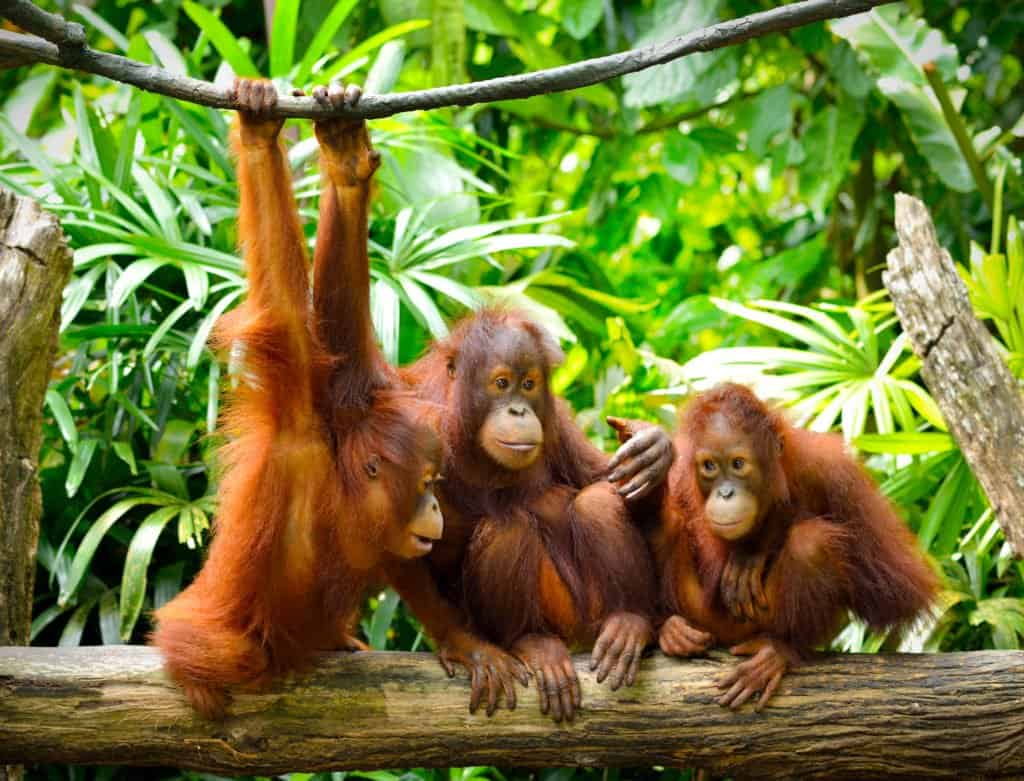
Orangutans make nests to sleep in at night high in the canopy by folding branches over and padding them out with leaves to ensure a comfortable night.

Reproduction and Life Cycles

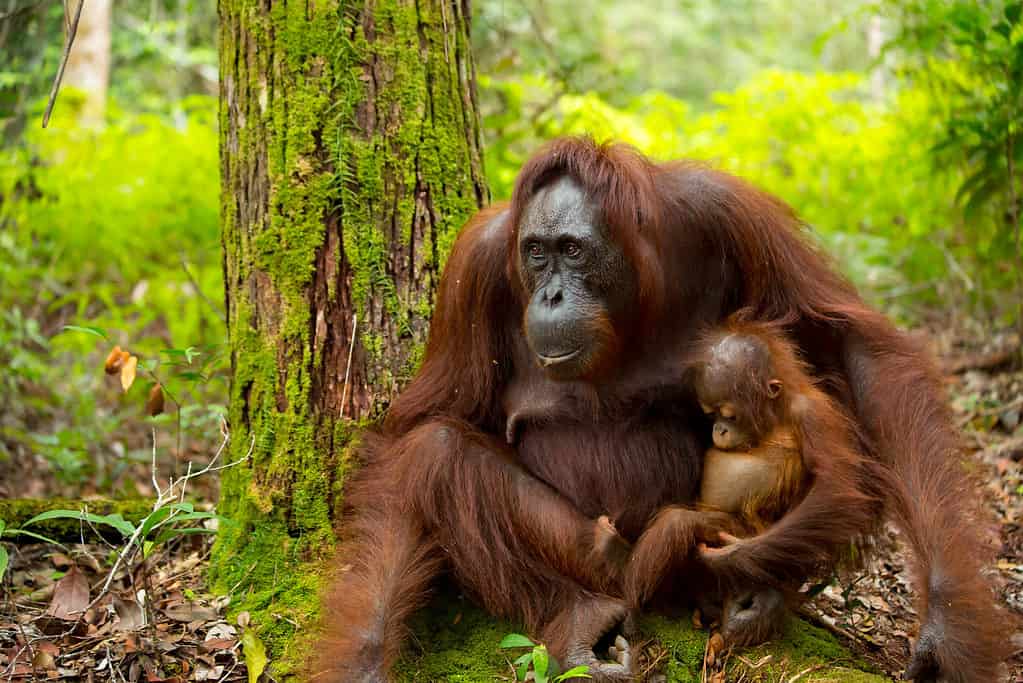
After a gestation period that lasts for around nine months, the female orangutan gives birth to a single infant in a special nest built high in the trees. Young orangutans cling onto their mother’s hair to stay secure whilst she is moving through the trees in search of food and is not fully weaned until they are three years old. However, orangutans will remain with their mother until they are often seven or eight years old as she teaches them the skills they need to survive in the forest. This includes learning about what plants to eat and where they can be found and also involves them being taught how to use tools such as sticks and leaves to make life easier. The orangutan is one of the most slow-developing mammals on the planet that cannot breed until it is between 12 and 15 years old. Females tend to have a maximum of three offspring during their life which means that in areas where populations have been affected by hunting or habitat loss, they take a very long time to recover.

Animals with Opposable Thumbs-orangutan

The orangutan is one of the most slow-developing mammals on the planet that cannot breed until it is between 12 and 15 years old

Diet and Prey

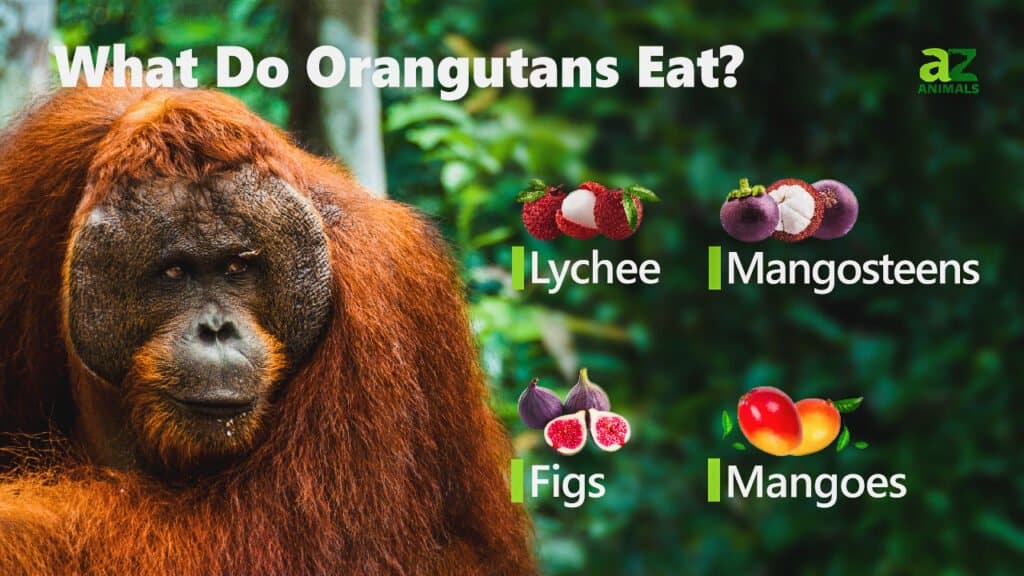
The orangutan is an omnivorous animal that eats a mixture of both plant and animal matter. The majority of its diet is comprised of numerous types of fruit. Their large size and frugivorous nature mean that orangutans must spend most of their day eating, which is possibly the reason why they have evolved to being semi-solitary animals. Despite the fact that orangutans do move throughout large home ranges, they have their own patch of forest that tends to contain the perfect amount of food to sustain that individual (or a mother with her young). Orangutans eat both ripe and unripe fruits, including mangoes, lychees, durian, and figs, which grow in abundance in some places and are where a number of individuals may meet up to feed. When there is a good fresh water source, the orangutan collects it in its cupped hands and then drinks it as it falls, but they don’t need to drink too much as they get the majority of the moisture that they need from their food.

For a complete analysis of the diet of orang-utans, make sure to visit ‘What Do Orangutans Eat.’

What Do Orangutans Eat
Orang-utans eat a diet that’s mostly comprised of fruit and insects.

Predators and Threats

Historically, orangutans on both Borneo and Sumatra would have been threatened by a number of large, ground-dwelling carnivores, which is possibly why they have evolved to lead an almost completely arboreal life. Large felines such as tigers and clouded leopards are the primary predators of the orangutan, along with crocodiles and the occasional large Asian black bear. However, due to drastic deforestation in both Malaysia and Indonesia, the population numbers of the orangutan’s predators have fallen drastically, with some being even more endangered today than the orangutans themselves. Humans are by far the biggest threat to the remaining orangutan populations as they have not only destroyed much of their unique forest homeland but also hunt and capture the young that are then sold into the exotic pet trade.

Humans are by far the biggest threat to the remaining orangutan populations.

Interesting Facts and Features

The orangutan is a very distinctive animal in the tropical Indonesian forests, with its bright, red, and orange hair leading to it also being known as the red ape. The orangutan is not only the largest tree-dwelling animal in the world, but it is also one of the most intelligent. In order to make the most of the seasonal changes in the tropical rainforest, Orangutans are known to make a mental map of where the different fruit trees are and when they will bare their ripened fruits. Like a number of other great apes, Orangutans are also known to use tools to facilitate their lives in their jungle, often using sticks and branches to collect honey from bee hives or extract ants and termites from inside hollow trees. Although the exact tool skill-set seems to depend on individual populations, they are really quite remarkable, with some orangutans actually known to use large leaves as an umbrella to keep the worst of the rain off and also put smaller leaves on the soft pads of their hands and feet to protect them in thorny vegetation.

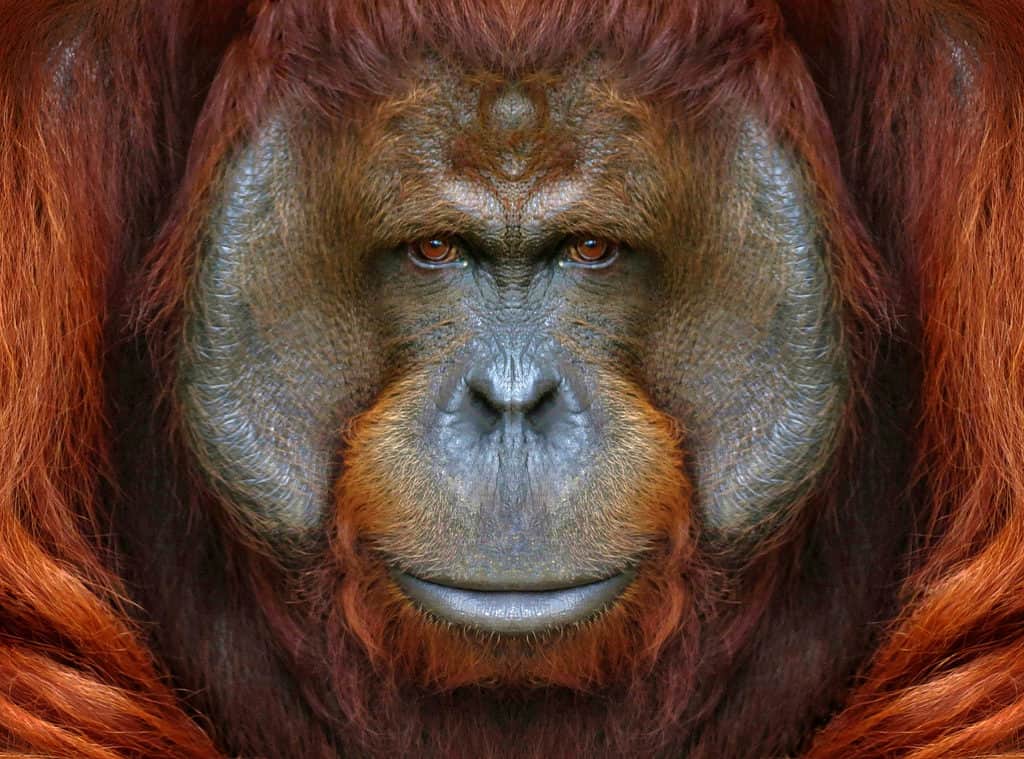
Orangutan close-up

The orangutan is not only the largest tree-dwelling animal in the world, but it is also one of the most intelligent.

Relationship with Humans

Since the arrival of modern humans in the Indonesian Archipelago roughly 40,000 years ago, orangutan numbers throughout southeast Asia have been declining. Once also found on the island of Java, orangutans are extinct throughout much of their natural range today due to both hunting and habitat loss. Originally hunted for their meat, things became more sinister in the 1800s when orangutans were in higher demand from zoos around the world, and infants were captured to be sold to them. Things were only made worse with the boom in the trade of exotic pets, with mother orangutans often being killed trying to prevent their young from being captured by people. The biggest threat to orangutans, though, is habitat loss in the form of deforestation for the often illegal logging of tropical timbers and the land clearance for the ever-increasing palm oil industry.

Orangutan, bornean

The biggest threat to orangutans, though, is habitat loss in the form of deforestation for the often illegal logging of tropical timbers and the land clearance for the ever-increasing palm oil industry.

Conservation Status and Life Today

Today, all three orangutan species are listed by the IUCN as animals that are severely under threat in their natural environments, with the Bornean orangutan, the Sumatran orangutan, and the Tapanuli orangutan listed as Critically Endangered. With up to 104,700 Bornean orangutans, 7,000 Sumatran orangutans, and just 800 Tapanuli orangutans thought to remain in the diminishing rainforests, the situation is only getting worse, and despite their legal protection, an estimated 5,000orangutans are killed every year. A number of rehabilitation and reintroduction projects exist in both Borneo and Sumatra, some of which have shown success. A population of young that were confiscated from the illegal pet trade have been introduced into one of Sumatra’s national parks, which have been known to be successfully breeding, with the population now totaling 70 members. If nothing continues to be done though about their dwindling habitats, it has been estimated that orangutans will be extinct from the wild within the next 10 years.

Find out the population of orangutans in the world today.

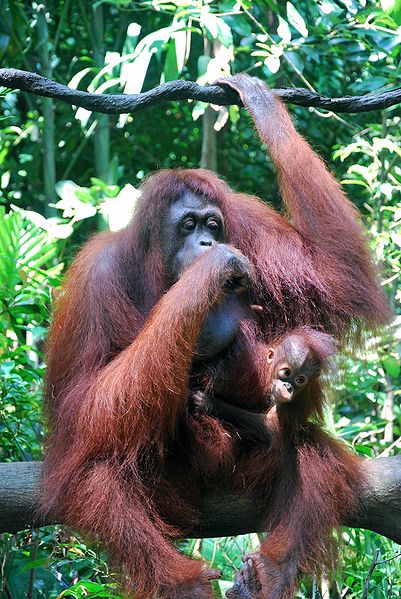
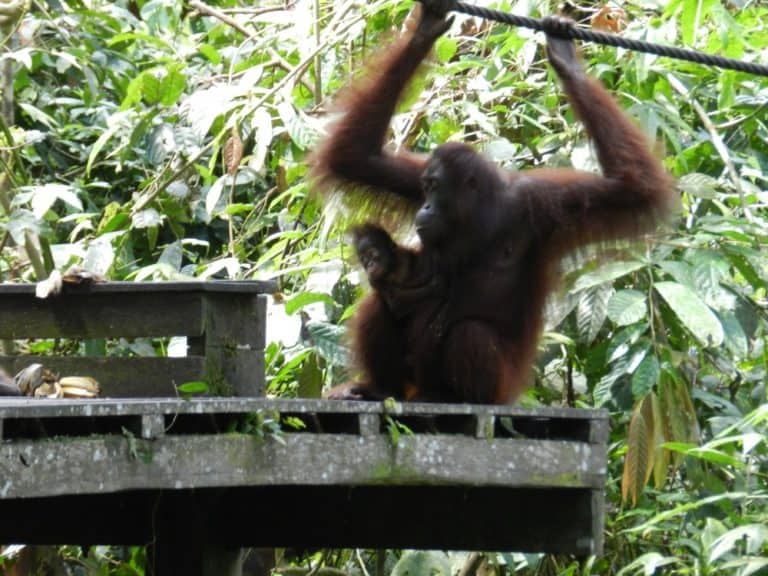
Orangutan in Indonesia with her baby.

Orangutans will be extinct from the wild within the next 10 years unless drastic measures are taken.

3 Types of Orangutans

There are three species of orangutan – Bornean, Sumatran, and Tapanuli. Additionally, the Bornean orangutan has three subspecies. Here is a breakdown below.

Sumatran Orangutan (Pongo abelii). Males are 5.6 feet tall and 200 pounds. Females are 3 feet tall and 100 pounds. Thin, long face with light red hair. Eat almost exclusively fruit and insects. It uses tools and travels by tree.

Tapanuli Orangutan (Pongo tapanuliensis). Rarest great ape. frizzy hair, smaller head. Males have large mustaches. Males are 4.5 feet tall and 200 pounds. Females are 3.5 feet tall and 110 pounds.

Bornean Orangutan (Pongo pygmaeus) – The third-largest ape. Tree-dwelling. Males 165 pounds. Females 85 pounds. Arms up to 4.9 feet long. Shaggy red coat.

  • Northwest Bornean orangutan (Pongo pygmaeus pygmaeus). They live in Malaysia and northern Indonesia.
  • Central Bornean orangutan (Pongo pygmaeus wurmbii). They live in Southern and Central Indonesia.
  • Northeast Bornean orangutan (Pongo pygmaeus morio). They live in East Indonesia and Malaysia.
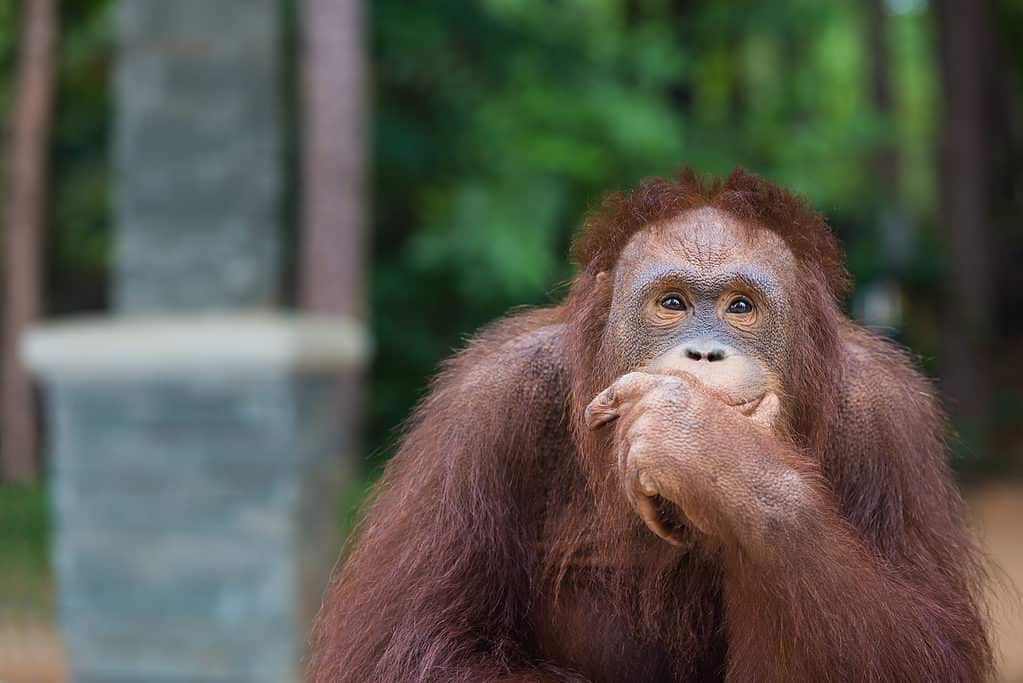
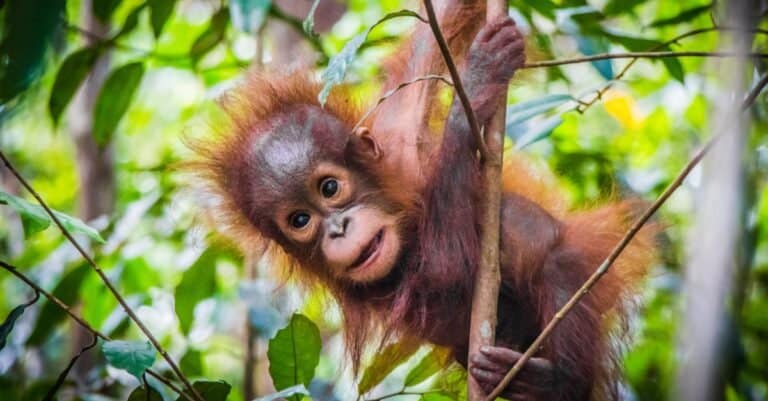
Orangutan deep in thought

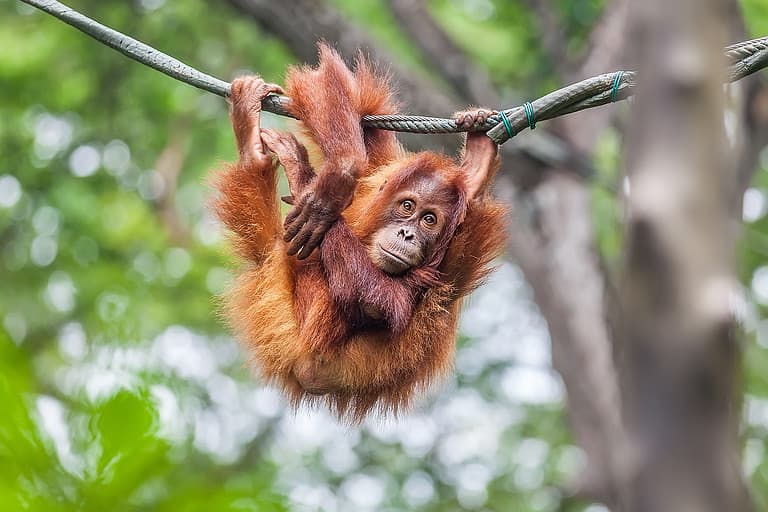
Orangutans are highly intelligent, and curious.

View all 88 animals that start with O
How to say Orangutan in ...
Bulgarian
Орангутани
Catalan
Orangutan
Czech
Orangutan
Danish
Orangutang
German
Orang-Utans
English
Orangutan
Esperanto
Orangutano
Spanish
Pongo
Finnish
Orangit
French
Orang-outan
Galician
Orangután
Hebrew
אורנגאוטן
Croatian
Orangutan
Hungarian
Orangután
Indonesian
Orang utan
Italian
Pongo (zoologia)
Japanese
オランウータン
Latin
Pongo
Malay
Orang utan
Dutch
Orang-oetans
English
Orangutang
Polish
Orangutan
Portuguese
Orangotango
English
Orang utan
Swedish
Orangutang
Turkish
Orangutan
Chinese
猩猩

Sources

  1. David Burnie, Dorling Kindersley (2011) Animal, The Definitive Visual Guide To The World's Wildlife / Accessed November 10, 2008
  2. Tom Jackson, Lorenz Books (2007) The World Encyclopedia Of Animals / Accessed November 10, 2008
  3. David Burnie, Kingfisher (2011) The Kingfisher Animal Encyclopedia / Accessed November 10, 2008
  4. Richard Mackay, University of California Press (2009) The Atlas Of Endangered Species / Accessed November 10, 2008
  5. David Burnie, Dorling Kindersley (2008) Illustrated Encyclopedia Of Animals / Accessed November 10, 2008
  6. Dorling Kindersley (2006) Dorling Kindersley Encyclopedia Of Animals / Accessed November 10, 2008
  7. David W. Macdonald, Oxford University Press (2010) The Encyclopedia Of Mammals / Accessed November 10, 2008
  8. Sumatran Orang-utan Information / Accessed November 10, 2008
  9. Bornean Orang-utan Information / Accessed November 10, 2008
Heather Hall

About the Author

Heather Hall

Heather Hall is a writer at A-Z Animals, where her primary focus is on plants and animals. Heather has been writing and editing since 2012 and holds a Bachelor of Science in Horticulture. As a resident of the Pacific Northwest, Heather enjoys hiking, gardening, and trail running through the mountains with her dogs.

Thank you for reading! Have some feedback for us?


Orangutan FAQs (Frequently Asked Questions)

Orang-utans are Omnivores, meaning they eat both plants and other animals.