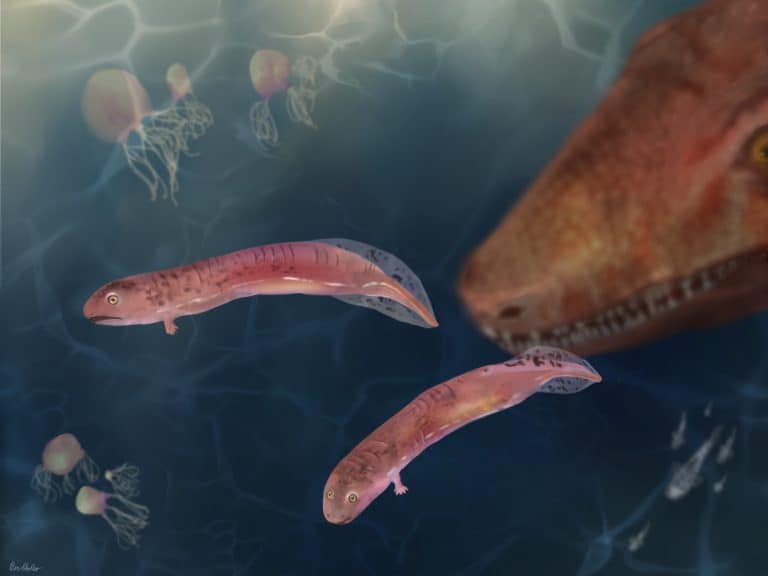
With just how old the earth is, it’s not hard to imagine that we don’t know everything, including the animals that once roamed the earth. Millions of animals have lived on our earth, many of which are long extinct. Recently, a team from the University of Leicester, Yunnan Key Laboratory for Palaeobiology and the Institute of Palaeontology at Yunnan University, Chengjiang Fossil Museum, and the Natural History Museum in London, have discovered something ground-breaking about the evolution of arthropods from a new three-eyed extinct creature.
Although arthropod fossils aren’t anything new, scientists have discovered a well-preserved Kylinxia, an ancient animal over 500 million years old, in a rock. This nearly completely preserved fossil has been able to give experts insight into arthropods. After using a CT scanner, these scientists were able to view the fossil’s three eyes. Not only did the extinct Kylinxia have three eyes, but also a pair of large grasping limbs.
So, why is this so shocking or important? Experts in the field are still trying to understand how arthropods and insects evolved over the years. Most arthropod fossils have revealed an animal with fewer segments than living species. However, the newly discovered Kylinxia has a head of six segments, like many modern-day arthropods.
What is an Arthropod?
Arthropods aren’t all three-eyed extinct creatures. Arthropods are any member of the phylum Arthropoda. They are invertebrates with jointed legs. This large group of animals is hard to define since it’s a broad term. For instance, arthropods have an exoskeleton and a segmented body. This can refer to animals like cockroaches, lobsters, spiders, beetles, ladybugs, and more. About 80% of all animal species are arthropods. While we are still discovering more about these creatures, the first known arthropods are trilobites. These ancient marine arthropods went extinct about 251 million years ago.
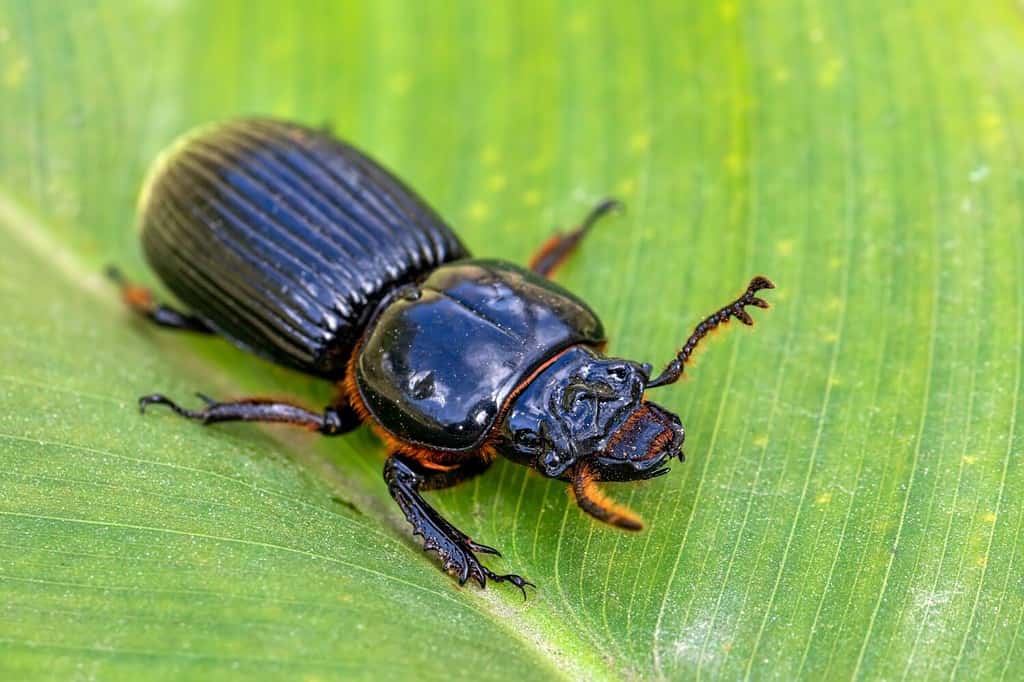
Beetles are arthropods.
©Artush/Shutterstock.com
Other Extinct Arthropods
There are many extinct arthropods. One of the more recent extinct arthropods is the Namibcypris costata, likely endemic to the southern Kaokoveld in northern Namibia. It was an ostracod crustacean. It hasn’t been seen since at least 1990.
Also listed as extinct on the IUCN Red List is the Thomasettia seychellana. It was discovered in 1911, and after this was never seen again.
The Pentagenia robusta is also extinct. This burrowing mayfly was endemic to Indiana, Kentucky, and Ohio. It lives along the Ohio River. Not a lot is known about this mayfly species, however, it may have gone extinct by 1926.
Have you ever heard of the Afrocyclops pauliani? This copepod is a true mystery. Only one Afrocyclops pauliani was ever found. The one specimen was found in 1951 near Antananarivo, Madagascar.