
Quick Take
- A spider walking upside down beneath a pool's surface sounds impossible, yet the physics behind it are stranger than you'd expect. See the physics →
- Wolf spiders don't build webs, and that hunting strategy is exactly what makes a pool encounter so unsettling.
- At least one wolf spider species has been studied running across open water, and its speed is surprisingly fast. Discover the research →
- Despite looking terrifying, a wolf spider bite has a surprisingly anticlimactic outcome for most people. Check bite outcomes →
If spiders make you nervous, finding one in your swimming pool probably isn’t your idea of a relaxing afternoon. A family in the United States discovered a large wolf spider in their pool, but simply finding it wasn’t the strangest part. The spider appeared capable of moving across the water’s surface as if there were something solid underneath its feet.
Wolf spiders are built for hunting. Unlike spiders that rely on sticky prey-catching webs, members of the wolf spider family, Lycosidae, generally roam around and pursue insects and other small arthropods. They are fast, have excellent vision compared with many other spiders, and are commonly found running across the ground, hiding beneath rocks, or moving through vegetation.
One of their easiest identifying features is the eyes. Wolf spiders typically have eight eyes arranged in three rows, including two particularly large eyes that can give them a surprisingly intense look when viewed up close.
The wolf spider in this clip ended up in a much wetter situation. After the family disturbed the area while taking down a water slide, the spider was seen at the surface of the pool. At one point it appears upside down beneath the surface, creating the bizarre illusion that it is walking across an invisible ceiling.
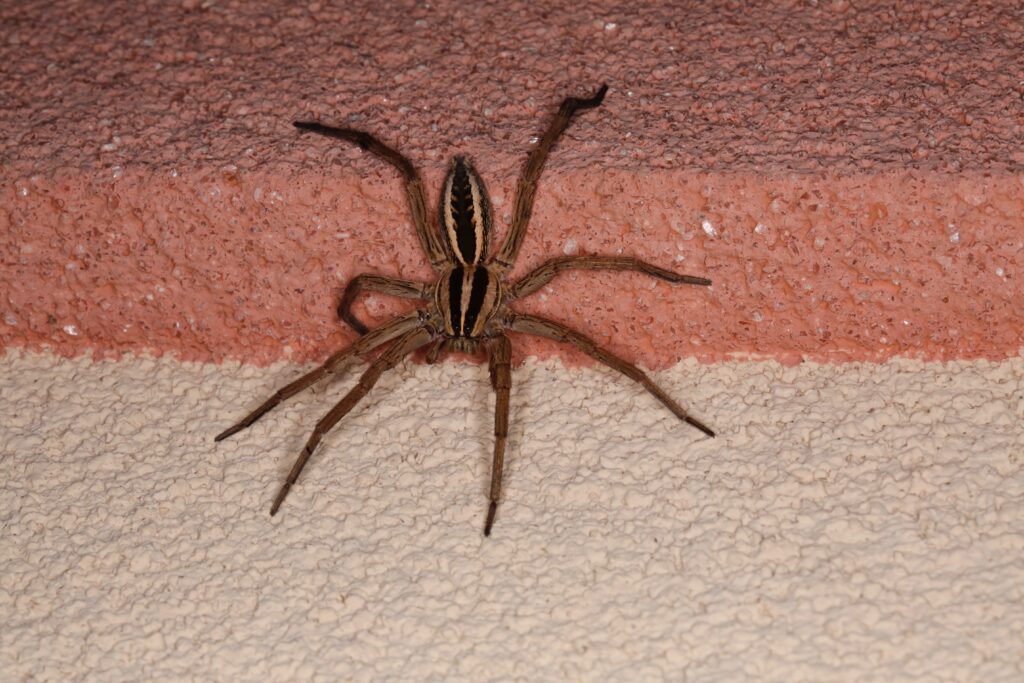
Wolf spiders are active predators that feed on insects and other small arthropods.
©Cathleen Wake Gorbatenko/Shutterstock.com
The person filming eventually helps turn the spider upright. That’s when things get even better. Instead of immediately sinking, the spider begins moving across the surface of the pool, its legs supported by the boundary between the water and the air.
How Can a Spider Walk on Water?
The trick comes down largely to surface tension. Water molecules attract one another strongly enough that the surface behaves a little like a flexible film. For a lightweight animal with the right body structure, that surface can provide enough support to keep it from immediately breaking through.
Some spiders also have tiny hairs and water-repellent surfaces on their legs that help keep them from becoming completely soaked. Rather than concentrating their weight in one tiny point, their long legs can distribute it across the water’s surface.
Researchers have actually studied this behavior in wolf spiders. One species, Pardosa valens, lives around mountain streams in southeastern Arizona and has been documented running both across rocky ground and on top of the water. Scientists studying the spiders found that they could perform surprisingly quick bursts of movement on the water’s surface.
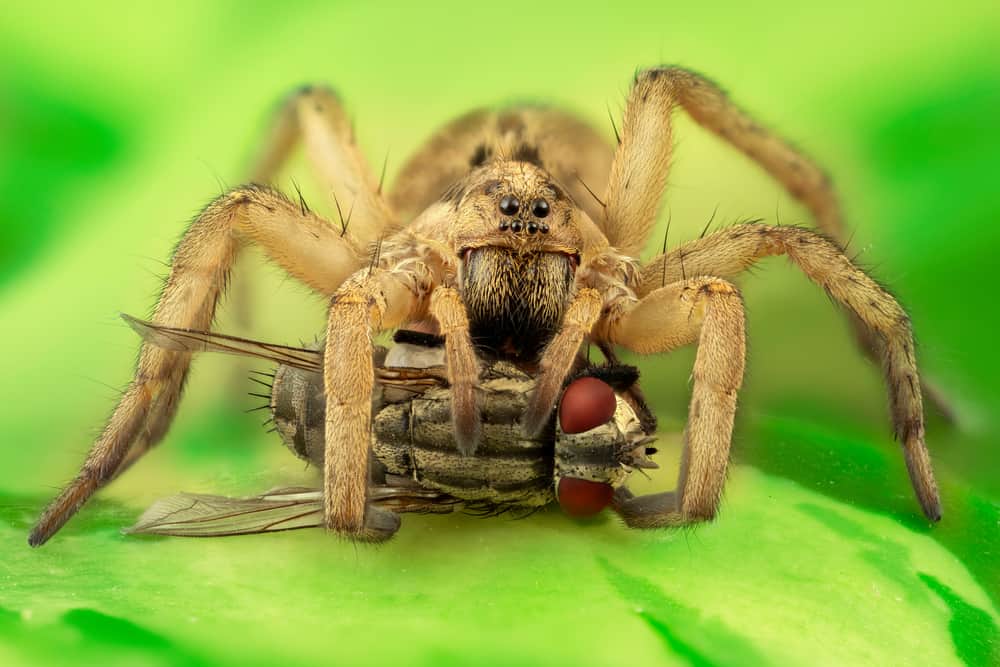
There are thousands of wolf spider species found in habitats around the world.
©Vida Shams/Shutterstock.com
That doesn’t mean every wolf spider is equally comfortable on water. The family contains thousands of species occupying everything from forests and grasslands to shorelines and stream banks. Some are much better adapted to life around water than others.
Are Wolf Spiders Dangerous?
Despite their size, speed, and admittedly intimidating appearance, wolf spiders are not aggressive toward people. Like other spiders, they can bite if trapped against the skin or handled roughly, but bites are uncommon.
When a wolf spider does bite, the usual effects are localized pain, redness, and sometimes swelling. Serious medical complications are not expected for most people. Giving the spider some space is still the smart move, both for your sake and the spider’s.
Wolf spiders are also useful neighbors. They prey on insects and other arthropods around yards, gardens, and homes, helping keep those populations in check without asking for much in return.
The family filming this encounter ultimately released the spider rather than killing it. Considering it had just demonstrated the ability to run across a swimming pool, I’d say it had earned its freedom.