
Quick Take
- Gibbons raising their arms while walking is not a quirky habit but rather a biomechanical solution to a very specific problem their bodies created. See the biomechanical reason →
- A gibbon's arms are built for something far more extreme than walking, and that specialization comes with a surprisingly awkward trade-off on the ground. Explore their arm specialization →
- Watching a gibbon walk upright looks like a performance, but it's actually one of the most natural things it does. The reasons have nothing to do with imitation. Why bipedal walking is natural →
- Gibbons can hit speeds most people would never associate with a small ape, and the anatomy behind that ability is the very same reason they look so odd on two legs. See their speed and anatomy →
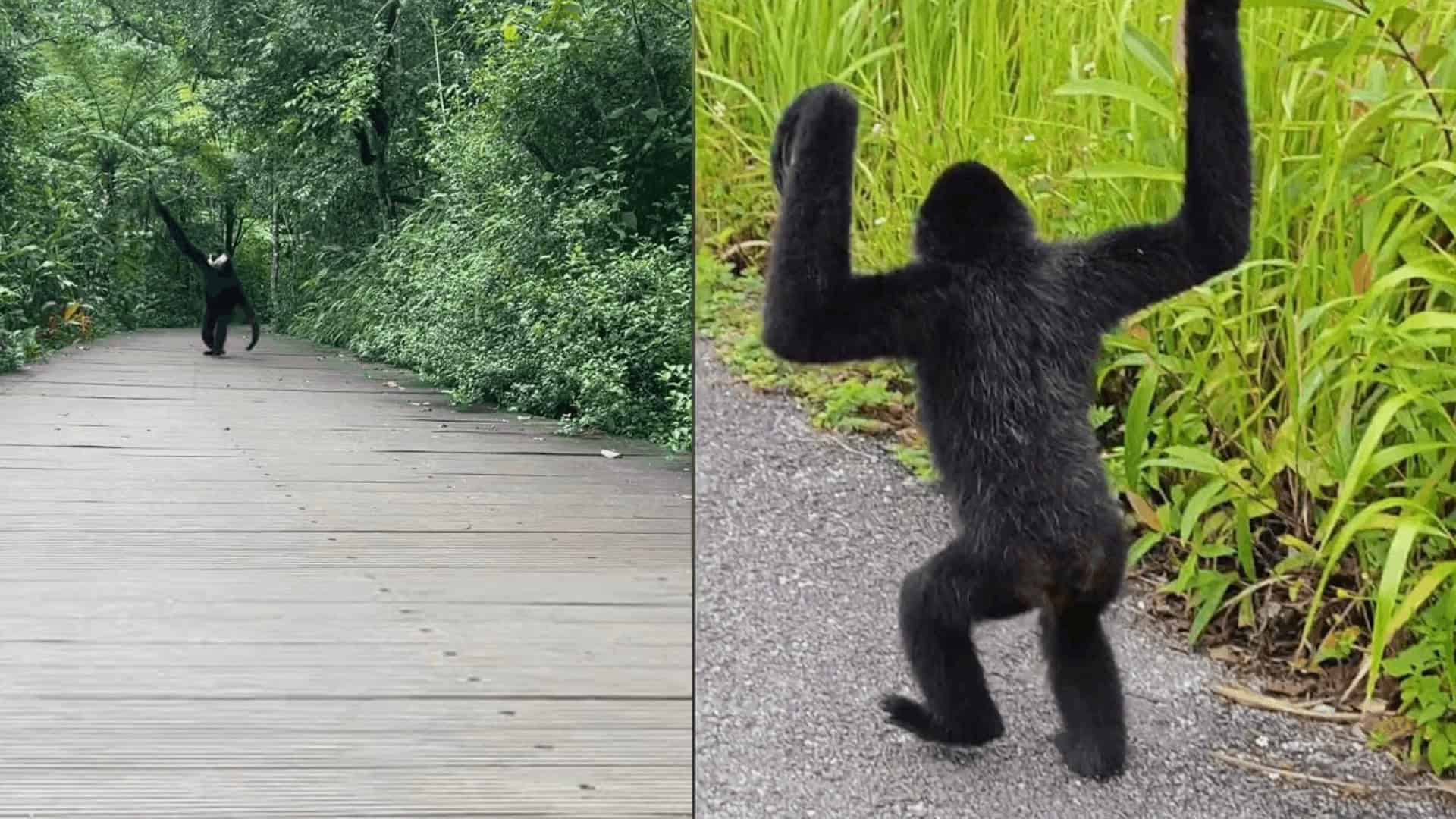
Gibbons are famous for swinging through trees with their extraordinarily long arms. But when these two little apes come down from their ropes, they show off another impressive ability: walking upright on two legs. In this entertaining footage, the gibbons stroll along with their arms held high, looking almost like tiny humans trying to balance on a tightrope. So why do they walk this way instead of using all four limbs like many other primates?
Watch These Gibbons Walk Upright on Two Legs
The video, shared by the Finding Flora and Fauna YouTube channel, begins with a gibbon effortlessly swinging between ropes. Its long arms make the movement look almost ridiculously easy. That’s hardly surprising, considering these animals are among the most accomplished climbers and swingers in the primate world.
But around the 24-second mark, things get considerably more interesting. Two gibbons make their way down and begin walking upright on their hind legs. Their arms remain raised as they move, giving them a distinctly humanlike appearance. Watch the gibbon with the darker fur in the background, and you’ll get an especially good look at just how long those arms are compared with its legs.
Although the channel’s creator is based in India, the footage doesn’t establish the exact filming location or whether the animals are in a managed setting. What we can say is that this unusual-looking movement is entirely natural for gibbons.
Why Do Gibbons Walk With Their Arms Raised?
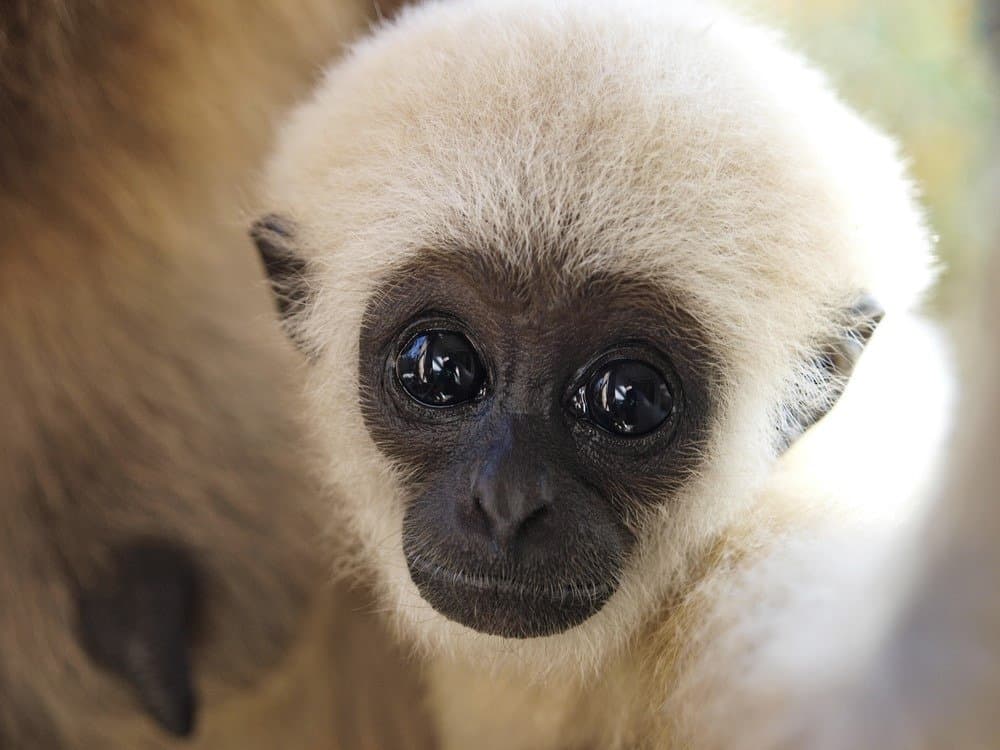
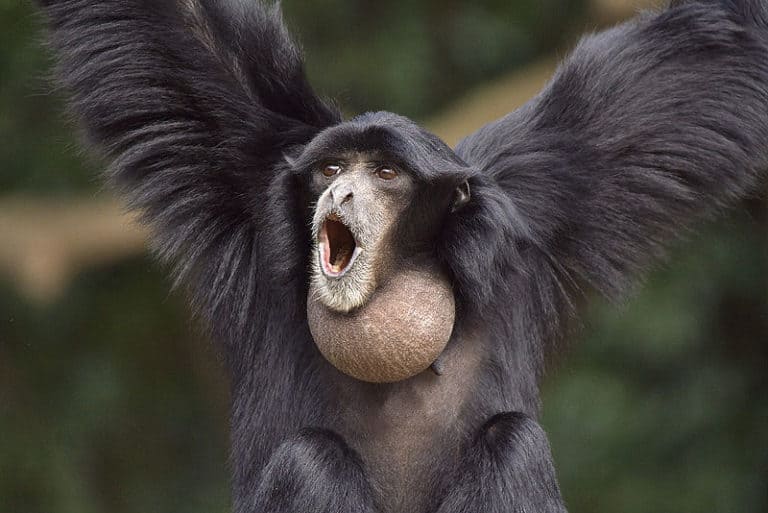
Gibbons have exceptionally long arms that help them swing through trees and maintain balance while walking upright.
©Simia Attentive/Shutterstock.com
Gibbons are naturally bipedal when walking along branches or moving across the ground. That means they use two legs rather than walking on all fours. Their unusually long arms help them maintain balance, particularly when navigating narrow surfaces high above the forest floor.
According to the Smithsonian’s National Zoo, a gibbon’s arms are typically about one and a half times as long as its legs. That proportion gives them a tremendous advantage in the treetops, but it also creates a distinctive appearance when they’re walking upright.
By raising their arms, gibbons can adjust their balance as they move. It’s similar to the way a person might extend their arms while walking along a narrow beam. Unlike humans, however, gibbons spend most of their lives in trees and are far better adapted to traveling through the forest canopy than walking long distances on the ground.
That makes their upright walk especially entertaining to watch. They aren’t imitating people or performing a learned human trick. They’re simply using a natural form of movement that has evolved alongside their remarkable tree-climbing abilities.
How Do Gibbons Swing Through Trees So Easily?
Gibbons are members of the ape family, not monkeys. Like chimpanzees, gorillas, orangutans, and humans, they belong to the broader group of apes. One easy way to distinguish them from many monkeys is that gibbons don’t have tails.
They’re sometimes called lesser apes or small apes because they’re generally much smaller than the great apes. But don’t mistake their size for a lack of athletic ability. Gibbons have specialized shoulder joints, powerful upper-body muscles, and long, hook-like fingers that allow them to move through trees using a technique called brachiation.
Instead of climbing from branch to branch using all four limbs, they swing beneath the branches, reaching forward with one arm and then the other. The motion is remarkably efficient, allowing some gibbons to reach speeds of around 35 miles per hour and cross gaps of up to 50 feet between trees.
That explains why the animals in the video look so comfortable swinging from their ropes. The movement closely resembles the way wild gibbons travel through the forest. Their upright walking might be the funniest part of the footage, but those extraordinary arms are what really make them such impressive acrobats.
Where Do Gibbons Live in the Wild?
Gibbons belong to the family Hylobatidae and are native to forests across parts of South and Southeast Asia. Different species live in countries including India, Myanmar, Thailand, Malaysia, Indonesia, Vietnam, Laos, Cambodia, and China.
India’s native gibbons are known as hoolock gibbons, and their wild populations are concentrated in the northeastern part of the country. They’re not native to Uttarakhand, where the creator of this particular YouTube channel is reportedly based. Without additional information about the video, it’s best not to assume where the animals were filmed or identify their exact species.
Unfortunately, many gibbon species face serious conservation challenges. According to the International Union for Conservation of Nature’s SOS Gibbons initiative, habitat destruction, hunting, poaching, and the illegal pet trade are among their greatest threats.
Because gibbons rely so heavily on connected forest canopies, clearing or fragmenting their habitat can make it difficult for them to move between feeding areas and maintain healthy populations. Protecting their remaining forests is essential to their survival.
And that’s what makes footage like this worth appreciating. We get to see these remarkable little apes showing off the same adaptations that allow them to navigate the treetops with extraordinary speed and precision. Although watching them walk upright is undeniably amusing, there’s some genuinely fascinating biology behind those raised arms.