
Quick Take
- Buddy startles Nathan to tears, and then does something that changes everything. Watch Buddy and Nathan →
- Golden retrievers are famous family dogs, but their size hides a risk most new parents don't consider. See the family pet details →
- The breed's biggest downside isn't what most people expect, and whatever it is turns out to be non-negotiable. Discover the biggest downside →
- Golden retrievers can thrive in surprisingly small spaces, but only under one condition. See their exercise needs →
Buddy the golden retriever clearly wants to get close to baby Nathan. Nathan, however, is not quite prepared for a cold, wet dog nose in the face. When Buddy leans in for a sniff, the surprise is enough to bring on the tears. Buddy then stays nearby and gently interacts with him as Nathan settles down. It is a sweet little moment between a very large dog and a very small human who are still figuring each other out.
Watch Buddy and Nathan Below
Do Golden Retrievers Make Good Family Pets?
Golden retrievers have a well-earned reputation as family dogs. The American Kennel Club describes the breed as friendly, reliable, eager to please, and generally good with children. They are also intelligent and usually respond well to consistent training and early socialization.
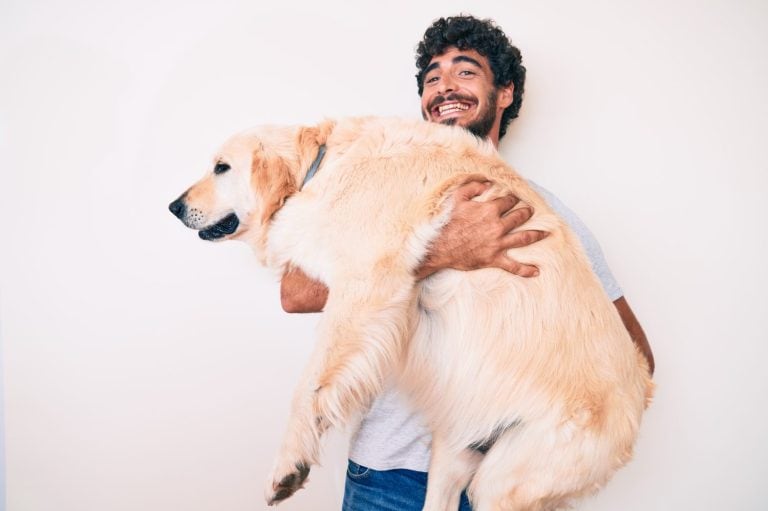
That does not mean every golden retriever will automatically be perfect with every child. Individual temperament and training still matter, and babies and young children should always be closely supervised around any dog, including a familiar family pet. Goldens are also fairly big animals. Adult males typically stand 23 to 24 inches tall and weigh 65 to 75 pounds, while females are usually 21.5 to 22.5 inches tall and weigh 55 to 65 pounds. A friendly dog that size can accidentally knock over a small child without meaning any harm.
For active families, though, the breed can be a natural fit. Golden retrievers were developed as sporting dogs and tend to enjoy walking, running, swimming, retrieving, and other activities that give them both exercise and something to do. As children grow older, that enthusiasm can make a Golden a very willing backyard and trail companion.
What Is the Downside of Owning a Golden Retriever?

Golden retrievers shed – a lot!
©sonsart/Shutterstock.com
The biggest consideration is that golden retrievers need regular exercise and attention. They are energetic sporting dogs, and the AKC recommends plenty of daily activity. A Golden can live in a smaller home or apartment if its exercise needs are consistently met, but leaving one bored and inactive for long stretches is a good way to end up with unwanted behavior.
Then there is the hair. Goldens have a thick, water-repellent double coat developed for retrieving birds in wet conditions. They shed moderately throughout the year and usually shed much more heavily once or twice annually, so brushing and vacuuming become part of the deal.
The breed is also susceptible to several health problems. The Golden Retriever Club of America recommends screening breeding dogs for hip and elbow dysplasia, eye disease, and heart conditions, and the organization also tracks cancer and several inherited disorders that affect the breed. None of that guarantees an individual dog will become ill, but prospective owners should choose breeders carefully and plan for regular veterinary care. With Buddy and Nathan, the important part for now is much simpler: supervised introductions, plenty of space, and letting both of them get comfortable at their own pace.