
Quick Take
- Baby snake embryos have no muscles, yet they all spiral in the same direction. Something hidden inside their bodies is forcing them into shape. See how coiling starts →
- Scientists discovered a previously unexplored structure inside snake embryos, a finding that rewrites what we thought we knew about how bodies coil. Discover the gut pillar →
- The position of the yolk sac inside the egg quietly determines which way a snake spirals, and the reason behind this has more to do with mechanics than biology. See how yolk position matters →
- This research may unlock the mystery behind spiral shapes found across all of nature, spanning everything from snail shells to your own intestines. Explore the broader implications →
Snake embryos look super cute inside their eggs, coiled into spirals. This shape helps their elongated bodies fit inside their eggs. But how do these spirals form, and why are so many of them spiraling in the same direction? A recently published study that was first thought of during the COVID pandemic has revealed how these snake spirals form. Read on to find out more about snake reproduction and the mysterious world of snake embryos.
The Basics of Snake Reproduction
Not all snake species reproduce in the same way. Some lay eggs (oviparous), some give birth to live young (viviparous), and some females can reproduce through parthenogenesis, which does not require a male at all!
Snakes that lay eggs typically do so in a sheltered place such as an underground burrow or buried in leaves. Laying eggs is a useful reproductive approach for snakes, and around 70 percent of snake species reproduce in this way. Some well-known examples are pythons and corn snakes.
Developing Embryos in Snake Eggs
Snakes lay amniotic eggs, which means that they have a shell and a series of membranes to protect the developing embryo within the egg. Snake eggshells are leathery and tough, but they are also flexible. So, when they drop into nests and collide with each other, they do not break.
At the center of the eggs, you will find the embryo essentially floating in amniotic fluid and surrounded by the amniotic membrane. Outside of this, there is another membrane called the allantois, which provides gas diffusion and allows waste to be removed.

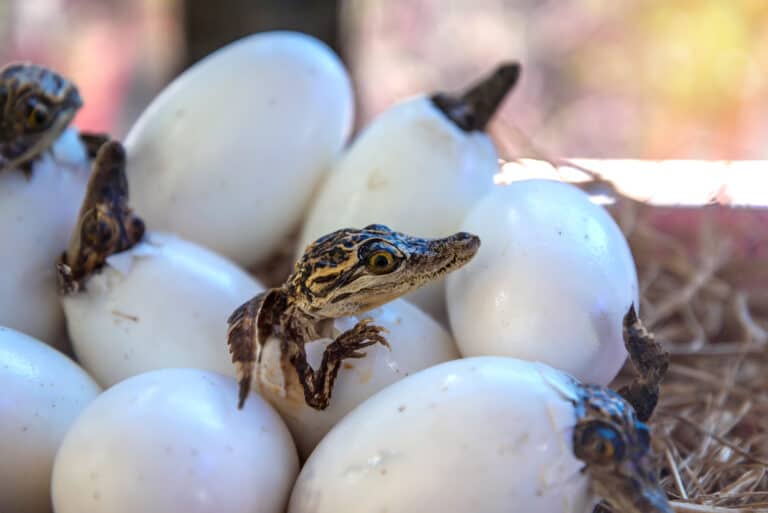
©Ton Ponchai/Shutterstock.com
The embryo is not alone in the egg; it has a yolk sac! This provides the nutrition that the embryo needs to grow and develop before it is ready to hatch out of the egg. The yolk sac is large when the egg is first laid but gets smaller as it is used up. Surrounding the embryo and egg sac is yet another membrane called the chorion. Then there is the egg albumen – this is a source of water and protein and protects the embryo from physical damage and pathogens. Finally, there is the outer shell.
Snake Incubation Periods
The baby snakes form a spiral shape during their incubation period, the period between the egg being laid and the baby snake hatching from the shell. This can be anything from ten days to a few months. For example, the female ball python (Python regius) incubates her eggs for two months! Some species, such as the Barbados threadsnake (Tetracheilostoma carlae), lay just one egg. The Burmese python (Python bivittatus), however, can lay up to 122 eggs in one clutch.
Levels of maternal care towards the eggs also vary. Females of some snake species simply lay their eggs and then leave. The female king cobra is a more attentive mother. She creates a nest from leaves and lays her eggs on it, before curling up on top of it herself. The warmth of the decomposing vegetation and her body helps the embryos inside the eggs develop.
How Were Snake Embryos Studied?
An international team of scientists led by researchers from Canada trawled through published research and museum databases for photographs of developing snakes. In all, they examined pictures of more than 900 embryos covering 39 snake and other limbless squamate species. By looking at so many images, the study was able to reach statistical significance, making the findings applicable to other snakes.
Also, Dr. Raul Diaz, a collaborator at California State University Los Angeles, used CT imaging to look closely at snake embryos and their internal organs in more detail.
Solving the Spiraling Mechanism Mystery
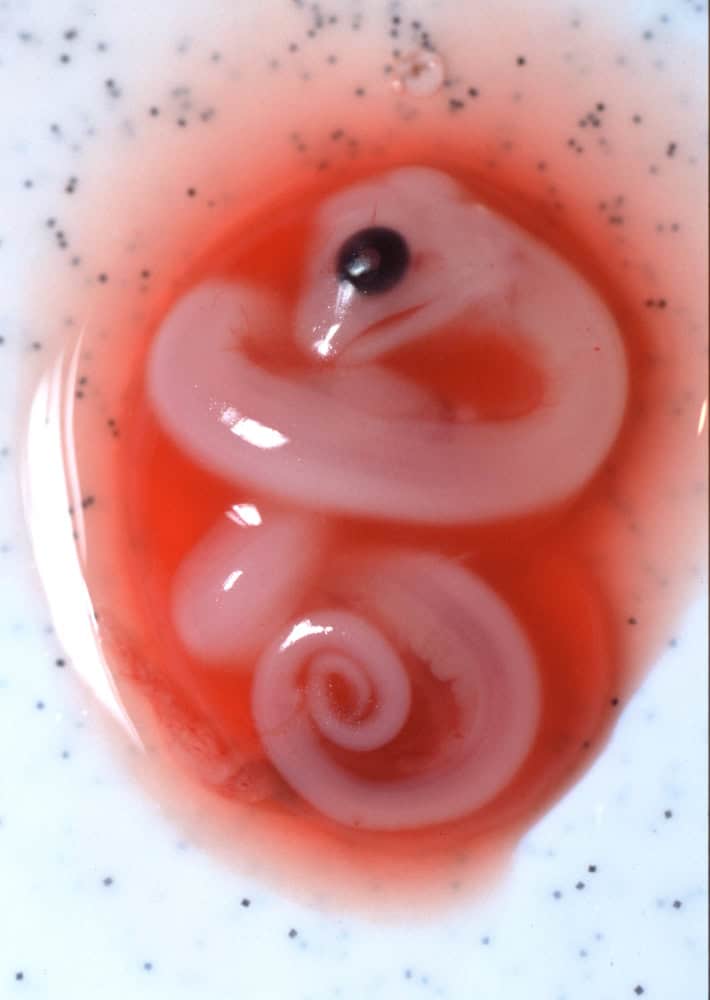
The study showed that snake embryos always coil to the right when viewed from head to tail. This happens during the first several weeks after the eggs are laid. Such young embryos do not have muscles, so what is making them coil?
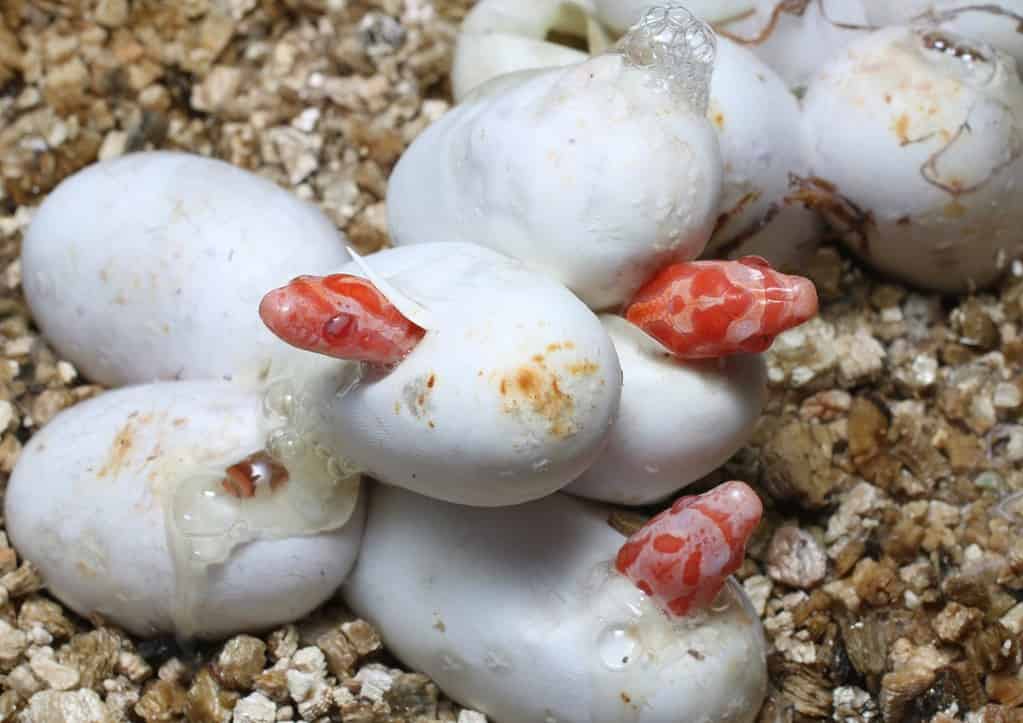
Snake embryos feed on their egg sac.
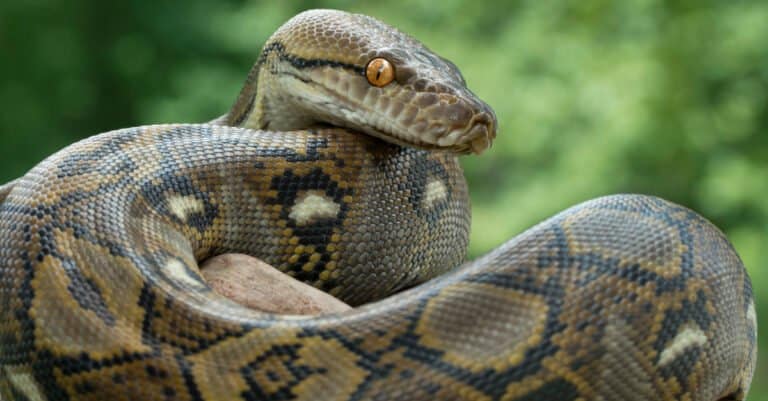
©Dan Olsen/Shutterstock.com
The CT scans revealed a previously unidentified structure. It is a pillar of gut that stretches through the young snake’s body. It’s a part of the intestine that’s not attached to the rest of the body, but that’s surrounded by blood vessels.
As the baby snake’s body lengthens rapidly, this gut structure does not grow at the same rate. It pulls the embryo’s body into a spiral. The egg yolk is always on the embryo’s left side, so it coils to the right.
Changes in Coiling Direction
As the embryos grow bigger, they use up the yolk sac, and it becomes smaller. This gives them more room to move around. Also, they develop muscles and can move and change position within the egg. While some stay in a right-handed coil position, others change to a left-handed one.
It’s hoped that this research will help explain other spiral forms which are common in nature, such as intestinal loops and snail shells.