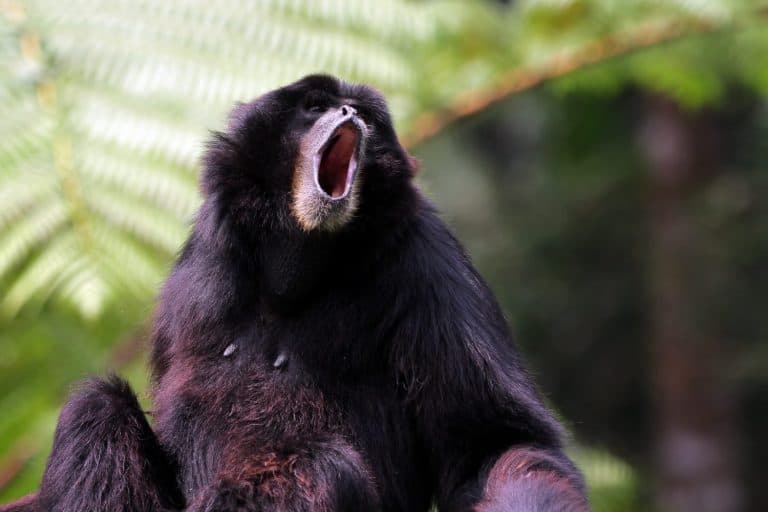

What’s the first thing you do when you wake up? Many of us might snooze our alarm, grab a bite to eat, and get ready for the day. Well, if you’re a gibbon, your morning routine is a bit different — it involves a lot of very loud, early-A.M. screaming!
This post was updated on October 29, 2025 to clarify the loudness of howler monkey calls and gibbon calls, as well as the traveling distance of calls being environment dependent.
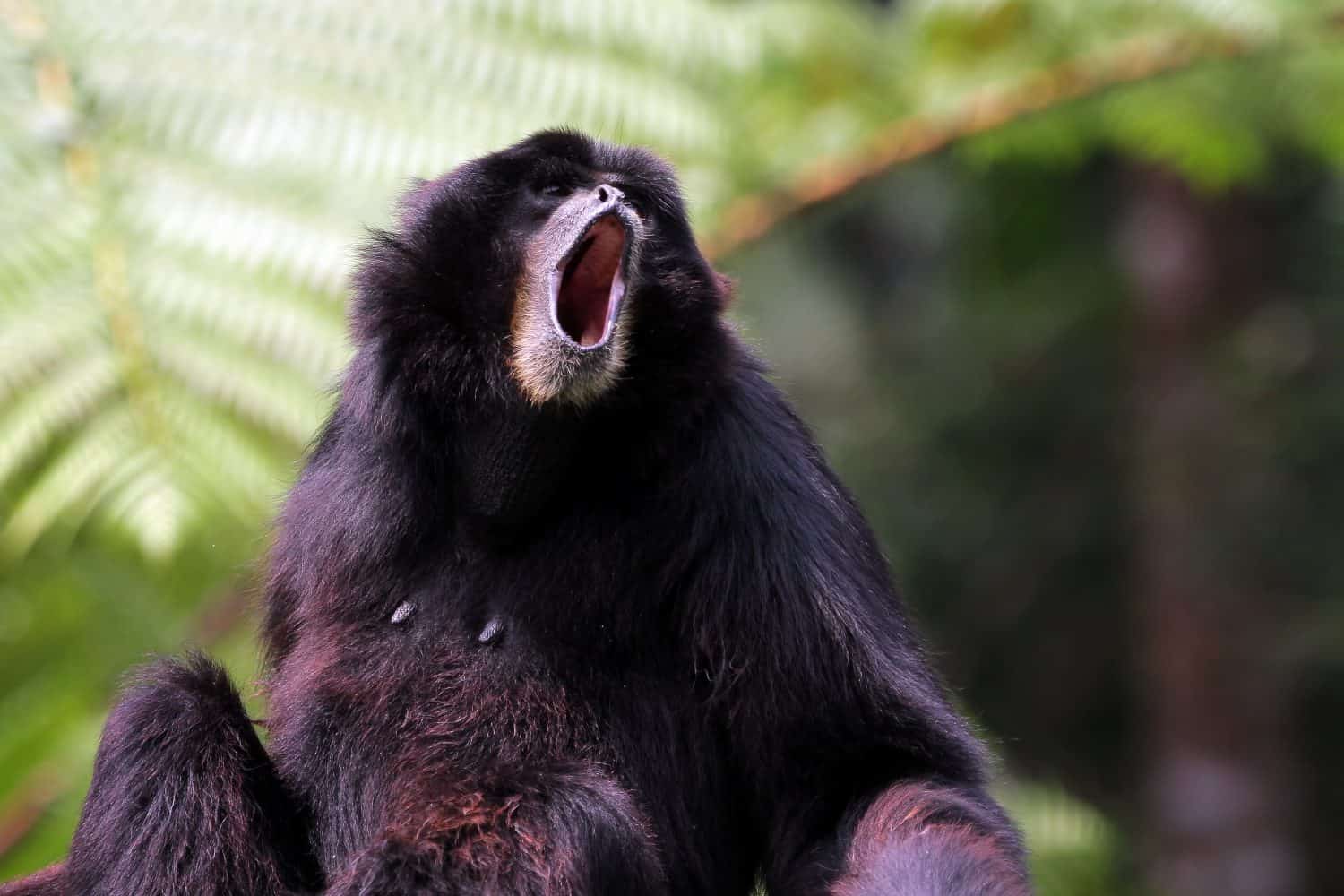
There are 20 species of gibbons, organized into four genera.
©Kurit afshen/Shutterstock.com
While they are part of the ape family, gibbons are often referred to as “lesser” or “small” apes due to their smaller size compared to the great apes. Despite their smaller status, however, these special primates easily stand out with their incredibly loud vocalizations. If you want to know what a gibbon sounds like, be sure to turn the volume up to fully appreciate their extraordinary vocal power in the video above!
Why Do Gibbons Scream?
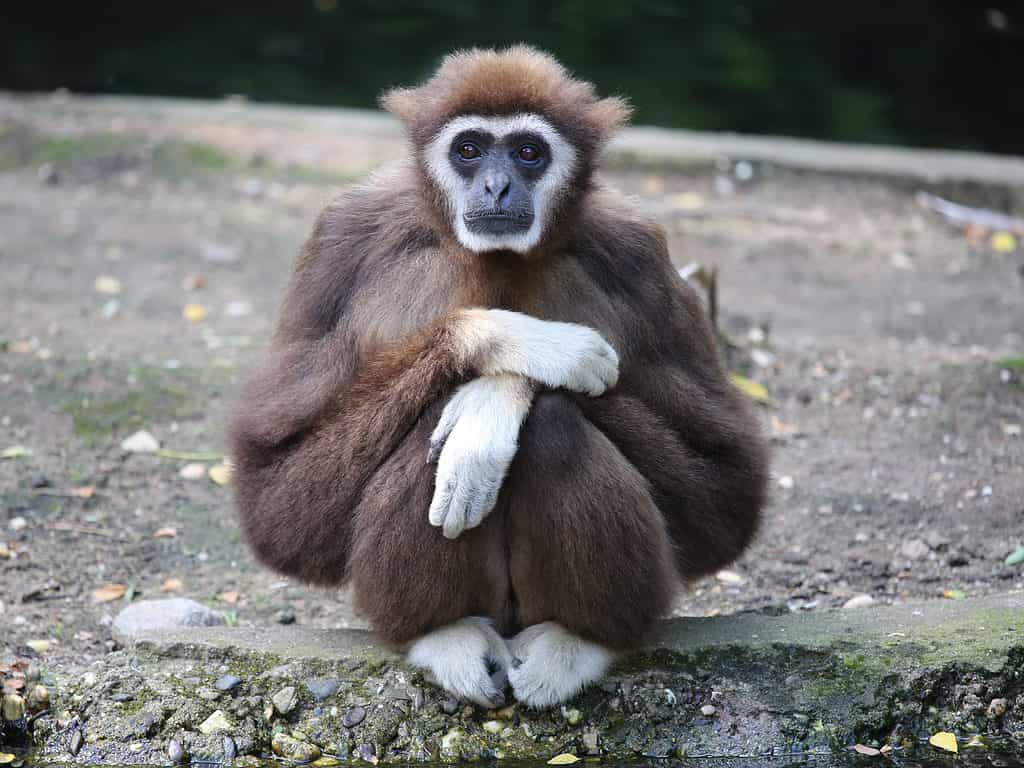
Unlike other apes, gibbons do not make nests.
©Edwin Butter/Shutterstock.com
Much like humans, gibbons use a variety of sounds for different reasons. In the morning, they often begin their day with loud, booming calls to claim their territory. Male and female gibbons also greet each other with loud calls, often harmonizing in a unique duet. Even distant groups of gibbons might engage in a call-and-response concert, singing in a round across the forest.
Gibbons create complex songs from a set of basic calls. These loud sounds serve many purposes, including defending territory, attracting mates, and strengthening pair bonds and family ties. Some gibbons, like the lar or white-handed gibbons (Hylobates lar) in Thailand, even use their songs as a defense mechanism against predators.
However, gibbon calls are more than just loud noises. Male and female gibbons have different songs that they often sing together in intricate duets, synchronized and harmonized with surprising precision. These duets use precise timing, harmonization, and melody interplay — remarkably similar to human music.
How Do Gibbons Make Such Loud Sounds?
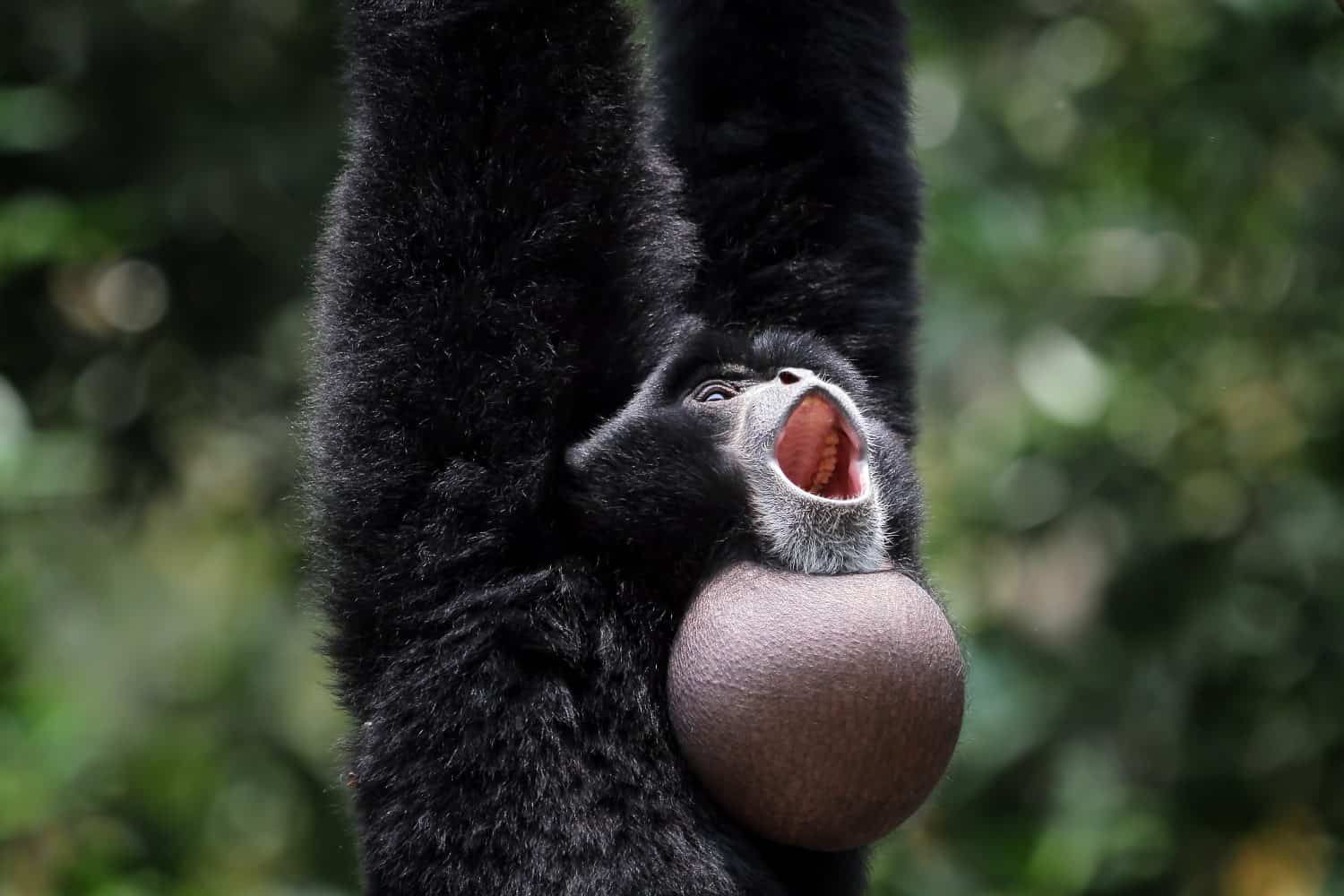
A gibbon’s song is unique to its particular group and region.
©Kurit afshen/Shutterstock.com
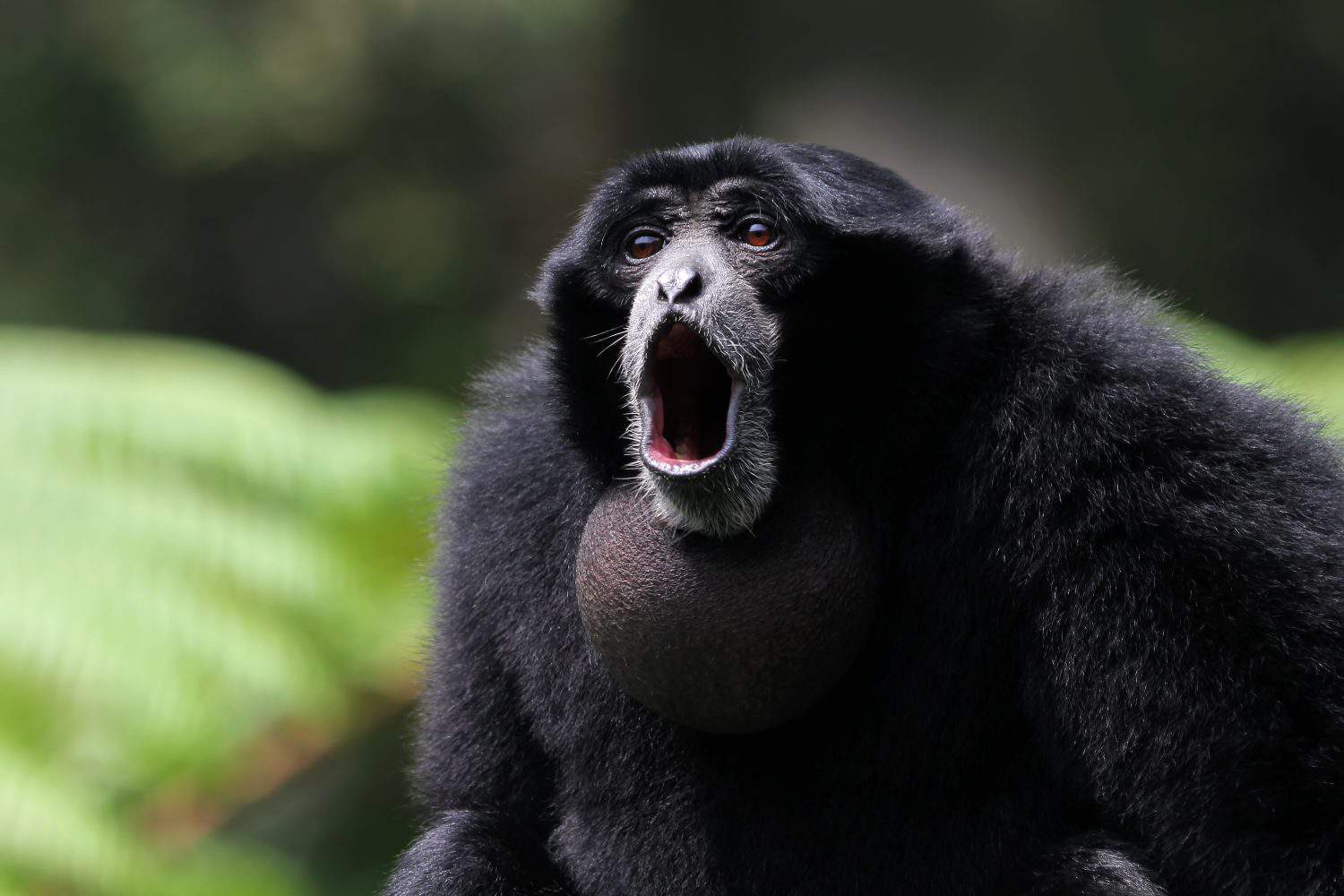
Gibbons are among the loudest primates in the world, second only to the howler monkey (A gibbon call is generally around 100dB, while howler monkey calls are up to 140 dB). Their loud calls are quick to alert other humans and animals of their presence in an area. In fact, a gibbon’s call can be heard from up to two miles away. Of course, distance depends on environment; in dense rainforest, siamang calls may travel 1–2 miles under ideal conditions, but most gibbon songs carry roughly 0.5–1 mile.
Gibbons, like humans, produce sound through a “source-filter” method. Their vocal cords vibrate, creating a blend of harmonic frequencies. The shape of their vocal tract, which they can adjust by manipulating their mouth, teeth, and lips, determines which of these harmonics are amplified. This process, known as “resonance tuning,” allows gibbons to produce a variety of calls, much like how human singers adjust their vocal tracts to produce different notes and sounds.
The Siamang (Symphalangus syndactylus) is the largest — and loudest — of the gibbon family. These unique gibbons have an inflatable air sack below their face that they can inflate to the size of their head! While this might make them look like bullfrogs, it allows them to produce loud, booming calls that can travel for miles through the rainforest.
Where Do Gibbons Live?
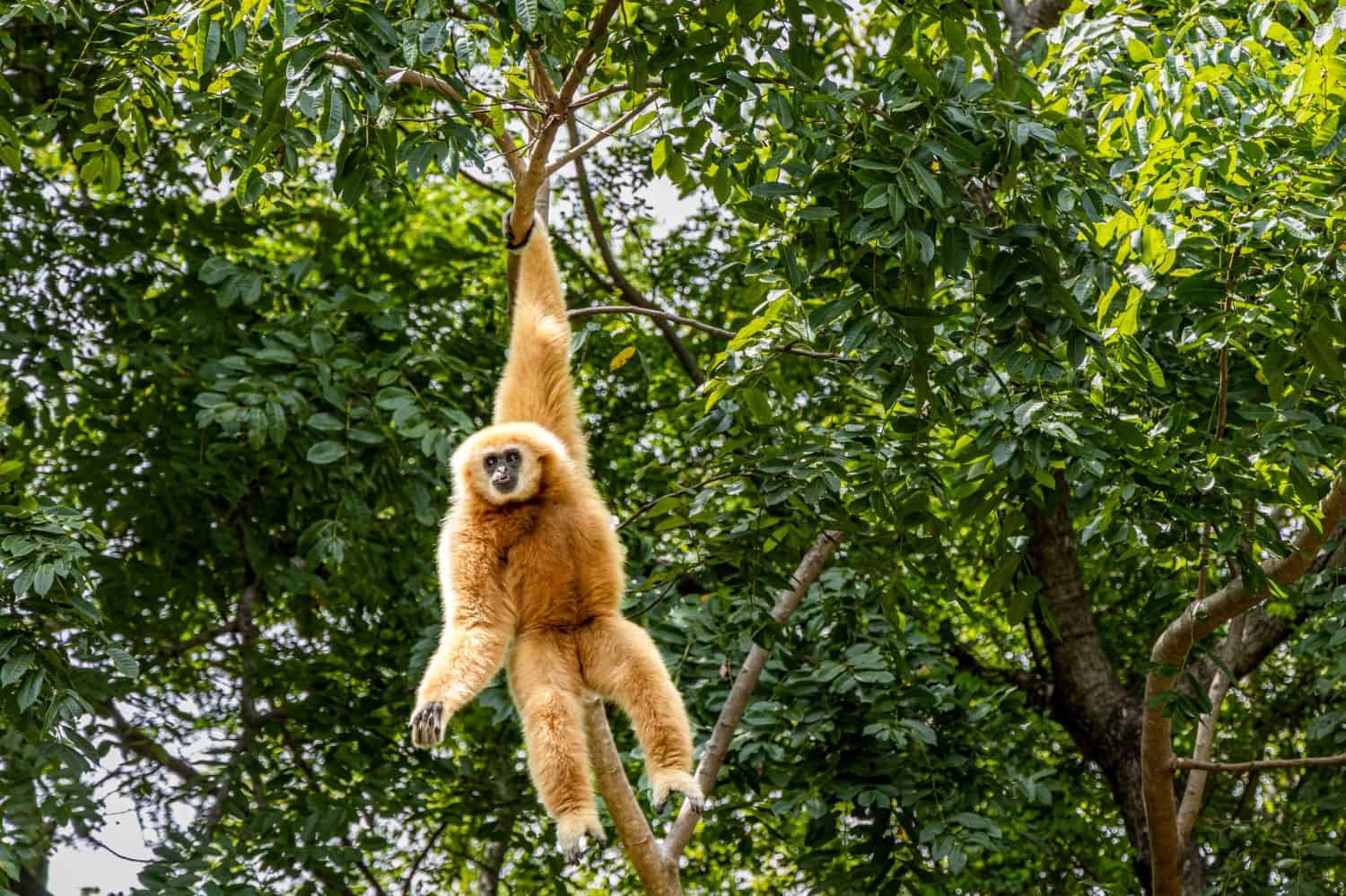
Gibbons can travel through the trees going nearly 35 mph!
©FOTO JOURNEY/Shutterstock.com
Gibbons are native to the southern, southeastern, and eastern regions of Asia. Twenty species of gibbons can be found throughout these regions in the subtropical and tropical rainforests of countries like Thailand, China, Vietnam, Indonesia, Bangladesh, and India. All gibbons are arboreal primates, which means they spend nearly all their time up in the trees.
Unlike other apes, gibbons have incredibly long arms — longer than their entire body. When on the ground, they hold their arms out for balance. But up in the trees, gibbons shine as true acrobatic masters, swinging effortlessly through the canopy.
Gibbons are highly social creatures who form strong, lifelong bonds. Male and female gibbons often mate for life and develop their own unique songs and calls.
Unfortunately, nearly all 20 species of gibbons are endangered or critically endangered. The eastern black-crested gibbon (Nomascus nasutus), for example, is the rarest primate on earth, while the Hainan gibbon (Nomascus hainanus) is the rarest mammal, with fewer than 25 remaining in the wild. There aren’t any Hainan gibbons in captivity either, which puts these incredibly rare creatures on the brink of extinction.