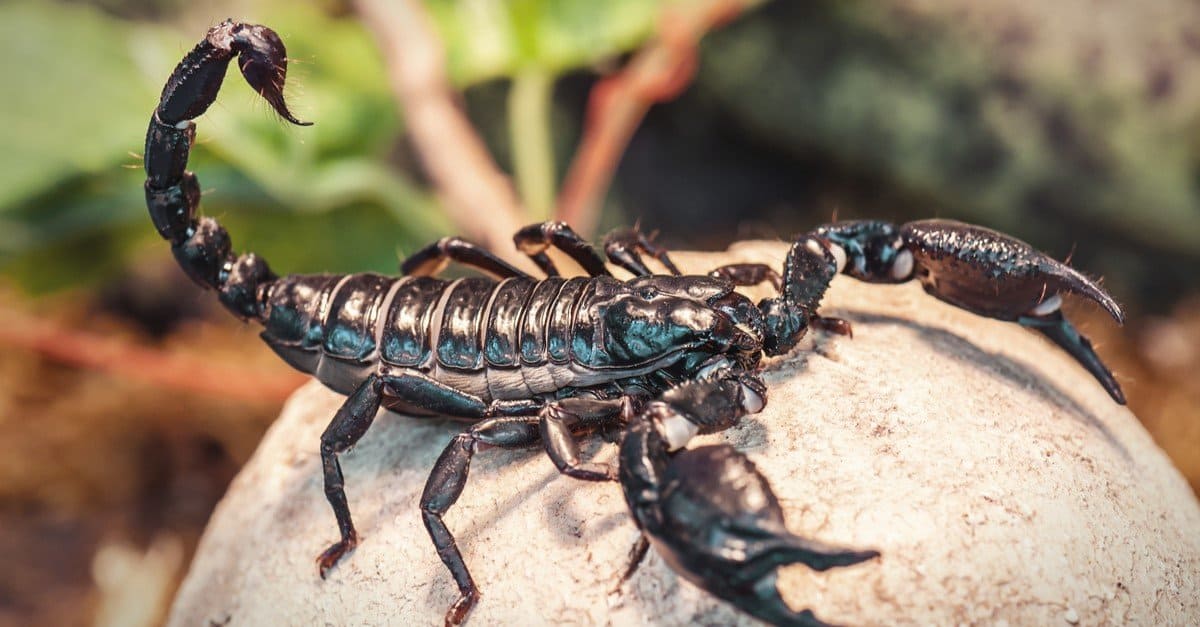
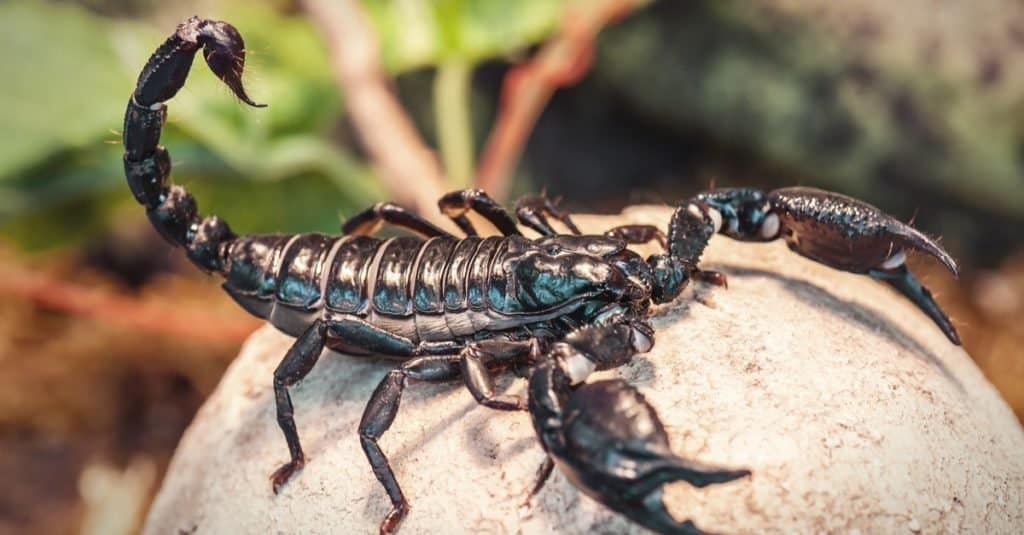
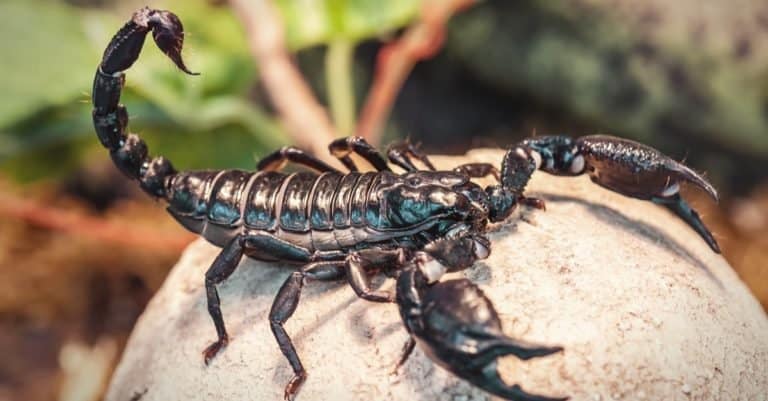
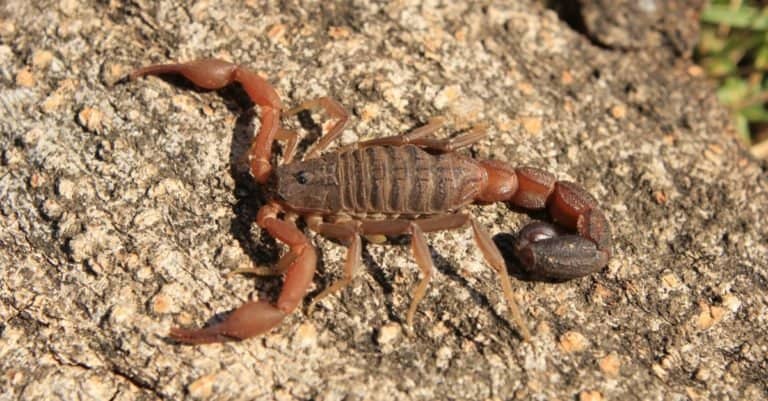
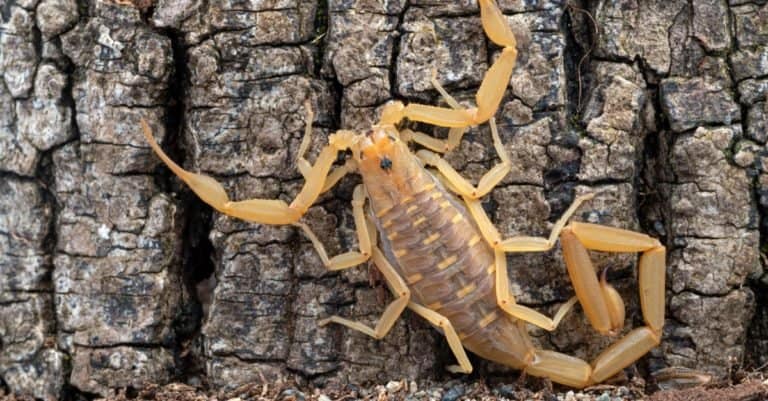
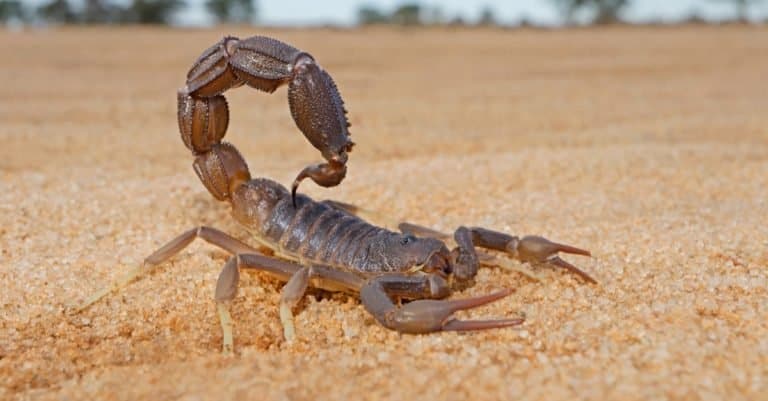

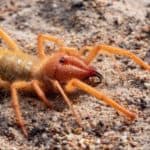
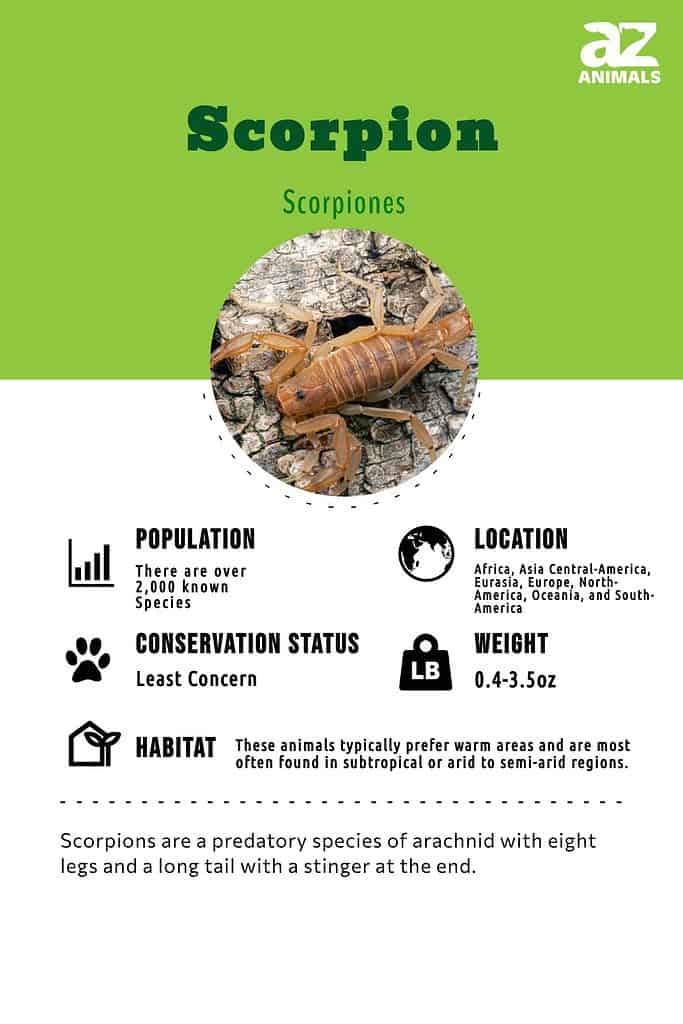
Scorpions are a predatory species of arachnid with eight legs and a long tail with a stinger at the end.
Two of the scorpion’s eight legs are in the form of pincers that look a bit like lobster claws. Scorpions are well-distributed all over the world, and they live on every continent except Antarctica. There are over 2,600 species of scorpions.
6 Incredible Scorpion Facts!
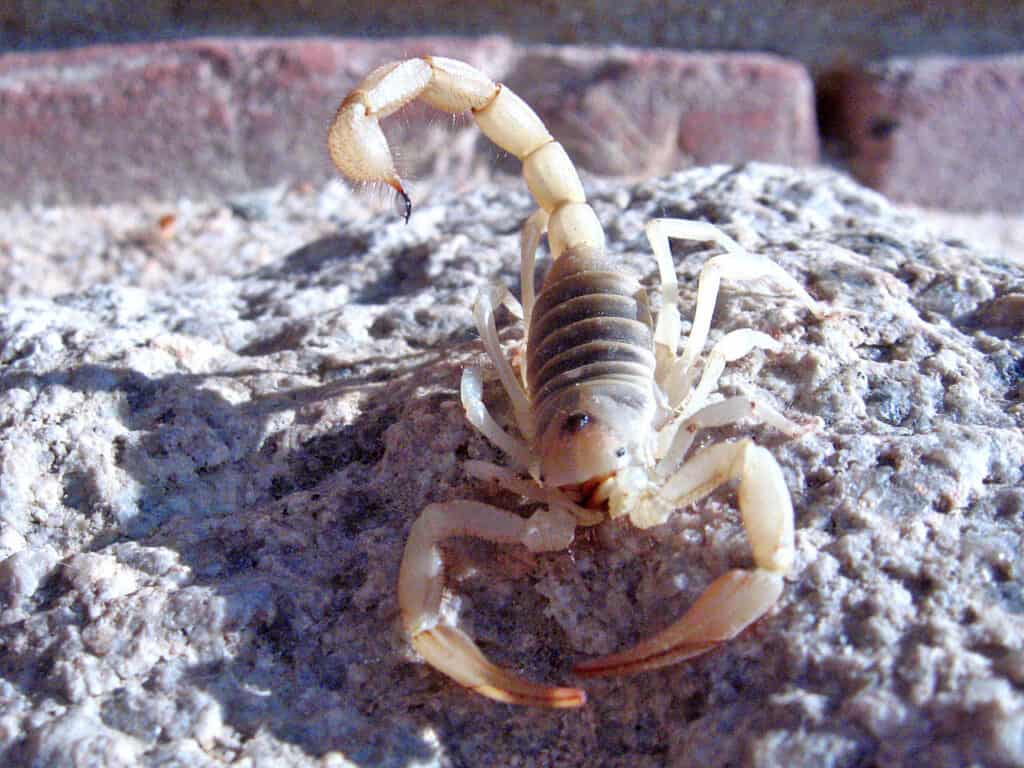
Most species of scorpions are not a serious threat to humans.
©Robb Hannawacker, while working for Joshua Tree National Park / CC BY 2.0 – Original / License
Here are some awesome Scorpion facts:
- Most species of scorpions are not a serious threat to humans.
- Their exoskeletons have fluorescent chemicals that glow in ultraviolet light.
- People in some places of Africa and East Asia often consume them as food.
- About 25 species of scorpions have venom deadly enough to kill a human.
- Some scorpions can squirt venom to ward off predators.
- The largest scorpion in the world is the giant forest scorpion. It can grow to more than 9 inches in length!
Evolution and Origins
Interestingly enough, Scorpions first appeared as an aquatic organism in their evolutionary history. Studies suggest that they certainly evolved from the Eurypterids or sea scorpions, a group of extinct marine anthropods, since both groups share several common morphological features. In order to defend itself from prey animals, Scorpions had to develop a defense and method for hunting and eating.
Species, Types, and Scientific Names
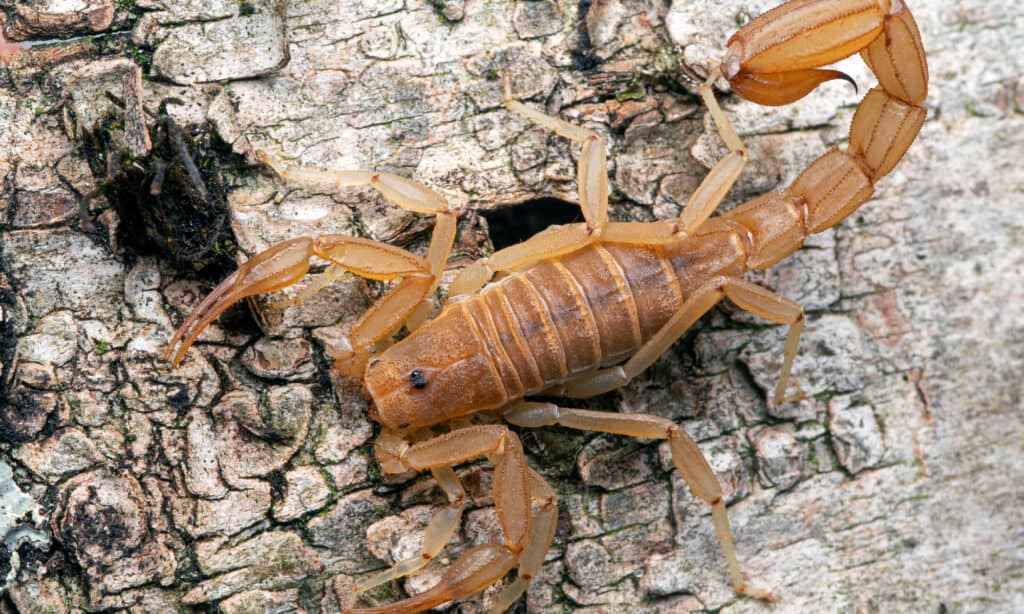
Scorpiones are predatory arthropods belonging to the Arachnida class and the order of Scorpiones.
©Ernie Cooper/Shutterstock.com
Scorpions are predatory arthropods belonging to the Arachnida class and the order of Scorpiones.
There are several families that fall under this order, including the following:
- Chaerilidae
- Pseudochactidae
- Buthoidea
- Iuridae
- Bothriuridae
- Chactidae
- Scorpionidae
There are over 2,650 described species, and the vast majority are found in subtropical areas and deserts. The scientific name varies by species.
For example, the scientific name of the giant forest scorpion is Heterometrus swammerdami, and it belongs to the Scorpiondae family.
The classification of scorpions commonly accepts that there are around 1,004 known species. However, the number may be greater than this, and some classifications are disputed.
The full classification is Kingdom Animalia, Phylum Arthropoda, Subphylum Chelicerata, Class Arachnida, and Order Scorpiones.
Additionally, different Scorpion types:
- Emperor scorpion
- Deathstalker
- Tityus serrulatus
- Brazilian scorpion
- Tetratrichobothrius flavicaudis
- Heterometrus
- Giant hairy scorpion
- Heterometrus spinifer
- Euscorpius italicus
- Bark scorpions
- Hottentotta tamulus
- Fattail scorpion
- Diplocentrus
- Caraboctonidae
- Pandinus
- Arrowbreasted scorpions
- Scorpionidae
- Euscorpius
- Brontoscorpio anglicus
- Flat rock scorpion
- Stripe-tailed scorpion
- Vaejovis
- Nebo hierichonticus
- Bothriurus
- Lurus
- Cercophonius squama
- Euscorpiidae
- Hadogenes
- Vaejovidae
- Kolotl
- Luridae
- Chaerilus
- Scorpionoidea
- Pseudochactoidea
- Chaeriloidea
- Chactoidea
- Belisarius
Appearance
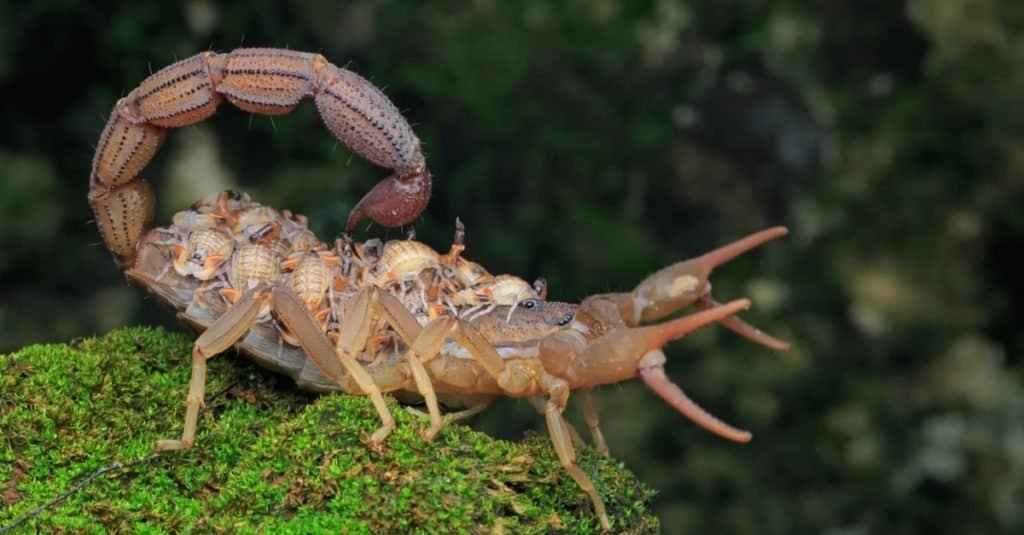
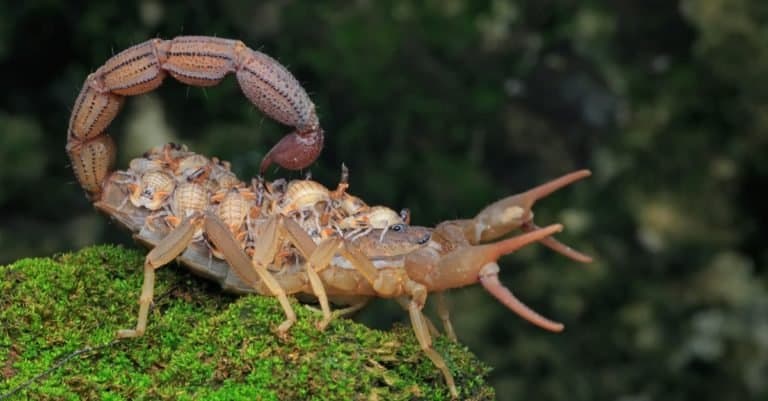
A scorpion mother (Hottentotta hottentotta) is holding her babies on her back.
©I Wayan Sumatika/Shutterstock.com
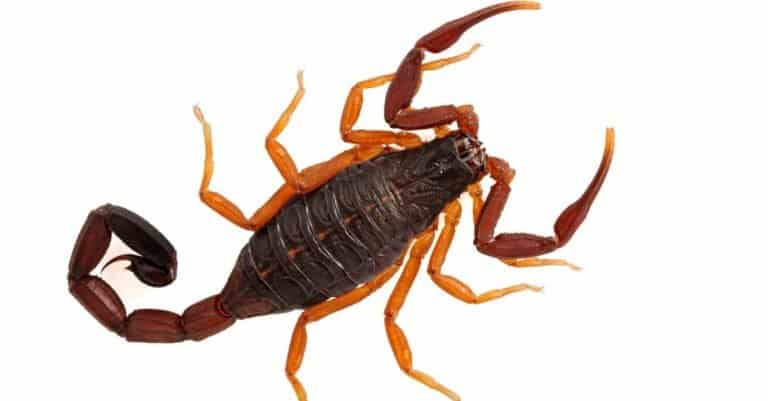
Compared to other pest bugs or animals, scorpions are very easy to identify. The front pincers and the tail with a stinger are the main ways to identify them.
The largest species is the giant forest scorpion, which has the world record for size at nine inches long and a weight of two ounces. In general, the emperor scorpion is one of the largest species with an average length of nearly eight inches.
The emperor scorpion also has the distinction of having the largest pincers, which are very similar to a lobster.
Due to its large pincer size, the emperor scorpion has relatively weak venom. The smallest scorpion is a species found in Texas that measures only 23 millimeters. Most of these animals are around two inches in size.
Their coloring can vary based on where they live. They often blend into rocks, bark, and sand. Yellow and black are the most common colors of scorpions, but they can also be brown, red, or orange.
Desert scorpions tend to be lighter colors while forest scorpions are typically black. When under ultraviolet light, all of them will appear blue or blue-green.
They are largely solitary compared to bug pests like ants or bees. They tend to stay in holes or burrows by themselves. If they are found in groups, it’s likely due to recently born young scorpions.
Habitat
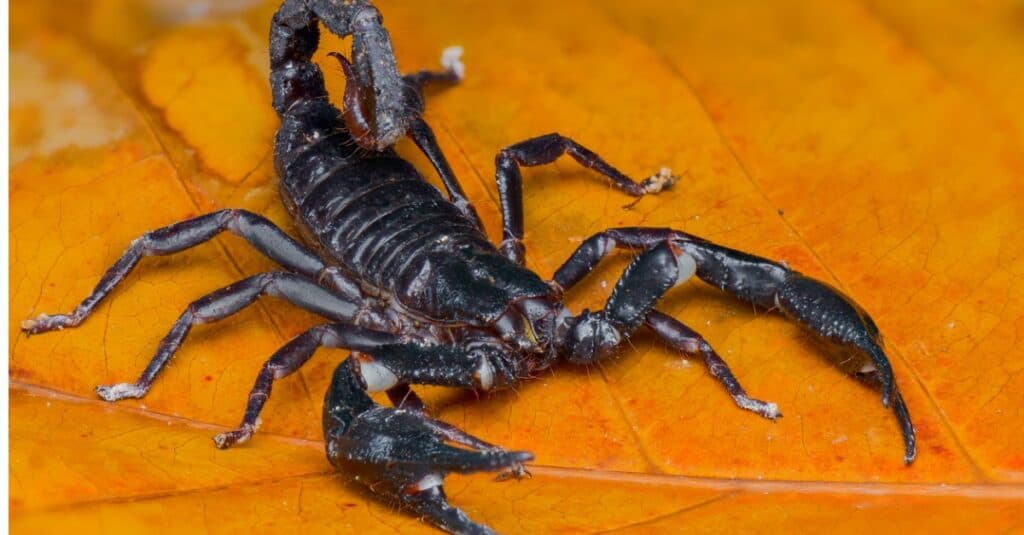
These animals typically prefer warm areas and are most often found in subtropical or arid to semi-arid regions.
©iStock.com/Dwi Yulianto
These animals typically prefer warm areas and are most often found in subtropical or arid to semi-arid regions. Every continent except Antarctica can claim some species of them. They often hide under rocks, logs, leaves, debris, or clutter.
It’s also common for them to dig burrows where they hide during the day. Some of them even use their burrows to ambush prey. If daytime temperatures are cool and moist, the animal might be more active. Otherwise, they typically only come out at night.
When it comes to finding these animals in human homes, it’s important to consider what they like in the wild. They can get into houses through gaps around doors and windows.
Since they like to hide under things in the wild, they will often hide behind and beneath things inside a house. Another place scorpions like to hide is in shoes. These animals can climb quite well and may also climb into hanging clothes.
They can’t climb on smooth glass. Placing wide-mouth jars beneath the table and crib legs can keep them from climbing in these areas. Another deterrent is covering the legs with petroleum jelly.
Diet
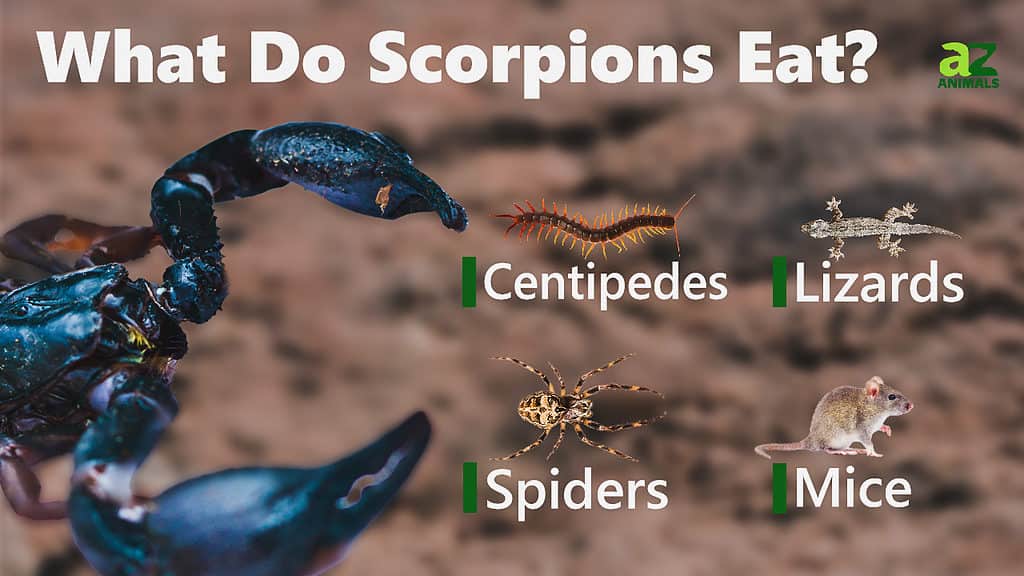
These animals prey mainly on bugs such as grasshoppers, termites, beetles, and wasps. They may also eat other arachnids, including other scorpions. Large species sometimes prey on animals such as small reptiles and mammals.
Different types hunt and kill prey in different ways. For example, species with large powerful pincers will use their pincers to crush prey.
Scorpions with smaller pincers but stronger venom will sting their prey. Some of them chase or ambush prey while others wait in burrows.
These animals can survive a long time without food due to their slow metabolic rate, general inactivity, and efficient biological method of food storage. Some of them can survive six months to a year without food.
What do scorpions eat?
These animals eat all manner of insects as well as other arachnids. Very large species may also prey on small reptiles and rodents. They also eat other scorpions, and large spiders will prey on smaller scorpions as well.
Natural Predators
It seems silly to have a section dedicated to the scorpion’s predators. All too often, we think of them as the predators. Regardless, there are plenty of animals that actively dine on them.
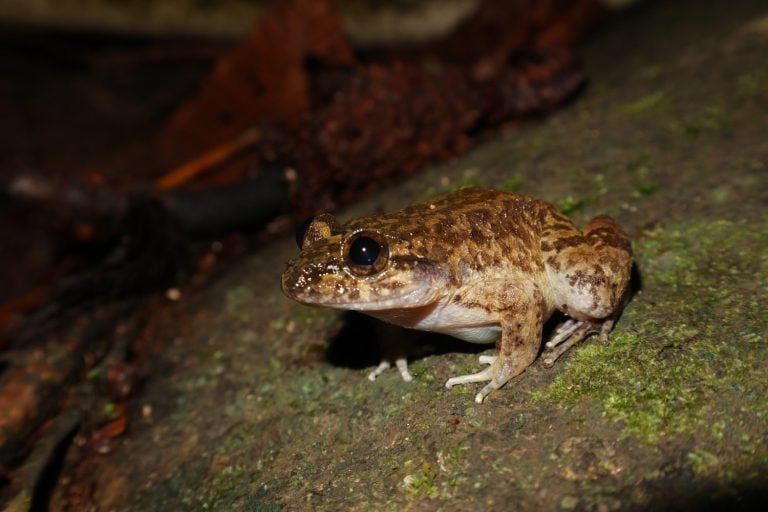
Scorpions need to watch out for birds of prey, such as hawks and owls, who can snatch them up before they even have a chance to defend themselves; some species of bats, most notably the pallid bat (Antrozous pallidus); snakes, which capture and restrain them; some species of lizards; the sticky tongues of toads and frogs that shoot out from their enormous mouths and retract so quickly that scorpions do not even have a chance to sting them before being gulped down; and rodents, as unusual as that may sound.
Many of the scorpion’s natural predators have a notable tolerance to or what appears to be immunity from scorpion venom. While no creature is 100% immune, several appear unphased by it, mostly because of mechanisms designed to lessen the effects of scorpion venom.
For example, hedgehogs are known to have “immunity.” Rather, its spines and thick skin act as a physical barrier. The scorpion’s stinger struggles, and often fails, to penetrate to susceptible areas. It is said that meerkats are immune to scorpion venom. The truth is that they are just better at hunting scorpions than scorpions are at defending themselves against meerkats.
The Grasshopper Mouse, a noted, but small predatory rodent in North America, loves to snack on scorpions, seemingly unphased by their venom. In fact, in their nerve cells are receptors that do not allow scorpion venom to harm them.
Let’s not forget that humans are also a natural predator to scorpions. Many of us stomp them or call pest control. Others, however, eat them. Scorpions are part of the culinary landscapes of China, Thailand, Cambodia, Laos, and Mexico, where these arachnids are grilled, stir-fried, deep-fried, and skewered.
Prevention
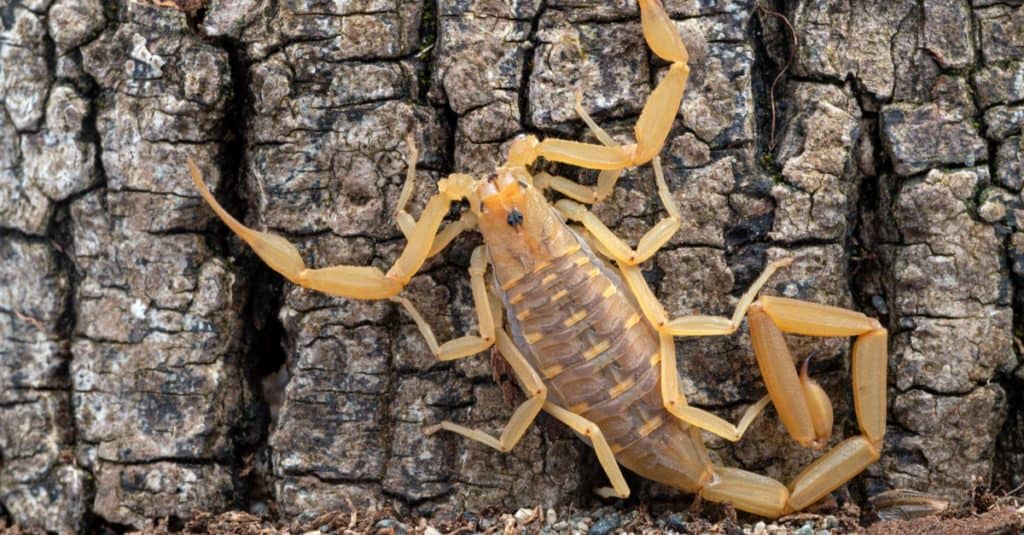
If you live in an area with these animals, it’s best to prevent them from entering your house by plugging up gaps.
©Ernie Cooper/Shutterstock.com
If you live in an area with these animals, it’s best to prevent them from entering your house by plugging up gaps around doors, windows, wires, and pipes. Keep organic litter away from your house as it’s a place where scorpions like to hide.
Expose the trunk and ground around shrubs and trees by pruning. Piles of rocks or firewood are also places where they like to hide. Use tight-fitting screens on all windows and doors and make sure that your air conditioner doesn’t leak.
Avoiding stings inside means not walking around at night with bare feet. Use an ultraviolet flashlight to shine in dark corners. Always check shoes and clothing before wearing them as these are favorite spots for them to hide. If you find one of them on your body, don’t swat at them but brush them off.
Insecticides can be used against these animals as well. This should be sprayed around the house perimeter as well as near entry points, inside around baseboards, inside closets, around plumbing, and in the garage and/or basement.
Scorpion Pictures
View all of our Scorpion pictures in the gallery.

Vova Shevchuk/Shutterstock.com
Sources
- Wikipedia / Accessed June 6, 2021
- African Snakebite Institute / Accessed June 6, 2021
- Orkin / Accessed June 6, 2021
- Animals.mom / Accessed June 6, 2021