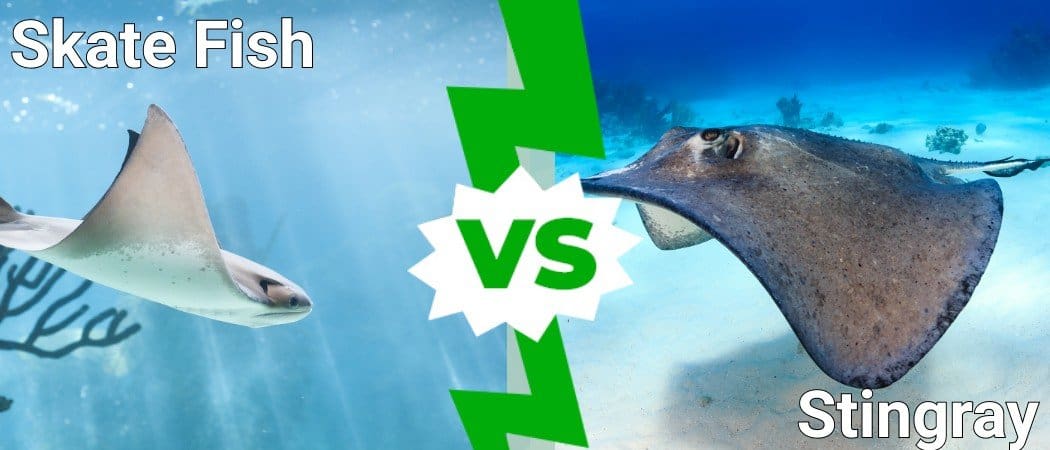

Skate fish and stingrays are found in oceans all around the world. They are often confused for one another because of their similar appearances. They are both flat, with gills and mouths located on the undersides of their bodies. To confuse matters further, some stingrays can be diamond-shaped like skates. They are also both bottom dwellers that camouflage themselves by hiding in the mud and sand. So, considering all these similarities, is it possible to tell them apart? There are actually a few notable differences between them. Join us as we discover the differences between skate fish and stingrays.
This post was updated on November 2, 2025 to clarify the size range of stingrays, number of functional barbs, that skates lay one egg case at a time, and that developing stingray embryos are nourished by a nutrient-rich fluid called uterine milk.
Comparing Skate Fish vs. Stingray
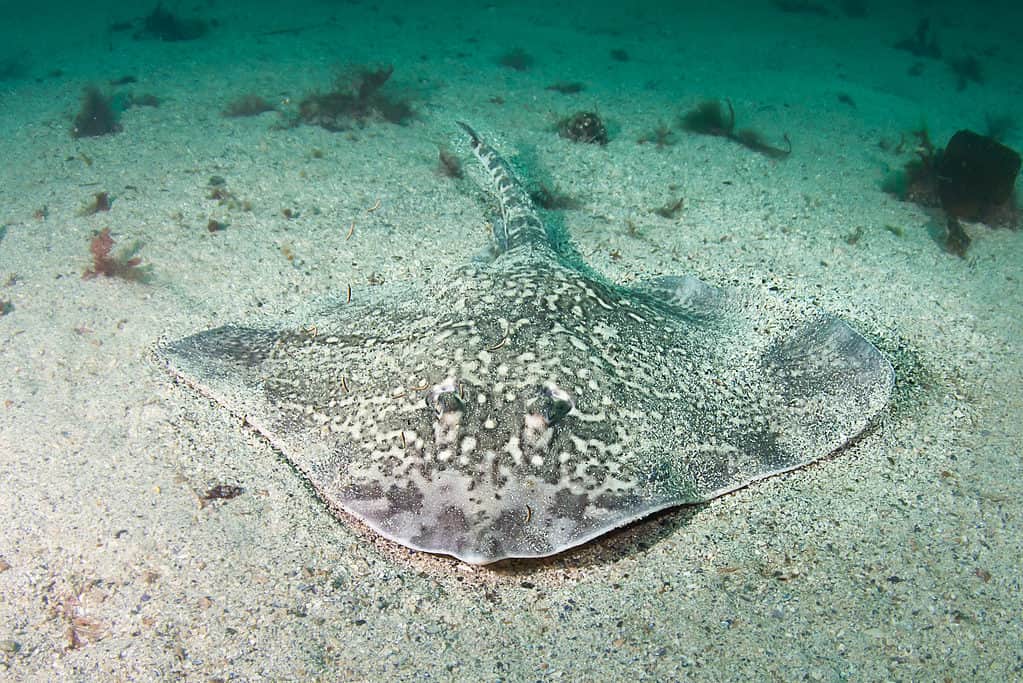
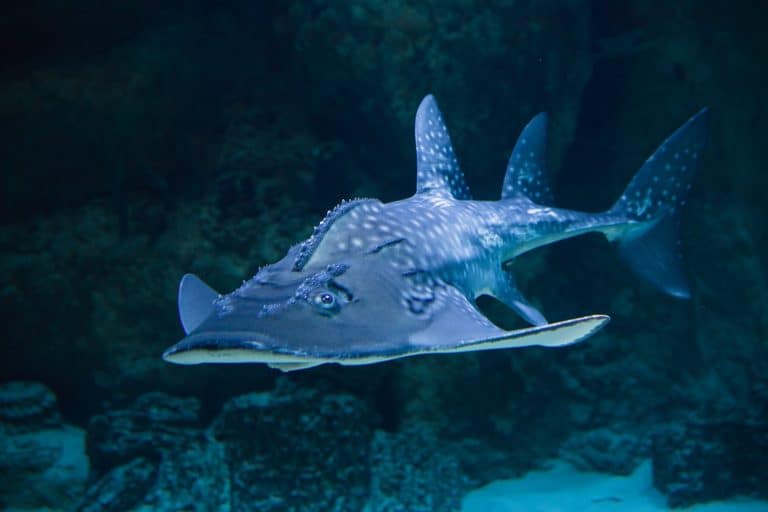
Skates and stingrays have skeletons made of cartilage, not bone.
©Joern_k/Shutterstock.com
Skate fish and stingrays are both cartilaginous fish, which means they have a skeleton that is made from cartilage rather than bone. Cartilaginous fish belong to the class Chondrichthyes. Both skate fish and stingrays belong to the subclass Elasmobranchii, which includes all sharks, rays, skates, and sawfish. There are currently around 200 species of stingray in the oceans today and more than 200 species of skate fish. Check out the chart below to learn a few of the main differences between skates vs. stingrays.
| Stingray | Skate Fish | |
|---|---|---|
| Habitat | Typically warm, shallow coastal waters | From tropical to the Arctic waters down to depths greater than 9,000 feet |
| Size | Up to 16 feet across | Up to about 8 feet long |
| Color | Varies widely | Typically brown or grey |
| Tail | Long and thin with a long stinger | Thick and fleshy. No stinger but has spikes on the top |
| Pelvic Fins | One lobe | Two lobes |
| Dorsal Fin | Absent or vestigial | Small but distinct |
| Teeth | Flattened plates | Small and pointed |
| Reproduction | Viviparous | Oviparous |
| Diet | Crustaceans, shrimp, worms, clams, oysters | Crustaceans, clams, shrimp, worms, small fish |
The 4 Key Differences Between Skate Fish and Stingrays
Even though both are cartilaginous fish, there are vital differences between a skate fish and a stingray. For a start, stingrays can be more dangerous to humans, while skate fish are relatively harmless. A skate fish’s tail is typically much thicker and shorter than a stingray’s tail. They also have different fins, teeth, and even reproduce and give birth in completely different ways. Let’s explore the differences between a skate vs. stingray in detail.
Tails
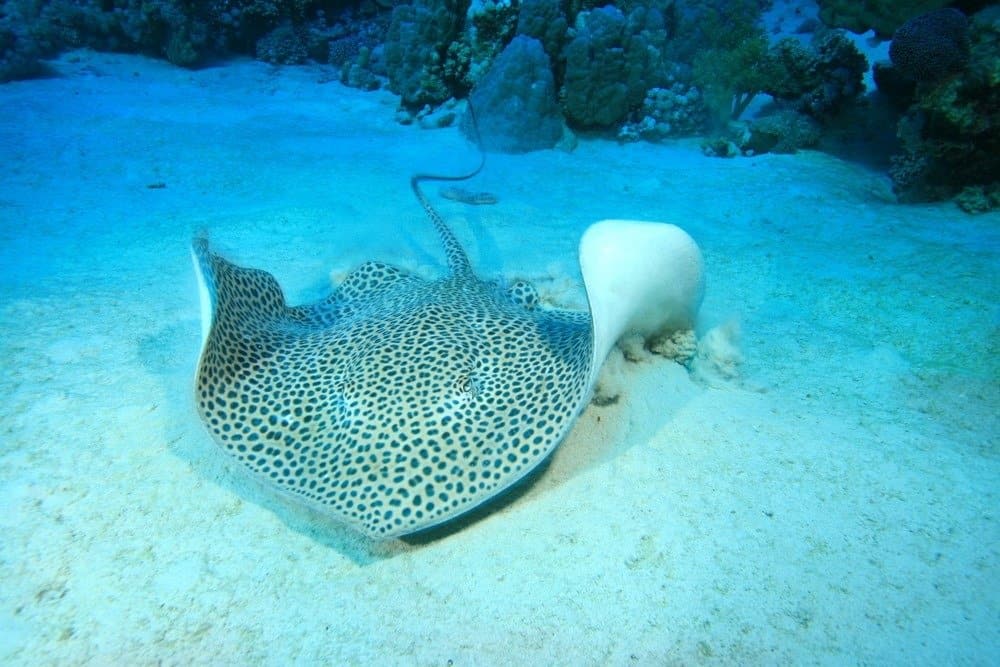
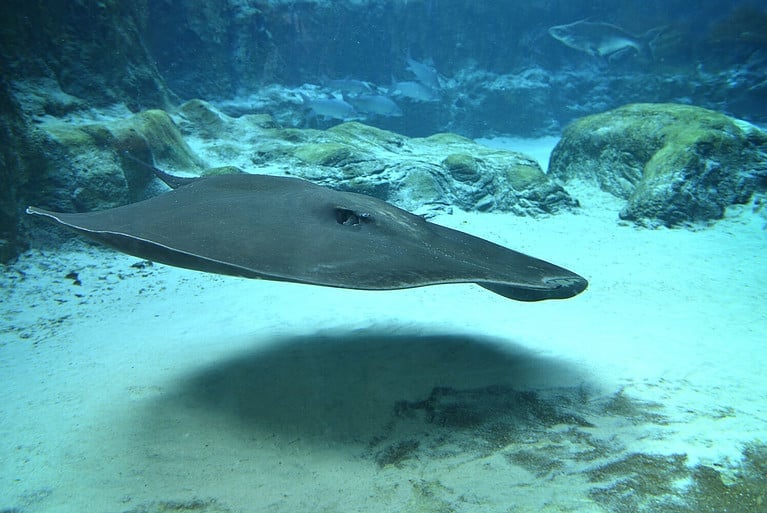
Stingrays are bottom dwellers and have long, venomous barbs on their tail.
©Rich Carey/Shutterstock.com
The most noticeable difference between skate fish and stingrays is their tails. Skate fish have a much thicker tail which is often shorter than that of a stingray. Skate fish also lack venomous barbs on their tails. However, they do still have a method of protecting themselves. They have a row of sharp spikes or thorns that run up their tails and the center of their backs, but they are not venomous.
Stingrays have a long whip-like tail which has long barbs, or stingers, on it, which is where they get their name. Most stingrays have one functional venomous barb on the end of the tail, though a few species may temporarily have two if a new spine grows before the old one is shed. Though these barbs are venomous, stingrays are not typically aggressive to humans and only sting in self-defense. A sting from a stingray can be very painful, but it is rarely fatal.
Fins
Stingrays and skate fish also have slightly different fins. Skate fish have large, prominent pectoral fins that look like wings. Their pelvic fins are divided into two lobes, and they have two small but very distinct dorsal fins near the tail. They also have reduced caudal fins and no anal fin.
Stingrays also have wide, wing-like pectoral fins. However, they have only one lobe on their two pelvic fins, which are located at the base of the tail. The dorsal fin is either mostly absent or extremely small, and it is difficult to see even when it is present. Most stingrays also lack developed caudal and anal fins.
Teeth
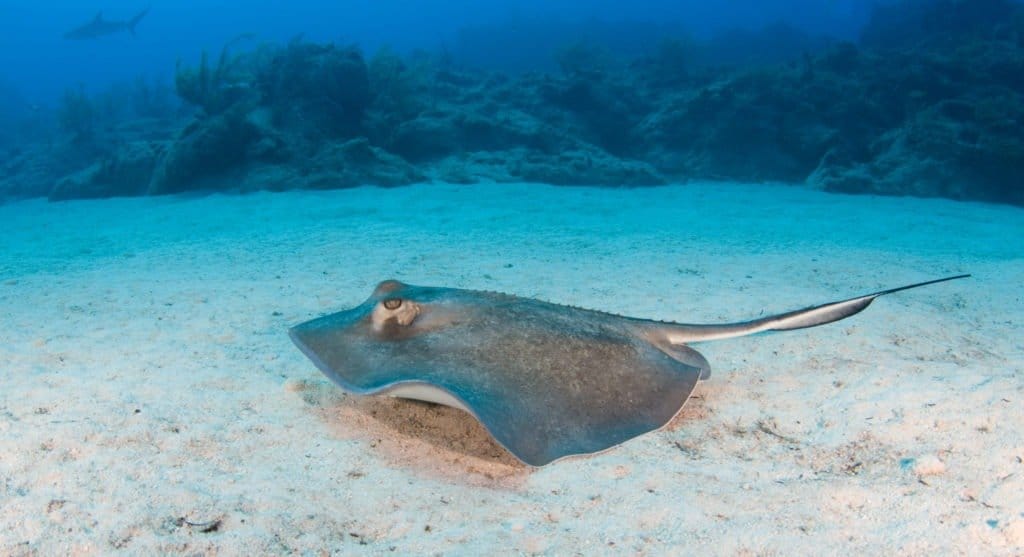
Skates have tiny, pointed teeth designed to grasp and hold fast-moving prey.
©A Cotton Photo/Shutterstock.com
Another difference between skate fish and stingrays is their teeth. Skate fish have tiny, pointed teeth designed for biting. These sharp teeth allow them to grasp and hold onto struggling prey such as small fish, crustaceans, and other organisms that live on the sea floor.
Stingrays have flattened plates in their mouths for crushing hard-shelled prey like clams and oysters. They are made from modified placoid scales, which are also known as dermal denticles. Incredibly, these dermal denticles are actually the same type of scales that cover a shark’s body. Not only that, but stingrays also constantly replace their teeth, just like sharks do.
Reproduction
Skate fish and stingrays also reproduce in vastly different ways. Skate fish are oviparous, which means that they lay eggs. They produce egg cases which are known as “mermaid’s purses.” These are extremely unusual, as they look like black rectangles with arm-like extensions protruding from each corner. Each egg case is unique to the species of skate fish that laid it, and they hatch after around 12 weeks. Skates lay one egg case at a time, though a female may produce dozens over the course of a breeding season.
In contrast, stingrays are viviparous, meaning they give birth to fully formed live young, known as pups.
The developing embryos are nourished by a nutrient-rich fluid called uterine milk (histotroph) rather than a placenta. Stingray gestation periods vary by species and can range from 3 to 11 months, with litter sizes typically between 2 and 10 pups