
Quick Take
- "Asian carp" isn't actually one fish, and the distinction matters more than you'd expect. See the species breakdown →
- Silver carp have turned some leisure activities into something genuinely dangerous, and the reason why is hard to believe. See the boating hazard →
- One of these fish tastes surprisingly good, though it's probably not the one you'd pick. Explore the taste comparison →
- Common carp were introduced to the U.S. nearly 150 years before Asian carp, so why does only one carry the "invasive" label? Understand the invasive label →
Common carp inhabit nearly all U.S. states, but Asian carp are primarily concentrated in the Mississippi River basin. Common carp feed on aquatic vegetation like phytoplankton. However, since the 1970s, there has been intense competition for their food source from invasive Asian carp species. Conservation efforts are underway to clear out invasive carp. We’ll break down a few differences between Asian carp and common carp so you can tell these fish apart.
Comparing Asian Carp vs. Common Carp
| Asian Carp | Common Carp | |
|---|---|---|
| Classification | Bighead carp: Hypophthalmichthys nobilis Black carp: Mylopharyngodon piceus Grass carp: Ctenopharyngodon idella Silver carp: Hypophthalmichthys molitrix | Cyprinus carpio |
| Appearance | Color depends on the species; Slender, torpedo-shaped bodies with large heads; no barbels; small scales | Olive to brassy-bronze bodies with yellowish sides and bellies; deep-bodied with short heads; barbels; typically has large scales |
| Species Status | Invasive | Non-invasive but a nuisance fish |
| Behavior | Prone to jumping when startled (especially silver species) | Occasionally jump to clean gills |
| Edibility | Mild, sweet, and clean with light, firm, flaky meat | Mild but with a tendency to taste muddy; oily, dark, soft meat |
The Key Differences Between Asian Carp and Common Carp
The primary difference between Asian carp and common carp is that Asian carp are increasingly invasive and threaten native habitats while common carp are less of a threat. Other key differences include their classification, appearance, behavior, and edibility. Take a deeper look at these differences in the paragraphs below.
Classification
The Asian carp and common carp belong to the same broader family of freshwater fish called Cyprinidae. All of these fish are related to goldfish, minnows, and koi. However, when you hear the term “Asian carp,” it can be misleading. The Asian carp does not just refer to one fish. The term is applied to a group of four related fish species, including the grass, silver, bighead, and black carp.
The scientific name for Asian bighead carp is Hypophthalmichthys nobilis. Asian black carp are classified as Mylopharyngodon piceus. Asian grass carp are Ctenopharyngodon idella. Finally, silver Asian carp are classified as Hypophthalmichthys molitrix. The scientific name for common carp is Cyprinus carpio.
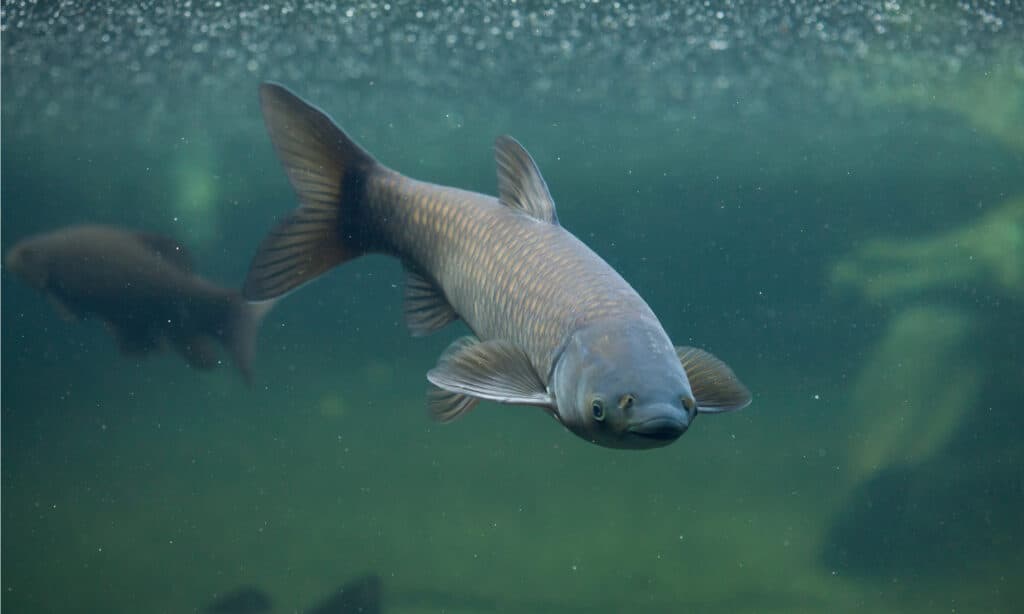
Grass carp are one of the four types of Asian carp.
©Vladimir Wrangel/Shutterstock.com
Appearance
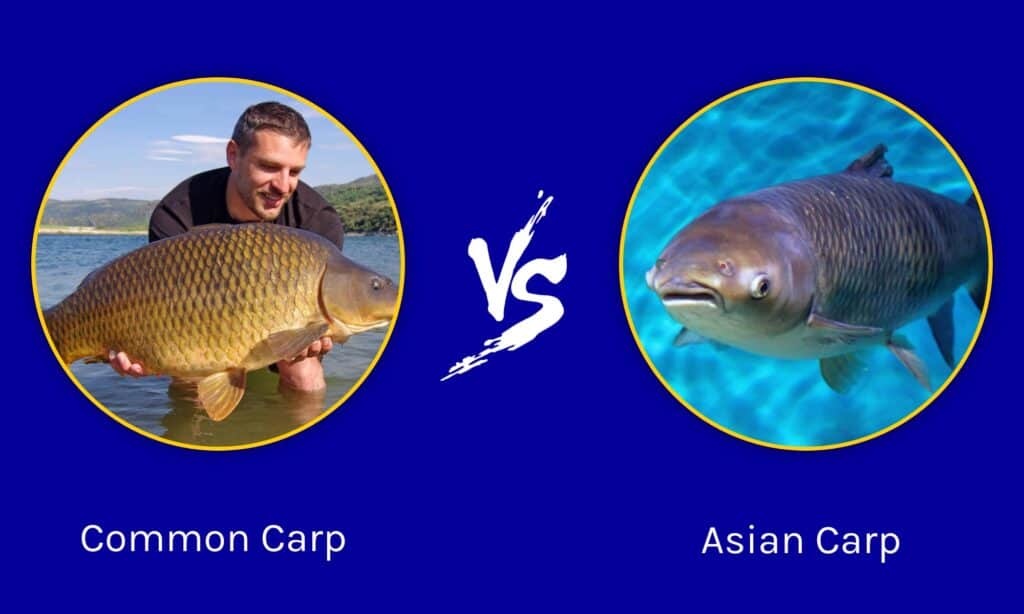
Asian carp are typically more streamlined with slender bodies. However, bighead and silver carps have large, scaleless heads. Their eyes are set low on their heads, either level with or below the mouth. They do not have barbels. Their scales are generally much smaller than other carp. Asian carp typically average around 30-40 pounds, but they can easily reach over 100 pounds. For example, the black carp can grow to up to 5 feet long and 150 pounds.
Bighead carp are dark gray above with pale undersides and dark blotches on the back and sides. Black carp are brown to black with bluish-grey to white bellies and overlapping scales with dark edging. Grass carp are olive-brown to black with brassy or silvery sides and bellies, as well as outlined scales. Silver carp are silver with grey heads and backs, plus white bellies.
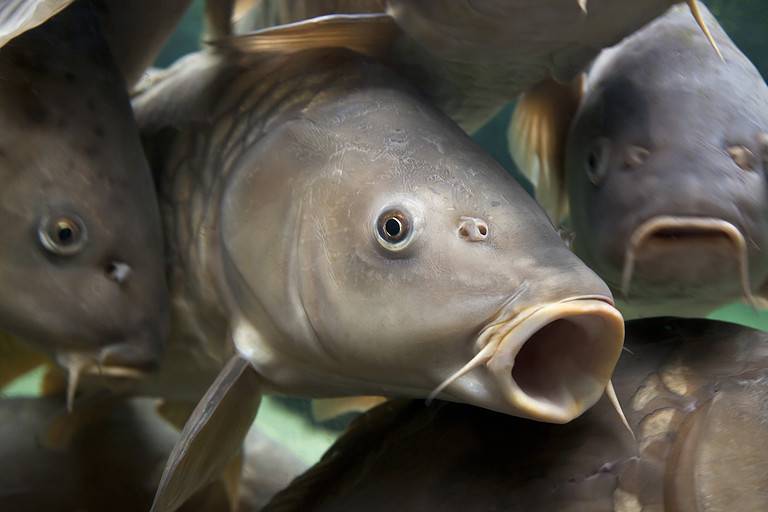
Common carp have stouter bodies and shorter heads. Unlike Asian carp, common carp have barbels and their eyes are positioned near the top of their head. They have large, overlapping scales. They have olive to brassy bronze bodies with yellowish sides and lighter yellow bellies.

Common carp have stout bodies with large, overlapping scales.
©iStock.com/HenrikNorway
Invasive Species Status
Asian carp are an invasive fish species in North America. These fish are native to major river systems in Asia, mainly in China and Russia. They were introduced to North America in the 1970s. The idea was that importing the Asian carps would help control algal blooms in wastewater treatment zones in the Southeast.
However, within 10 years of being introduced to the treatment plants and aquaculture ponds, the Asian carp escaped, entering the Mississippi River basin and other large rivers like the Illinois and Missouri. Now Asian carp are a significant problem. As an invasive species, they directly compete with native species for habitat and food. Since their population is reproducing at a rapid rate, they’re disrupting the food web and ecology of large rivers throughout the Southeast and Midwest.
Common carp are native to large rivers and shallow lakes in Europe and Asia. These fish were first introduced to North American waters in 1831. While they are considered a nuisance fish or pest fish due to their wide distribution, they are not classified as an invasive carp.
Behavior
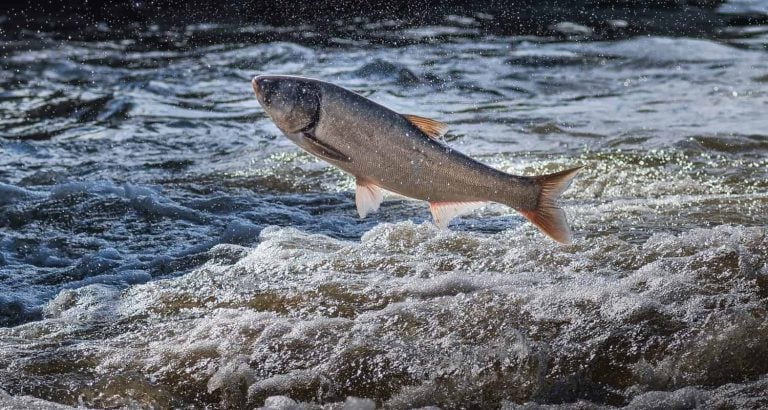
Asian carp are not aggressive fish, but silver carp swim in large schools and are prone to jumping out of the water to escape threats. These fish can weigh over 20 pounds and leap up to 10 feet, so it’s no surprise jumping schools of silver carp have injured boaters and damaged many boats. Water skiing along the Missouri River has also become more dangerous, as large numbers of carp leap behind passing boats.
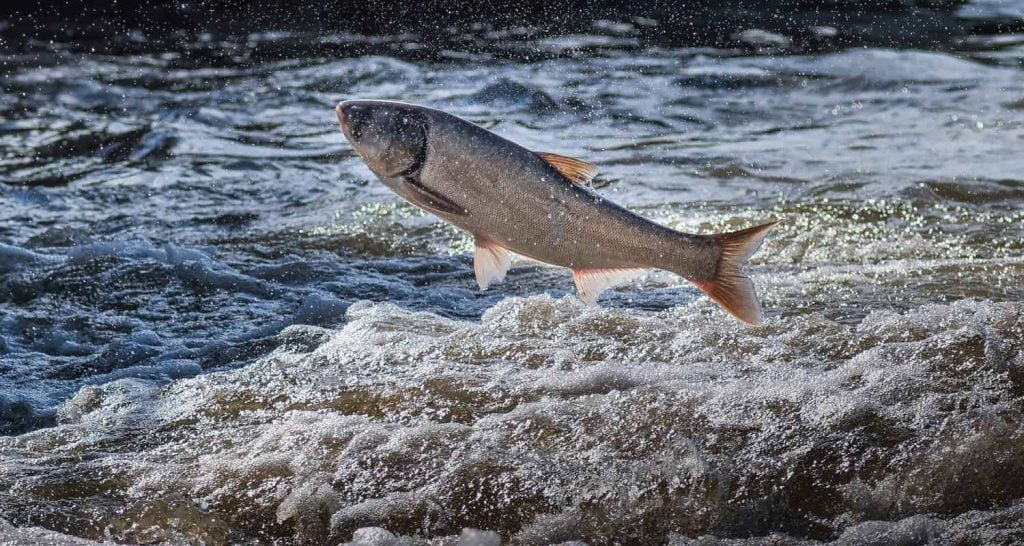
Silver carp are prone to jumping out of the water to escape threats.
©SandmanPhotography/Shutterstock.com
Common carp are also docile fish; however, anglers must be careful when retrieving hooks stuck far down the fish’s throat. Common carp have pharyngeal teeth deep within their throat that they use to crush and chew their food. Like the Asian carp, the common carp is also prone to jumping out of the water to clear mud and dirt from its gills after eating.
Edibility
You can eat Asian carp, and it is considered to be good table fare. All Asian carp have a mild, sweet, clean taste with little fishy flavor. Invasive carp tend to feed on plankton higher up in the water column, which keeps their flesh cleaner. They have firm, flaky white meat that has been compared to cod or tilapia. Asian carp are also high in omega-3s (which are good for heart health) and lean protein, and they have very low mercury levels.
Common carp can also make a good meal, as long as the fish was caught in clean, cold water and is properly prepared. Common carp feed on plankton and organisms in river bottom sediment, so their tissues can absorb a muddier flavor. The meat is also darker, oilier, and has a softer texture than Asian carp. Common carp also has omega-3 fatty acids, as well as vitamins A, E, and D, and essential minerals like phosphorus and potassium.