S
Species Profile

Sea Anemone

Actiniaria

Stinging "flowers" of the seafloor
Natalia Fedori/Shutterstock.com

Sea Anemone Distribution

Click a location to explore more animals from that region

This map shows coastal regions where Sea Anemone are found.

Loading map...

Size Comparison

Human 5'8"
Sea Anemone 4 in

Sea Anemone stands at 6% of average human height.

Sea anemone

At a Glance

Order Overview This page covers the Sea Anemone order as a group. Stats below are general traits shared across the order.
Also Known As Anemone, Sea flower, Flower of the sea, Marine anemone, Flower animal
Diet Carnivore
Activity Cathemeral+
Lifespan 10 years
Weight 5 lbs
Status Not Evaluated
Did You Know?

Size spans from tiny anemones just a few millimeters-centimeters across to giants with oral discs approaching ~1 m in diameter, depending on species and inflation state.

Scientific Classification

Order Overview "Sea Anemone" is not a single species but represents an entire order containing multiple species.

Sea anemones are sessile (or slowly moving) predatory cnidarians with a cylindrical body and a ring of stinging tentacles surrounding a central mouth. They capture prey with nematocysts and can reproduce sexually and asexually (e.g., budding, fission).

Kingdom
Animalia
Phylum
Cnidaria
Class
Anthozoa
Order
Actiniaria

Distinguishing Features

  • Radial symmetry with a single opening (mouth/anus) at the oral disc
  • Tentacles armed with nematocysts (stinging cells) for prey capture and defense
  • Polyp-only life stage (no medusa stage, unlike many other cnidarians)
  • Pedal disc used to attach to substrate; some can detach and creep or drift short distances
  • Common symbioses (e.g., with clownfish; some host photosynthetic dinoflagellates)

Physical Measurements

Males and females differ in size

Height
2 in (0 in – 3 ft 3 in)
4 in (0 in – 1 ft 8 in)
Length
2 in (0 in – 4 ft 11 in)
6 in (0 in – 3 ft 3 in)
Weight
0 lbs (0 lbs – 22 lbs)
0 lbs (0 lbs – 11 lbs)
Top Speed
0 mph
swimming
Venomous

Appearance

Primary Colors
Secondary Colors
Skin Type Soft, contractile polyp column with mucus-coated epidermis; texture varies from smooth to warty (verrucae) or adhesive, with some burrowing forms having a thin, elongate, flexible column.
Distinctive Features
  • Size range (order-wide): oral disc ~0.2 cm to ~1.5 m+; column height ~0.1 cm to ~1 m; tentacles from <20 to several hundred.
  • Body plan: cylindrical column ending in an oral disc with central mouth and tentacle crown; can rapidly contract into a compact form.
  • Nematocyst-bearing tentacles for prey capture and defense; sting potency and prey size vary widely among families.
  • Pedal disc for strong attachment; many can slowly glide, detach, or drift to relocate; some are sand/mud burrowers.
  • Tentacles may be short and dense (carpet-like) or long and filamentous; some have specialized acrorhagi or aggressive marginal structures.
  • Habitat breadth: intertidal pools to abyssal depths; rocky reefs, kelp forests, seagrass, sand flats, caves, and some extreme environments.
  • Ecology generalizations: mostly sit-and-wait predators/scavengers; diets range from zooplankton to small fishes/crustaceans depending on size and species.
  • Frequent symbioses in subsets: mutualisms/commensalisms with clownfish, anemone shrimps/crabs, and photosynthetic symbionts (zooxanthellae) in many shallow-water species; many others lack symbionts entirely.
  • Reproduction diversity: sexual spawning or brooding varies; asexual fission/budding and clonal colonies occur in several lineages, affecting local abundance patterns.
  • Lifespan range: commonly years to decades (~1-50+ years reported); some long-lived individuals may exceed many decades, and clonal lineages can persist far longer than single polyps.

Did You Know?

Size spans from tiny anemones just a few millimeters-centimeters across to giants with oral discs approaching ~1 m in diameter, depending on species and inflation state.

Many species can reproduce both sexually (spawning or brooding) and asexually (fission, budding, pedal laceration), so one individual can found a whole clonal patch.

Tentacle counts vary widely: some have a few dozen, while others (especially feathery-plumed forms) can have hundreds to well over a thousand.

They can be "sessile but not stuck": many can slowly glide on the pedal disc, detach and drift, or balloon with water to reposition.

Some host symbionts-such as photosynthetic algae (zooxanthellae) or protective crustaceans/fish-while many others are strictly non-symbiotic predators.

Their stinging cells (cnidae) are single-use microscopic "harpoons," replaced continuously as the animal grows and regenerates.

Anemones can regenerate remarkably well; some species recover from partial damage and can regrow lost tissues over time.

Unique Adaptations

  • Cnidae (including nematocysts): specialized stinging capsules for prey capture and defense-one of the defining cnidarian tools, with toxin potency and cnidae types differing among species.
  • Hydrostatic body plan: a water-filled gastrovascular cavity lets anemones rapidly inflate/deflate to extend tentacles, wedge into crevices, or reduce exposure when threatened.
  • Powerful adhesion: the pedal disc secretes mucus and uses muscular control to attach strongly to rock, shell, mangrove roots, or even mobile substrates; attachment strength varies by species and surface.
  • Regeneration and clonal growth: many can regrow damaged tissues; asexual modes (fission/budding/pedal laceration) allow persistence and rapid local spread when conditions are favorable.
  • Symbiosis-capable tissues: in multiple lineages, internal tissues can host photosynthetic dinoflagellates (zooxanthellae), shifting energy budgets toward sunlight in clear, shallow waters.
  • Digestive versatility: a single opening serves as mouth and anus; mesenteries increase internal surface area for digestion and can be used in defense in some groups.
  • Color and camouflage diversity: pigments and (where present) algal symbionts create colors from drab sand-matching browns to vivid greens/purples; patterning often reflects habitat and light regime.

Interesting Behaviors

  • Ambush predation: most wait with tentacles expanded, then grip prey (zooplankton to small fish/crustaceans) and pass it to the central mouth; prey size and diet vary by habitat and species.
  • Defensive postures: many retract tentacles and close into a smooth, compact form when disturbed or exposed at low tide; some eject internal filaments (e.g., acontia in certain families) for defense.
  • Slow relocation: while generally sedentary, numerous species can creep on their pedal disc, detach to drift, or reposition after storms, sediment shifts, or competition.
  • Territorial interactions: neighboring anemones may engage in space competition using specialized stinging structures or by inflating/leaning to shade or contact rivals; intensity varies strongly among species.
  • Feeding mode variation: besides active capture, some supplement nutrition via symbiotic algae, while deep-sea species rely entirely on capturing/absorbing organic matter in low-light environments.
  • Reproductive variety across the order: broadcast spawning in some; internal brooding or releasing developed young in others; asexual splitting or pedal laceration is common in several lineages, producing clones that can form dense aggregations.
  • Habitat breadth: Actiniaria occur intertidally (tidepools), on reefs, kelp forests, soft sediments, under rocks, and in deep sea settings including cold seeps and hydrothermal regions-behavior often tracks local currents, light, and predators.

Cultural Significance

Sea anemones (Actiniaria), called "sea-flowers" for their petal-like tentacles, are famous in reefs with anemonefish, seen in aquariums to teach about cnidarian stinging cells, symbiosis, and regrowth, and are eaten as Andalusian "ortiguillas."

Myths & Legends

Name-link to Greek myth: "anemone" comes from the windflower, tied in classical tradition to stories of Aphrodite and Adonis-an enduring mythic association that helped inspire the "sea-anemone/sea-flower" name when Europeans compared the animals to blossoms.

Victorian "animal flowers": 19th-century British seaside naturalists and aquarium-keepers popularized sea anemones as wondrous "flowers that are animals," a cultural fascination that shaped early home-aquarium lore and public exhibitions.

Japanese naming lore: the common Japanese word for sea anemone, isoginchaku, alludes to a kinchaku (a traditional drawstring pouch), reflecting a folk comparison to the animal's purse-like shape when contracted.

Sailors and coastal people told tales of anemones as beautiful but painful “stinging flowers” of rock pools, warnings for children and beach visitors about hidden stings under the tide line.

Conservation Status

NE Not Evaluated

Has not yet been evaluated against the criteria.

Population Unknown

Protected Under

  • Marine Protected Areas and no-take zones (various national/regional frameworks)
  • Habitat protection measures for reefs, rocky shores, and sensitive benthic areas (jurisdiction-dependent)
  • Fisheries restrictions on bottom trawling/dredging in designated sensitive habitats (region-specific)

You might be looking for:

Beadlet anemone

22%

Actinia equina

Common intertidal sea anemone of rocky shores in the NE Atlantic; often red with a column of wart-like beads.

Plumose anemone

20%

Metridium senile

Feathery-tentacled anemone found in colder waters, often attached to docks and rocks.

Bubble-tip anemone

18%

Entacmaea quadricolor

Indo-Pacific reef anemone frequently hosting clownfish; popular in aquaria.

Giant carpet anemone

15%

Stichodactyla gigantea

Large tropical carpet anemone on reefs and sandy flats; strong symbiosis with anemonefish.

Aggregating anemone

12%

Anthopleura elegantissima

Pacific intertidal species forming dense clonal aggregates; often greenish from symbiotic algae.

Life Cycle

Birth 10000 planulas
Lifespan 10 years

Lifespan

In the Wild
1–50 years
In Captivity
2–80 years

Reproduction

Mating System Promiscuity
Social Structure Solitary
Breeding Pattern Not Applicable
Fertilization Broadcast Spawning
Birth Type Broadcast_spawning

Most sea anemones are solitary or form clonal aggregations (mm-~1 m), living from a few years to 100+; reproduction is typically gonochoric with external broadcast spawning, no pair bonds, and frequent asexual fission/budding producing local clones; brooding occurs in some lineages.

Behavior & Ecology

Social Aggregation Group: 5
Activity Cathemeral, Nocturnal, Diurnal
Diet Carnivore Typically soft-bodied zooplankton and small crustaceans (availability-driven; larger anemones can favor bigger, more energy-rich prey such as small fishes when opportunities arise).

Temperament

Body size range across Actiniaria: ~1 cm to >1 m oral disc; height from centimeters to >1 m.
Lifespan range: many years to decades; some large species may reach ~50+ years in stable habitats.
Primarily sessile ambush predators; activity is tentacle expansion/contraction rather than locomotion.
Feeding and tentacle extension often track currents, prey availability, and light; some expand more at night.
Generally non-social; interactions are mostly spacing, competition for substrate, and occasional tolerance in dense beds.
Aggression varies widely: from tolerant clustering to strong territoriality using stinging and acrorhagi in some taxa.
Reproduction varies: broadcast spawning, brooding in some, and common asexual cloning (budding/fission) driving local clusters.
Many host symbionts (e.g., zooxanthellae) or mutualists (fish/crustaceans), influencing tolerance and spacing behavior.

Communication

none known
Chemical signaling in mucus and waterborne cues E.g., spawning synchrony, neighbor recognition
Tactile contact via tentacles for assessment, spacing, and escalation during competition.
Cnidocyte (nematocyst) discharge as a direct contact-based deterrent/attack signal.
Posture changes (tentacle/oral disc expansion, retraction, inflation) that alter apparent size and deterrence.

Habitat

Coastal Rocky Shore Coral Reef Kelp Forest Estuary Mangrove Cave Cliff/Rocky Outcrop Seabed/Benthic Deep Sea Open Ocean +5
Biomes:
Terrain:
Coastal Island Rocky Sandy Muddy
Elevation: Up to 36089 ft 3 in

Ecological Role

Benthic predators (and, in many lineages, mixotrophic symbiont hosts) that link planktonic/benthic food webs and create microhabitat structure on reefs, rocky shores, and soft-bottom communities.

regulation of local zooplankton and small benthic invertebrate populations transfer of pelagic production to benthic communities (capturing drifting prey/particles) provision of refuge and nursery habitat for commensals/mutualists (fish and crustaceans) nutrient recycling via digestion/excretion and support of microbial/symbiont productivity contribution to biodiversity and community structuring in benthic ecosystems

Diet Details

Main Prey:
Zooplankton Small crustaceans Polychaete worms and other small benthic invertebrates Mollusk larvae and other meroplankton Fish eggs and larvae Small fish Carrion and animal fragments +1
Other Foods:
Photosynthate from symbiotic dinoflagellates Detritus Dissolved organic matter

Human Interaction

Domestication Status

Wild

Sea anemones (Order Actiniaria) are wild animals, not truly domesticated. A few species are kept and sometimes bred (fragmentation/fission) for marine aquariums. They range widely in size and lifespan, usually live attached to rocks or sand but can move, eat with stinging cells, host zooxanthellae or clownfish, and reproduce sexually or asexually.

Danger Level

Moderate
  • Stings from nematocysts: commonly mild to painful localized reactions; severity varies widely across species and individual sensitivity
  • Allergic or exaggerated immune reactions (rare but possible), including significant swelling or dermatitis after handling
  • Eye/mucous membrane injury risk if tentacles contact sensitive tissues
  • Envenomation risk increases with larger anemones and prolonged contact; a few taxa are associated with more serious stings than the typical 'mild burn' experience
  • Secondary risks in aquaria: anemone movement can damage corals/invertebrates via stinging; mishandling can lead to tank crashes indirectly affecting human exposure to irritants

As a Pet

Suitable as Pet

Legality: Sea anemones are usually legal in home marine aquariums, but collecting wild intertidal or reef invertebrates can be restricted by local rules, marine protected areas, permits, and trade laws. Prefer captive-bred.

Care Level: Experienced

Purchase Cost: $10 - $1,000
Lifetime Cost: $2,000 - $20,000

Economic Value

Uses:
Marine aquarium trade (live display animals, including captive-propagated clones in some species) Public aquaria and education Scientific research (cnidarian biology, symbiosis, venoms/nematocysts, regeneration, development) Ecotourism and reef/intertidal wildlife viewing (indirect value) Aquaculture support (host species used in clownfish-focused aquarium systems, where applicable)
Products:
  • Live anemones for home and public aquaria
  • Cultured/propagated clones (limited to certain species that readily divide in captivity)
  • Research materials related to nematocysts and bioactive compounds (primarily non-commercial or specialized)

Relationships

Related Species 6

Stony corals Scleractinia Shared Class
Soft corals and sea fans Alcyonacea Shared Order
Zoanthids Zoantharia Shared Class
Corallimorphs Corallimorpharia Shared Class
Black corals Antipatharia Shared Class
Tube anemones Ceriantharia Shared Class

Ecological Equivalents 5

Animals that fill a similar ecological role in their ecosystem

Hydroids Hydrozoa Many are sessile, tentacled ambush predators that use nematocysts to capture zooplankton in similar nearshore habitats. Unlike sea anemones, many hydroids form colonies and have different life cycles.
Tube anemones Ceriantharia Have a very similar body plan and feeding mode—sessile, tentacled predators—but typically live in tubes and are classified outside Actiniaria within Anthozoa.
Corallimorphs Corallimorpharia Anemone-like, benthic predators and scavengers with tentacles and often photosymbionts; they occupy similar reef niches but belong to a different order.
Stony corals Scleractinia Share anthozoan polyp anatomy; many host symbiotic algae and have similar plankton-feeding behavior. They differ by producing a hard calcium carbonate skeleton and being predominantly colonial.
Sessile filter-feeding sponges Porifera Often co-occur on hard substrates and compete for space; share a sessile (attached) lifestyle but have very different feeding modes—filtration in sponges versus nematocyst-based predation in the other organisms.

Types of Sea Anemone

16

Explore 16 recognized types of sea anemone

Beadlet anemone Actinia equina
Plumose anemone Metridium senile
Bubble-tip sea anemone Entacmaea quadricolor
Giant carpet anemone Stichodactyla gigantea
Aggregating anemone Anthopleura elegantissima
Giant green anemone Anthopleura xanthogrammica
Starlet sea anemone Nematostella vectensis
Dahlia anemone Urticina felina
Christmas anemone Urticina crassicornis
Giant Caribbean anemone Condylactis gigantea
Magnificent sea anemone Heteractis magnifica
Sebae anemone Heteractis crispa
Haddon's carpet anemone Stichodactyla haddoni
Rock flower anemone Phymanthus crucifer
Hermit crab anemone Calliactis tricolor
Glass anemone (aiptasia) Exaiptasia diaphana

The sea anemone is a fascinating, colorful creature. There are over 1,100 recorded species. You’ll find them at depths of over 32,000 feet in oceans all over the globe. Despite this, the biggest and most diverse creatures tend to live in shallow tropical waters. The animal can be mesmerizing with its rainbow of colors, but trust us, these are not animals to play with.

Sea Anemone: Classification and Scientific Name

Animals That Don't Have a Brain - Sea anemone

Sea anemone alters its shape in the water to adapt to its environment.

The sea creature got its moniker from the plant of the same name. This terrestrial flowering plant shares the array of colors found in many sea anemones.

This animal is a predatory marine creature. They’re classified as Anthozoa (pronunciation: An·​tho·​zoa). The creature belongs to the Cnidaria (pronunciation: cni·​dar·​i·​an) phylum and the subclass Hexacorallia (pronunciation: Hex·​a·​co·​ral·​la). They are cousins of jellyfish, corals, and tube-dwelling anemones. The order Actiniaria, which includes sea anemones, consists of about 1,200 species.

The average sea anemone is no more than a single polyp attached by its base to a hard surface. But there are species that float near water surfaces (adaptations of bigger creatures) while others live in soft sediment.

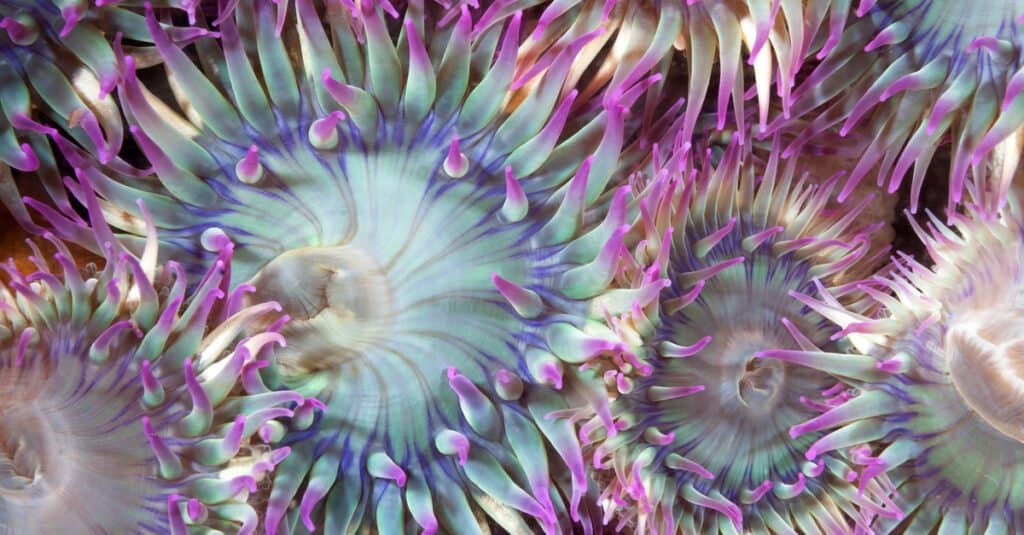
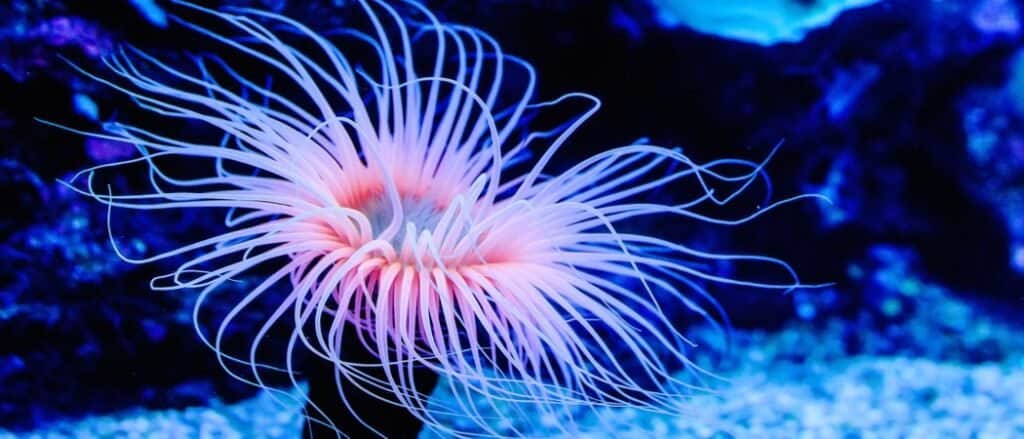
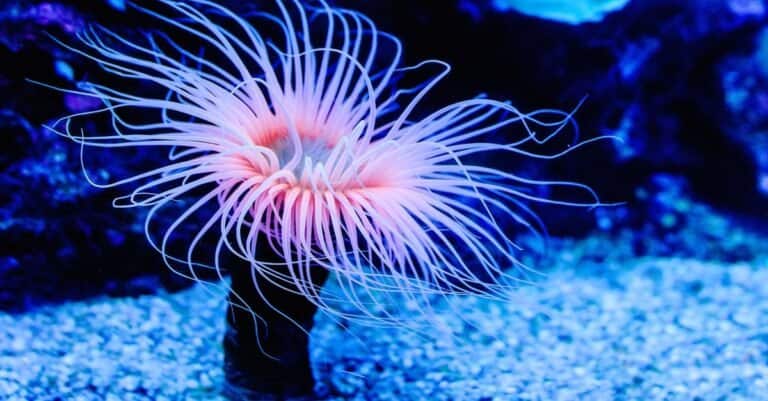
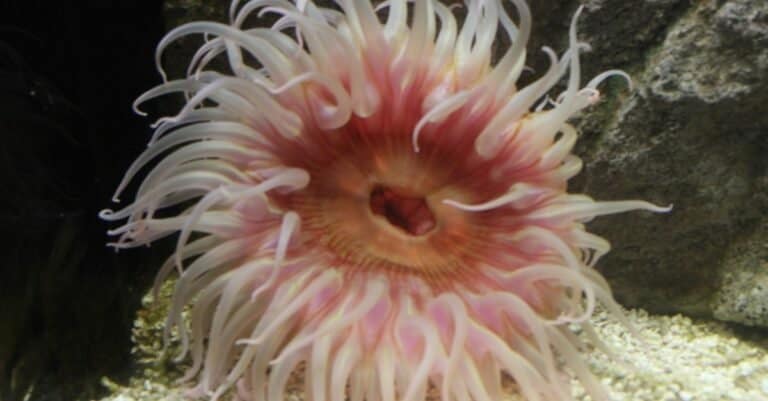
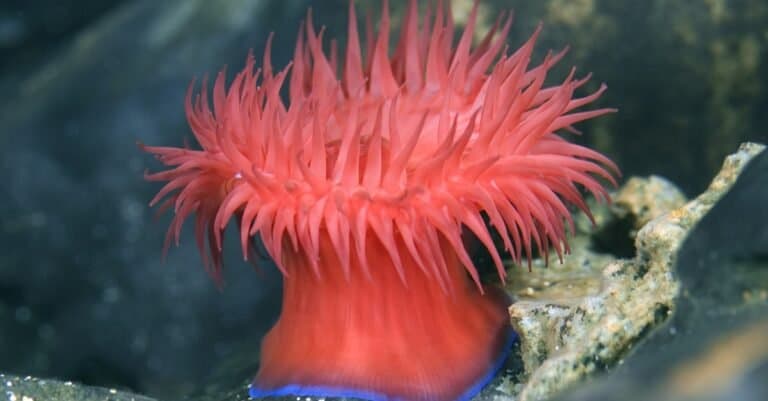
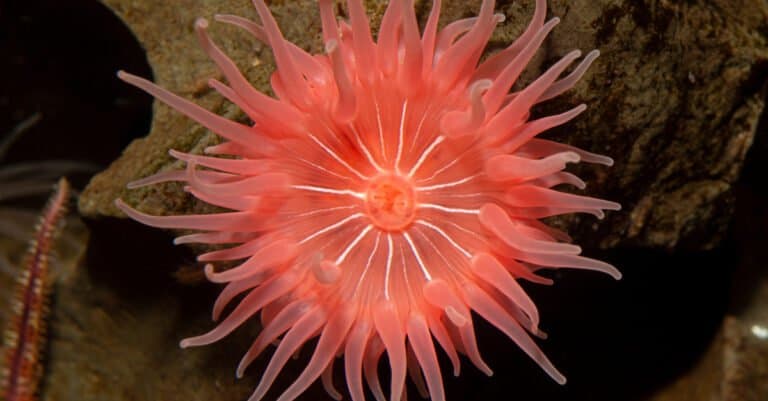
The polyp contains a columnar trunk with an oral disc at the top. The disc has a central mouth and a ring of tentacles. The tentacles are retractable, pulling into the body cavity or expanding to trap passing prey.

The creatures have stinging cells, which disarm, giving anemones an advantage. Some species live in the proximity of small fish and hermit crabs.

Sea Anemone: The Different Species

There are both wild and recreational creatures among the hundreds of species. Among the families are the Host/Clownfish, Rock/Aiptasiidae, Sea/Actiniidae, Stinging/Actinodendronidae, Tube/Burrowing, and, lastly, what we call the Misc families. Each group has its unique members that encompass over 1,100 species of anemones. Here are a few of each with their scientific names.

Host Creatures

  • Delicate sea anemone (Heteractis malu)
  • Beaded sea anemone (Heteractis aurora)
  • Saddle anemone (Stichodactyla haddoni)

Rock Creatures

  • Trumpet anemone (Aiptasia mutabilis)
  • Brown glass anemone (Exaiptasia pallida)
  • Curlique anemone (Bartholomea annulata)

Sea Creatures

  • Christmas anemone (Urticina crassicornis)
  • Giant green anemone (Anthopleura xanthogrammica)
  • White-spotted rose anemone (Urticina lofotensis)

Tube Creatures

  • Tube anemone (Cerianthus membranaceus)
  • Burrowing tube anemone (Pachycerianthus fimbriatus)
  • North Sea tube anemone (Cerianthus lloydii)

Sea anemones – Misc Families

  • Caribbean carpet anemone (Stichodactyla helianthus)
  • Red bearded anemone (Phymanthus crucifer)

Sea Anemone: Stingers

Anemones sting, but not with enough force to hurt most animals, including humans. The average sting only feels sticky to us. Members of the family with strong stings include the Carpet anemones. They are part of the Condylactis genus. There are also Tube anemones in the Pachycerianthus genus.

Some stings result in several reactions, including a rash. The rash can spread fast. If allergic, you can have a severe response. The sting is known to cause anaphylactic shock, which can lead to respiratory failure.

Sea Anemone: What is the Relationship Between Clownfish and Sea Anemones?
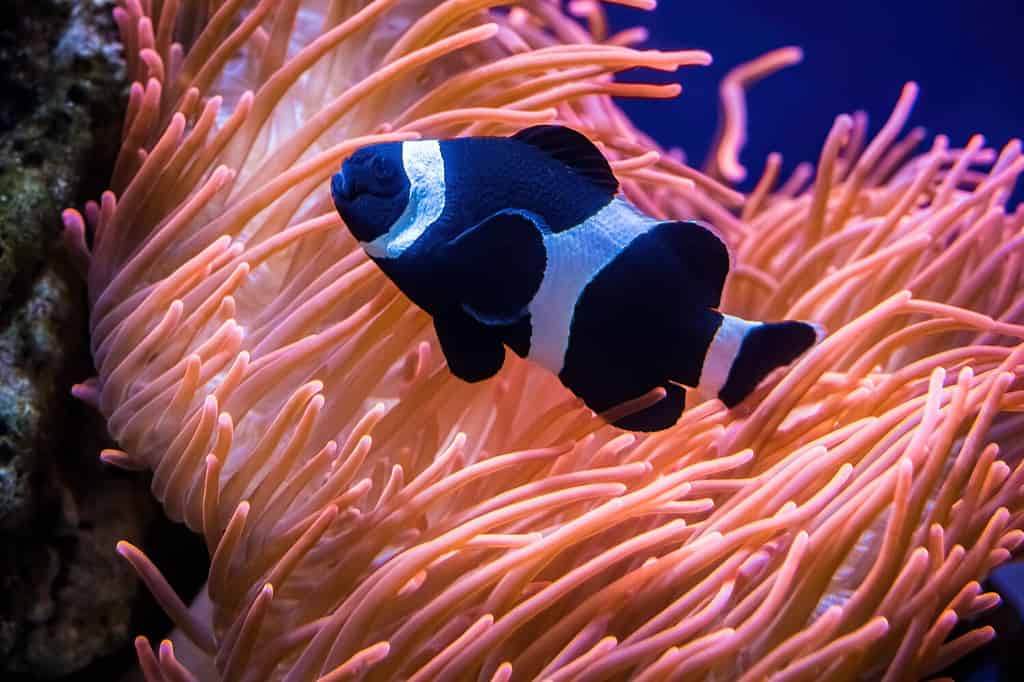
Colorful sea anemone as viewed from an aquarium. The tentacles or arms were swaying with the water current, accompanied by a black clown fish.

Colorful sea anemone as viewed from an aquarium. The tentacles or arms were swaying with the water current, accompanied by a black clown fish.

The anemones have unique relationships with various organisms and animals. It’s a bond where each creature lives in symmetry with the other. The union provides a region of safe passage for their friends. It’s unique for a predator where anything that moves is potential food.

The clownfish is among those animals hosted by almost a dozen various sea anemones, including the adhesive sea anemone, sebae, saddle, and the magnificent sea anemone (its actual name).

The clownfish is provided both a home and protection by its host. What helps is a skin mucus on the fish that minimizes the stingers. In exchange, the clownfish intervenes with potential predators and keeps its host’s tentacles free of detritus. The creature also feeds on clownfish scraps.

Sea Anemone: Appearance

Among its hundreds of species, you will find these animals in a variety of environments, shapes, and colors. Some are a half-inch in size, and others are six feet across.

What does unite them is a wide-blossoming, plant-like appearance. But the creature is an invertebrate and kin to coral and jellyfish. It has cylindrical, hollow bodies that sit on a sticky disc. The animal has a central mouth covered by clustered tentacles.
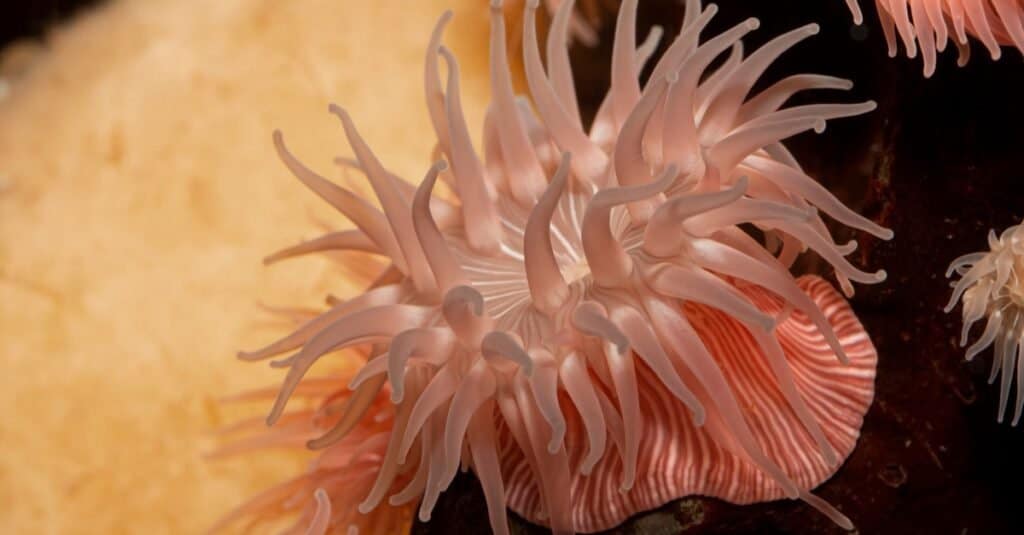
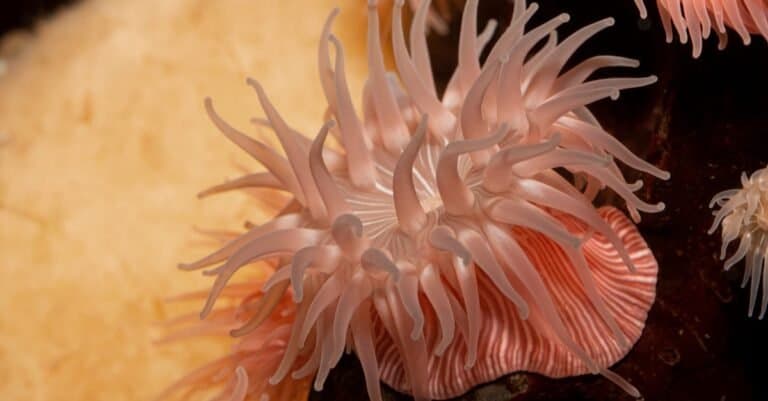
Colourful pink-striped brooding sea anemone (Epiactis prolifera) from shallow marine waters of British Columbia.

Colorful pink-striped brooding sea anemone (Epiactis prolifera) from shallow marine waters of British Columbia.

Sea Anemone: Distribution, Population, and Habitat

Here are facts about the world of the sea anemone.

Distribution

The sea creature is a species used by humans only for recreation. In other words, the creatures are popular as residents in home aquariums. Otherwise, find them in homes and oceans around the world.

These animals are not on any endangered species list and are not food for anything outside of their ocean predators.

Population

There are about 1,200 species, with the greatest diversity and abundance found in shallow tropical waters. This makes keeping track of their numbers challenging.

Habitat

Depending on the species, the animals live in shallow waters, in rock pools and crevices, under cool, damp rocks, in the sand, on dead coral, and attached to hermit crabs and sea whips. They inhabit tropical and temperate seas with both low and high currents. They are not comfortable in direct sunlight, so they often attach to rocks in shaded areas.

Sea Anemone: Predators and Prey

The stingers are instrumental in deterring most predators. Thanks to that, most species are fortunate enough to live a non-threatened existence. However, some are still vulnerable. Sea stars, several species of fish, snails, and sea turtles can get beyond the sea creatures’ security and feed on them.

Sea anemones are carnivorous predators. They eat fish, shrimp, krill, plankton, and anything else that gets too close. The animal’s tentacles react to touch. The appendages shoot off a nematocyst, a harpoon-ish filament. It’s a neurotoxin whose characteristics have the potential to paralyze small creatures. Once injected, the prey is wrapped in tentacles and guided to the mouth.

small delicate sea anemone on reef wall

Small, delicate sea anemone on a reef wall.

Sea Anemone: Reproduction and Lifespan

A large number of these animals reproduce through asexual budding. That’s a reproduction process where fragments break off the body and develop into new life.

Other species actually stretch their base and split across the middle. The act results in two new creatures. In yet other families, small bits of tissue break from the creature’s base and form new, tiny creatures. This is as close to cloning characteristics and reproduction as you get.

The sea creatures can live long lives in the absence of disease or predators. In corners of the scientific community, it’s argued these creatures do not age, can reproduce themselves, and therefore live indefinitely. The truth is the animal has a lifespan of six to eight decades. There is one documented case of a sea anemone living for over a century.

Sea Anemone: Recreational Use

The animals are growing in popularity as household pets. But fish aficionados have to approach the project carefully. Not all types of sea anemones are suitable for life outside the ocean. Those that can survive in captivity require a very specific habitat. The tanks need specific lighting, oxygen levels, water flows, and other elements to thrive. These conditions must be carefully created and maintained. It can be rewarding to pair a sea anemone with a clownfish and observe their symbiotic relationship.

View all 391 animals that start with S

Sources

  1. Marine Biological Association / Accessed September 26, 2021
  2. Wikipedia / Accessed September 26, 2021
  3. Britannica / Accessed September 26, 2021
  4. Ohio State University Bio Museum / Accessed September 26, 2021
  5. NBC News / Accessed September 26, 2021
  6. E-Fauna BC / Accessed September 26, 2021
  7. Pets on Mom / Accessed September 26, 2021
Taiwo Victor

About the Author

Taiwo Victor

For six years, I have worked as a professional writer and editor for books, blogs, and websites, with a particular focus on animals, tech, and finance. When I'm not working, I enjoy playing video games with friends.

Thank you for reading! Have some feedback for us?


Sea Anemone FAQs (Frequently Asked Questions)

The sea creature is a soft-bodied invertebrate that’s part animal, part plant. It’s a mostly sedentary marine animal found in all oceans.