
Quick Take
- One of these creatures is the only animal on Earth with a skull but no spine, and it is probably not the one you would expect. See the anatomy details →
- Hagfish have a defense so extreme it can actually turn on and kill the hagfish itself. Explore the slime defense →
- One of these jawless fish can take down a shark, though the method it uses is nothing like what predators normally do. See how lampreys feed →
- Despite looking nearly identical, these two fish are so anatomically different that comparing them reveals a gap in vertebrate evolution most people never knew existed. Compare their anatomy →
Hagfish and lamprey have many similarities. One thing these fish share is that despite their eel-like appearance, neither of these animals is an eel. They are both cyclostomes, or jawless fish. These fish have neither scales nor fins. While they have a number of elements in common, these fish differ in some very strange ways. Read on to learn what sets a hagfish and a lamprey apart.
Comparing Hagfish vs. Lamprey
| Hagfish | Lamprey | |
|---|---|---|
| Taxonomy | Family Myxinidae | Family Petronyzontidae |
| Distribution and Habitat | Exclusively marine; generally found on the ocean floor in cold and temperate waters across the world | Larval stage in freshwater environments; open ocean, coastal, and freshwater habitats in temperate areas worldwide |
| Appearance and Anatomy | Dental plate for feeding Three hearts No spinal column | Sucker-like mouth One heart Definitive vertebrae Lensed eyes Electroreceptive sensory organs |
| Defense mechanisms | Slime | Wound healing |
| Diet | Scavengers feeding on marine carcasses and preying on small invertebrates and crustaceans | Fish and large marine animals like sharks; as juveniles, they eat small bits of ocean debris |
Hagfish vs. Lamprey: Key Differences
The differences between a hagfish and a lamprey include their taxonomy, distribution and habitat, appearance and anatomy, defense mechanisms, and diets. Take an in-depth look at each of these differences in the sections below.
Taxonomy
As jawless fish, both hagfish and lampreys belong to the superclass Cyclostomata (Agnatha). However, they diverge at the class level. Hagfish belong to the class Myxini (order Myxiniformes) and the family Myxinidae. This family is further divided into six accepted genera, including Eptatretus, which includes 49 different species alone. There are currently over 80 known species of hagfish.
Lampreys belong to the class Cephalaspidomorphi (or Hyperoartia, order Petromyzontiformes) and the family Petromyzontidae. The family includes eight genera and 50-51 known species. However, the genus-level taxonomy of Petromyzontidae is still under debate.
Distribution and Habitat
The hagfish is exclusively a marine animal. They typically inhabit the ocean floor where they can burrow in soft sand or mud. They favor cold-temperate to temperate water all over the world. Hagfish typically avoid extremes like warm tropical oceans or polar seas.
In contrast, lampreys live in either freshwater or saltwater, primarily depending on the stage of life. They spawn in freshwater, then the larvae (called ammocoetes) live in slow-moving parts of streams. They bury themselves in the sediment and filter feed, often for several years. Once they transform, juveniles may swim to the ocean or to large lakes. They favor temperate regions and avoid the tropics, inhabiting both coastal regions and the open ocean.
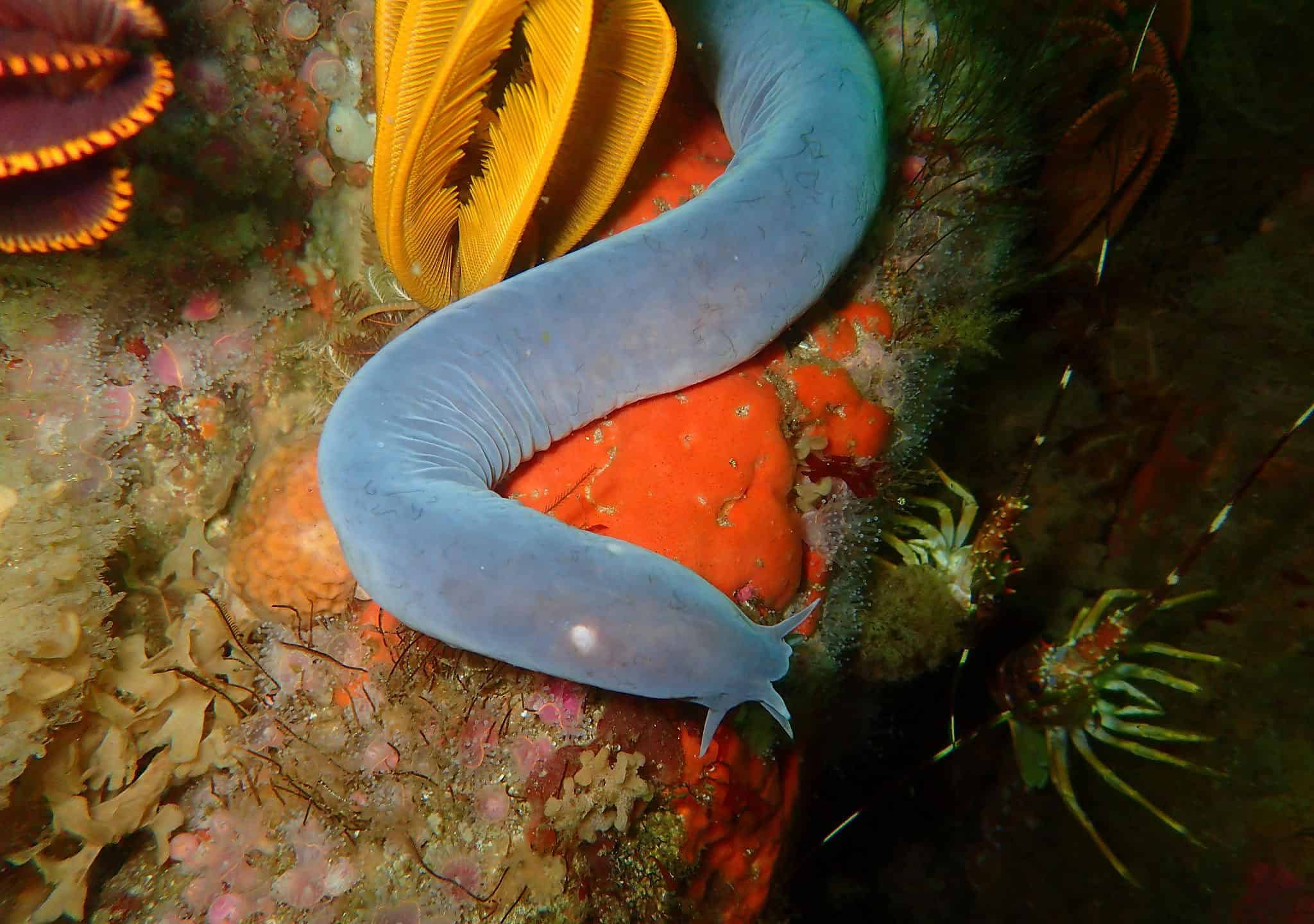
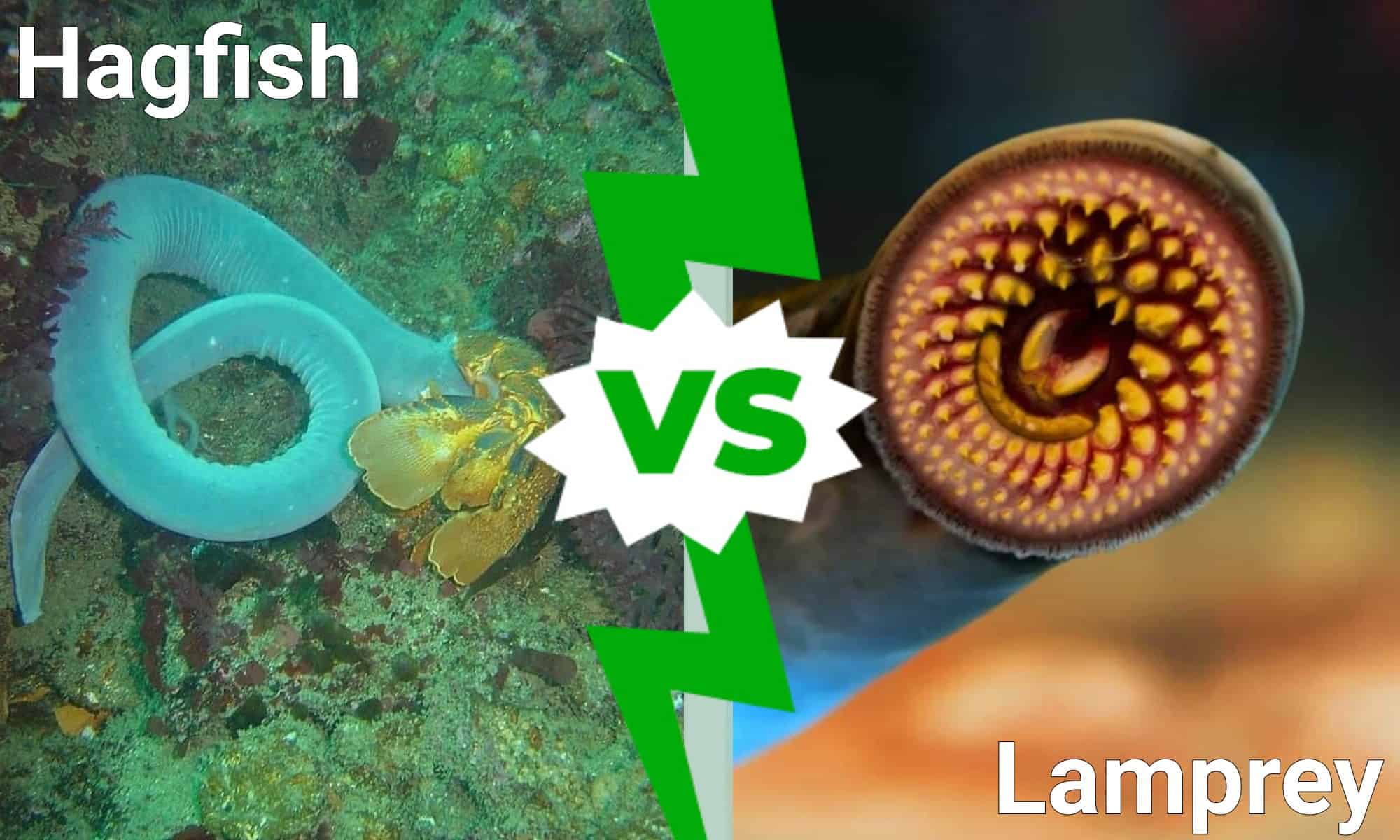
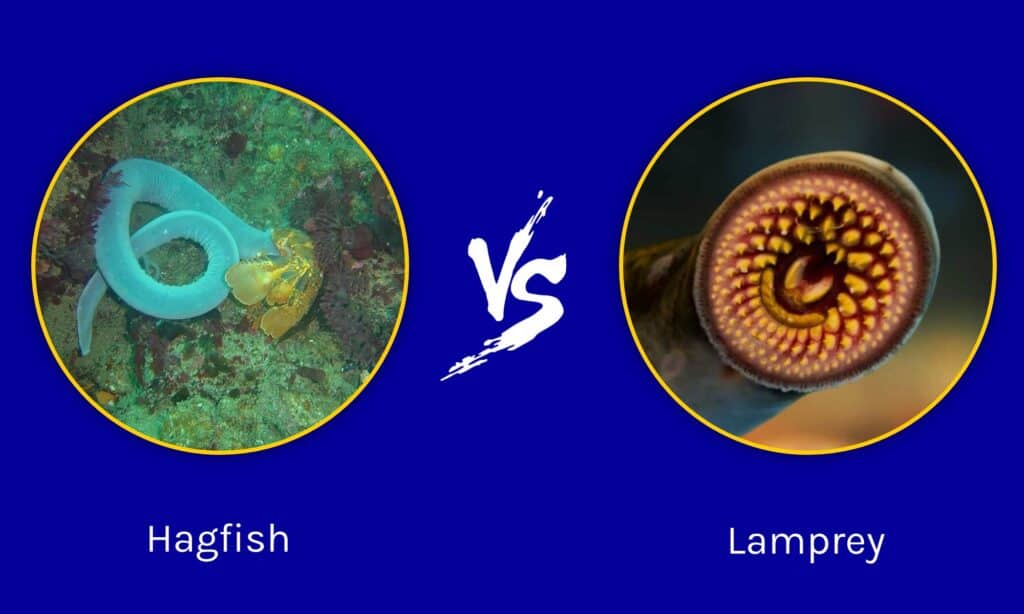
Hagfish are bottom-dwelling, eel-shaped marine creatures.
Hagfish vs. Lamprey: Appearance and Anatomy
Both hagfish and lamprey are long with slender eel-like bodies. As mentioned previously, neither fish has scales or fins. Both animals have drab coloring to blend into their environments, but the color patterns differ by species.
However, hagfish have a unique anatomy. For one, hagfish have four hearts: one main branchial heart and three accessory hearts. These hearts can also beat without any oxygen. Scientists believe the fats stored in the fish’s body power its hearts. Hagfish are also the only known living animals that have a skull but no vertebral column, though they do possess rudimentary vertebrae. Instead, they have a cartilaginous notochord, which is a type of skeletal rod. Most vertebrates transition away from their notochord in utero, but hagfish retain theirs, which makes them incredibly flexible. Additionally, hagfish have a keratin plates on their tongues for feeding. Muscles push the plates out of the mouth where they unfold to expose rows of sharp teeth. When those muscles retract, they fold the teeth up, ripping off a chunk of flesh. They have also been found to tie their bodies into a knot for leverage so they can tear pieces off a carcass.
Lampreys are more advanced in many areas. They only have one heart, but they have a well-developed circulatory system. Lampreys also have definitive vertebrae. They have lensed eyes with multifocal lenses more like jawed fish and other higher vertebrates. Lampreys have electroreceptive sensory organs that assist them with navigation, communication, and electrolocation. Finally, lampreys have sucker-like mouths for feeding. They latch onto host fish with the sucking disk, then the horny teeth and rasping tongue bore through a fish’s scales and skin while an anticoagulant keeps the host’s blood and bodily fluids flowing.
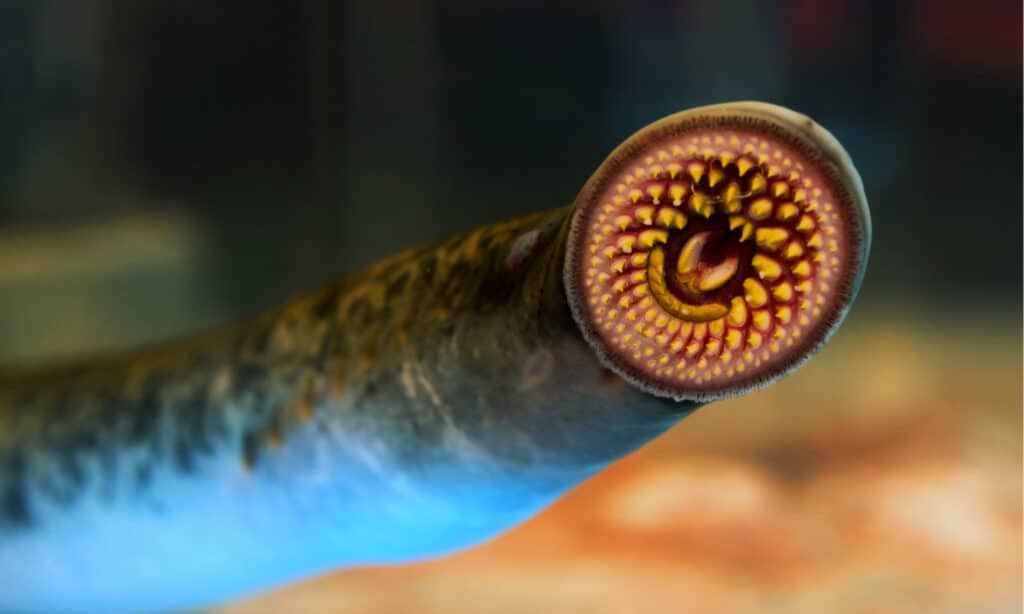
Lampreys have sucker-like mouths for feeding.
©Gena Melendrez/Shutterstock.com
Defense Mechanisms
Hagfish have one of the most incredible defense mechanisms: slime. Hagfishes have slime glands and 90 to 200 slime pores running down the entire body. Large amounts of slime ooze out of their pores when a hagfish is threatened. The slime is unique, with a sticky, cohesive quality. The slime can expand on contact with seawater and is incredibly efficient at defending against gilled predators. Even a hagfish can die if it gets covered in its slime. Scientists are looking for ways to use the slime threads since they are more sustainable than spider silk.
Unlike hagfish, lampreys do not have active defense mechanisms. Instead, they try to avoid predators by feeding in deep, murky waters. Lampreys also have a wound-healing response that mitigates tissue damage and prevents infections if they are bitten or injured.
Diet
Hagfish are carnivorous scavengers. They primarily feed on dead or dying marine animals on the ocean floor. They frequently burrow into carcasses with the keratin plates on their tongues. When hagfish eat their way out, scientists believe they may not just be feeding through their guts, but also directly through their gills and skin. Hagfish actively hunt small invertebrates such as crustaceans and marine worms as well. Young hagfish feed similarly to adults.
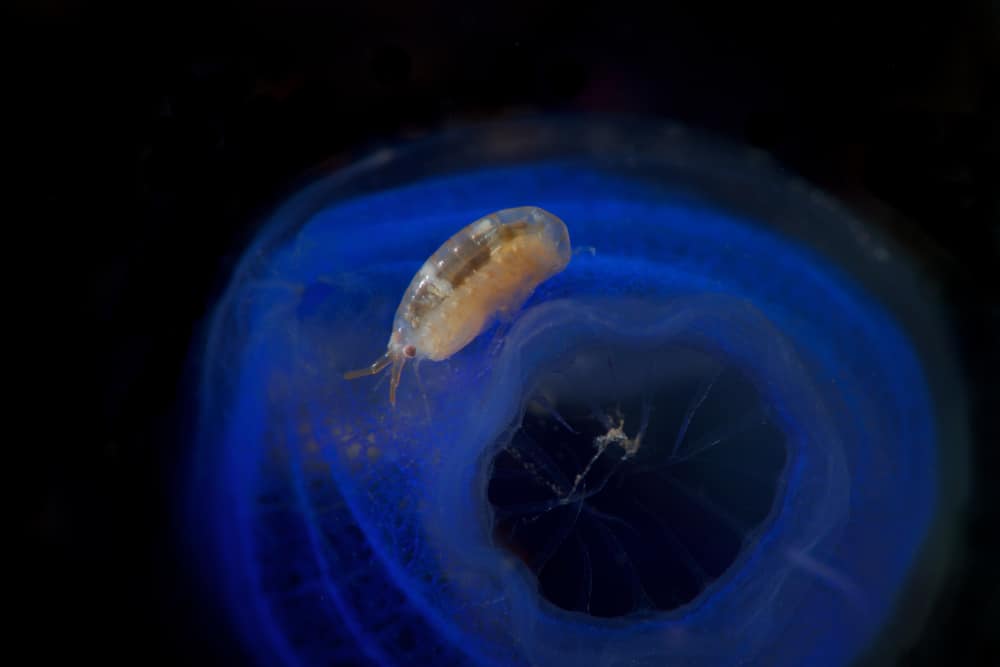
Hagfish feed on small marine animals like crustaceans.
©The Urban Tropic/Shutterstock.com
Lampreys are also carnivores, but they are not scavengers. Lampreys feed on other fish’s blood and bodily fluids. The sea lamprey even feeds on large fish, such as sharks. During the larval stage, a lamprey can only feed on tiny bits of debris filtered through their gills. However, once they reach the adult stage, these parasitic fish are capable of attaching themselves to prey. As mentioned above, they suck blood and bodily fluids through a hole that their teeth and tongue rasps in a fish’s flesh. A lamprey will hold on to a fish until it gets its fill and then it detaches. The process of feeding can take days.