
Quick Take
- A 300-pound fish towing a boat sounds like an exaggeration. That is, until you learn what's actually powering it. See it happen →
- Arapaima have a fatal weakness that also makes them nearly impossible to wipe out in low-oxygen water, and these two facts are directly connected to each other. Discover the air-breathing adaptation →
- Keeping this fish underwater to release it safely could actually kill it. Understand the release risks →
- Arapaima can hit a size that makes 300 pounds look modest, and their upper limit is stranger than you would expect. See their staggering size →
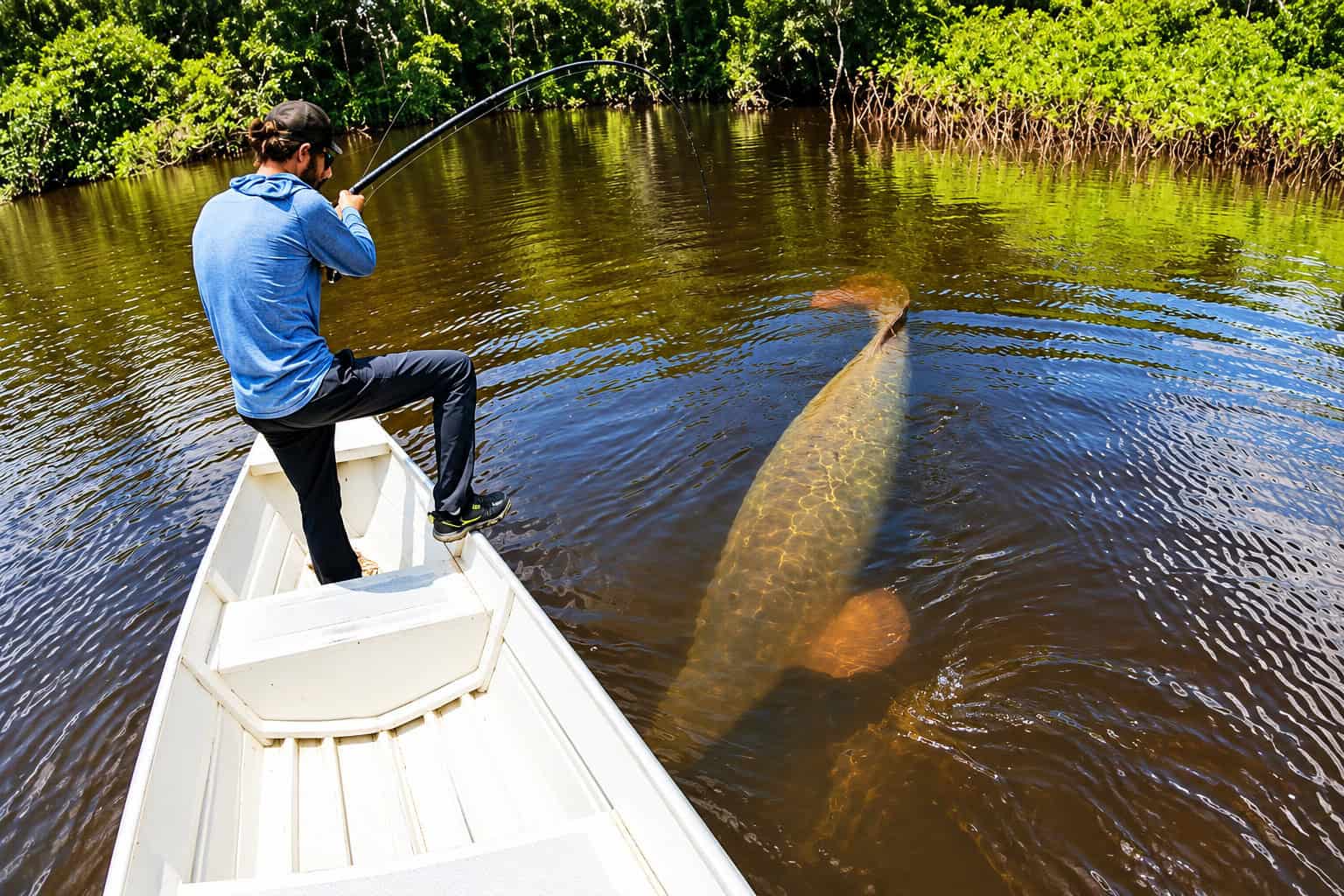
There are big fish, and then there are fish powerful enough to start towing your boat. During a fishing trip in Guyana, South America, angler Ty Kleeb of Ty PigPatrol hooks into an enormous freshwater giant that seems determined to take him for a ride. The massive fish, estimated by the angler to weigh around 300 pounds, surges through a secluded lagoon and pulls the boat toward the surrounding trees. What follows is an impressive battle with an arapaima, one of the largest freshwater fish on Earth. But what makes these enormous fish so powerful, and how do they survive in waters where many other species would struggle to breathe?
Watch This Giant Arapaima Tow a Fishing Boat
What Happens During This Incredible Catch?
The adventure begins in a remote lagoon in Guyana, where the fishing team is searching for some of South America’s most impressive freshwater species. After landing a much smaller fish, Kleeb hooks into something in an entirely different weight class. Almost immediately, it becomes obvious that this isn’t going to be an ordinary fishing trip.
The enormous fish powers through the water, bending the fishing rod and pulling the boat toward the trees lining the lagoon. As the battle continues, the anglers struggle to control the animal’s movements. Eventually, Kleeb and his guide leave the boat and enter the shallow water to manage the catch.
The fish is an arapaima, a massive, air-breathing predator native to tropical South America. Kleeb estimates his catch at approximately 300 pounds, although the footage doesn’t establish a verified weight. After the encounter, the anglers release the fish back into the water.
While its enormous size is impressive enough, the arapaima has several unusual adaptations that make it especially well suited to life in South America’s rivers, lakes, and flooded forests.
Where Do Arapaima Live?
Arapaima are native to tropical South America, particularly the Amazon River basin and connected floodplain habitats. They thrive in slow-moving rivers, lakes, and lagoons where warm temperatures and seasonal flooding create extensive feeding grounds. These environments can become surprisingly low in dissolved oxygen, especially when water levels fall or decaying vegetation accumulates.
Guyana is also home to important arapaima populations, particularly in the Essequibo, Rupununi, and Rewa river systems. According to Guyana Tourism, community-led conservation efforts have helped restore populations in parts of the country, where sustainable catch-and-release fishing has become an attraction for visiting anglers.
These habitats help explain why encounters like the one in this video are possible. Arapaima can inhabit relatively secluded waterways, and their enormous size makes them especially memorable when they rise toward the surface.
Why Do Arapaima Need to Breathe Air?
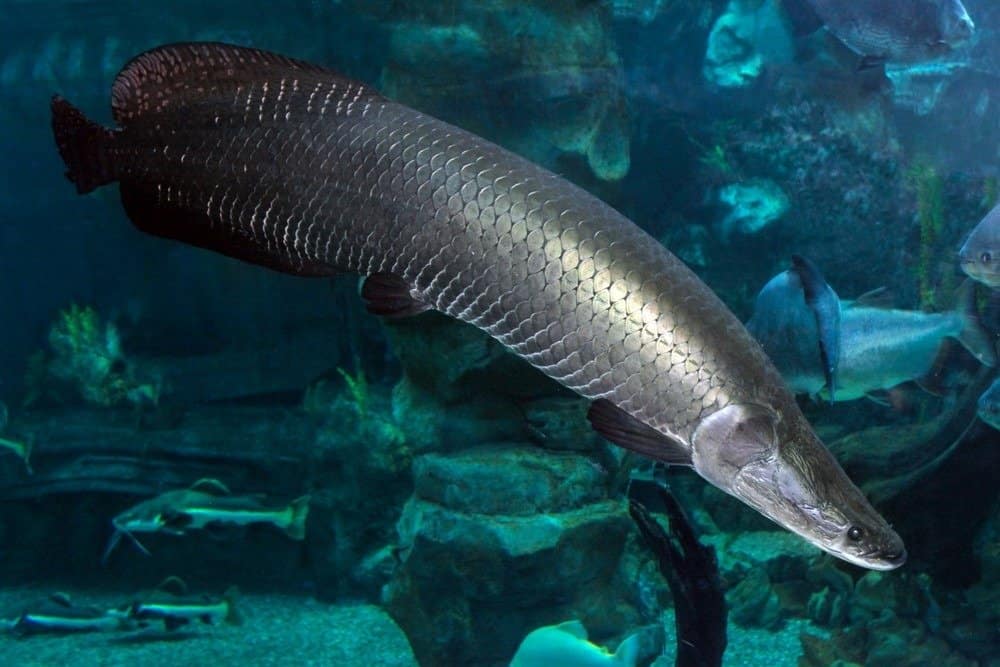
Arapaima possess a modified swim bladder that allows them to breathe atmospheric oxygen. Their bony tongues and specialized teeth also help them handle prey.
©Tatiana Belova/Shutterstock.com
One of the arapaima’s most remarkable characteristics is something most people wouldn’t expect from a fish. It must regularly come to the surface to breathe air. Unlike fish that obtain all the oxygen they need through their gills, adult arapaima rely heavily on a specialized, highly vascularized swim bladder that functions as an air-breathing organ.
According to the Smithsonian’s National Zoo, arapaima typically surface every 10 to 20 minutes to take a breath. This unusual adaptation allows them to survive in oxygen-poor waters where many other large fish would have difficulty living.
Young arapaima initially rely more heavily on their gills. As they develop, their respiratory system changes, and the modified swim bladder becomes increasingly important for obtaining oxygen. Adults still possess functional gills, but they cannot meet their oxygen requirements through gill breathing alone.
That ability provides an enormous advantage in the shallow, vegetation-filled waterways these fish inhabit. It also means that an arapaima cannot remain submerged indefinitely, even in water that might otherwise seem perfectly suitable for a fish.
Just How Big Can an Arapaima Get?
The arapaima ranks among the largest freshwater fish in the world. According to the Smithsonian’s National Zoo, these giants can reach approximately 10 feet in length and weigh as much as 440 pounds. Individuals measuring around seven to eight feet and weighing roughly 200 pounds are more common, although size varies significantly.
Their enormous bodies are built for power. Arapaima have streamlined shapes, muscular tails, and large scales that help protect them from injury. They are formidable predators, feeding primarily on other fish while also consuming smaller animals and other available food sources.
They also possess an unusual feeding mechanism. By rapidly opening their large mouths, arapaima create suction that pulls prey inside. Their bony tongues and teeth help them grip and process food once it has been captured.
Put that size, muscular body, and powerful swimming ability together, and it’s easier to understand how the fish in this video manages to pull a small boat through the water. An arapaima doesn’t have to be particularly aggressive to give an angler an unforgettable experience. Its sheer strength is more than enough.
Why Is Catch-and-Release Fishing Important for Arapaima?
Arapaima populations have faced considerable pressure from overfishing and habitat changes. Their habit of surfacing to breathe makes them easier for fishermen to locate, which historically contributed to heavy exploitation in parts of their native range.
In Guyana, conservation programs have helped protect arapaima while supporting local communities through regulated fishing and ecotourism. Catch-and-release experiences, when properly managed, can provide economic incentives to preserve both these remarkable fish and the waterways they inhabit.
However, handling an animal this large requires considerable care. Because arapaima must breathe atmospheric oxygen, keeping them submerged during an extended release attempt can be dangerous. Experienced local guides can help ensure that the fish remains supported in the water, has access to the surface, and is released with as little unnecessary stress as possible.
There are also obvious risks to entering unfamiliar tropical waterways, where caimans and other wildlife may be present. The safest approach is to follow local fishing regulations and rely on qualified guides rather than attempting to reproduce the techniques seen in an online video.
For most people, encountering a fish of this size will remain a once-in-a-lifetime experience. Fortunately, videos like this offer a remarkable look at one of South America’s most impressive freshwater predators without requiring the rest of us to wrestle a 300-pound fish in a jungle lagoon.