
Quick Take
- Some cockroaches have evolved to look so much like ladybugs that even their wings mimic the hard shell, and the reason why is stranger than you would expect. Meet the mimicking cockroach →
- At least one spider mimics a ladybug so convincingly it even copies how the beetle walks, though a few dead giveaways exist for those who know what to look for. See the ladybird mimic spider →
- Several common garden beetles share ladybugs' red-and-black color scheme, and confusing them could mean missing a serious crop pest. Spot the crop pest lookalike →
- Ladybugs have a chemical defense so effective it makes predators stop mid-attack, and some imposters manage to exploit this reputation without producing a single drop themselves. Learn about ladybug defenses →
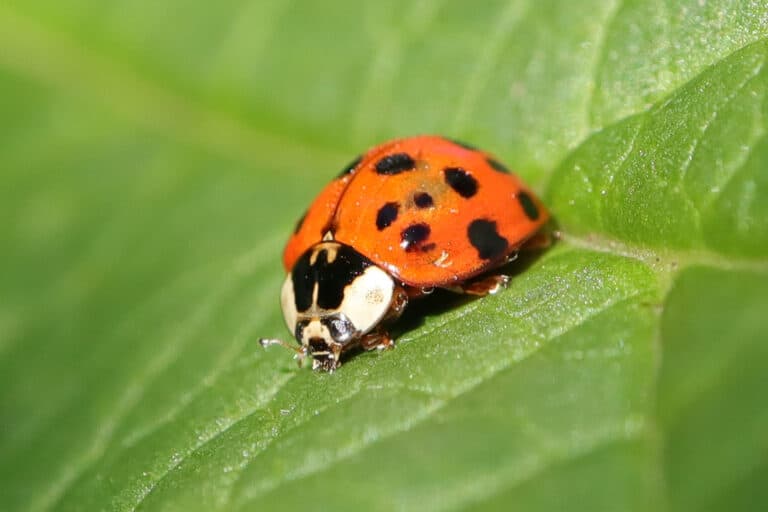
Ladybugs, commonly known as ladybirds in Great Britain or lady beetles in other parts of the world, are widespread insects in the family Coccinellidae. There are more than 6,000 described species of small to medium-sized lady beetles worldwide, with nearly 500 species in North America. They come in different colors and patterns, but the seven-spotted ladybugs (Coccinella septempunctata) with glossy, red-and-black bodies are among the most common ones. Despite their vivid coloring, with so many different species, ladybugs are often confused with other bugs. Read on to discover some surprising bugs that mimic ladybugs, and learn how to differentiate between them.
About Ladybugs
Most ladybugs have round to oval dome-shaped bodies with flat undersides, short, clubbed antennae, six legs, and two sets of wings. Their fragile flight wings are protected by a pair of hardened or leathery outer wings called elytra. Most ladybugs are less than 0.39 inches long. Depending on the species, they may have stripes, spots, or no markings at all. Their bright red, orange or yellowish color patterns actually protect them from threats by warning predators that they are distasteful. This is called aposematic signaling. Ladybugs have a defense called reflex bleeding. When attacked, they secrete alkaloid toxins through the joints of their exoskeletons, deterring predators from feeding on them.
Ladybugs inhabit many different types of habitats, including suburbs, cities, forests, grasslands, meadows, and agricultural fields. They are mostly active in spring and summer, when they mate and lay several clutches of eggs. During the winter, ladybugs hibernate in warm, secluded places, such as under rocks and tree bark, or in leaf litter and rotting logs. They even overwinter inside houses.
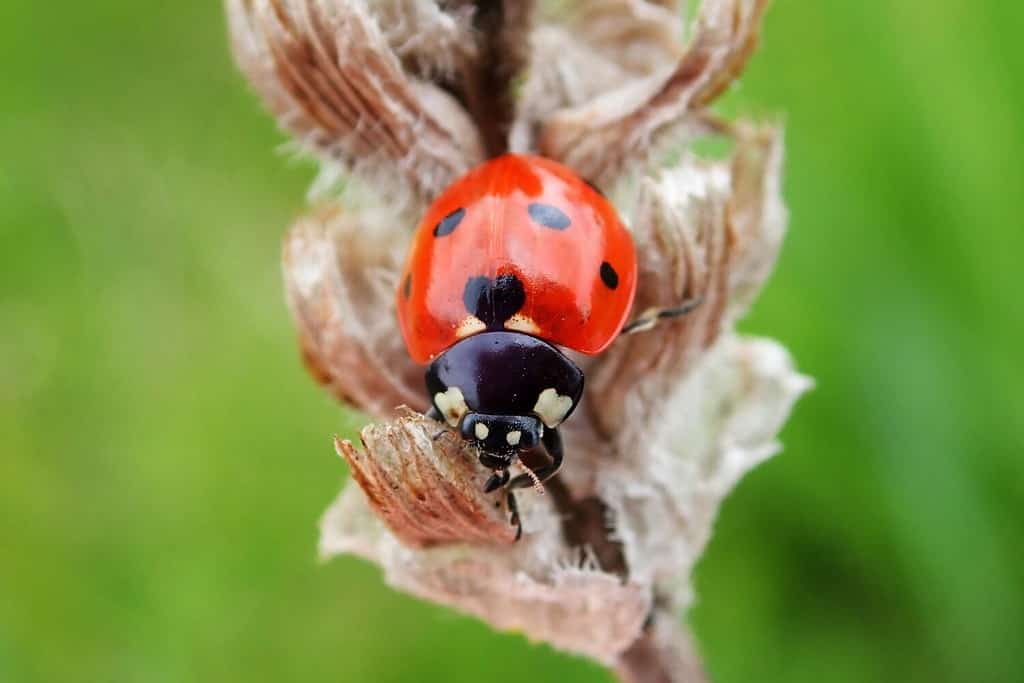
The seven-spotted ladybug is among the most common in the U.S.
©Vojce/Shutterstock.com
The Beetle-Mimicking Cockroach
Although many cockroaches are brown or black in appearance, members of the Prosoplecta genus native to Southeast Asia have evolved to mimic the domed body shape and red and black color patterns of ladybugs. This evolutionary adaptation is called Batesian mimicry, and it allows them to trick predators into thinking they are toxic. Other cockroaches in the genus have bright orange or yellow bodies with black spots similar to Asian lady beetles. These cockroaches also have modified forewings that resemble the hard elytra of ladybugs. However, these cockroaches generally have long antennae and their forewings have flanged edges, or flat borders.
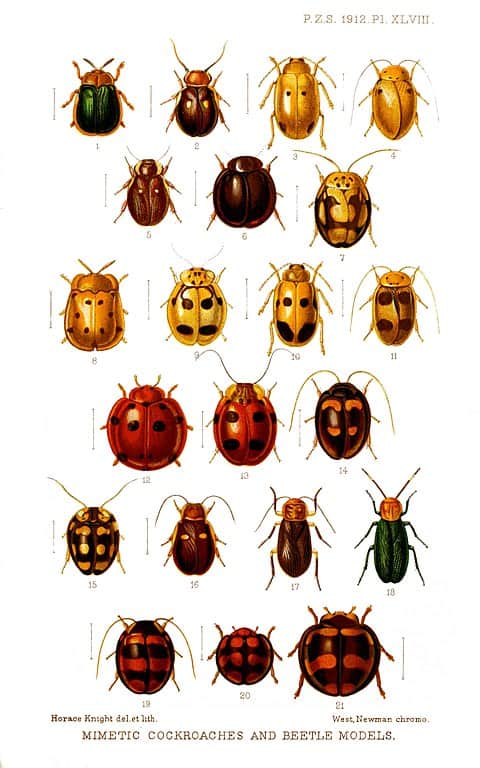
Beetle-mimicking cockroaches belong to the Prosoplecta genus.
©Horace Knight / Public domain, via Wikimedia Commons – Original / License
The Ladybird-Mimic Spider
Spiders in the Paraplectana genus, such as the Paraplectana tsushimensis, can also appear similar to ladybugs. It is a species of orb-weaver spider that is native to China, Taiwan, and Japan. These spiders have reddish-orange dome-shaped bodies with black spots. Their heads are yellow-orange and have no markings. Ladybugs have black heads, and most ladybugs have all-black legs, but ladybird-mimicking spiders have yellow-orange legs. Their highly specialized form of Batesian mimicry even allows them to imitate the way a beetle walks. However, as they are spiders, they have eight legs instead of six, and of course, they have no wings.
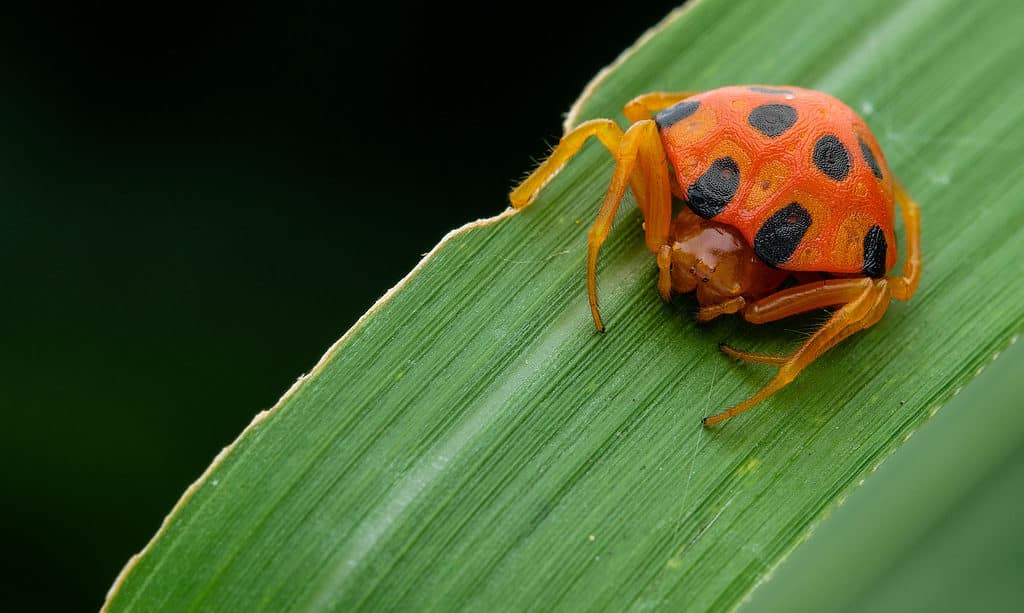
Ladybird-mimic spiders can even imitate the way a beetle walks.
©hellomumu/Shutterstock.com
Argus Tortoise Beetle
The Argus tortoise beetle (Chelymorpha cassidea), also known as the milkweed tortoise beetle, is a leaf beetle species in the Chrysomelidae family. It’s one of the largest leaf beetles native to North America at about 0.33 inches in length. The Argus tortoise beetle closely resembles a ladybug in terms of size, body shape, and its reddish-orange color pattern. However, Argus tortoise beetles can stretch their heads beyond the front end of their thoraxes, similar to the way turtles can stretch their heads past the openings of their shells. Their elytra also have flanged edges that fan out, and they have relatively long, thread-like antennae.
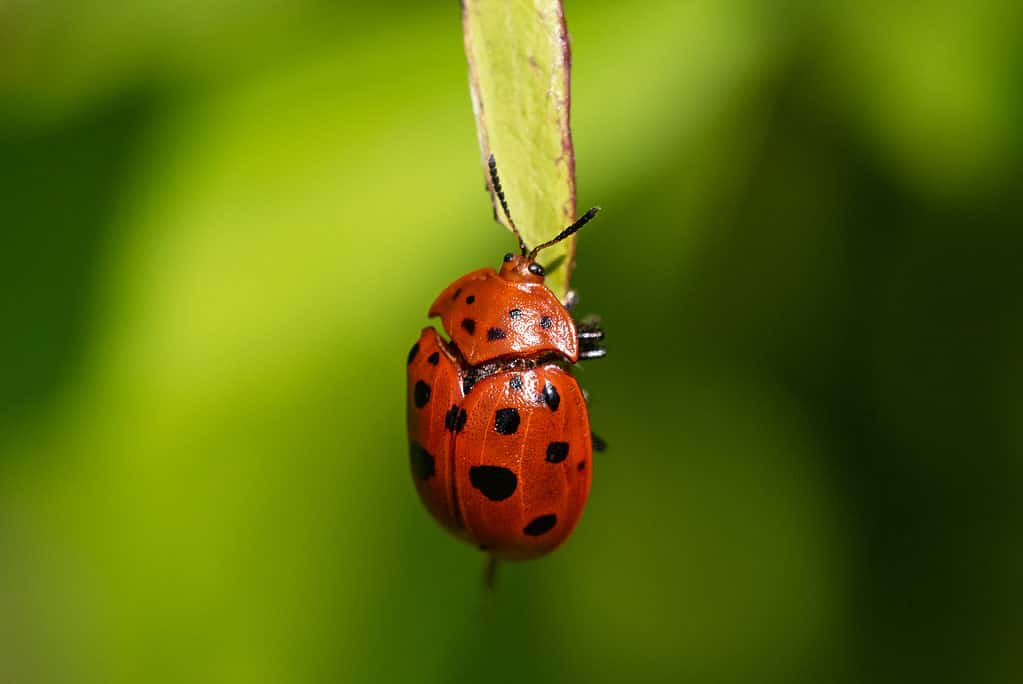
The Argus tortoise beetle closely resembles a ladybug in terms of body size, body shape, and markings.
©iStock.com/bookguy
Spotted Cucumber Beetle
Spotted cucumber beetles (Diabrotica undecimpunctata) resemble yellow ladybugs such as 22-spot ladybirds (Psyllobora vigintiduopunctata). These cucumber beetles are greenish-yellow with black spots. Their small black heads also appear similar to most ladybugs and they are similar in size to some ladybug species at 0.2 inches. However, unlike the round, dome-shaped ladybugs, spotted cucumber beetles have elongated, oval bodies and they are slightly flatter. These beetles also have long, thread-like antennae.
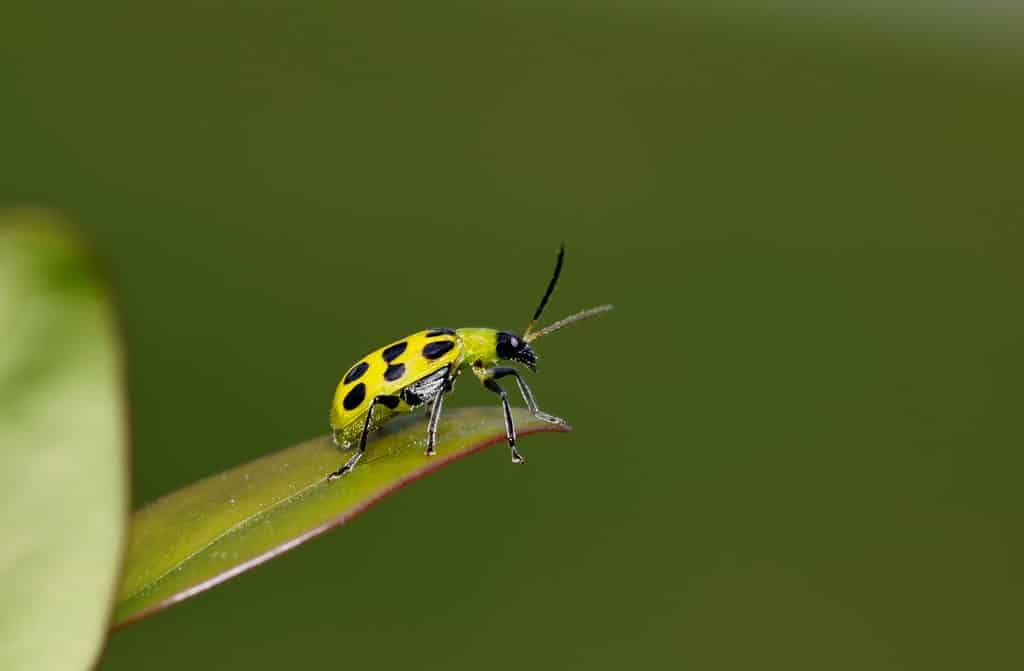
Spotted cucumber beetles rarely grow larger than 0.2 inches.
©iStock.com/Brett_Hondow
Bean Leaf Beetle
The bean leaf beetle (Cerotoma trifurcata) belongs to the family Chrysomelidae that is commonly found in bean, alfalfa, and soy crops. It is similarly sized at around 0.31 inches and often has golden coloring with black spots. However, it can also be red with black spots, which is why it’s often confused with many ladybug species. The bean leaf beetle has four black spots on its back and a non-spotted morph. However, unlike a ladybug’s head, which is usually spotted, bean leaf beetle heads are always black. These leaf beetles also have long, thread-like antennae and elongated oval bodies that are flatter than ladybugs’ domes.
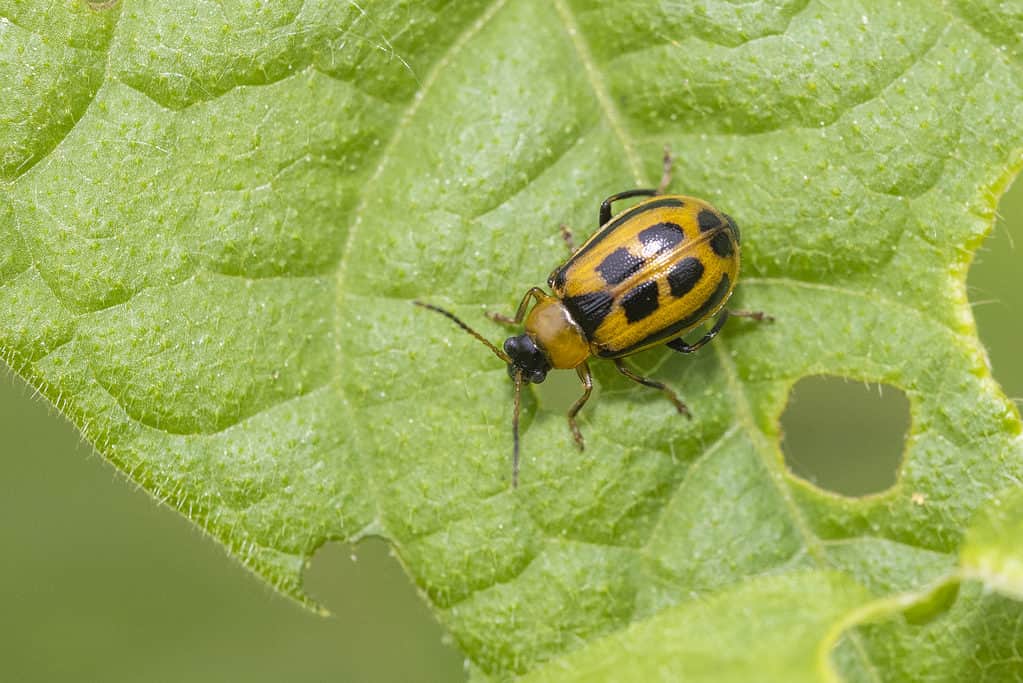
The bean leaf beetle is often a yellow shade and generally has four dark spots on its back.
©iStock.com/mirceax
8. Swamp Milkweed Leaf Beetle
The swamp milkweed leaf beetle (Labidomera clivicollis) is another leaf beetle species in the Chrysomelidae family. It’s often confused with red ladybug species due to its similarly rounded, orange or red dome-shaped body with black spots and short, slightly clubbed antennae. Swamp milkweed leaf beetles tend to be larger, growing up to approximately 0.5 inches in length, and they have longer legs. You can also differentiate the two by observing their dark markings. Most swamp milkweed leaf beetles have large, dark blue to black blotches rather than small black spots.
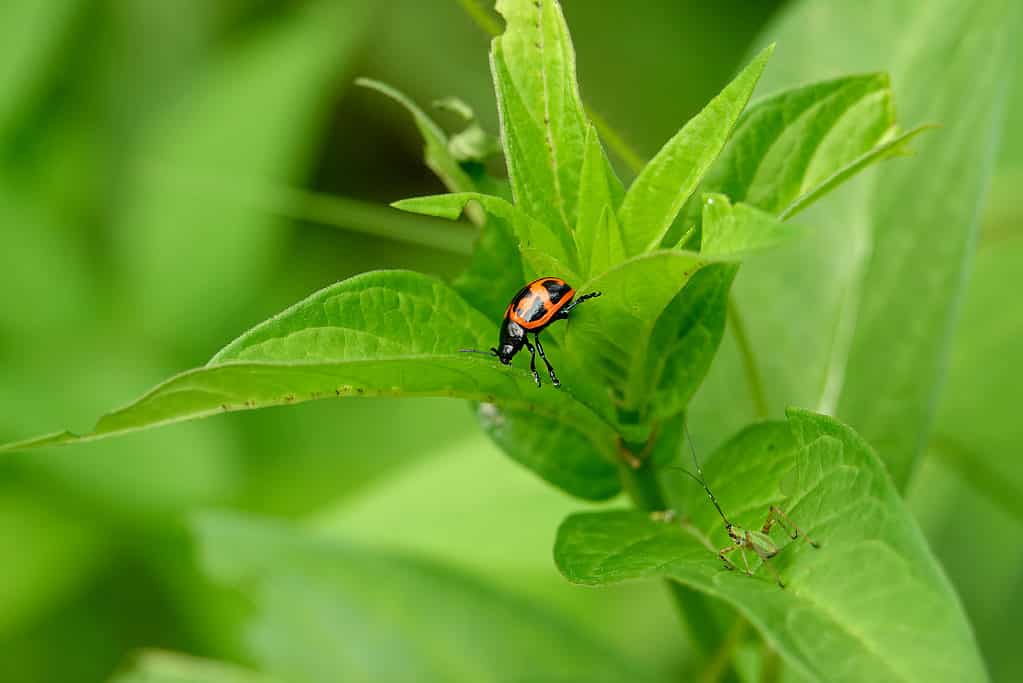
Swamp milkweed leaf beetles tend to be larger than ladybugs, growing up to 0.5 inches in length.
©iStock.com/ErikAgar
Larger Elm Leaf Beetle
| Larger Elm Leaf Beetle | |
|---|---|
| Scientific Name | Monocesta coryli |
| Color | Yellow-orange body with black spots |
| Size | 0.4 to 0.6 inches (10 to 16 mm) |
| Habitat | Forests |
The larger elm leaf beetle (Monocesta coryli) is the only species of the large neotropical genus Monocesta found in the United States. It is commonly found in forests. Like many ladybug species, this elm leaf beetle has a yellow-orange body and dark markings. However, it has four large, metallic blue to black blotches instead of small black spots. This beetle is also larger at 0.38 to 0.63 inches in length. Although their body shapes are somewhat similar, elm leaf beetles are more pear-shaped than rounded, and they have long, thread-like antennae.
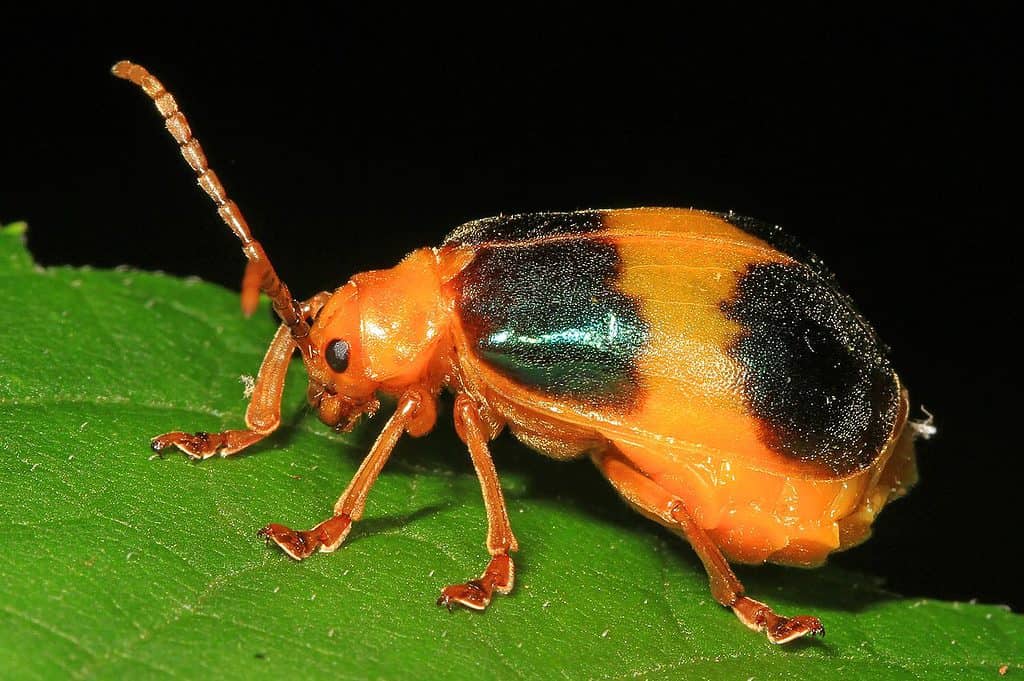
Elm leaf beetles are more pear-shaped than dome-shaped.
©Judy Gallagher / CC BY 2.0, via Wikimedia Commons – Original / License
Grapevine Beetle
The grapevine beetle (Pelidnota punctata), also known as the spotted June beetle or spotted pelidnota, is a type of scarab beetle that resembles a ladybug. It has a dull yellow or yellowish-tan color with four small black marks on each side. Like most ladybugs, grapevine beetles also have all-black legs and relatively small antennae. However, the grapevine beetle is much larger at 1 to 1.2 inches in length, and its body is an elongated oval rather than a rounded dome.
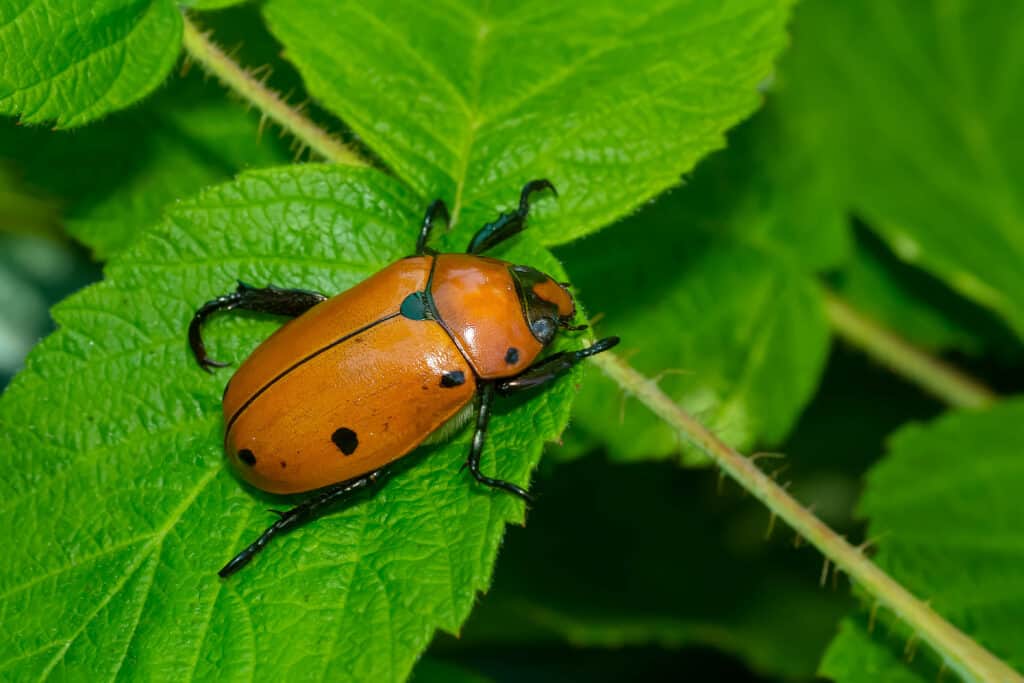
The grapevine beetle is also known as a spotted June beetle.
©Paul Reeves Photography/Shutterstock.com