
Quick Take
- One of these look-alike blue parrots holds a world record, and telling them apart comes down to a single stripe of yellow near the bill. See the yellow markings →
- Lear's macaws skip the treetops entirely to nest somewhere you'd never expect a parrot to call home. Explore cliff-nesting behavior →
- Hyacinth macaws use a quirky egg-laying strategy that scientists think may be a secret survival mechanism. Discover the egg-laying strategy →
- One of these species roams across multiple countries while the other is trapped in just two colonies, a situation caused by a single plant. Compare their ranges →
When you first see a Lear’s macaw (Anodorhynchus leari) vs. a hyacinth macaw (Anodorhynchus hyacinthinus), you may think you’re looking at the same bird. After all, both of them are large blue parrots from Brazil. However, these birds have several important differences. Read on to learn what sets these two parrots apart.
Comparing a Lear’s Macaw vs. a Hyacinth Macaw
| Lear’s Macaw | Hyacinth Macaw | |
|---|---|---|
| Size | About 75% the size of a hyacinth macaw; approximately 30 inches long with a wingspan of around 3 feet | Around 40 inches long with a wingspan between 4 and 5 feet |
| Appearance | Pale yellow semi-circle patch beside the lower bill; duller, slightly greener blue color | Thin band of yellow around the lower bill; uniform cobalt blue color |
| Distribution and habitat | Caatinga thornscrub in northeastern Brazil; vegetation with licuri palm trees | Brazil’s Pantanal, the Cerrado, and Amazon basin; small population in Bolivia; palm savannas, tropical wetland forests |
| Nesting habits | Roost and nest in groups in the crevasses of red sandstone cliffs | Roost in trees and nest alone in tree cavities |
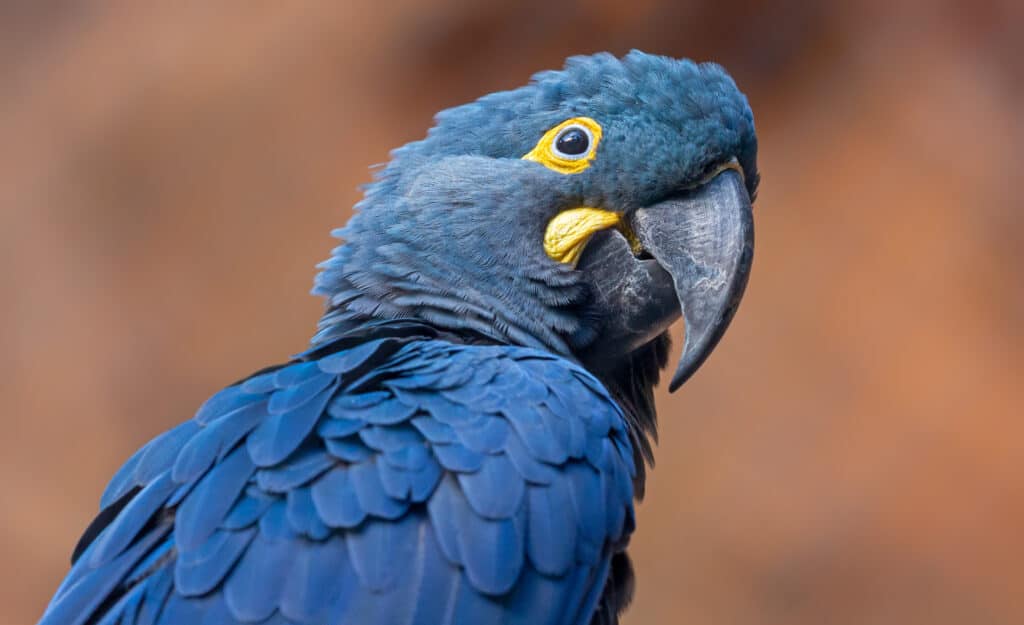
Lear’s macaws have a pale yellow semi-circle patch beside the lower bill.
©iStock.com/tane-mahuta
The Key Differences Between Lear’s Macaw and Hyacinth Macaw
One of the biggest similarities these two species share is their love of eating nuts. Lear’s macaws and hyacinth macaws are experts at cracking open the toughest nuts and leisurely dining on them in the shade. The key differences between Lear’s macaws and hyacinth macaws are their size, appearance, distribution and habitats, and nesting habits. Keep reading to fully understand the differences between Lear’s macaw and hyacinth macaw.
Size
One of the quickest ways to tell these two birds apart is their size. Lear’s macaw is noticeably smaller. It is still a large bird, but it is only about 75% the size of a hyacinth macaw. Lear’s macaws measure up to approximately 30 inches long from the top of the head to the tip of the tail, and they have a wingspan of around 3 feet.
The hyacinth macaw is the largest flying parrot species on Earth. These birds reach about 40 inches long from the top of the head to the tip of the tail. They also have an incredible wingspan measuring between 4 and 5 feet.

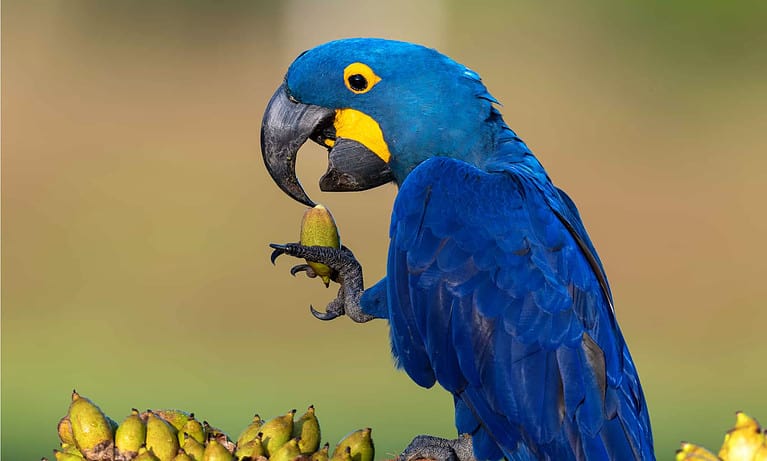
The hyacinth macaw is the largest flying parrot species.
©Dgwildlife/Shutterstock.com
Appearance
There are also several differences in appearance. Both parrots have yellow around the lower bill, but Lear’s macaw’s is a different size and shape. These birds have a pale yellow semi-circle patch beside the lower bill. Their feathers are also a duller, slightly greener blue color than those of a hyacinth macaw. Their heads can also appear slightly more grey.
Instead of a semi-circle patch around the lower bill, hyacinth macaws have a thin band of yellow. Their feathers are also a more uniform cobalt blue color all over their bodies.
Distribution and Habitat
Lear’s macaws do not have as wide a distribution as hyacinth macaws. They only inhabit a tiny region in Bahia, a northeastern Brazilian state. There are two colonies where they occur: Serra Branch and Toca Velha. You can find these beautiful birds flying around dry, thorny forest habitats called caatinga, where they favor licuri palm trees, as their primary diet consists of licuri palm nuts.
Most hyacinth macaws inhabit Brazil, but there is a small population in Bolivia. You can find most of the hyacinth macaws in the Pantanal region, as they prefer a neotropical climate. There is also a healthy population of hyacinth macaws in the tropical savanna region of Brazil, as well as in the Amazon basin. These birds favor palm savannas, as they primarily feed on palm nuts, and tropical wetland forests.

Lear’s macaws can only be found in the state of Bahia in Brazil.
Nesting Habits
Lear’s macaws do not roost in the treetops like most macaws. These birds roost and nest in groups in the crevasses of red sandstone cliffs. When Lear’s macaws find a partner, they have a mate for life. They’ll leave the group and build their nest high up on the face of a cliff. Female Lear’s macaws lay one to two eggs that incubate for around 28 days. The female might leave for a brief period to eat but must return quickly to provide warmth. As night falls, both parents can be found in the nesting area.
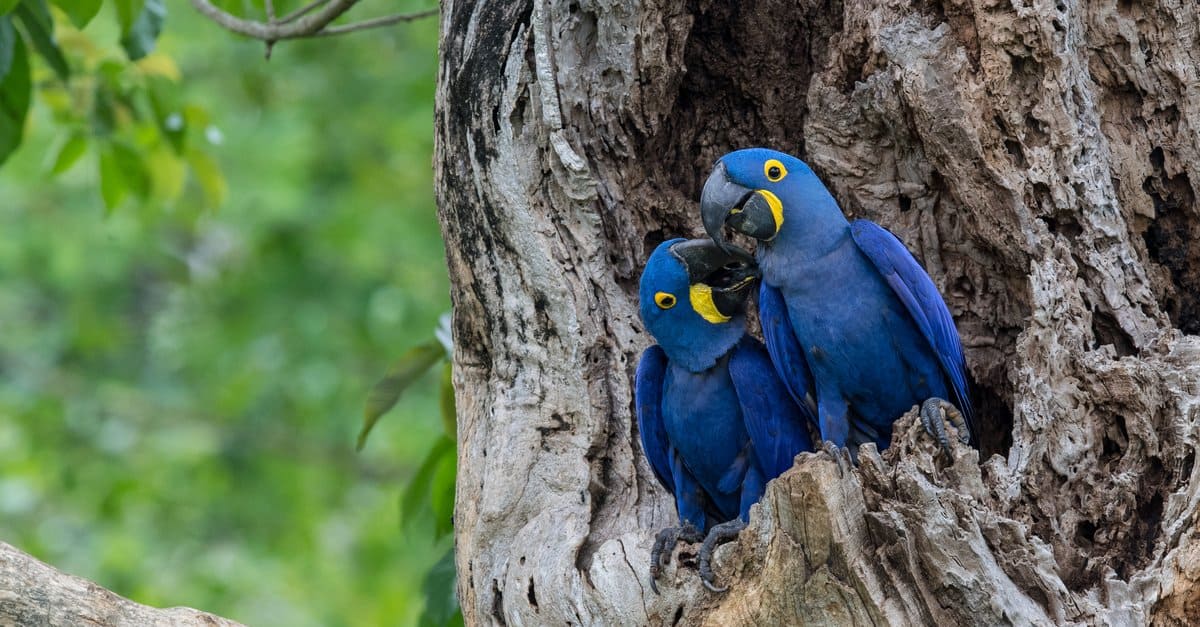
Hyacinth macaws roost in trees, and they are not as social as Lear’s macaws. They generally nest alone in tree cavities. Hyacinth macaws are also monogamous, but they don’t breed every year. Most pairs choose large hollows in mature trees high up off the ground to build their nests. Hyacinth macaws in northeastern Brazil may also use cliff crevices as nesting spots. They also lay one to two eggs, but several days apart. This is called asynchronous hatching, and it may be a way to ensure the survival of the species. The female hyacinth macaw incubates the eggs for about a month. The male leaves the nest to bring food to the female.
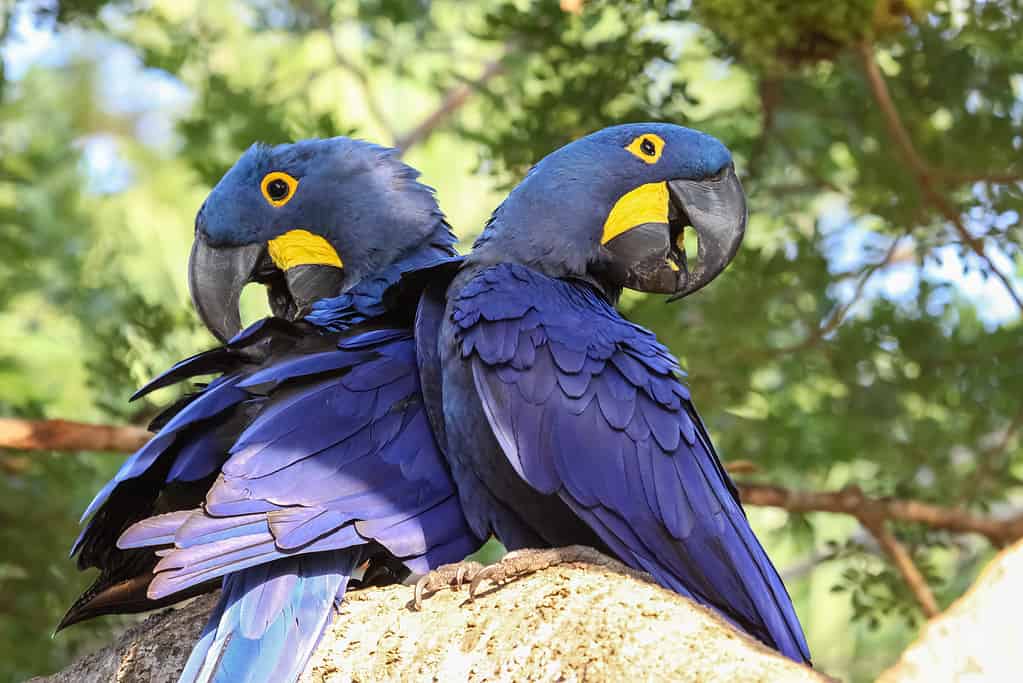
Hyacinth macaws are monogamous and build their nests in trees high up off the ground.
©Uwe-Bergwitz/iStock via Getty Images