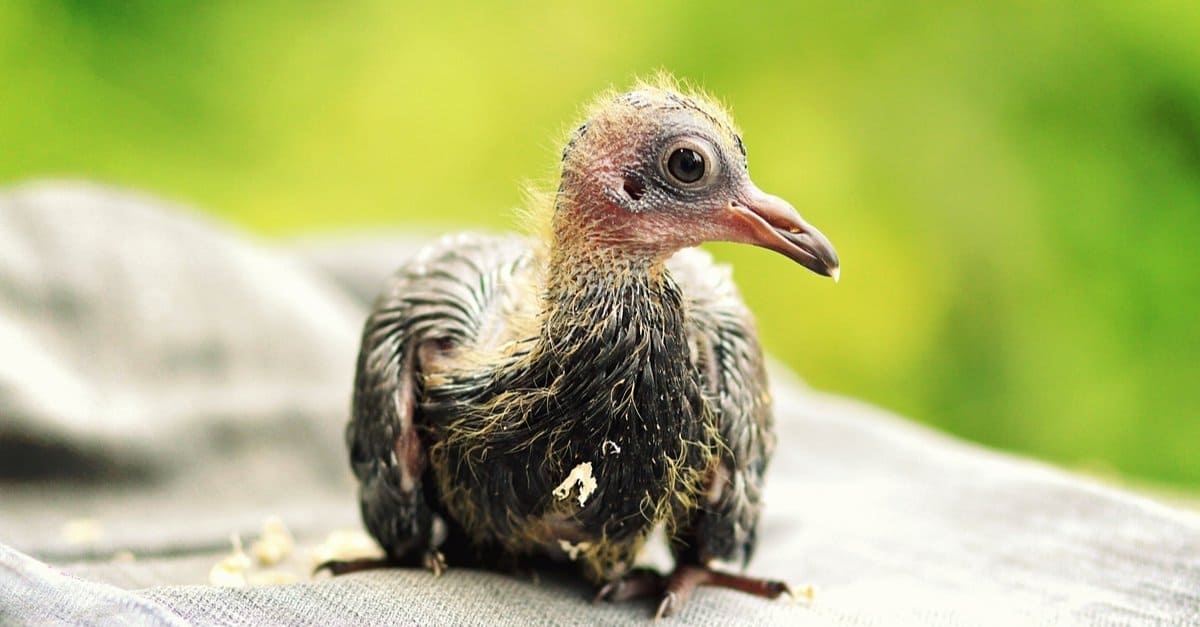

Baby pigeons may be tiny at the beginning, but they sure do grow up fast. In fact, pigeons are so developed when they leave their nests, most people think they are adults. There are many things to learn about these super-intelligent squabs, so let’s get started! Here are five amazing facts and five unbelievable squab pictures.
#1: Baby Pigeons Have Involved Parents
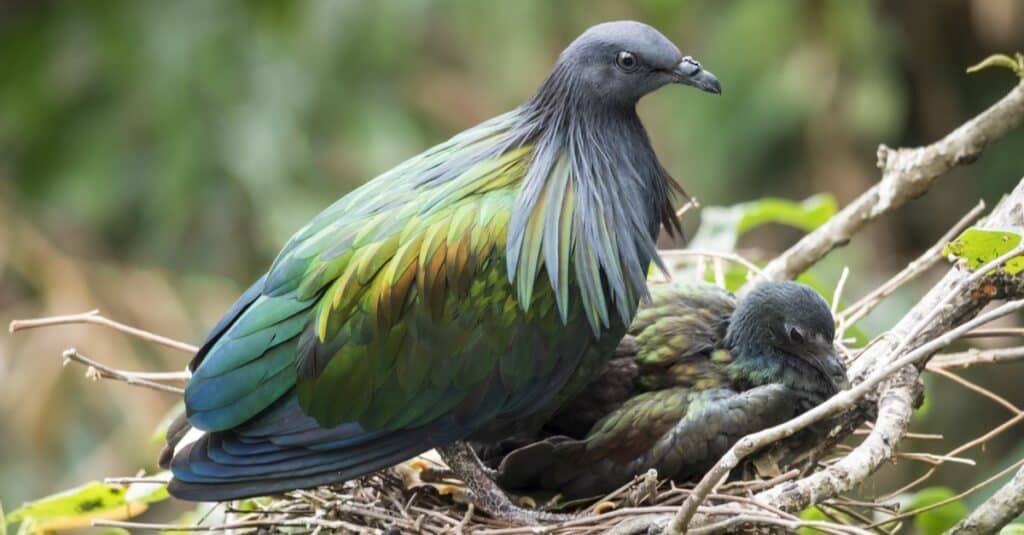
Both male and female pigeons care for their offspring.
©iKhai_TH/Shutterstock.com
Many animals in the animal kingdom are raised only by their mothers, but this cannot be said about the baby pigeon. Unlike many other species, both male and female pigeons build the nest and take turns incubating the eggs. Male and female pigeons also both feed their babies, but we’ll discuss that intriguing fact next.
Raising their young isn’t the only thing that a pair of pigeons commit to. When the two adult pigeons mate, they typically do so for life. During their lives together, the pigeons work together to protect their babies from predators by emitting soft coos when danger is near. They may also slap intruders with their wings.
#2: The Babies Drink Pigeon Milk
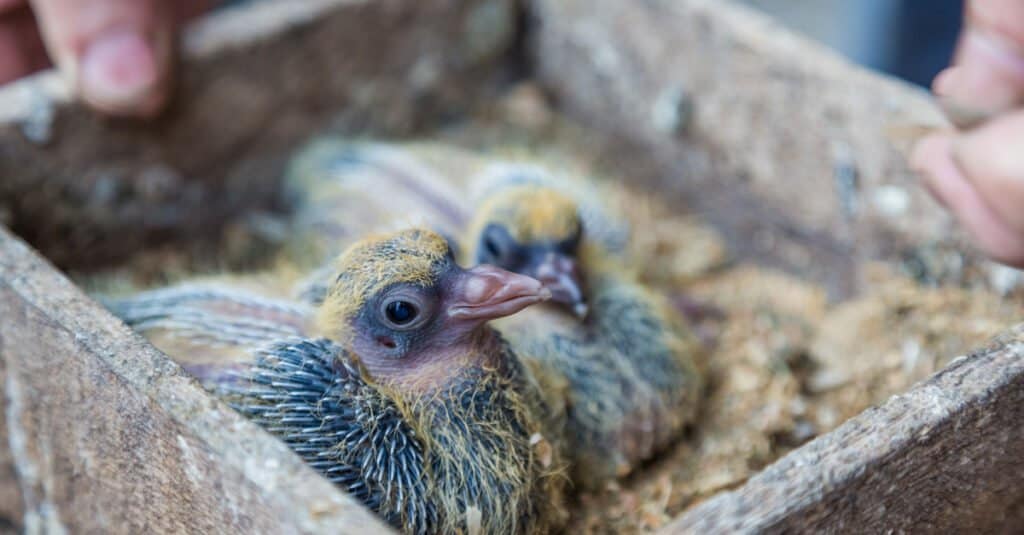
Baby pigeons drink crop milk that is regurgitated directly into their mouths.
©Galina Sharapova/Shutterstock.com
Male and female pigeons produce crop milk, often referred to as pigeon milk. The crop is a pouch in the pigeon’s throat that is part of the esophagus. Crop milk is a special secretion, high in protein and nutrients, that is used to feed the squabs.
The parents regurgitate this secretion directly into their babies’ mouths. During the second week, the parents begin to add partially digested grains and seeds to the mix. By the third week, the baby pigeons are weaned off crop milk and given only regurgitated adult food.
#3: Squabs Are a Rare Sight in the Wild
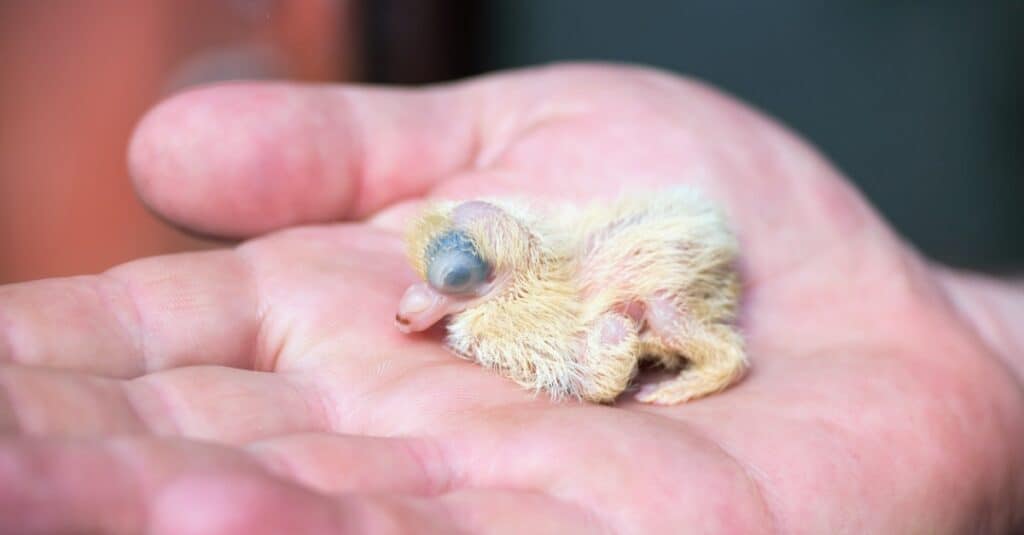
Squabs won’t leave their nests for 4 to 5 weeks.
©iStock.com/AGEphotography
One reason why baby pigeons are a rare sight in the wild is because the parents build the nests in high, inaccessible locations. This keeps the nests safe from predators like cats and raccoons. The squabs remain in the nest, guarded by their parents, for about 4 to 6 weeks.
While they are in the nest, baby pigeons grow very quickly. They weigh around half an ounce at birth, but by the time they are 30 days old, they weigh between 9.5 and 12.3 ounces. When they fledge, they have all of their feathers and are nearly the size of their parents. Most people do not realize they are seeing juvenile pigeons, not adults.
#4: Baby Pigeons Are Born With A Built-In GPS
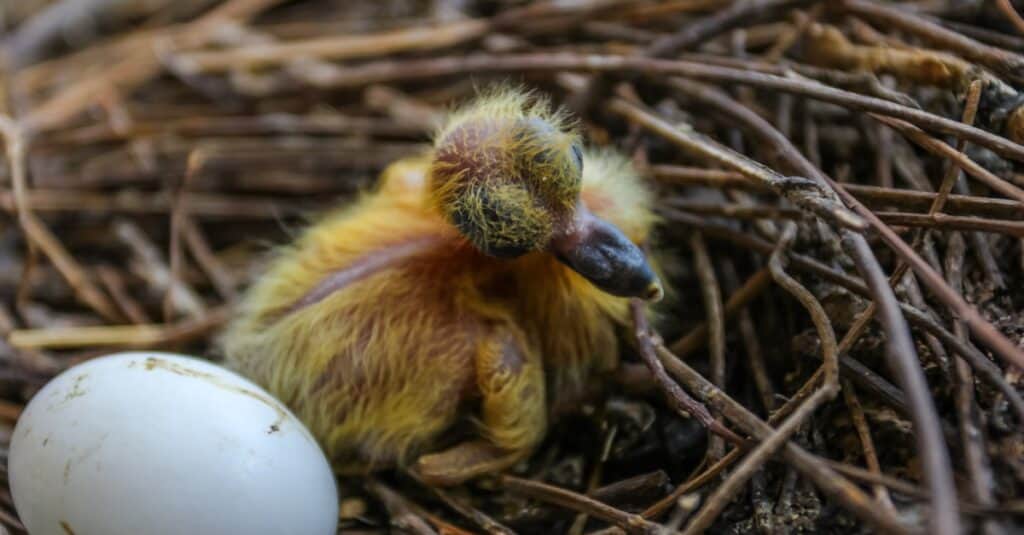
Squabs are born with special nerve cells in their brains that help them create spatial maps.
©iStock.com/icestylecg
Carrier pigeons are pigeons that are trained to carry messages over long distances. During WWI and WWII, carrier pigeons transported important messages to and from the front lines. One pigeon even saved the lives of 194 American infantrymen.
Pigeons were chosen for training because they can find their way back to their home coops from over a thousand miles away. This means that these tiny pigeons are born with their own special GPS. Researchers believe pigeons have special nerve cells in their brains that create spatial maps based on Earth’s electromagnetic fields.
#5: Squabs Have Extraordinary Eyesight
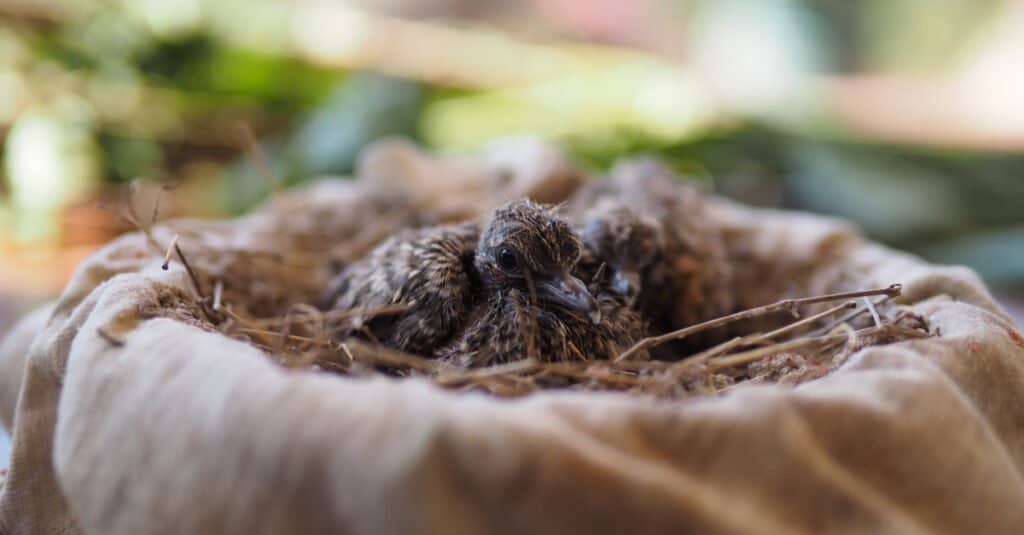
Pigeon babies can see ultraviolet and polarized light.
©Tota shutter/Shutterstock.com
When squabs are born, their eyes are shut. However, just a few short weeks after hatching, these baby pigeons can see ultraviolet light and polarized light. Due to their wide-set eyes, they also have a field of view that is almost 360°.
Despite these advantages, pigeons have limited depth perception. However, researchers believe that the reason they bob their heads is to gain a sense of perspective, which allows them to judge whether an object is near or far.