
Quick Take
- One Texas rattlesnake has venom so uniquely dangerous that scientists gave it its own classification, and there is no way to identify which snakes carry it just by looking at them. Meet the Mojave toxin →
- The deadliest rattlesnake in Texas isn't the one responsible for the most bites, a distinction that matters if you spend time outdoors. Most bites in Texas →
- One tiny Texas rattlesnake's venom was turned into a life-saving heart attack drug, even though locals gave it a nickname suggesting it's barely a threat at all. The heart attack drug snake →
- Some of Texas's most venomous rattlesnakes almost never rattle a warning, so the sound you're listening for won't always save you. Least aggressive rattler →
Texas is home to 10 different types of rattlesnakes, making it one of the states with the highest number of rattlesnake species in the U.S., along with Arizona and California. Most of the rattlesnakes in Texas are rarely aggressive, but if they feel threatened or in danger, they will certainly defend themselves with brutal force. Starting in late February and early March, the weather in Texas warms up enough for rattlesnakes to come out and enjoy the sun.
Although rattlesnakes are around throughout the summer, you are more likely to see them during their mating season in the spring. They are also more aggressive and defensive during this time.
So, what kinds of rattlesnakes live in Texas?
Western Diamondback Rattlesnake
| Scientific name: | Crotalus atrox |
| Distribution: | Widely distributed, but largely absent in East Texas and the Panhandle |
| Length: | 4-6 feet |
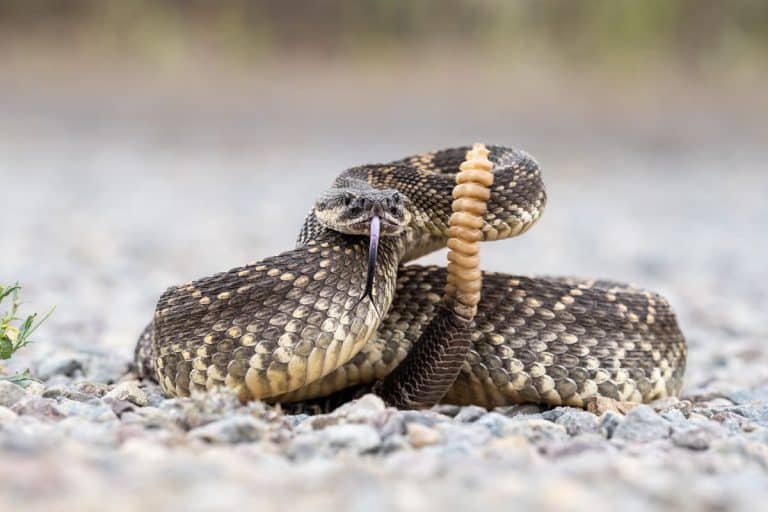
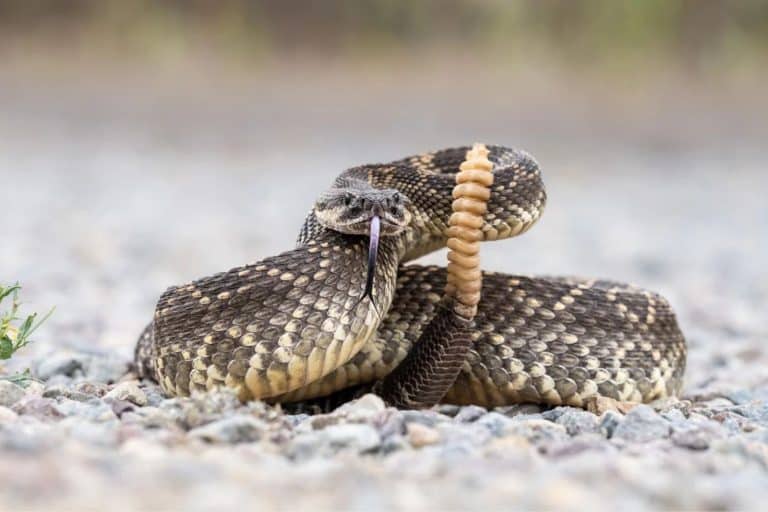
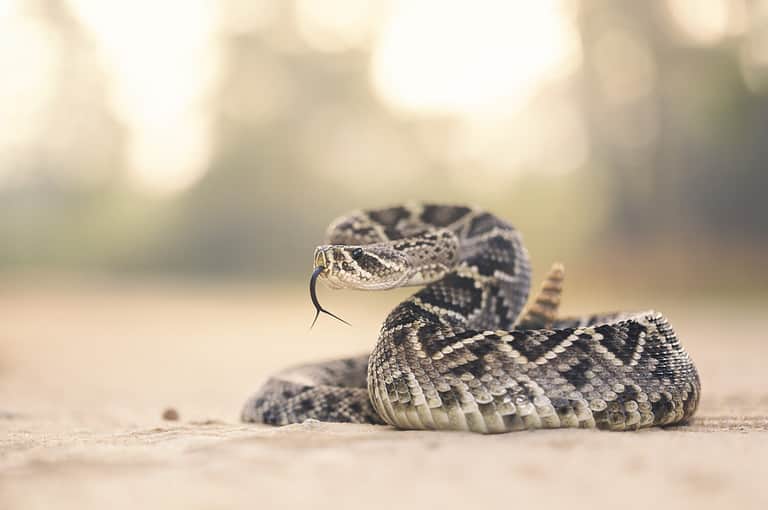
The western diamondback rattlesnake is the most common venomous snake in Texas. Thus, this rattlesnake lives in a variety of habitats all over the state, pretty much everywhere except for the northern Panhandle and some parts of eastern Texas. When you think of rattlesnakes in Texas, the western diamondback is likely what you’ll picture. This snake is an iconic image in many old western films.
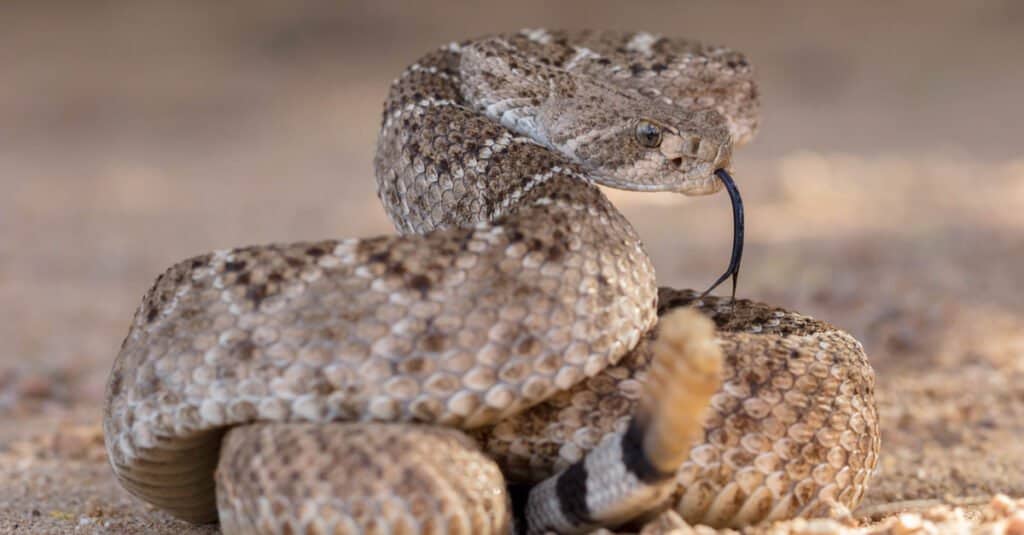
The western diamondback rattlesnake has very distinct black and white bands along the end of its tail.
©Alexander Wong/Shutterstock.com
The western diamondback causes the most rattlesnake bites in Texas. That’s because the western diamondback rattlesnake is aggressive, unlike many of the other snakes on this list. In fact, it may be the most aggressive of all rattlesnakes. This snake is not one to run from threats and will stand its ground in the face of danger.
Western diamondback rattlesnakes are usually 3–6 feet long and can live for 15–20 years or more in captivity. They are mostly gray with darker diamond patterns running along the length of their bodies. The diamonds on their backs have white or yellow outlines, and there are black and white bands on the end of the snake’s tail just before the rattle.
Timber Rattlesnake
| Scientific name: | Crotalus horridus |
| Distribution: | East Texas |
| Length: | 3-3.5 feet |
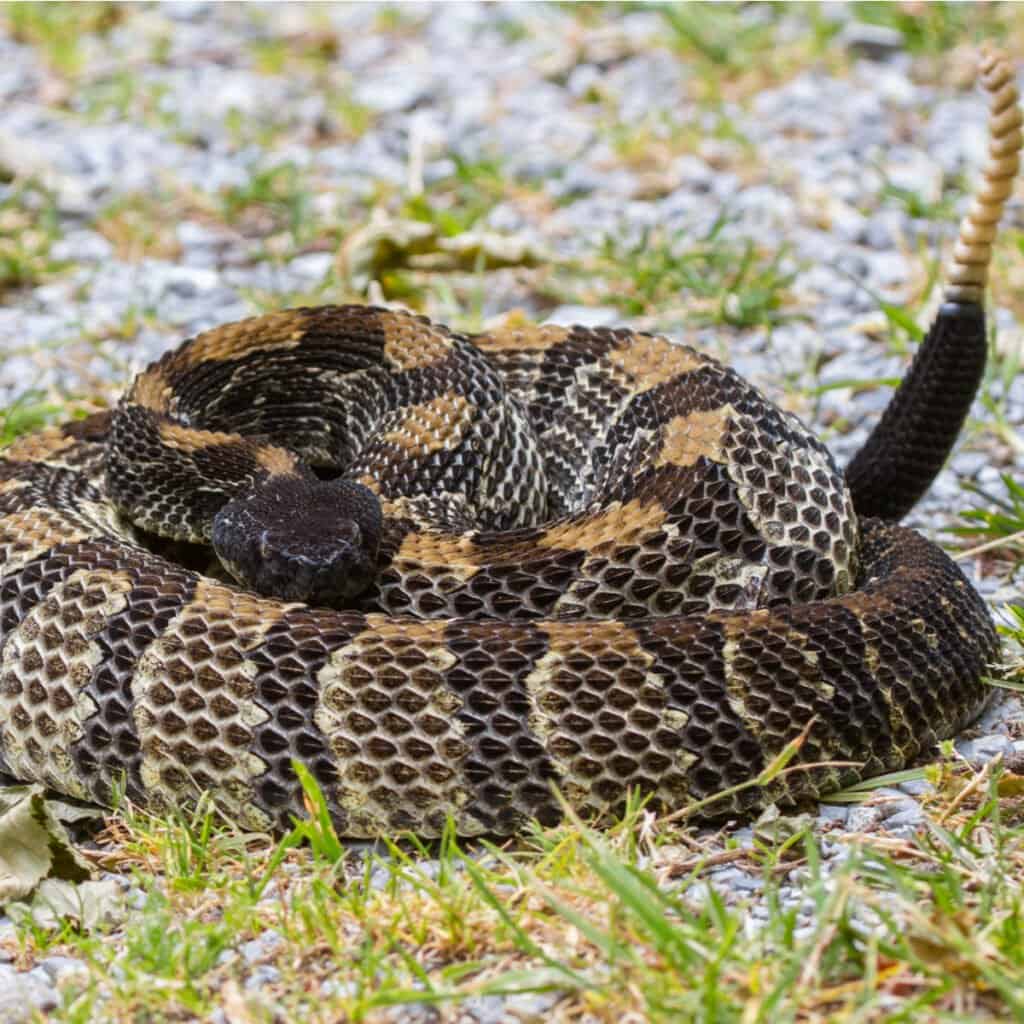
Timber Rattlesnakes use camouflage to hide from predators.
©Frode Jacobsen/Shutterstock.com
The timber rattlesnake, or canebrake rattlesnake, lives mostly in the eastern third of Texas in areas where it can be close to water. These snakes are generally 36-60 inches long, but can grow up to 7 feet, and are found in many regions of the eastern United States.
Timber rattlesnakes are usually gray, light yellow, or even a greenish-white color. Also, they have dark, jagged V-shaped bands along the length of their bodies, often with a rust or orange-colored stripe running down the middle of their backs as well. But the very end of the timber rattlesnake’s tail is dark near its rattle.
The timber rattlesnake is one of the most dangerous snakes in the United States, in part because they have such a high venom yield (it can inject a lot of venom in a single bite). These snakes eat rodents, amphibians, lizards, and even birds. Some reports in Texas suggest that these rattlesnakes especially like eating garter snakes.
Timber rattlesnakes are not always quick to defend. They prefer to stay silent and blend into their environment or escape rather than risk a fight. It can be hard to actually get these snakes to bite or even rattle a warning—although obviously it still happens, and you should never attempt to do so. This is because timber rattlesnakes are a threatened species in Texas and are protected by state laws.
Banded Rock Rattlesnake
| Scientific name: | Crotalus lepidus klauberi |
| Distribution: | In Texas, they are restricted to the Franklin Mountains in El Paso County |
| Length: | 23-27 inches |
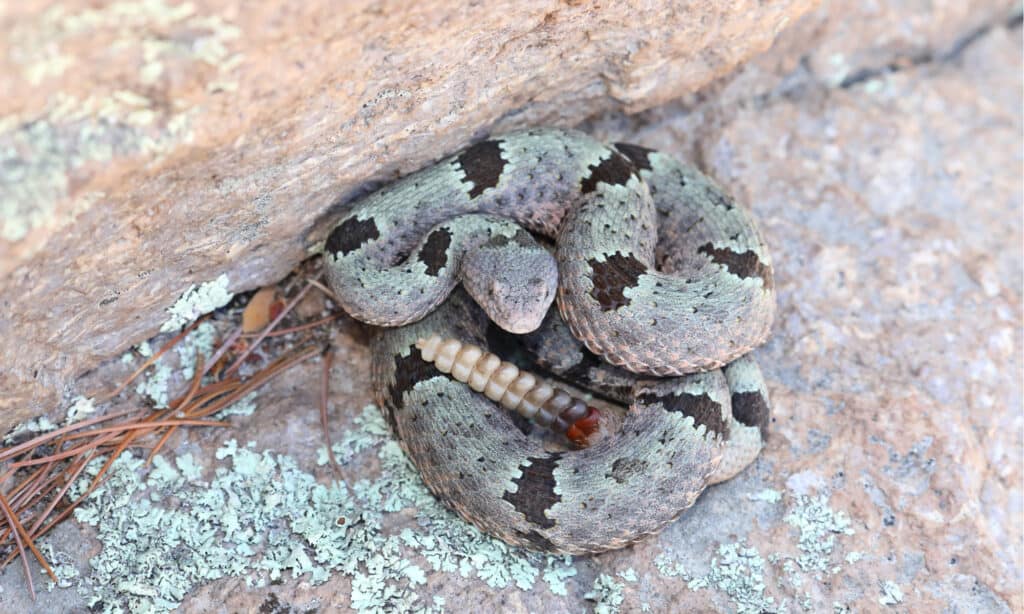
The Banded Rock Rattlesnake doesn’t travel very far and usually lives its entire life in the same area.
©Glenn McCrea/Shutterstock.com
The banded rock rattlesnake is found in the western tip of Texas, usually in rocky areas like canyons. Its habitat extends to the U.S. states of New Mexico and Arizona, as well as parts of Mexico. The banded rock rattlesnake is 23-27 inches long with a gray or dark green body. Like its name, this rattlesnake has dark gray or black bands patterned along the length of its body, giving it a very striking and unique appearance. Banded rock rattlesnakes are protected from capture of any kind by Texas state laws.
The banded rock rattlesnake is the least aggressive of all the rattlesnakes in Texas; therefore, these snakes are shy and do their best to avoid large predators and humans. In fact, these snakes usually don’t hiss or even use their rattles, preferring instead to simply stay quiet and blend into their surroundings. The banded rock rattlesnake’s venom seems to vary depending on where it lives, but it is usually hemotoxic, attacking red blood cells.
Mottled Rock Rattlesnake
| Scientific name: | Crotalus lepidus lepidus |
| Distribution: | West Texas |
| Length: | 1.5-3 feet |
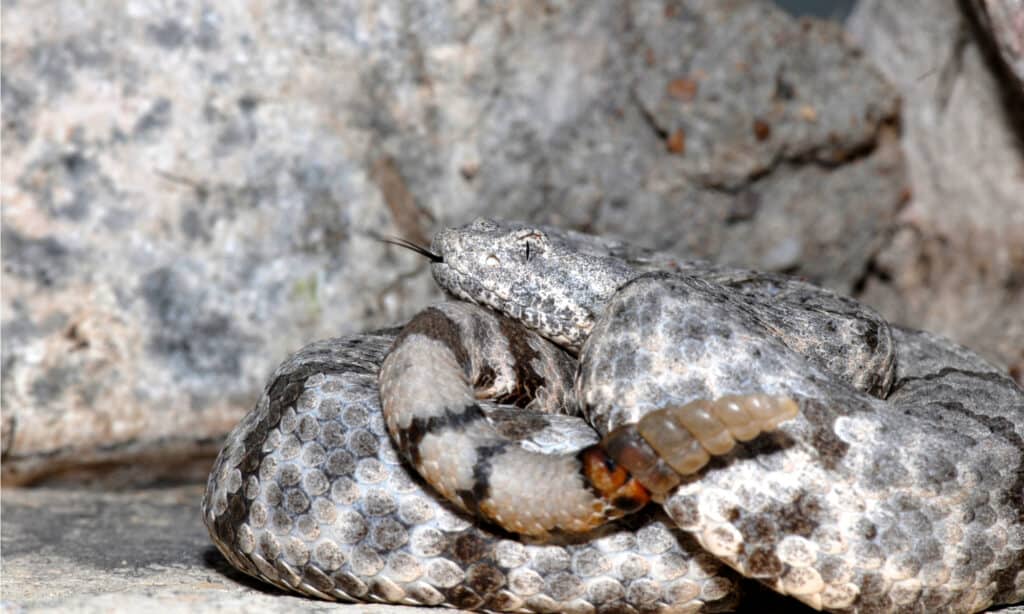
The Mottled rock rattlesnake can handle cold weather better than most other rattlesnakes.
©Rusty Dodson/Shutterstock.com
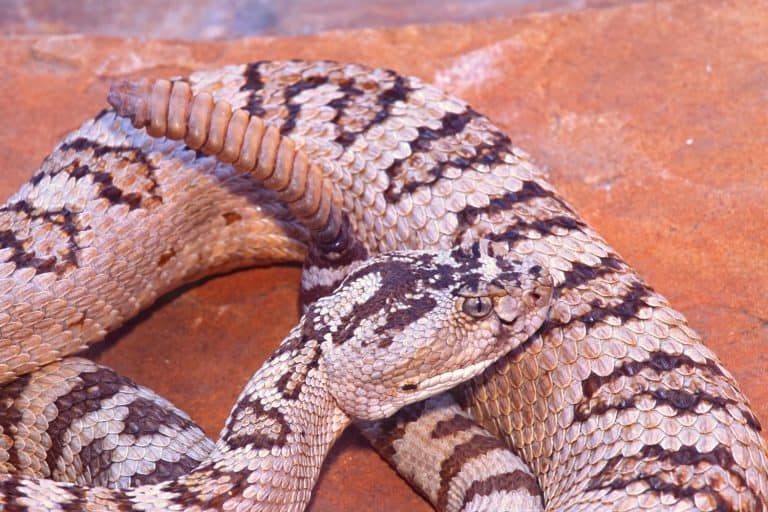
The mottled rock rattlesnake lives in the mountains and rocky areas of West Texas. This snake is a subspecies of the rock rattlesnake, measuring between 18-36 inches long. Due to its environment, the colors and patterns of mottled rock rattlesnakes help them to blend in seamlessly with their surrounding environment. So these snakes are often the pinkish or rust color of the rocks in their habitat. There are dark bands along the length of the snake’s body, as well as numerous small, scattered splotches that give it its namesake “mottled” appearance.
Mottled rock rattlesnakes are not typically aggressive and may not even rattle a warning unless a threat is very close to them. These snakes blend into the surrounding environment with their excellent camouflage and try to avoid humans and large animals whenever possible. However, mottled rock rattlesnakes do have potent venom with dangerous hemotoxins. Finally, like the banded rock rattlesnake, the mottled rock rattlesnake is protected from capture of any kind by Texas state laws.
Black-Tailed Rattlesnake
| Scientific name: | Crotalus molossus |
| Distribution: | Central and West Texas |
| Length: | 2.5-3.5 feet |
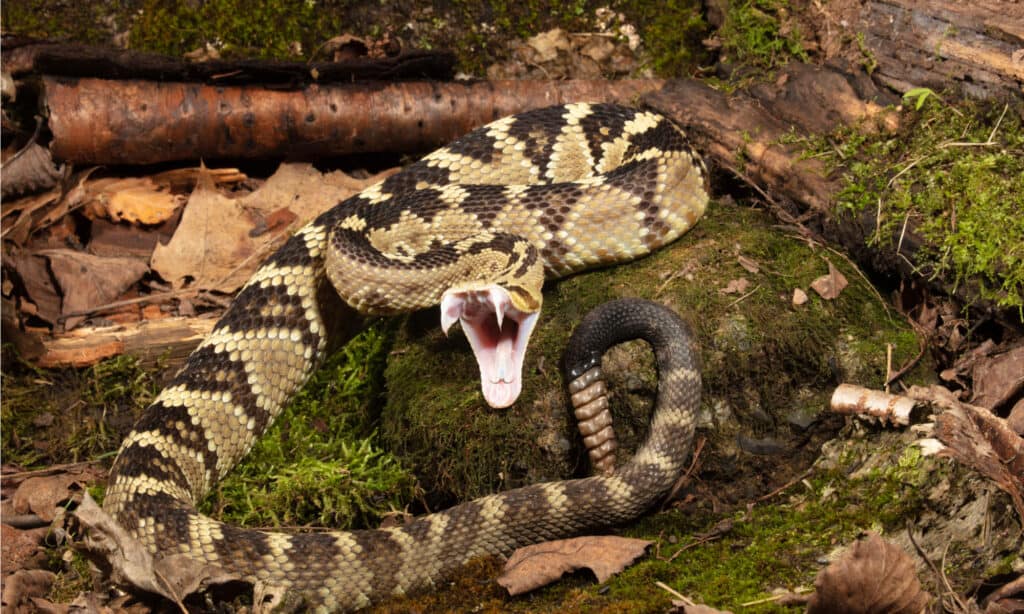
The Black-Tailed Rattlesnake is sometimes called the “dog-faced rattlesnake,” the “dog-headed rattlesnake”, the “velvet-tail rattlesnake”, or the “green rattler.
©Joe McDonald/Shutterstock.com
The black-tailed rattlesnake lives in central and west Texas, the southwestern United States, and Mexico. These snakes are typically some of the most docile rattlesnakes with a calm and curious nature. Black-tailed rattlesnakes may vibrate the rattle on the end of their tails as a warning if they feel threatened, but generally they prefer to blend into their surroundings with their camouflage, or quickly crawl away if necessary. Although these snakes are not typically aggressive, they are still dangerous with potent hemotoxic venom.
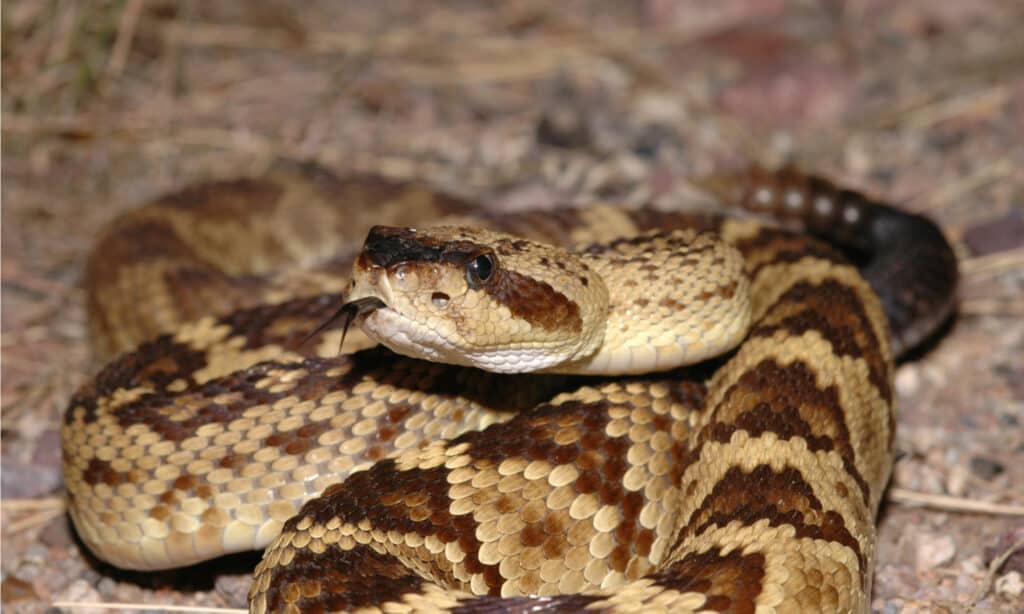
The “mask” of a black-tailed rattlesnake
©Rusty Dodson/Shutterstock.com
Black-tailed rattlesnakes have gray, silver, olive, or yellowish-colored bodies that measure 30-42 inches long. Additionally, dark diamond-shaped bands with light-colored borders run down the middle of the snake’s back, ending in a black or dark gray tail. The snake’s face is also marked with a dark band across its eyes like a mask.
Northern Mojave Rattlesnake
| Scientific name: | Crotalus scutulatus scutulatus |
| Distribution: | Extreme West Texas |
| Length: | 3-5 feet |
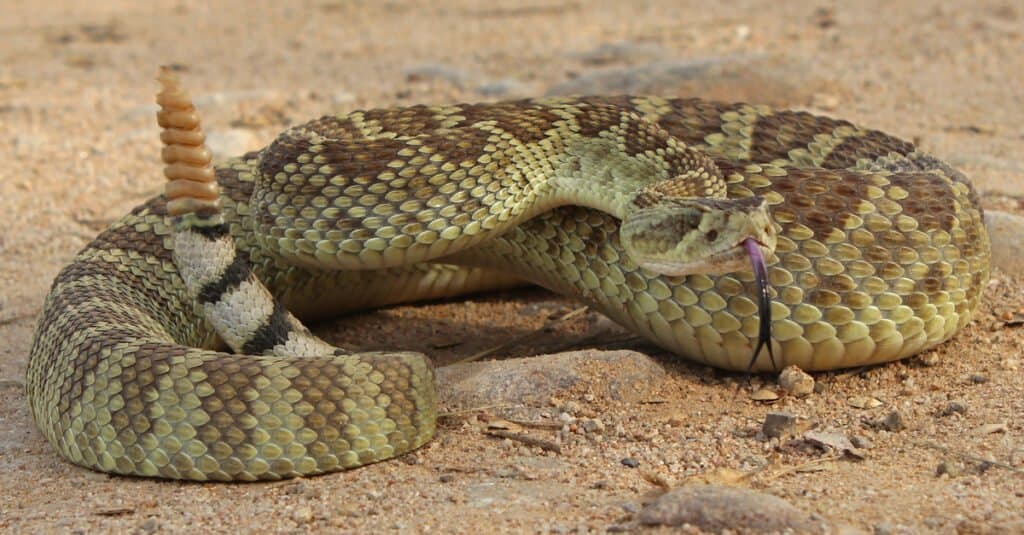
The Mojave rattlesnake, including both of its subspecies, typically grows to between 3.3 ft and 4.5 ft in length.
©Creeping Things/Shutterstock.com
The Mojave rattlesnake only lives in parts of Texas, mostly in the extreme far west regions of the state. However, this snake can also be found ranging from central Mexico to the southwest United States primarily in desert areas. Although they mostly reside in upland deserts, Mojave rattlesnakes can also be found in shrubby landscapes, grasslands, and forests. There, they hunt lizards, birds, and small mammals.
Mojave rattlesnakes have triangular heads and brown bodies with greenish hues, measuring between 39-54 inches long. Additionally, along their backs are dark diamond markings, ending with white banded marks on their tails.
Despite being quite skittish, Mojave rattlesnakes have some of the most dangerous venom in North America.
Scientists grouped them into two venom groups, calling them Venom A and Venom B. Venom A contains Mojave toxin, while Venom B doesn’t. Which snake has it? You can’t tell by looking. In any case, Mojave rattlesnakes are the snake most closely associated with this neurotoxin, though research has found it present in other rattlesnake species as well.
Some Mojave rattlesnakes’ venom contains both hemotoxins, which attack the circulatory system, and neurotoxins, which attack the nervous system. Although this snake is extremely dangerous, bites can be treated with anti-venom.
Prairie Rattlesnake
| Scientific name: | Crotalus viridis |
| Distribution: | West Texas |
| Length: | 3-4 feet |
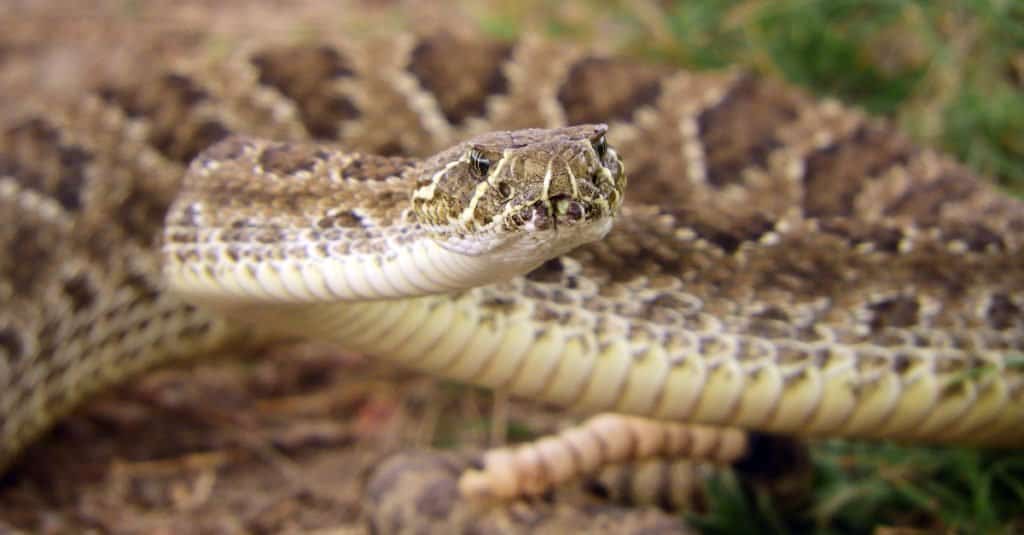
Prairie rattlesnakes spend most of their time slithering on the ground but they can also climb trees, navigate bushes, and are known to hide in rock crevices or small caves.
©Nina B/Shutterstock.com
| Prairie Rattlesnake | |
|---|---|
| Range | Western half of Texas |
| Length | 35-45 inches |
The prairie rattlesnake is only found in the western half of Texas, sometimes in the Trans-Pecos region but mostly in the Panhandle grasslands. These snakes grow between 35-45 inches with brown, gray, or green bodies. There are also dark brown oval-shaped patches with thin white borders along the middle of the snake’s back. Then, toward the end of the snake’s tail, these oval markings shift into dark rings. Plus, prairie rattlesnakes have keeled or ridged scales that make them look rough and bristly.
The venom of a prairie rattlesnake contains hemotoxins that attack red blood cells, and some neurotoxins that attack the nervous system. These snakes eat small mammals like mice, ground squirrels, prairie dogs, small rabbits, and rats. They also eat ground-nesting birds, small reptiles, and amphibians on occasion.
Western Massasauga
| Scientific name: | Sistrurus tergeminus |
| Distribution: | North-central Texas |
| Length: | 14-36 inches |
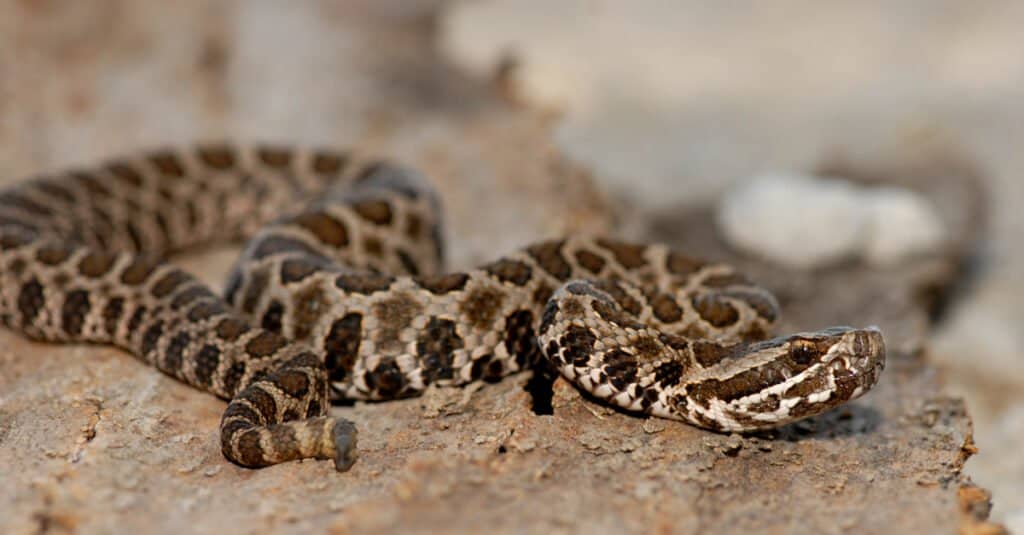
The western massasauga rattlesnake gets its name from the Chippewas language. “Massasauga” in Chippewas means “great river mouth.”
©Rusty Dodson/Shutterstock.com
| Western Massasauga | |
|---|---|
| Range | North-Central Texas |
| Length | 14-36 inches |
The western massasauga is a rattlesnake that lives only in the north-central part of Texas. Its habitat also stretches across the midwestern United States, in prairies and grassland areas. This is a calm rattlesnake that is active mainly at night and rests during the day. And unfortunately, the western massasauga is a candidate for federal listing under the U.S. Endangered Species Act.
The western massasauga is one of the smaller rattlesnakes, measuring between 14-36 inches long. These rattlesnakes are usually a light color with wide, dark blotches running along their backs. But one of their most distinctive features is a dark stripe that runs along each cheek, from the eye to the back of the mouth.
The western massasauga is a calm snake and doesn’t tend to rattle its tail right away. When it does rattle, the sound is different from other rattlesnakes. The rattle of the western massasauga has very fast vibrations that make it sound much more high-pitched than other rattlesnakes. This unique high-pitched rattle is why this snake has been nicknamed the buzztail. Western massasauga rattlesnakes have somewhat less potent venom, but its venom still contains dangerous hemotoxins that break down blood cells.
Desert Massasauga
| Scientific name: | Sistrurus tergeminus edwardsii (formerly classified as S. catenatus edwardsii) |
| Distribution: | Northwest Texas & Southern tip of Texas |
| Length: | 21 inches |
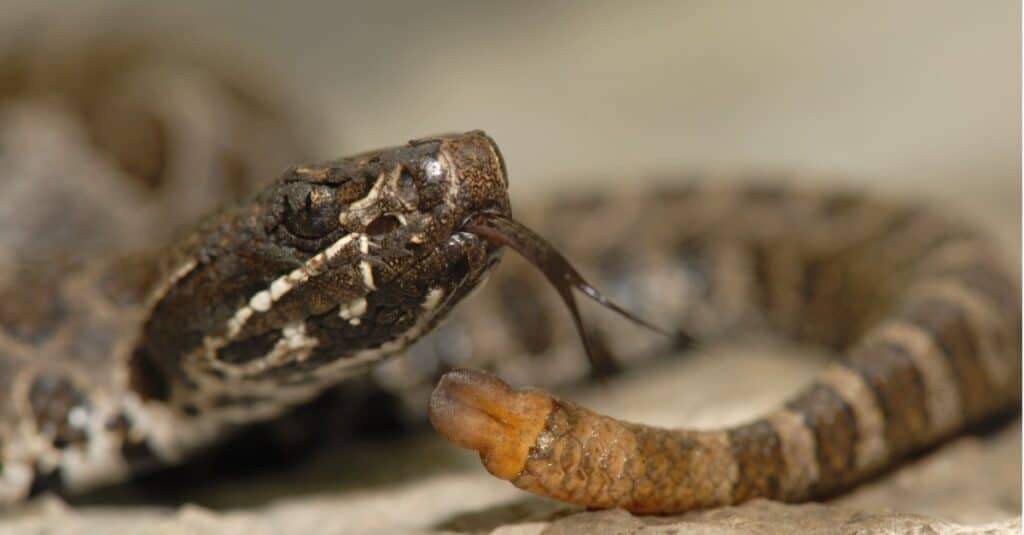
The desert massasauga rattlesnake is the smallest of the three subspecies of massasauga snakes.
©iStock.com/Shoemcfly
The desert massasauga is a subspecies of the western massasauga that inhabits northwest Texas and the southern tip of Texas, especially in the Rio Grande Valley. This snake prefers to live in similarly dry, rocky areas. The desert massasauga is a smaller rattlesnake, usually less than 21 inches long. Its base color is usually tan or gray, with large, brown blotches lined close together down the middle of its back. But it has a dark brown stripe along its cheek on both sides of the face, from the eye to the back corner of the mouth. There is also a very narrow white line just below this dark cheek stripe.
The desert massasauga is not an aggressive rattlesnake. It prefers to slither away from threats and danger rather than defend or attack. The desert massasauga’s venom is extremely potent, even more so than many larger rattlesnakes. However, it has a very low venom yield, which means that there is not a lot of venom in each bite. But it shouldn’t be underestimated, because the venom of the desert massasauga has very powerful cytotoxins which can cause severe pain, swelling, and necrosis.
Western Pygmy Rattlesnake
| Scientific name: | Sistrurus miliarius |
| Distribution: | East Texas |
| Length: | 16-24 inches |
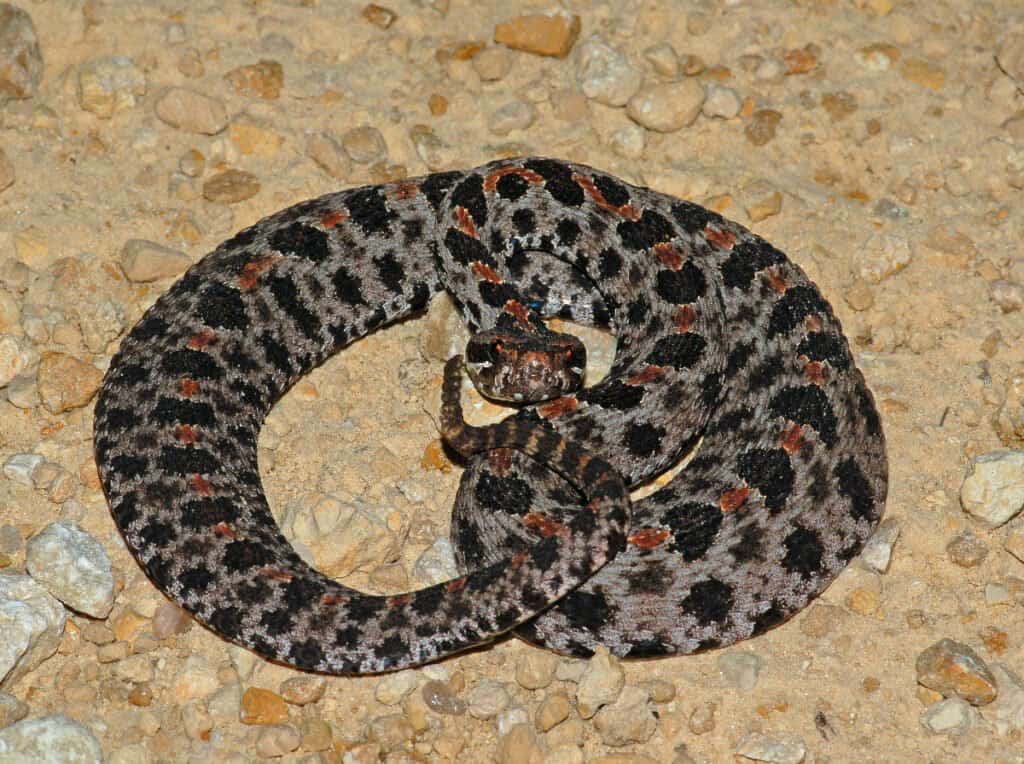
The western pygmy rattlesnake uses its tail to lure in prey like skinks.
©Gerald A. DeBoer/Shutterstock.com
The western pygmy rattlesnake is scattered throughout East Texas, as well as many other southeastern states in the U.S. This rattlesnake is small, usually only 16-24 inches long. Its base color is gray with dark, oval-like blotches running close together along the middle of its back and then along the sides of its body. The western pygmy rattlesnake also has a rust or orange-colored stripe running along the middle of its back, giving it a very colorful and striking appearance. Its head is wide with a black stripe along each cheek, running from each eye to the back corner of its mouth.
Another unique feature of the western pygmy rattlesnake is its unusually small rattle. Its rattle is so small compared to other rattlesnakes, that locals in Texas nicknamed it the “rattle-less ground rattler.” The western pygmy rattlesnake eats insects, birds, lizards, small mammals, snakes, frogs, and is especially known for eating giant desert centipedes. The venom of the western pygmy rattlesnake is cytotoxic, breaking down cells and causing hemorrhaging. Medical researchers used western pygmy rattlesnake venom to create eptifibatide, an anti-clotting drug often given to patients experiencing a heart attack.