
Quick Take
- The eyes of land-based snails are located on top of their larger, upper tentacles.
- A snail’s vesicular eye produces only blurry and unfocused images.
- Several species of underground snails thrive despite possessing no eyes at all.
- The manual focusing process is essential for snails due to the absence of ciliary muscles.
Aside from their shells, one of the most notable features of snails is the tentacles on top of their heads. Did you know those tentacles are actually where a snail’s eyes are located? Their eyes seem so alien in appearance compared to the human equivalent, but do they actually work like a human eye? Let’s take a look at snail eyes and learn how they see the world.
Snail Eyes
Most snails have eyes, but they are designed differently than human eyes. Additionally, a snail’s habitat typically determines the type and placement of its eyes. Land snails have simple eyes that detect light and motion on top of their larger, upper tentacles. Their eyes help them navigate their surroundings and forage for food. Many land snails also have the ability to retract their eyes so they are protected.
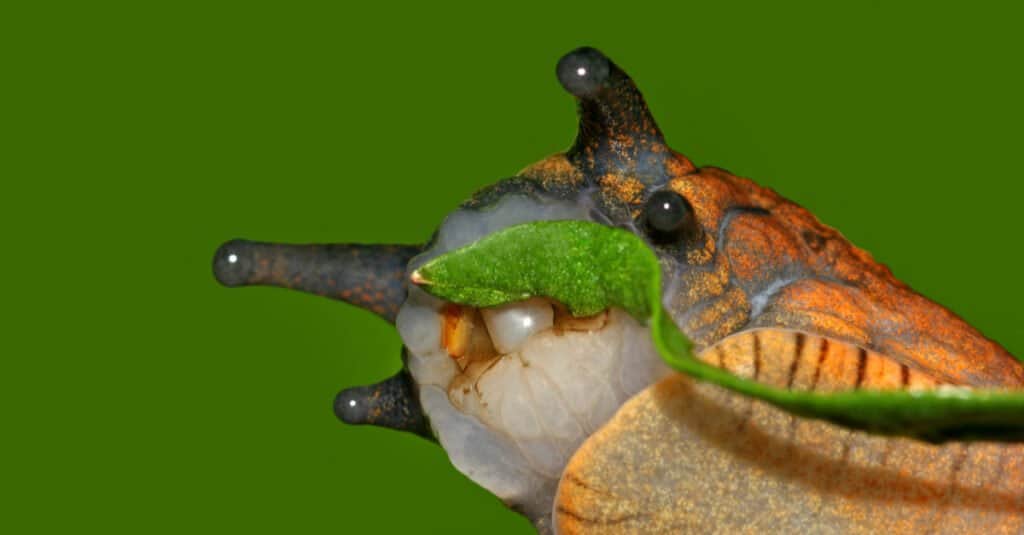
Snails have eyes on the top of their larger, upper pair of tentacles.
©Bildagentur Zoonar GmbH/Shutterstock.com
Sea snails also have eyes, but theirs are different from those of land snails. Aquatic snails have eyes at the base of their tentacles. As a result, they can’t rotate or move their eyes to look around, which makes their vision comparatively worse than that of land snails.
Some underground snails don’t have eyes. As a result, they use different senses to navigate their environment. Many snails also have photoreceptor cells throughout their skin, which allow them to sense light intensity and direction, even if they lack eyes or their eyes are ineffective.
Can Snails See Like a Human?
Not all eyes are created equal. On earth, there are all sorts of different evolutionary paths that have given vision to the creatures of the world. Some of the most common eye types are compound eyes, simple eyes, and camera-type eyes. Many insects have compound eyes with multiple lenses. They have incredibly wide viewing angles and the ability to detect fast movement, but poor resolution. Simple eyes refers to the use of a single lens and few photoreceptor cells. Simple eyes can detect light intensity, direction, and movement, but they do not form detailed images. A camera-type eye, like that of a human, has a single lens, an aperture (iris), and a light-sensitive retina. It can provide high resolution vision but has fairly limited viewing angles.
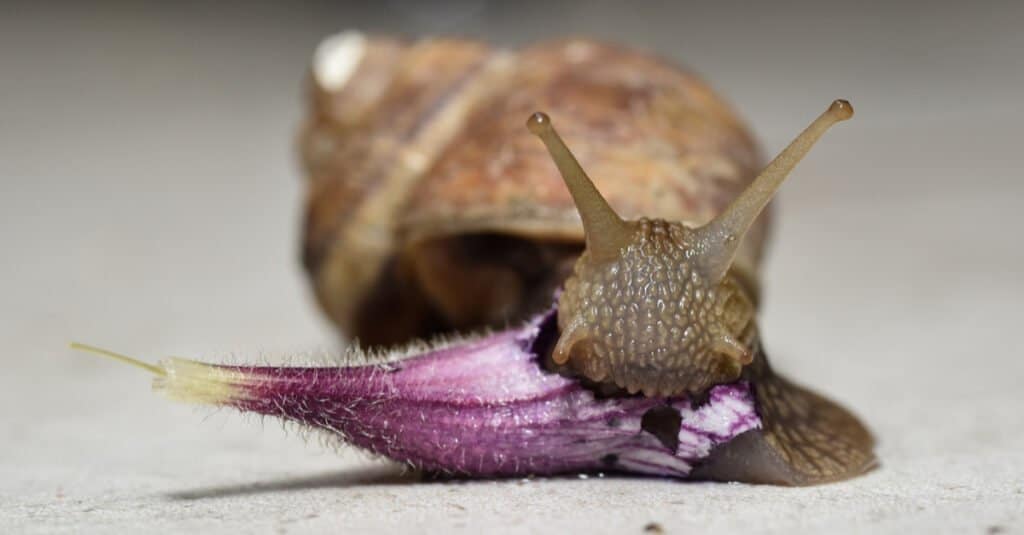
Snails can see, but a human has significantly better eyesight.
©microcosmos/Shutterstock.com
When it comes to a snail’s vision, their ability to see mostly depends on the species. Generally, snails have a vesicular eye, which is a type of eye structure where a liquid-filled bubble is used as a type of primitive lens. Snails have no ciliary muscles in their eyes, which are the muscles that allow us to reflexively focus images. This means they must use their stalks to manually focus their vision. Most snails have poor eyesight, although some carnivorous species have better vision to help them hunt.
However, some snails, like the golden apple snail (Pomacea canaliculata), have camera-like eyes with anatomical features similar to humans, although their vision is much less complex. These snails can even regenerate their eyes, which researchers hope will one day lead to eye regeneration in humans.
A Snail’s Other Senses
Aside from eyesight, snails have other senses that help them thrive in their specific ecological niches. The primary sense they use is smell, even if they have eyes. There are usually four tentacles on a snail’s head, two with eyes on the end and two near the front of their head. The two shorter ones are their smelling organs. These organs are used for smelling and tasting, which helps snails find food and determine if something is edible.

A snail can see, smell, taste, and sense vibrations.
©iStock.com/BushAlex
Additionally, snails have a sense of touch. This can be observed when you touch a snail and see it respond to the stimulus. Their sense of touch includes the ability to sense humidity, temperature, and more. Special cells distributed across their skin send signals that contribute to their sense of touch. While snails don’t have ears, they do have the ability to feel vibrations.