
Quick Take
- One common Georgia snake looks harmless but its bite triggers unusual bleeding, even though it is not venomous. About anticoagulant saliva →
- Georgia is home to a snake that actively hunts and eats venomous copperheads and coral snakes, and this species happens to be one of the most common in the state. Meet the copperhead hunters →
- Some of Georgia's 'non-venomous' snakes are actually mildly venomous, though just not to you. Garter snake's mild venom →
- Snake bites in Georgia have been climbing steadily, and the species behind the deadliest ones may not be the ones you'd guess. Rising bite trends explained →
Spanning 57,000 square miles, Georgia has a diverse range of habitats that are home to thousands of incredible animals. While some animals like the grey bat are incredibly rare or secretive and are hardly seen, there are other animals that we are much more likely to run across. With 46 species of snakes calling Georgia home, it’s not surprising that some of these animals are snakes. So join us as we discover some of the most common non-venomous snakes in Georgia.
Kingsnakes
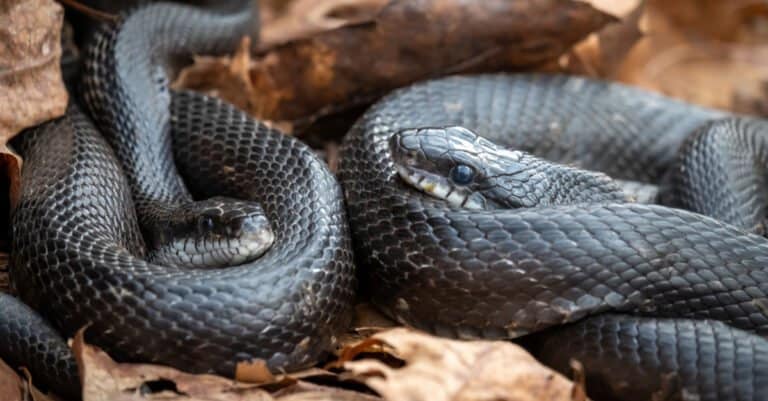
Also known as the common kingsnake, eastern kingsnakes are non-venomous snakes that are also popular as pets. They are typically between 36 and 48 inches long and are known for their shiny scales. In fact, the first part of their scientific name, Lampropelitis getula, means “shiny shields.” Eastern kingsnakes are usually dark brown with pale crossbands and a chain-like pattern down their sides. Georgia is also home to black kingsnakes (L. nigra). They have reduced or no banding with speckled bodies, although some adults can be uniformly black.
Eastern kingsnakes are found throughout the state. They prefer open habitats such as grasslands, sandy uplands, and prairies close to rivers and streams. Black kingsnakes are more common in northwest Georgia and favor moist habitats. These snakes are constrictors and eat rodents, birds, lizards, and frogs. They also eat other snakes, including venomous copperheads and coral snakes. The “king” part of their name refers to them preying on other snakes.
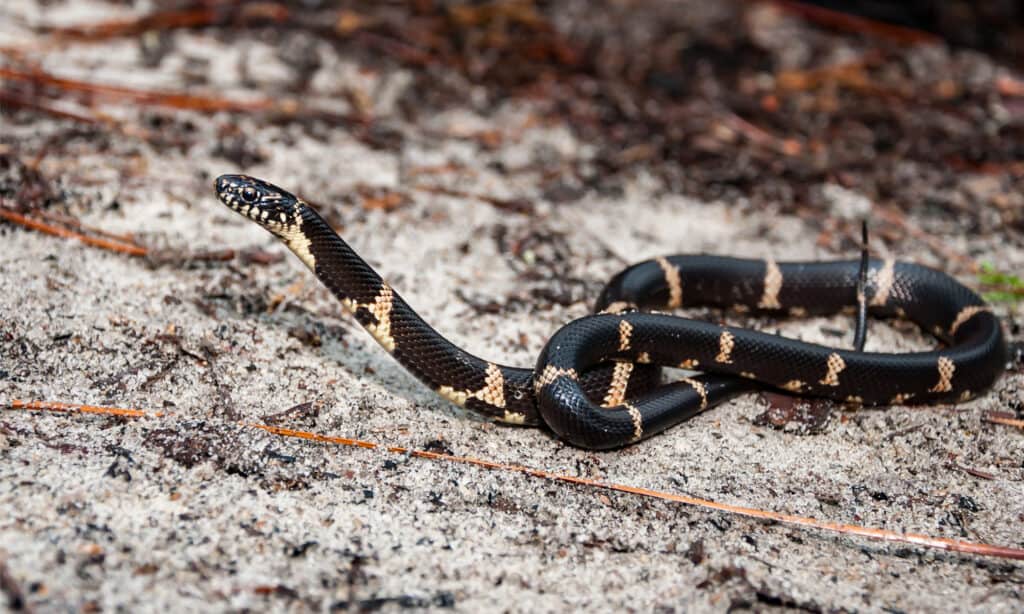
Eastern kingsnakes are known for being top predators of other snakes, including venomous ones.
©iStock.com/JasonOndreicka
Northern Water Snake
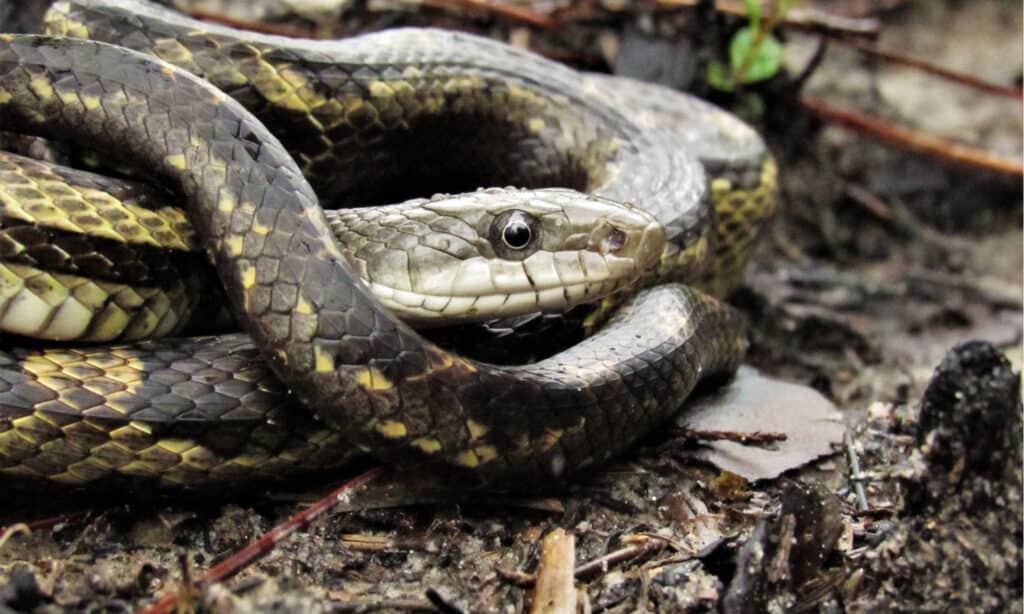
One of the largest common snakes in Georgia is the northern water snake (Nerodia sipedon), which can reach 24 to 55 inches long. Northern water snakes are typically brown, grey, or tan with darker crossbands on their neck and dark blotches down their back. They are always found near permanent water sources such as streams, ponds, rivers, lakes, and swamps. In Georgia, they can only be found in the Piedmont and mountains.
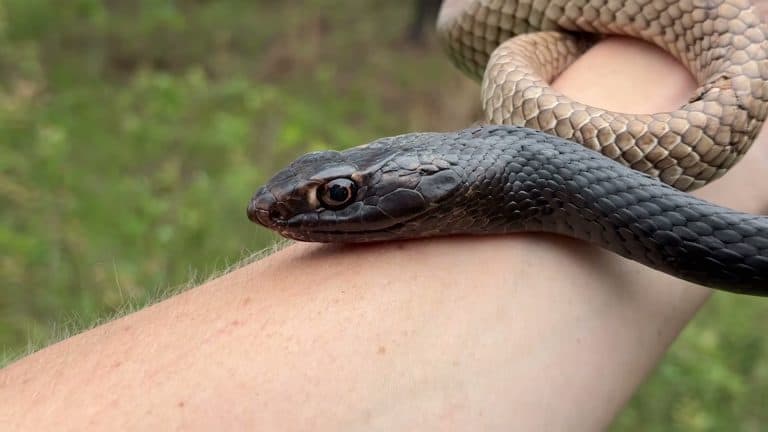
During the day they can often be seen basking in the sun on rocks and logs. Northern water snakes hunt along the water’s edge and in the shallows and they typically eat fish, frogs, birds, and salamanders. Although they are not venomous, their saliva contains an anticoagulant, which means that any bite bleeds much more than usual.
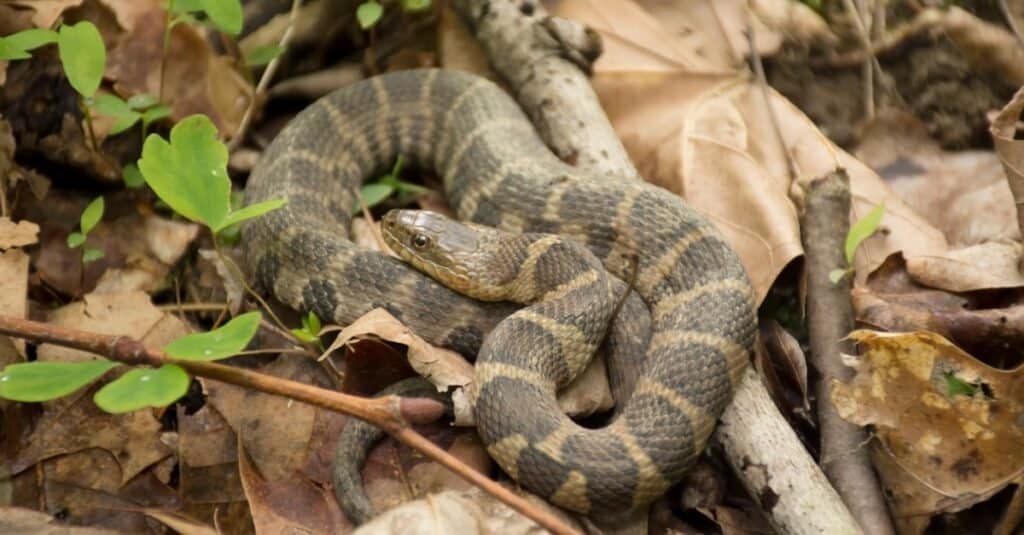
The northern water snake has a flat head that is as wide as its neck.
©iStock.com/IcemanJ
Eastern Garter Snake
One of the most widespread snakes across North America, eastern garter snakes (Thamnophis sirtalis) are found across the entire state. They are 18 to 26 inches long and are typically brown or greenish brown with three distinctive yellowish or cream stripes. However, some may have greyish or reddish bodies with a checkered pattern and light stripes. Snakes from southern Georgia can have a bluish background color.
Eastern garter snakes live in a wide variety of habitats, including entering urban parks. They like to bask in the sun but quickly flee underneath logs and rocks at the first sign of danger. Although they are not venomous to humans, eastern garter snakes are mildly venomous to their prey. They lack fangs with which to inject venom, so instead it is produced in their saliva. Their prey includes frogs, toads, and worms, but they will eat anything else they can catch.
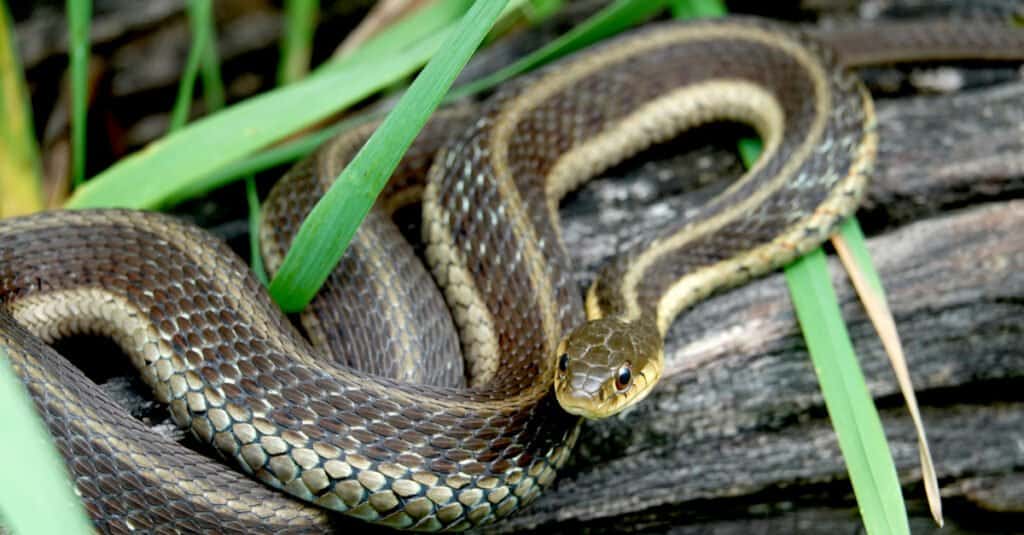
Eastern garter snakes are one of the most common snakes in North America
©Erik Agar/Shutterstock.com
Dekay’s Brown Snake
Also known as the brown snake, Dekay’s brown snakes (Storeria dekayi) are small reptiles that are usually 6 to 13 inches long. They have thin bodies and are usually brown with a lighter central stripe. However, they can also be yellow, brownish-grey, or reddish-colored.
Dekay’s brown snakes favor wetland habitats. Although they tend to be secretive, these snakes are widespread across Georgia. They mainly prey on earthworms and slugs. Due to their small size, they are often preyed upon by larger snakes. They can be found throughout the state, except at high elevations in the mountains.
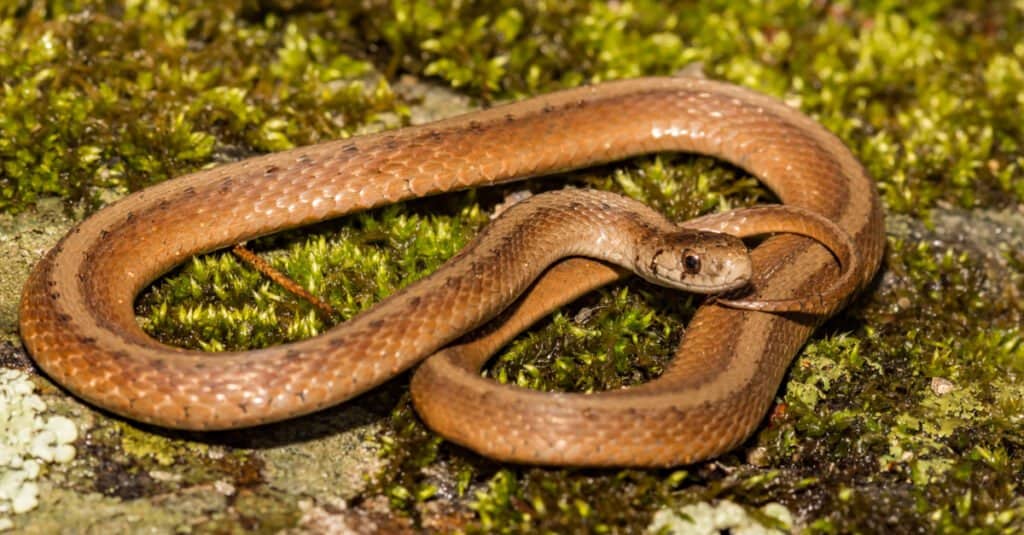
Dekay’s brown snakes are small and often preyed upon by other snakes
©Jay Ondreicka/Shutterstock.com
Ring-Necked Snake
Despite their secretive nature, ring-necked snakes (Diadophis punctatus) are actually one of the most common snakes in Georgia. They are also one of the smallest at only 8 to 14 inches long. Although they are black on their dorsal side, ring-necked snakes can have red, orange, yellow, or red-fading-to-yellow neck rings and bellies. In Georgia, there are two different subspecies: the southern ring-necked snake (D. p. punctatus) and the northern ring-necked snake (D. p. edwardsii). The main difference is the southern ring-necked has a bright yellow to orange belly with black half-moon spots, while the northern ring-necked has a plain yellow to orange belly.
As they are so secretive, ring-necked snakes prefer habitats where there is plenty of vegetation for them to hide under, such as woodlands or rocky hillsides. Ring-necked snakes produce a mild venom-like substance that they use to immobilize their prey, which is mainly salamanders, but they are not truly venomous or dangerous to humans. The northern subspecies is found only in the mountains, while the southern subspecies commonly inhabits the Coastal Plain.
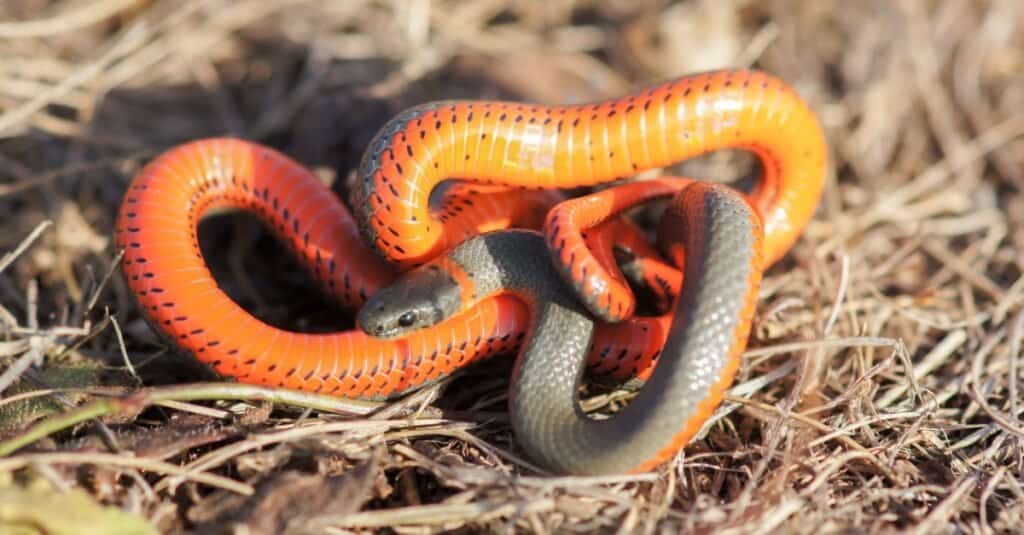
Small and colorful, the ring-necked snake is nocturnal and non-venomous.
©yhelfman/Shutterstock.com
Southern Black Racer
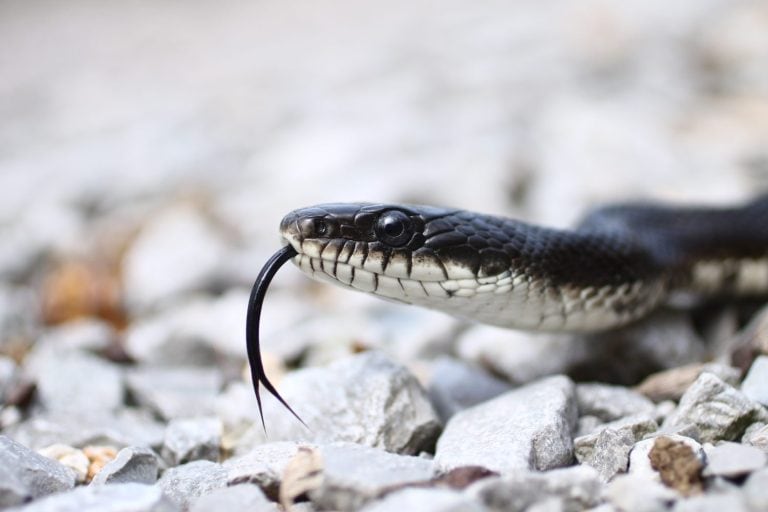
With 11 subspecies, North American racers (Coluber constrictor) are one of the most frequently seen snakes across North America. In Georgia, the southern black racer generally measures up to 4.5 feet in length, although some large individuals can reach over 5.5 feet. Adults have uniform, glossy black bodies, with white-to-gray chins and throats.
Racers are fast, active snakes that live in a variety of habitats, including grasslands, scrub, forests, wetlands, and old fields. They are also excellent climbers and often raid bird nests for eggs and chicks. In Georgia, southern black racers are found in the Piedmont, Coastal Plain, Blue Ridge, and Appalachian plateau regions.
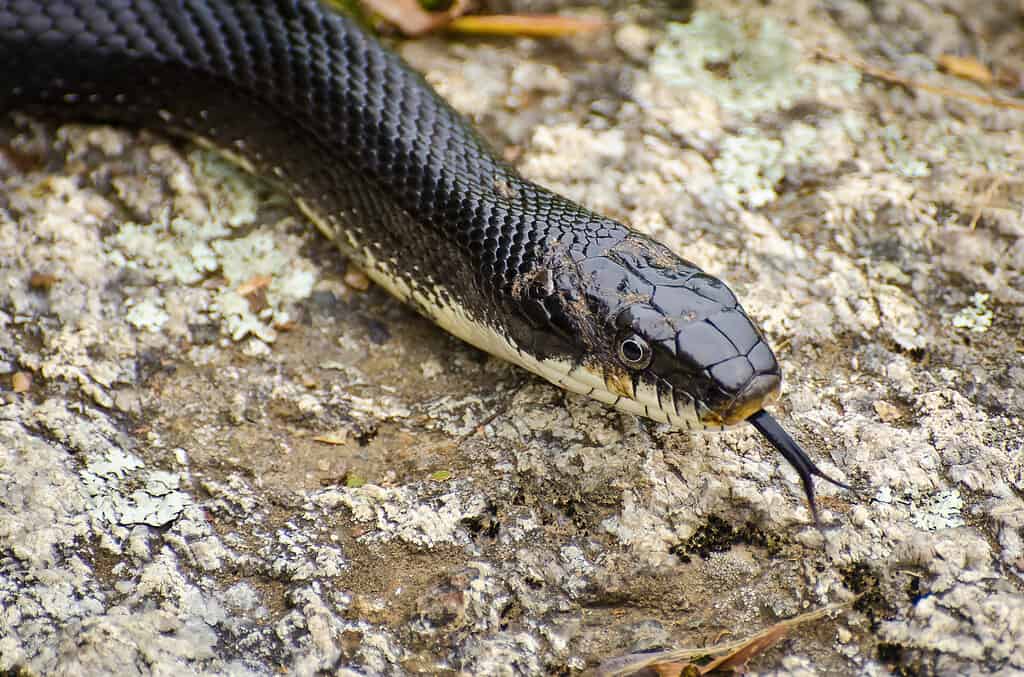
The southern black racer is the subspecies most likely to be seen in Georgia
©iStock.com/RCKeller
Rough Green Snake
One of the most stunning green snakes in Georgia is the rough green snake (Opheodrys aestivus) which is a vibrant green on its dorsal side with bright yellow or cream bellies. Rough green snakes are 14 to 33 inches long and typically live in meadows and woodlands. They are excellent swimmers and they are never far from a permanent water source.
Rough green snakes are also highly accomplished climbers and spend much of their time in trees. They are active during the day and often spend the night coiled around tree branches. Rough green snakes mainly eat small animals such as insects and spiders. They are most commonly seen in the Piedmont and Coastal Plain.
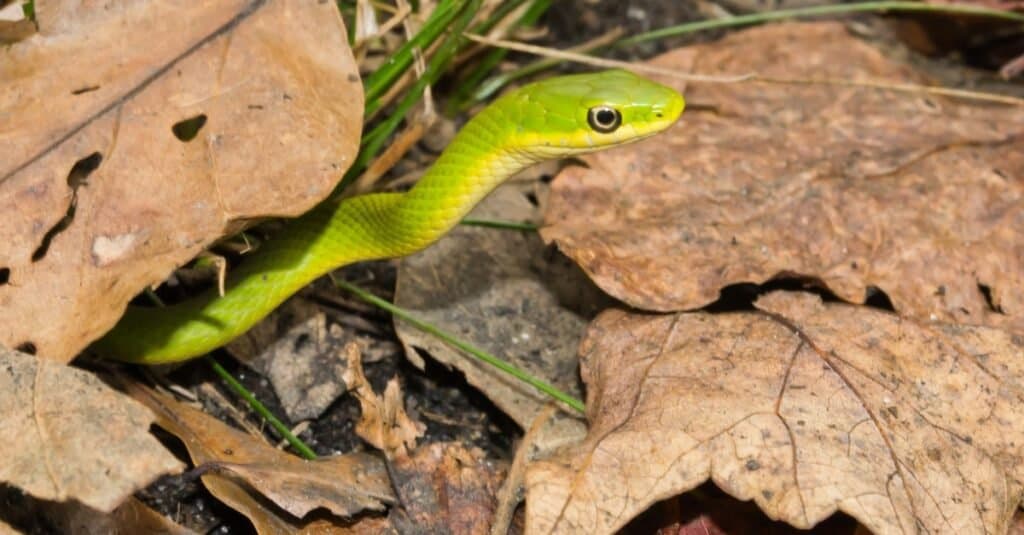
Rough green snakes often sleep coiled around tree branches
©iStock.com/BobMcLeanLLC
Rat Snake
The grey rat snake (Pantherophis alleghaniensis) and the yellow rat snake (Pantherophis quadrivittatus) are believed to be subspecies of the western/central rat snake (Pantherophis obsoletus). Grey rat snakes are usually black with a checkerboard-patterned belly. Yellow rat snakes are yellow to greenish with four dark stripes running down their bodies. As well as being one of the most common snakes in Georgia, rat snakes are also among the largest, as they can reach more than 6 feet long.
Rat snakes are adaptable and live in a range of habitats, although forests, tree-lined fields, and streams are preferred. They are excellent climbers and can be found at any height in trees, even up to the top. Their diet includes rodents, birds, and bird eggs, while juveniles prefer frogs and lizards. Grey rat snakes can be found throughout the state, while yellow rat snakes inhabit the Coastal Plain.
As well as being one of the most common snakes in Georgia, gray rat snakes are also one of the largest.
©Gabbie Berry/Shutterstock.com
Plain-Bellied Water Snake
Widespread across the southeastern region of the United States, plain-bellied water snakes (Nerodia erythrogaster), also called red-bellied water snakes, always live near permanent water sources. Although these semi-aquatic snakes are always found in and around freshwater habitats such as rivers, lakes, streams, and swamps, plain-bellied water snakes spend more time out of the water than other water snakes.
Despite this, they rely heavily on the water for their prey, which is mainly fish and amphibians. Plain-bellied water snakes are 30-48 inches long and are usually brown, gray, or black with a plain yellow or orange belly, although their color varies depending on the subspecies. Plain-bellied water snakes are most active during the summer months and hibernate during the winter. They are found across most of the state, except for extreme southeastern Georgia.
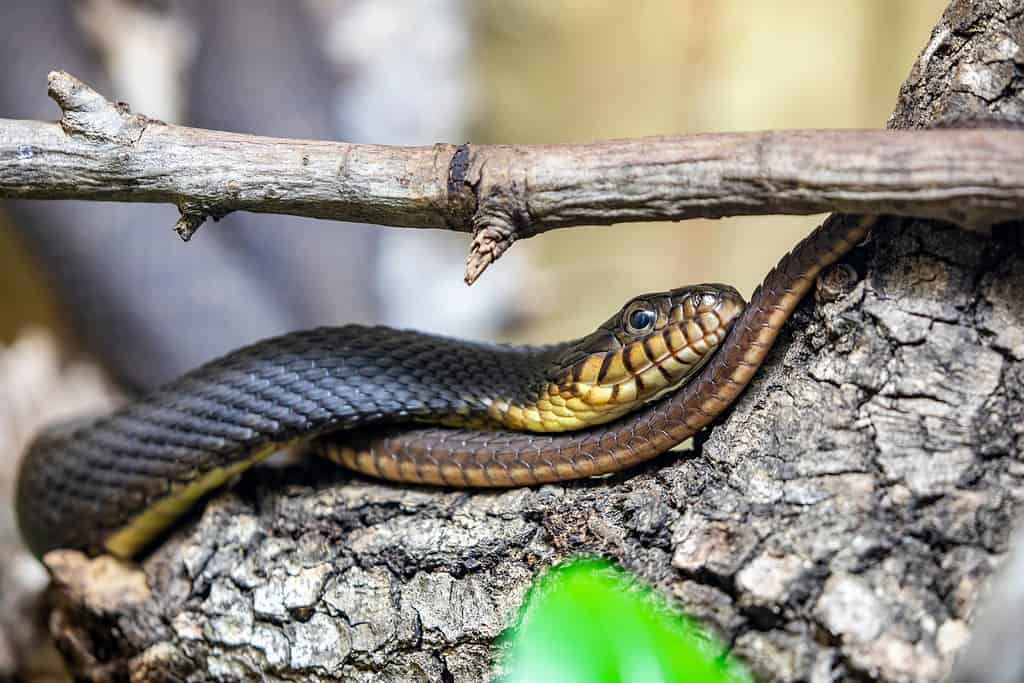
The plain-bellied water snake is a common semi-aquatic snake in Georgia.
©Danny Ye/Shutterstock.com
Eastern Coachwhip
Another common snake in Georgia is the eastern coachwhip (Masticophis flagellum flagellum), which is one of six subspecies of the coachwhip snake. Eastern coachwhips are 50 to 72 inches long and have slender bodies. Their heads are black, but their bodies are brown, lightening towards the tail. They have smooth, shiny scales which give the appearance of a braided whip, hence their name. These snakes are also the fastest snakes in the region and among the fastest in North America.
Eastern coachwhips live in many habitats, including sandhills, scrub, longleaf pine, and old fields. They are active snakes that hunt during the day using their sense of smell and sight. It’s not uncommon to see them scanning the nearby area with their head raised above the ground while looking for prey. They eat birds, lizards, snakes, and rodents. These snakes can be found throughout the state, but they are more common in the Coastal Plain.
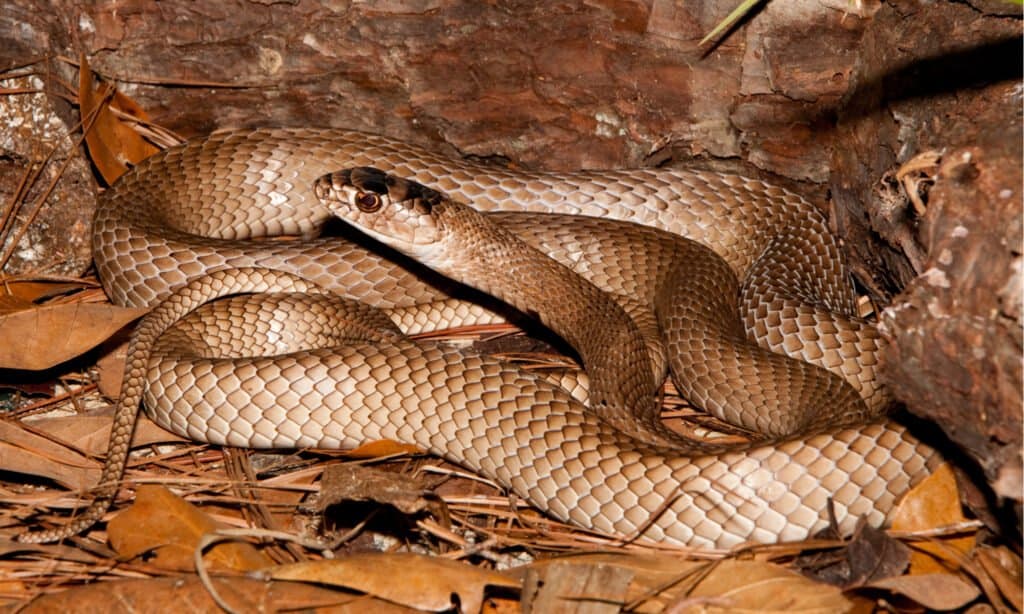
Eastern coachwhips have shiny scales that look like a braided whip.
©Jay Ondreicka/Shutterstock.com
How Many Venomous Snakes Are There in Georgia?
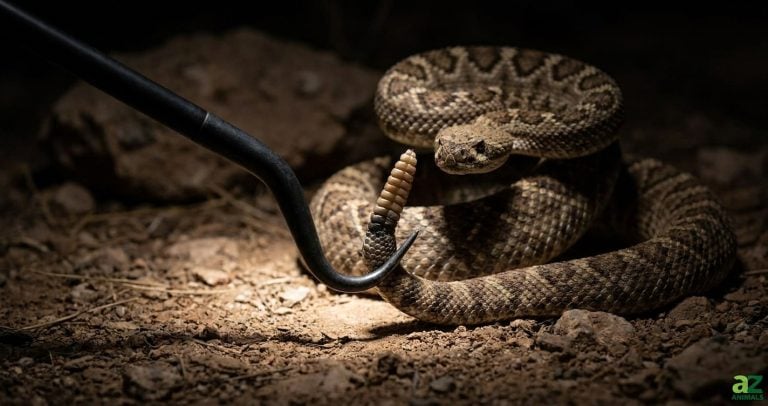
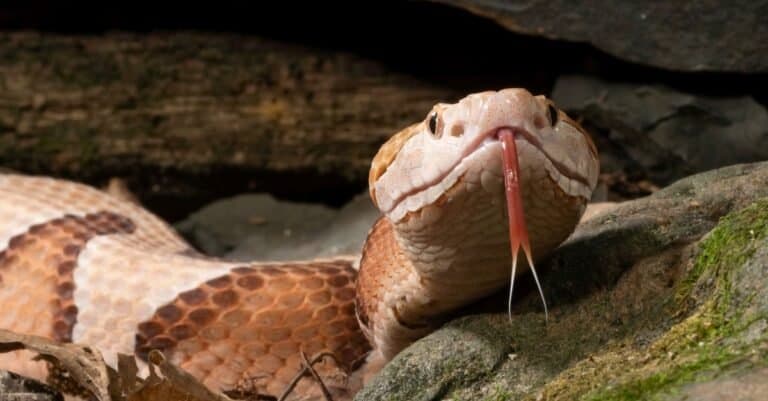
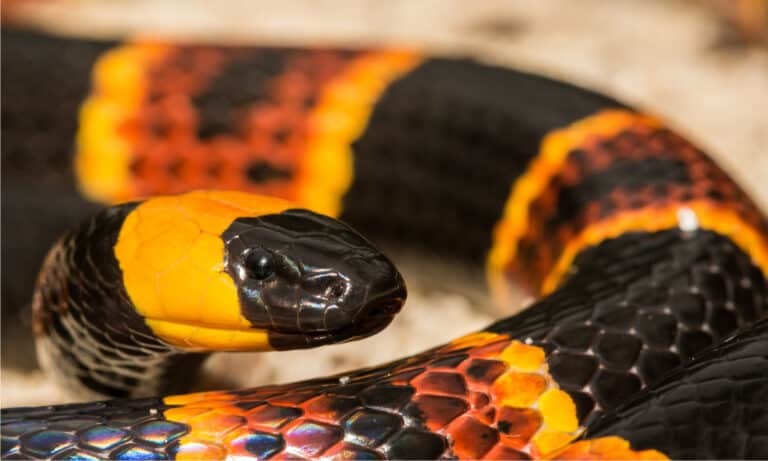
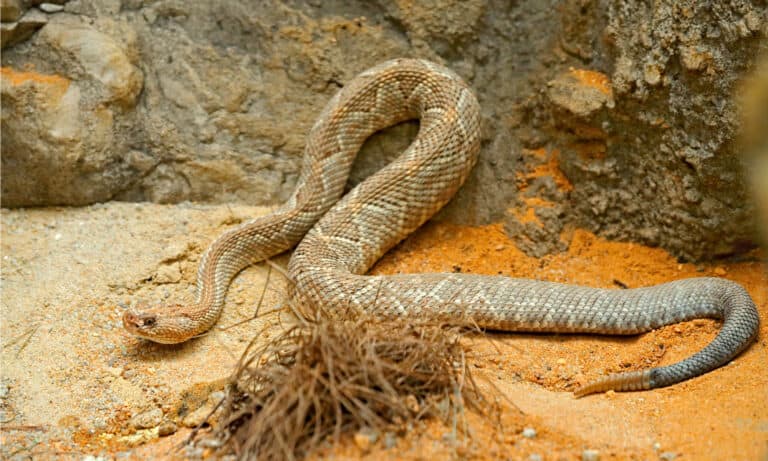
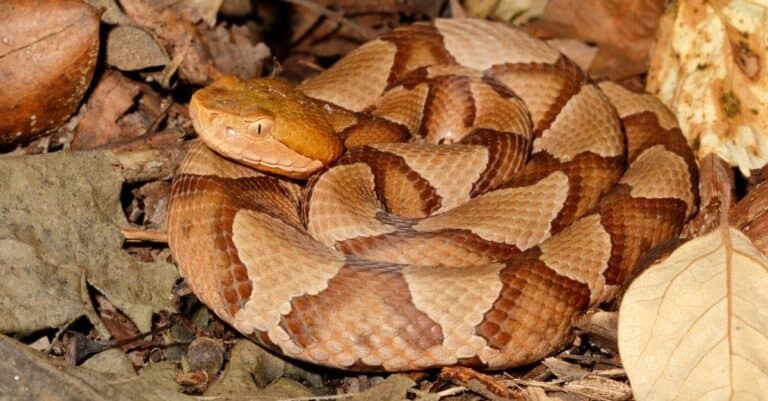
While Georgians can rest assured that the state’s 39 non-venomous snake species are not threatening to humans, even helping to control rodent populations, there are six venomous snake species in Georgia that residents should be aware of. The bite of a venomous snake can cause pain, inflammation, illness, and even death if not treated. The six venomous snakes in Georgia include:
- Copperhead
- Pygmy rattlesnake
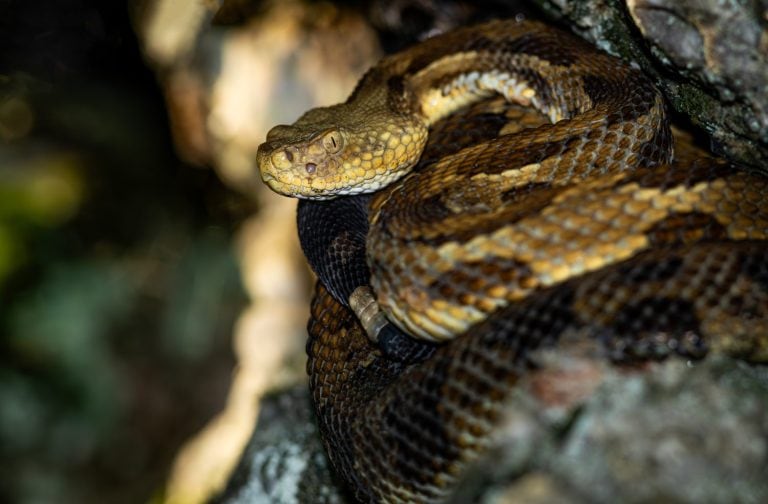
- Timber rattlesnake
- Cottonmouth
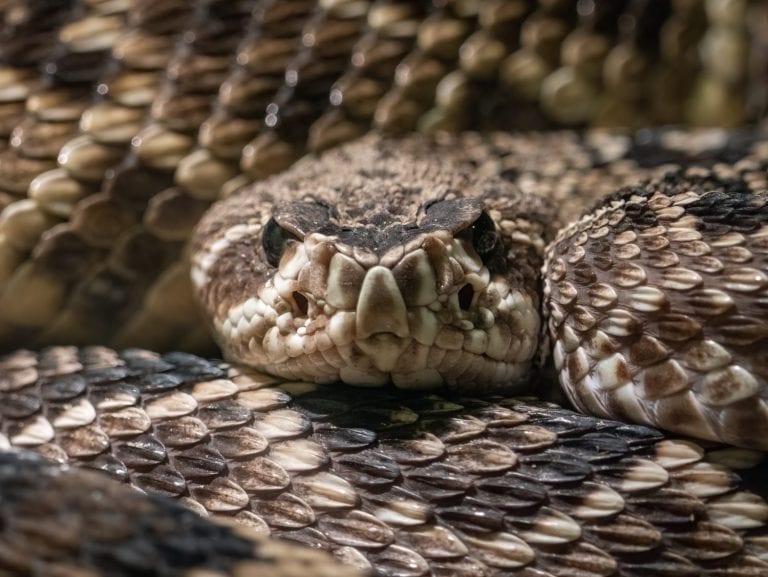
- Eastern diamondback rattlesnake
- Eastern coral snake
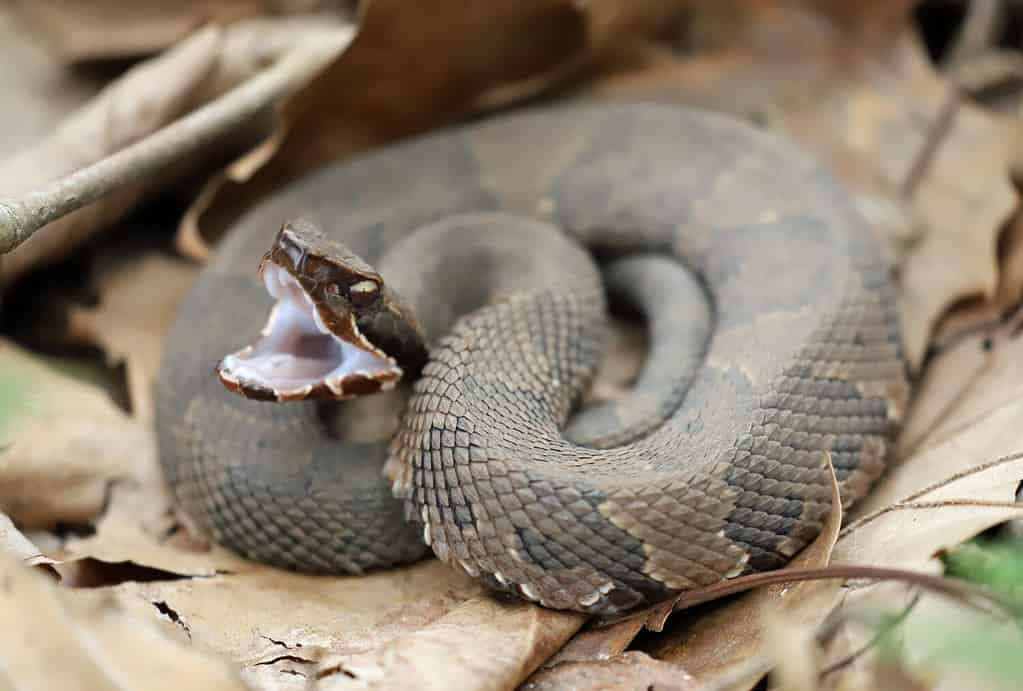
The cottonmouth is one of the six venomous snakes found in Georgia.
©KF2017/Shutterstock.com
Recorded snake bites in Georgia have been on a steady rise, with factors such as the housing boom and increasingly warmer temperatures possibly playing a role. For example, in 2019 there were almost 400 reported snake bites, with almost 100 cases of antivenom being administered as treatment. The previous year, the snake bites were around 350. The timber and eastern diamondback rattlesnakes are the most deadly, while the cottonmouth can also be deadly if the bite is left untreated.