C
Species Profile

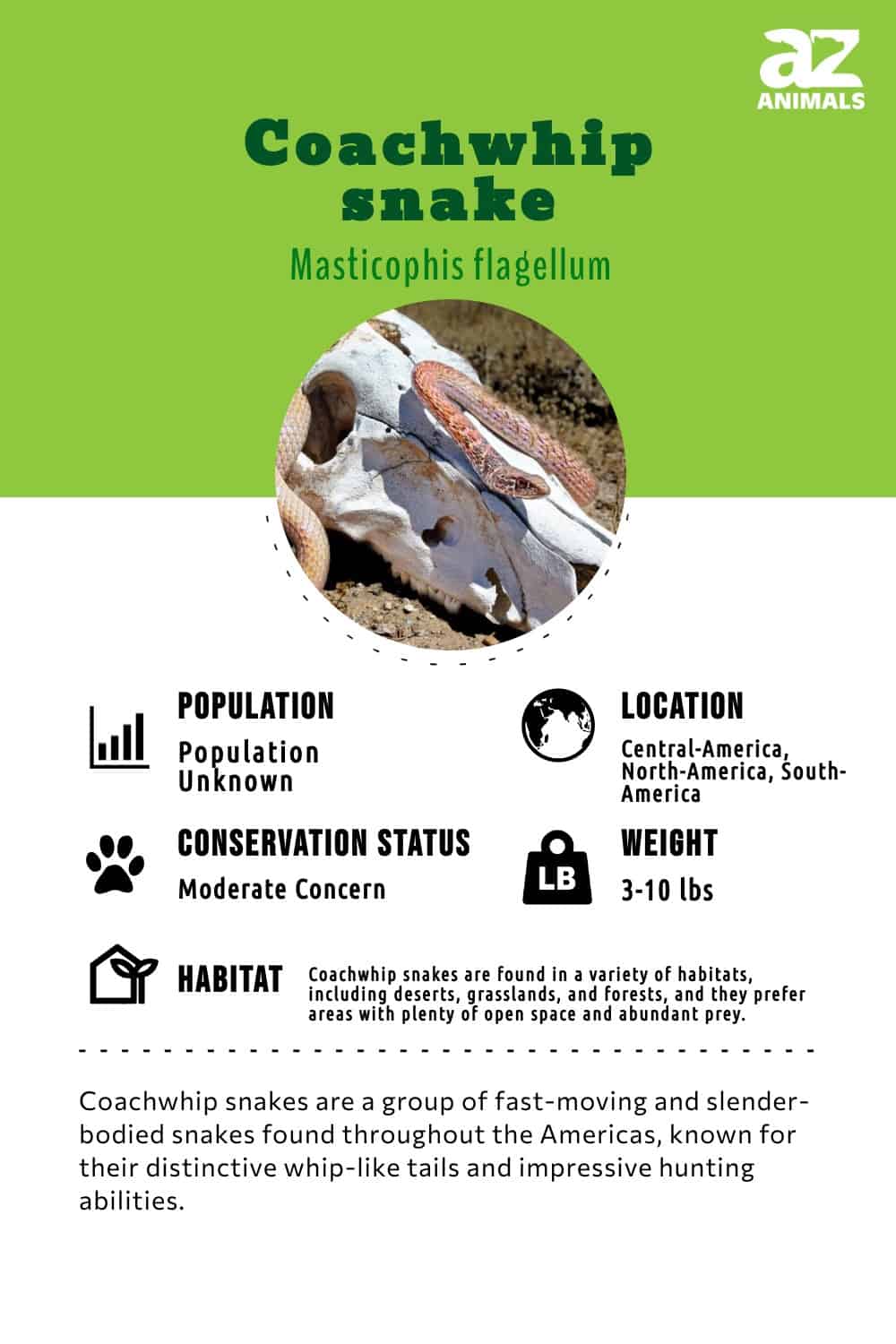
Coachwhip Snake

Masticophis flagellum

Built for speed. No venom required.
Matt Jeppson/Shutterstock.com
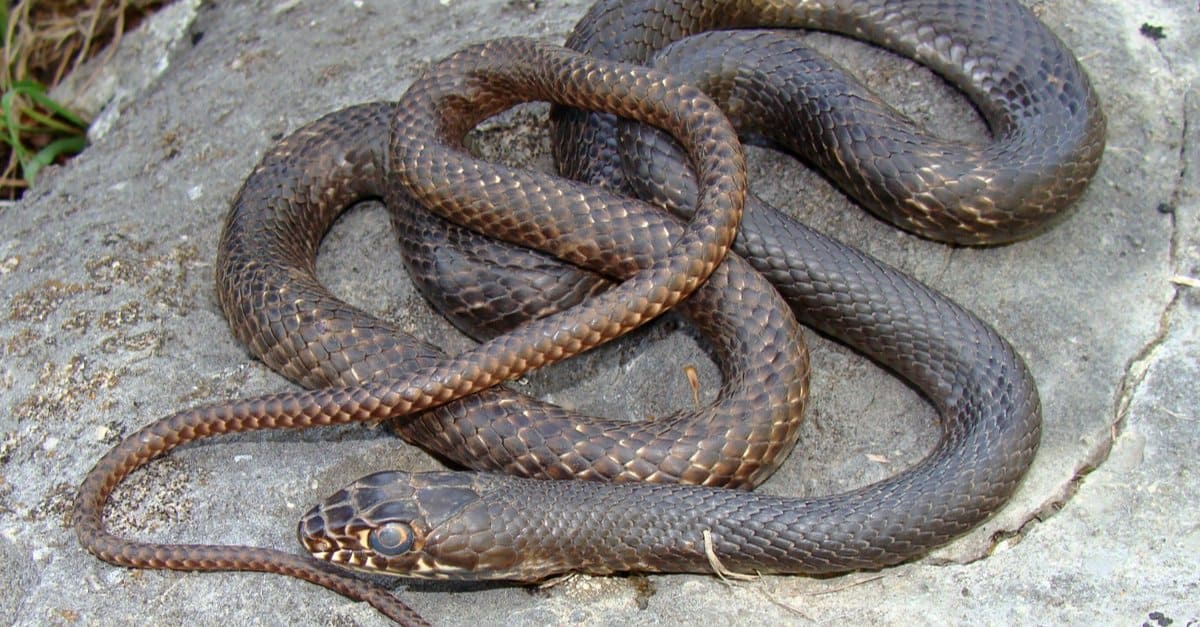
Eastern coachwhip snake

At a Glance

Wild Species
Also Known As Coachwhip, Coach whip, Whip snake, Common coachwhip
Diet Carnivore
Activity Diurnal+
Lifespan 6 years
Weight 1 lbs
Status Least Concern
Did You Know?

Adults are typically 102-152 cm total length; the maximum reported is ~259 cm (Stebbins, 2003).

Scientific Classification

The coachwhip (Masticophis flagellum) is a long, slender, diurnal colubrid snake of the southern and western United States and into northern Mexico, known for speed, alertness, and a “braided whip” look to the tail scales. It is nonvenomous and primarily preys on lizards, small mammals, and birds.

Kingdom
Animalia
Phylum
Chordata
Class
Reptilia
Order
Squamata
Family
Colubridae
Genus
Masticophis
Species
flagellum

Distinguishing Features

  • Very long, slender body (often 1.2–1.8 m, sometimes longer)
  • Large eyes and a keen, alert head posture; active by day
  • Color varies regionally (tan/brown/black to reddish); tail scales can appear braided/whip-like
  • Nonvenomous colubrid; relies on speed and agility to escape

Physical Measurements

Length
4 ft 3 in (2 ft 11 in – 8 ft 6 in)
Weight
1 lbs (0 lbs – 2 lbs)
Tail Length
1 ft 3 in (9 in – 2 ft 4 in)
Top Speed
4 mph
About 6.4 km/h

Appearance

Primary Colors
Secondary Colors
Skin Type Smooth, glossy scales; slender, whiplike body and tail. Dorsal scales typically smooth in 17 rows at midbody (commonly reported for Masticophis flagellum in standard North American herpetological references such as Ernst & Ernst; Stebbins).
Distinctive Features
  • Very long, slender, fast-moving, diurnal colubrid with large eyes and an alert, head-up posture while moving.
  • "Braided whip" look most evident on the tail, produced by the arrangement/appearance of the tail scales (source of the common name).
  • Adult Coachwhip snakes are usually 1.0–1.5 m long; most fall between about 0.76–1.83 m, though a few very large individuals have reached about 2.59 m.
  • Head often darker than the body in many populations; body coloration frequently grades from dark anterior to lighter posterior, but the species is regionally polymorphic (tan/brown to red/orange morphs).
  • Nonvenomous; relies on speed, vigilance, and escape. Defensive behavior may include rapid fleeing, bluffing, or striking if cornered-common myths that they "chase" people or use the tail to literally whip people are inaccurate.
  • Habitat association: typically open, sunny landscapes (desert scrub, grasslands, open woodland edges, sandy/rocky areas) where it can move quickly and visually forage during daylight.
  • Diet: primarily lizards and other small vertebrates (also small mammals and birds), taken by active pursuit/foraging rather than ambush; known for visually oriented, daytime hunting behavior.

Sexual Dimorphism

Sexual dimorphism is present but subtle. As in many colubrids, males tend to have proportionally longer tails (post-cloacal length) associated with hemipenes, while females may average slightly larger in body girth/overall mass. Strong, consistent color differences between sexes are not typically emphasized for this species in standard accounts.

  • Proportionally longer tail relative to total length (typical colubrid pattern).
  • May appear slightly more slender-bodied at similar total lengths (population-dependent; subtle).
  • Often slightly larger-bodied (greater girth/mass) at comparable lengths in many snake species; differences are subtle and not a reliable field marker alone.
  • Proportionally shorter tail than males (typical colubrid pattern).

Did You Know?

Adults are typically 102-152 cm total length; the maximum reported is ~259 cm (Stebbins, 2003).

They hunt mainly by sight in daylight-large eyes and an alert, head-up "searching" posture are characteristic.

Diet is lizard-heavy in many populations, but they also take small mammals, birds, and sometimes other snakes (Ernst & Ernst, 2003).

Color varies strongly by region (often treated as multiple subspecies): e.g., tan/black "whip" patterns in the East vs. red/orange "red racer" forms in parts of the Southwest.

They're nonvenomous colubrids; prey is subdued by rapid grabs/holding and sometimes pinning with body loops rather than constriction.

Clutches are commonly 4-24 eggs laid in early summer; hatchlings emerge later summer/early fall (Ernst & Ernst, 2003).

Unique Adaptations

  • Extreme elongation and smooth, tight scalation: a long, slender body and large ventral scutes support fast, efficient movement over open ground.
  • Excellent daytime vision: relatively large eyes and visual hunting suit open, sunny landscapes where movement detection is key.
  • "Braided whip" tail look: posterior dorsal scales create a braided, whip-like appearance that inspired the common name.
  • Thermal lifestyle tuned to sun: behavior strongly tied to warm surface temperatures-basking and active hunting peak in bright, open habitats.

Interesting Behaviors

  • Diurnal active foraging: travels widely in warm daylight, often pausing to visually scan before sprinting to a target.
  • High-speed escape: when disturbed, typically bolts in a straight, rapid dash to cover rather than coiling defensively.
  • "Periscope" vigilance: raises the head and neck above grasses/shrubs to spot prey and predators at distance.
  • Opportunistic climbing: will climb into shrubs/low trees or brush piles to hunt lizards/birds or to bask.
  • Defensive bluffing: may vibrate the tail in dry leaves (a rattlesnake-like sound), flatten the body slightly, strike, and release musk when handled.

Cultural Significance

Coachwhip Snake (Masticophis flagellum) in the southern US is well known to ranchers and hikers for being large, fast, and often seen in daylight. Named for its whip-like tail, it’s taught as a harmless, helpful hunter of lizards and small rodents in open country.

Myths & Legends

Frontier-era and modern rural Southern folktales describe coachwhips "chasing" people across fields and roads, sometimes said to be out of aggression rather than the snake's attempt to flee to cover.

A common story claims the snake can "whip" a person with its tail like a coachman's whip-an idea tied to the braided tail pattern that likely helped cement the name.

Some local anecdotes say a coachwhip will bite its own tail to form a hoop and roll downhill to escape, a traveling tall tale also told about other fast snakes.

Regional storytelling sometimes casts the brightly colored 'red racer' coachwhip as a fiery, hot-weather omen-appearing most often on scorching days when people are outdoors and the snakes are most active.

Conservation Status

LC Least Concern

Widespread and abundant in the wild.

Population Stable

Life Cycle

Birth 11 hatchlings
Lifespan 6 years

Lifespan

In the Wild
2–13 years
In Captivity
8–20 years

Reproduction

Mating System Promiscuity
Social Structure Solitary
Breeding Pattern Transient
Fertilization Internal Fertilization
Birth Type Internal_fertilization

Coachwhip snakes (Masticophis flagellum) are solitary, active by day, and mate with multiple partners. They breed in spring by internal fertilization, lay 4–24 eggs in early summer, and hatchlings appear in late summer. No pair bonds or parental care.

Behavior & Ecology

Social Solitary Group: 1
Activity Diurnal, Crepuscular
Diet Carnivore Lizards-particularly fast-moving, diurnal lizards such as whiptails (Aspidoscelis spp.), which match the coachwhip's active daytime hunting strategy (reported commonly in diet summaries; e.g., Ernst & Ernst 2003; Stebbins 2003).
Seasonal Hibernates

Temperament

Highly active, wide-ranging, and visually oriented forager; typically relies on rapid flight/avoidance when approached (Ernst & Ernst, 2003).
Alert and readily defensive if cornered or handled: may inflate body, strike repeatedly, and bite; can deliver rapid successive bites and may release cloacal musk (Ernst & Ernst, 2003; Stebbins, 2003).
Coachwhip Snake (Masticophis flagellum) is mostly active by day; in cool weather it's strictly daytime, but in extreme heat it becomes active at dawn and dusk, using shade and early or late hours.

Communication

Hiss produced by forced exhalation when threatened/handled Ernst & Ernst, 2003
Chemical Pheromonal) communication via tongue-flicking and vomeronasal (Jacobson's organ) detection; males follow female scent trails during the mating season (Ernst & Ernst, 2003
Tactile signaling during courtship/copulation Body alignment and cloacal contact typical of colubrids) (Ernst & Ernst, 2003
Visual threat displays: head/neck elevation, body flattening or S-coiling, and persistent orientation toward a threat prior to striking; consistent with their strong reliance on vision Stebbins, 2003; Ernst & Ernst, 2003
Defensive chemical release Cloacal musk) as an antipredator signal/deterrent (Ernst & Ernst, 2003

Habitat

Biomes:
Desert Hot Mediterranean Temperate Grassland Temperate Forest Tropical Dry Forest
Terrain:
Plains Hilly Plateau Valley Rocky Sandy Coastal Riverine +2
Elevation: Up to 7545 ft 11 in

Ecological Role

Mid-level terrestrial predator in arid to semi-arid and open woodland/grassland ecosystems; links lower-trophic prey (lizards/rodents/birds) to higher predators (raptors, mammalian carnivores).

Regulates populations of small vertebrates (notably diurnal lizards and small rodents), which can indirectly influence insect abundance and seed predation pressure via rodent control Contributes to trophic energy transfer as both predator and prey (important prey item for hawks/roadrunners and other snake-eating predators) Helps maintain community balance among small reptiles through predation and occasional ophiophagy

Diet Details

Main Prey:
Lizards Small mammals Birds Other snakes Large insects and other terrestrial invertebrates

Human Interaction

Domestication Status

Wild

Coachwhip snake (Masticophis flagellum) is not domesticated and has no history of selective breeding. Human contact is mostly accidental across southern/western U.S. and northern Mexico—sightings in rangeland, scrub, desert edges, open woodland, road encounters, and some killing. They are diurnal, very fast, hard to handle. Adults ~0.9–1.8 m (up to ~2.6 m). Oviparous; clutches often ~6–20 eggs.

Danger Level

Low
  • Nonvenomous; primary risk is a defensive bite (can be painful and may bleed due to long teeth and rapid striking).
  • Secondary risk of wound infection if bites are not cleaned (typical bacterial risk associated with reptile oral flora).
  • May musk/defecate when handled, creating a minor hygiene issue.
  • High-speed flight and defensive behavior can lead to unsafe attempts to capture/kill, increasing risk of falls, tool injuries, or vehicle accidents on roads.
  • Misidentification as a venomous snake can lead to unnecessary killing and conflict with humans.

As a Pet

Not Suitable as Pet

Legality: Coachwhip Snake (Masticophis flagellum) laws vary. Not CITES-listed and usually not banned federally in the U.S., but states may ban wild-caught snakes, require permits, or allow only captive-bred. Check state, provincial, and Mexican rules.

Care Level: Expert Only

Purchase Cost: $75 - $300
Lifetime Cost: $2,000 - $7,000

Economic Value

Uses:
Ecosystem services (predation on rodents and other small vertebrates) Education/outreach (nature centers, demonstrations-typically with experienced handlers) Research/monitoring (field ecology, movement, predator-prey dynamics) Limited pet trade (uncommon compared with many colubrids)
Products:
  • non-consumptive value (pest control services in agricultural/rural landscapes)
  • educational programming value
  • occasional sale of captive individuals where legal

Relationships

Predators 7

Red-tailed hawk Buteo jamaicensis
Swainson's hawk
Swainson's hawk Buteo swainsoni
Great horned owl Bubo virginianus
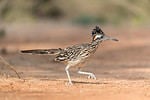
Greater roadrunner
Greater roadrunner Geococcyx californianus
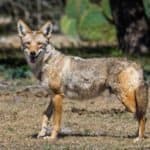
Coyote
Coyote Canis latrans
Bobcat
Bobcat Lynx rufus
Common kingsnake Lampropeltis getula

Related Species 7

California whipsnake Masticophis lateralis Shared Genus
Sonoran whipsnake Masticophis bilineatus Shared Genus
Striped whipsnake Masticophis taeniatus Shared Genus
Schott's whipsnake Masticophis schotti Shared Genus
North American racer
North American racer Coluber constrictor Shared Family
Eastern indigo snake
Eastern indigo snake Drymarchon couperi Shared Family
Common kingsnake Lampropeltis getula Shared Family

Ecological Equivalents 3

Animals that fill a similar ecological role in their ecosystem

The coachwhip snake gets its name from the resemblance to a lash used to drive a coach’s horse.

The coachwhip is a member of the whip snake genus. These are very long, slender, non-venomous snakes native to the Americas. Because of how common they are, it is easy to accidentally come across one in the wild. Fortunately, they pose little danger to people.

Watch on Youtube

5 Coachwhip Amazing Facts

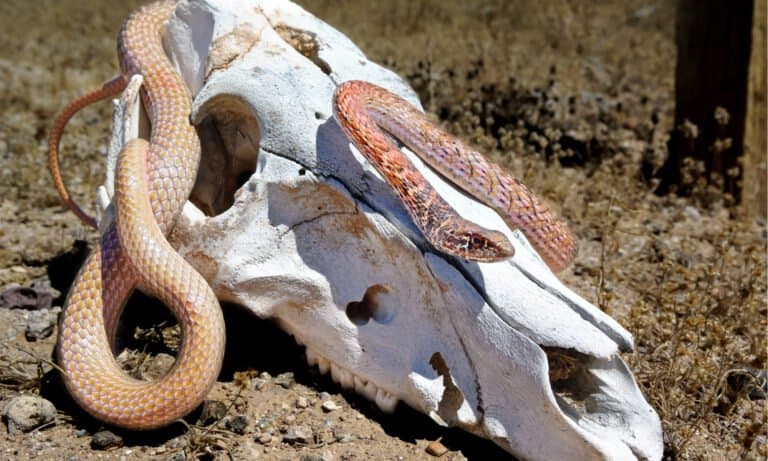
Pink Coachwhip Snake
  • The reproductive season of the coachwhip usually takes place in the late spring and summer months. Females may breed with several different males during this period. She will then lay up to 24 eggs in a small burrow (although the average number of eggs is just 11 eggs). It takes them more than two months for each baby to hatch on its own.
  • The coachwhip is among the fastest snakes in the Americas. It has a maximum speed of about 4 miles per hour.
  • The coachwhip tends to live about 13 years in the wild. The maximum age in captivity was recorded to be about 20 years.
  • Coachwhip snakes maintain a small home range that they use for hunting. In the breeding season, male snakes will defend this location from rivals to protect any females within it.
  • All sorts of myths have arisen around the coachwhip. One myth is that they have the ability to whip a person to death with their tail. Another myth is that they will suckle the milk from cows and other mammals, leaving the young baby calf without any milk. These myths are completely false.

Evolution and Origins

Coachwhip snakes are an intriguing collection of snakes that can be found from Canada to South America in much of the Americas. With long, slender bodies that may grow up to 8 feet long and a whip-like tail that gives them their common name, these snakes are recognized for their striking look. Coachwhips can hunt down animals including lizards, rodents, and birds because of their lightning-quick speed.

There is still substantial disagreement among experts regarding the evolution and origins of coachwhip snakes. One idea holds that they are closely related to the long, slender snakes that are known to hunt lizards in Africa, the species Psammophis.

However, according to other studies, coachwhips are more closely linked to North American rat snakes, which have comparable body structure and dietary preferences. Coachwhip snakes’ exact origins and evolutionary history must be explored further, but their unusual adaptations and astounding speed make them an interesting topic for future research.

Different Types

  • Masticophis flagellum cingulum: Sonoran coachwhip
  • Masticophis flagellum flagellum: Eastern coachwhip
  • Masticophis flagellum lineatulus: Lined coachwhip
  • Masticophis flagellum piceus: Red coachwhip, red racer
  • Masticophis flagellum ruddocki: San Joaquin coachwhip
  • Masticophis flagellum testaceus: Western coachwhip

Where to Find Coachwhips
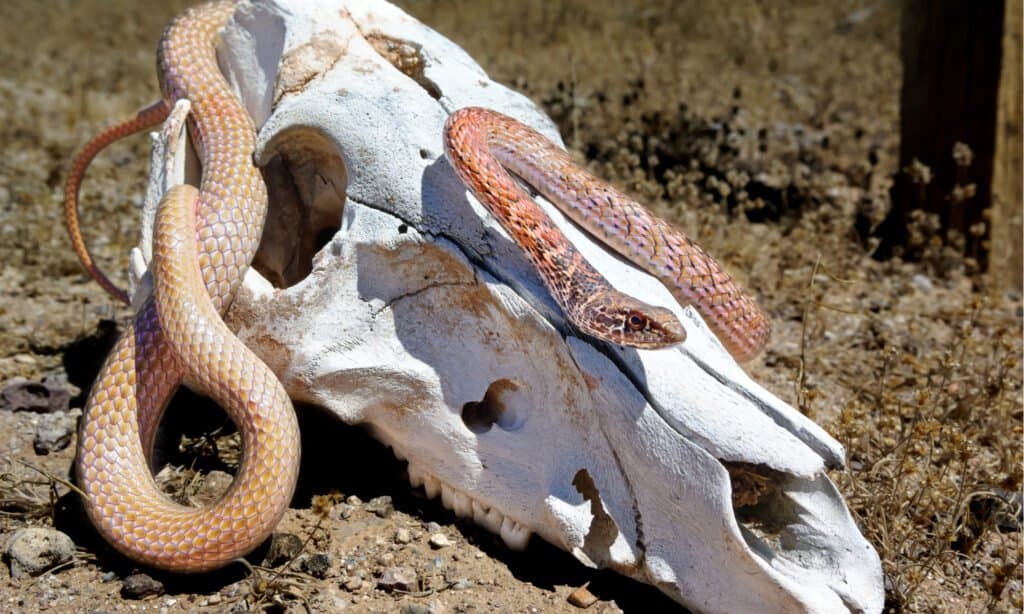
Coachwhip Snake - In Skull

Coachwhip snakes live across much of the southern United States and Mexico.

The coachwhip is very common throughout the southern United States and northern Mexico, from the Pacific to the Atlantic coast, although apparently not around the Mississippi River. They prefer areas with loose, sandy soil, including prairies, coastal dunes, open pine forests, sandhills, and fields.

These snakes are most active during the hottest hours of the day. When it’s nighttime or cold out, they will typically seek refuge in underground burrows or beneath objects. During the winter, they do hibernate for extended periods to conserve energy.

There are six recognized subspecies, each with its own geographical range. The eastern coachwhip lives as far north as Missouri and as far south as Florida; it’s also bounded by the Atlantic in the east and Texas in the western part of its range. The western coachwhip lives as far south as Mexico City and all the way north to Nebraska; it’s also bounded by New Mexico in the western part and Texas in the eastern part of its range.

The Sonoran coachwhip can be found in a small region between Arizona and Sonora, Mexico. The San Joaquin coachwhip is found around northern California. The red coachwhip lives between southern California and Arizona. Finally, the Baja California coachwhip is found in that respective peninsula of Mexico.

Scientific Name
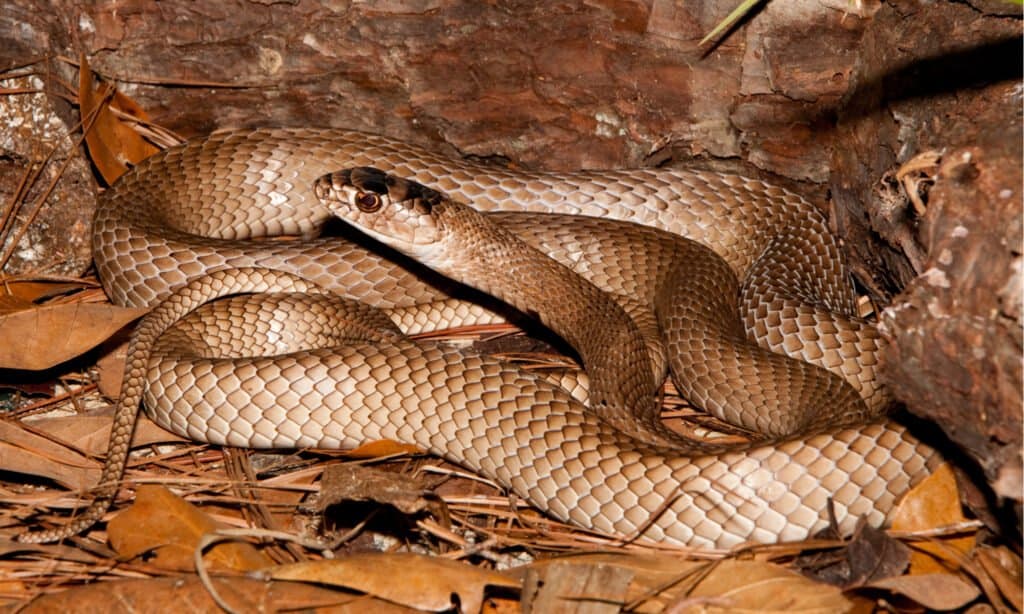
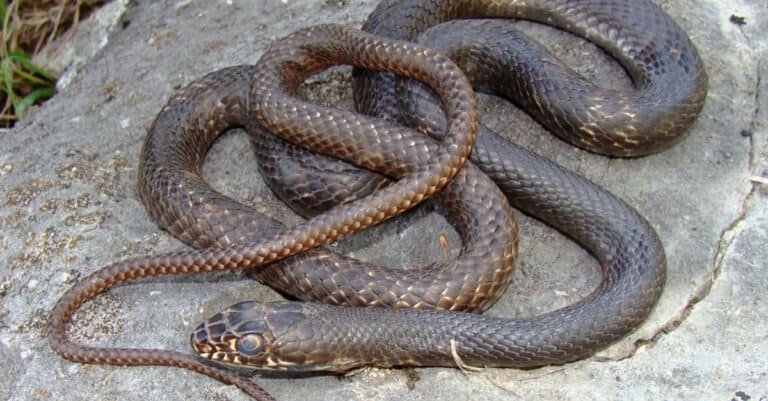
Eastern Coachwhip

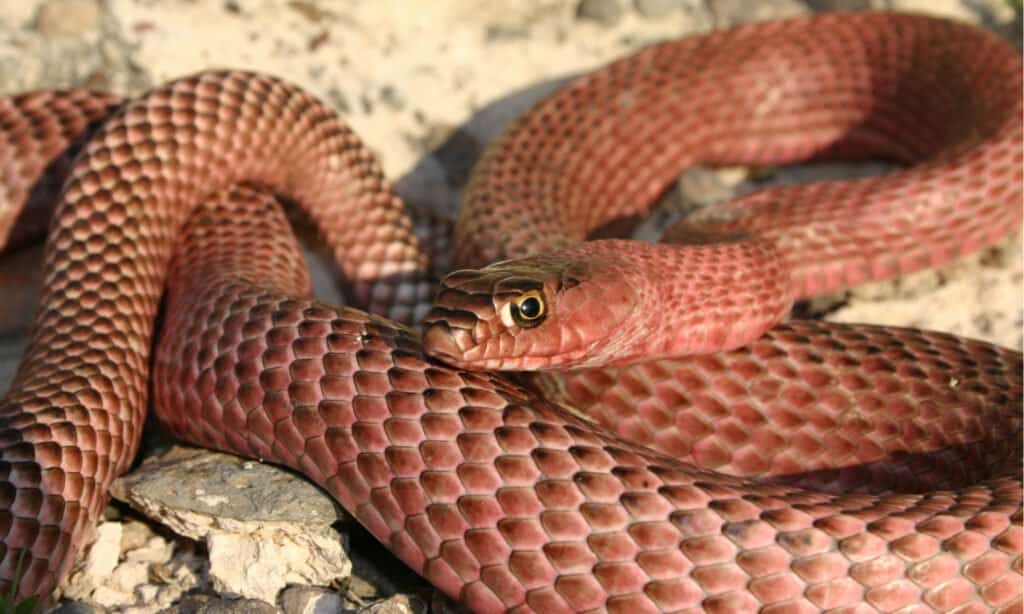
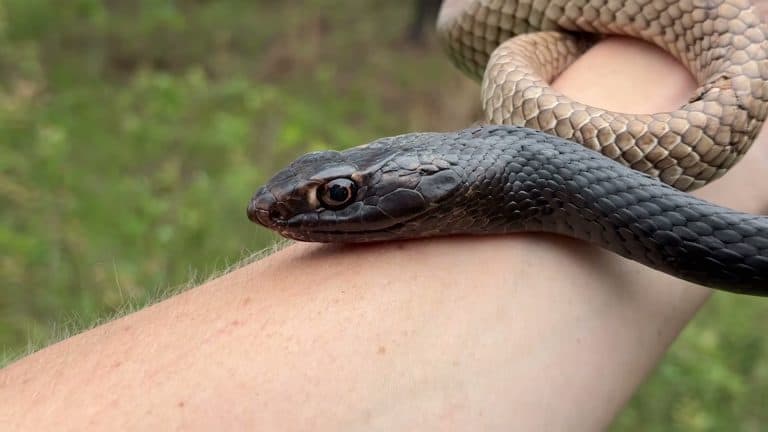
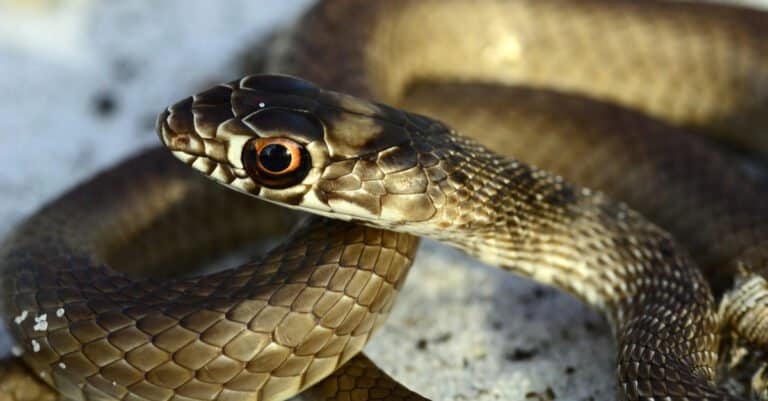
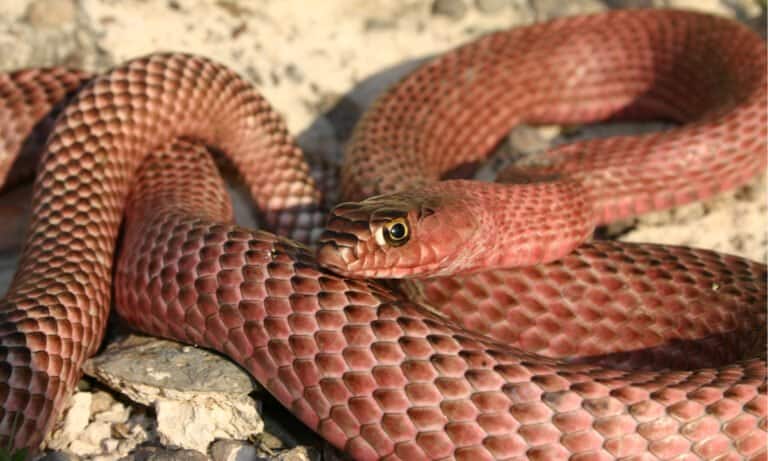
These snakes can be found in a wide variety of colors, including black, gray, tan, pink, reddish-brown, or any combination of these colors. They may also have broad crossbars of color.

The scientific name of the coachwhip is Masticophis flagellum. Masticophis is derived from two Greek words: mastix, meaning whip, and ophis, meaning snake. Flagellum comes from the Latin word flagrum, meaning whip or scourge. This is actually a common biological term used to describe many whip-like appendages on a variety of different organisms.

Population & Conservation Status

According to the IUCN Red List, the coachwhip is overall a species of least concern, but habitat loss and road accidents are responsible for a slight decline in numbers around some areas. The state of Illinois, for instance, lists it as an endangered species within its borders. But they are quite plentiful in the core of its territory, including Texas, Florida, and Arizona.

Appearance and Description
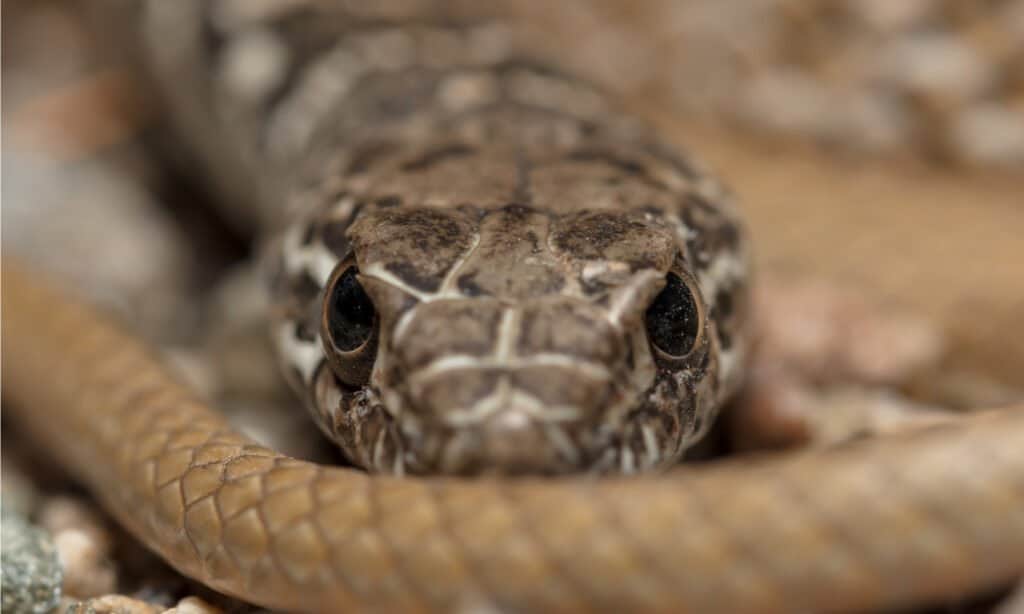
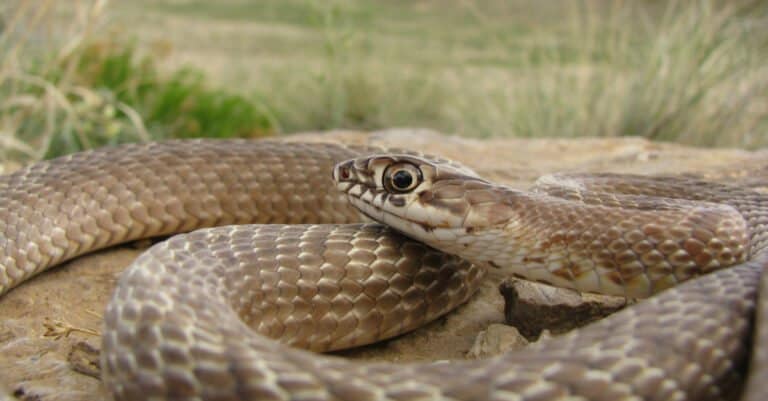
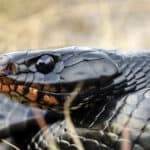
Coachwhip Snakes Close-Up

Coachwhips are long and slender snakes and can reach lengths up to eight feet.

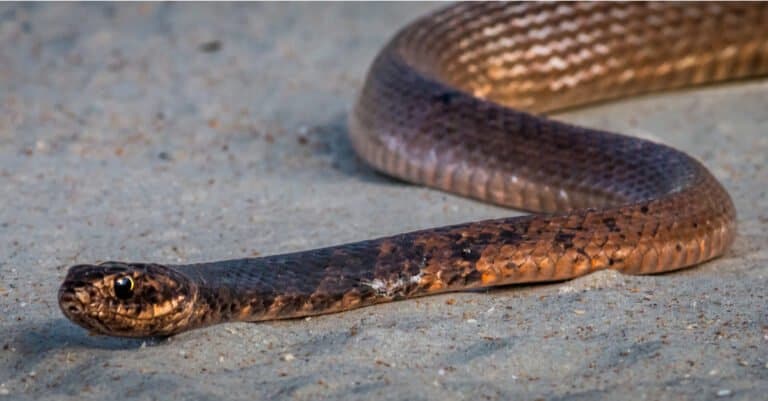
The coachwhip is a long, slender snake that has the capacity to reach up to 8 feet in length. They are characterized by a small head, large eyes, and a scale pattern that resembles a braided whip. Coloration is probably the easiest way to identify them. The skin is black or dark brown around the head and slowly progresses to tan or white around the tail.

The exact range of colors varies across subspecies and locations. The red coachwhip subspecies feature dark red or pink hues. In Georgia and Florida, the coachwhip is almost completely tan. And the Sonoran coachwhip has black bands interrupted by smaller red bands. There are few differences between males and females, but the juvenile or baby coachwhips are generally tan or brown with white spots on the snout.

Here is how to identify the coachwhip:

  • Extremely slender blender body, 3 to 8 feet in length
  • Small head with large eyes
  • The scale pattern resembles a braided whip
  • Colors range from black or dark brown on the head to tan or white on the tail

Read about the largest coachwhip snake ever recorded.

How Dangerous Are They?
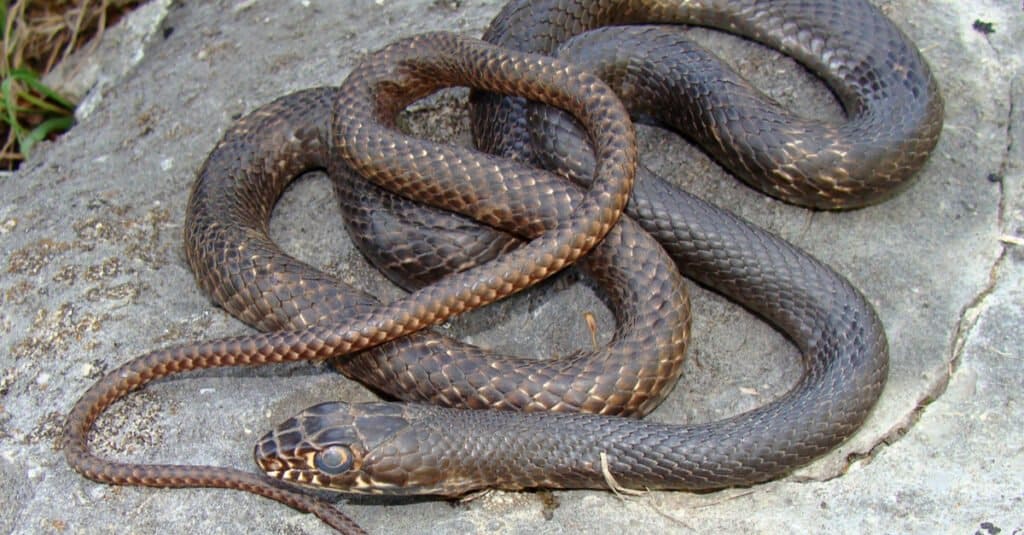
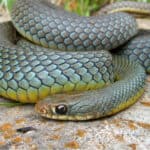
Eastern coachwhip snake

Coachwhip snakes are non-aggressive snakes found in South America.

Coachwhips are not very dangerous at all. These are non-venomous snakes that generally defend themselves by standing up and biting. Although the bite can cause pain and swelling (the snake also has the tendency to tear away at the skin), it generally goes away after a short time.

There are no long-term complications unless the wound becomes infected, so it’s always a good idea to wash the wound out with soap and water to prevent this from occurring. If the wound looks more serious, then you may want to contact a doctor. Because of its speed, agility, and size, the coachwhip has few natural predators in the wild besides maybe coyotes and great horned owls.

Behavior and Humans

There are a number of old myths associated with the coachwhip that persist to this day. Some people believe it will chase after you and attempt to whip you with its tail out of self-defense, but this is completely false. If threatened, they will attempt to run away and hide. They will try to flee back to their underground burrow or even climb up trees.

If cornered, they may try standing up and biting at their harasser. And if handled or captured, some snakes may turn very aggressive, whereas others will go limp and attempt to play dead.

Similar Animals

View all 392 animals that start with C

Sources

  1. https://srelherp.uga.edu/snakes/masfla.htm
  2. https://animaldiversity.org/accounts/Masticophis_flagellum/
Austin S.

About the Author

Austin S.

Growing up in rural New England on a small scale farm gave me a lifelong passion for animals. I love learning about new wild animal species, habitats, animal evolutions, dogs, cats, and more. I've always been surrounded by pets and believe the best dog and best cat products are important to keeping our animals happy and healthy. It's my mission to help you learn more about wild animals, and how to care for your pets better with carefully reviewed products.
Connect:

Thank you for reading! Have some feedback for us?


Coachwhip Snake FAQs (Frequently Asked Questions)

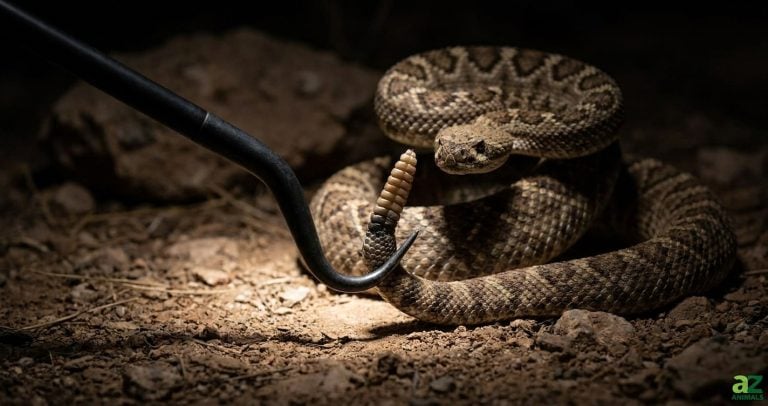
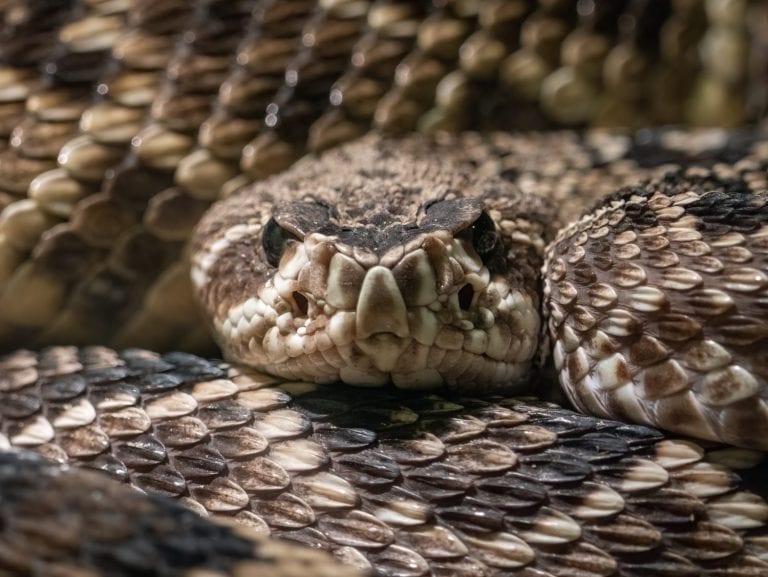
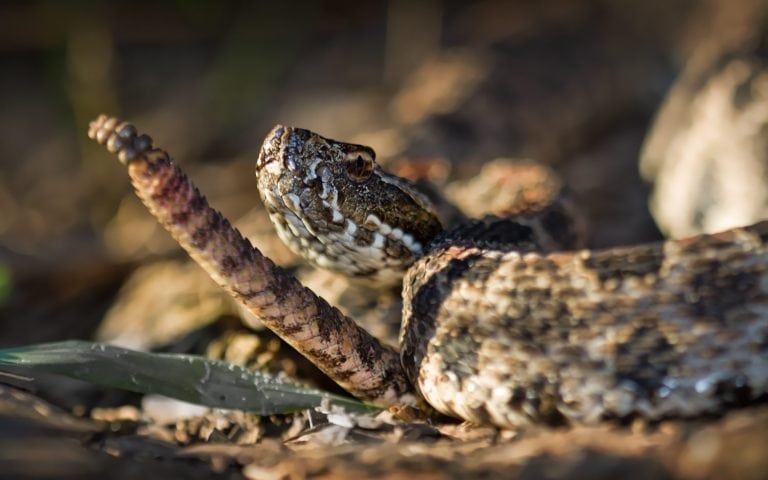
The biggest difference between coachwhips vs rattlesnakes is that coachwhips are nonvenomous while rattlesnakes have venom. Coachwhip snakes do not have fangs and also have no rattle on their tail to warn potential aggressors.