
Snakes are fascinating and often misunderstood animals. These legless creatures live just about everywhere in the world — some snakes even live in the ocean. The only large landmasses where there are no native snake species are New Zealand, Ireland, Greenland, Iceland, and Antarctica.
Many people suffer from Ophidiophobia, which is a fear of snakes. However, snakes are critical to keeping the earth’s ecosystems balanced. In addition, of the astounding 3,000 different snake species, only around 600 are venomous.
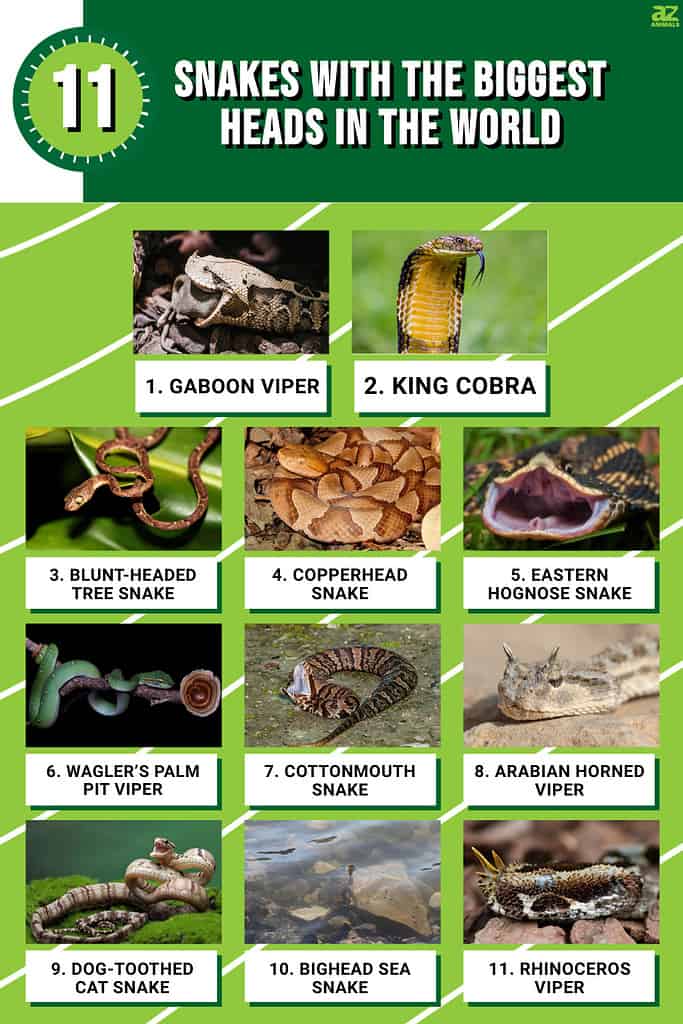
Snakes come in all shapes and sizes, from the extinct 42-foot-long Titanoboa to the 3-inch-long Barbados thread snake. Snakes have unique shapes as well, with heads much larger than their thin bodies. Let’s look at 11 snakes with the biggest heads in the world!
11. Rhinoceros Viper
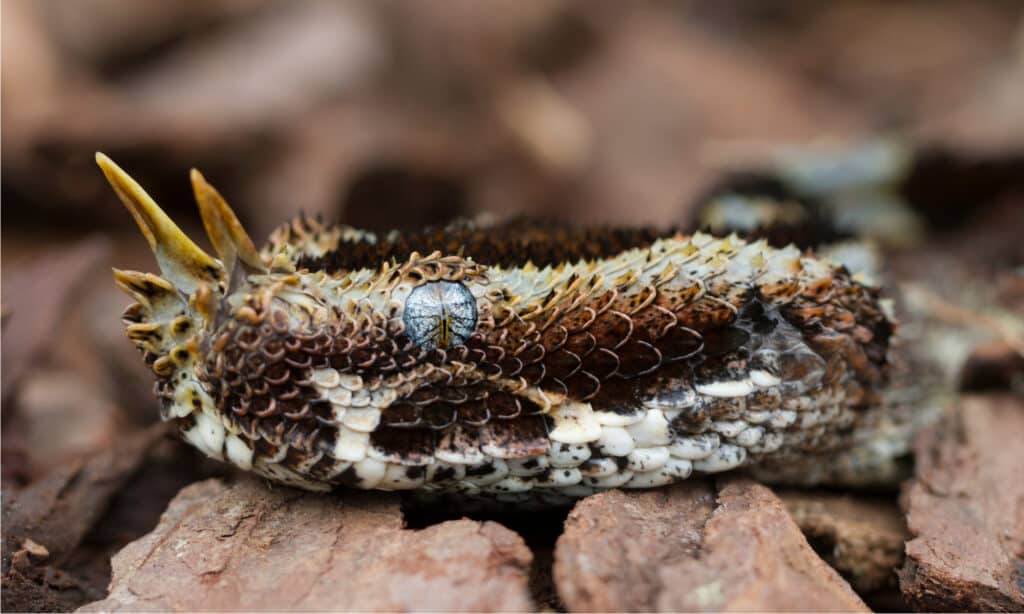
The rhinoceros viper typically moves slowly due to its heavy body, but this snake can strike very quickly.
©Mark_Kostich/Shutterstock.com
The rhinoceros viper (Bitis nasicornis) has a large, triangular head and a very unique nose. Like its name, this snake has two to three pairs of “horns” on the tip of its snout. Rhinoceros vipers have heavy bodies that can reach 36-48 inches in length. Their scales are extremely keeled, or ridged, giving these snakes a very bristly appearance. They can be brightly colored, with black, white, blue, green, red, and yellow scales.
These unique snakes live in Central Africa in swampy, forested areas with dense vegetation. Rhinoceros vipers have neurotoxic and hemotoxic venom, but since they live deep in the jungle, they rarely encounter or bite humans. In addition, rhinoceros vipers are not very aggressive and avoid human settlements.
10. Bighead Sea Snake
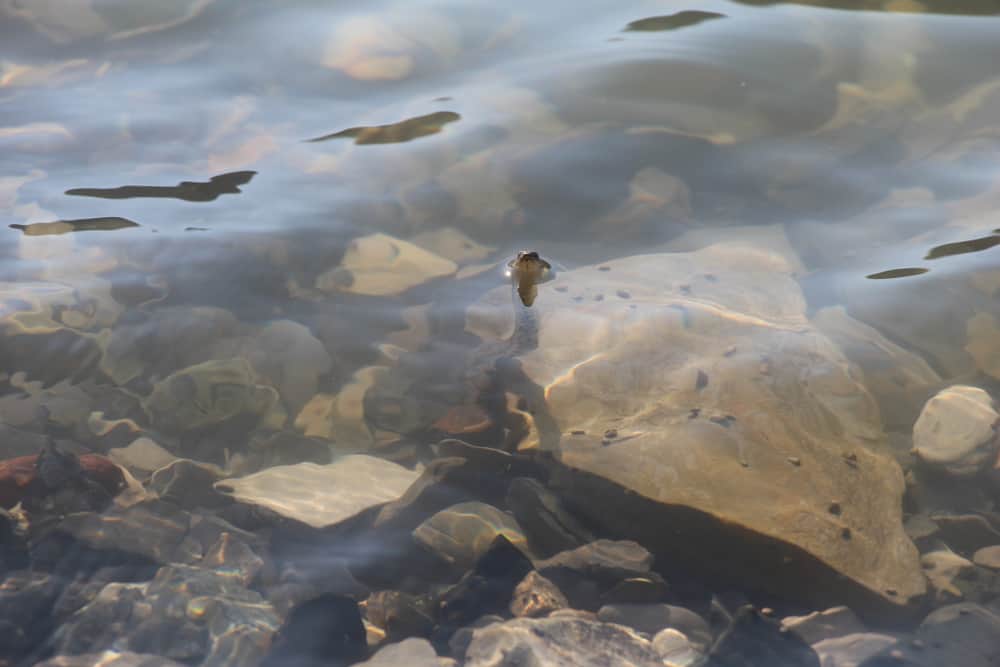
Bighead sea snakes prefer the shallow, muddy waters near the coast.
©Veron_7_7_7/Shutterstock.com
The bighead sea snake, also called Annadale’s sea snake (Hydrophis annandalei), is a smaller snake, measuring only 20 inches in length. Bighead sea snakes are venomous snakes that are native to the Indian Ocean. They can be found in shallow, muddy waters near the coasts of Indonesia, as well as Thailand, Vietnam, Malaysia, Cambodia, and Singapore.
As its name suggests, this snake has a uniquely large, wide head compared to its narrow body. These snakes have grey or blue-grey bodies with darker stripes or crossbands running along their entire length. They have lighter undersides that are pale cream or yellow.
9. Dog-Toothed Cat Snake
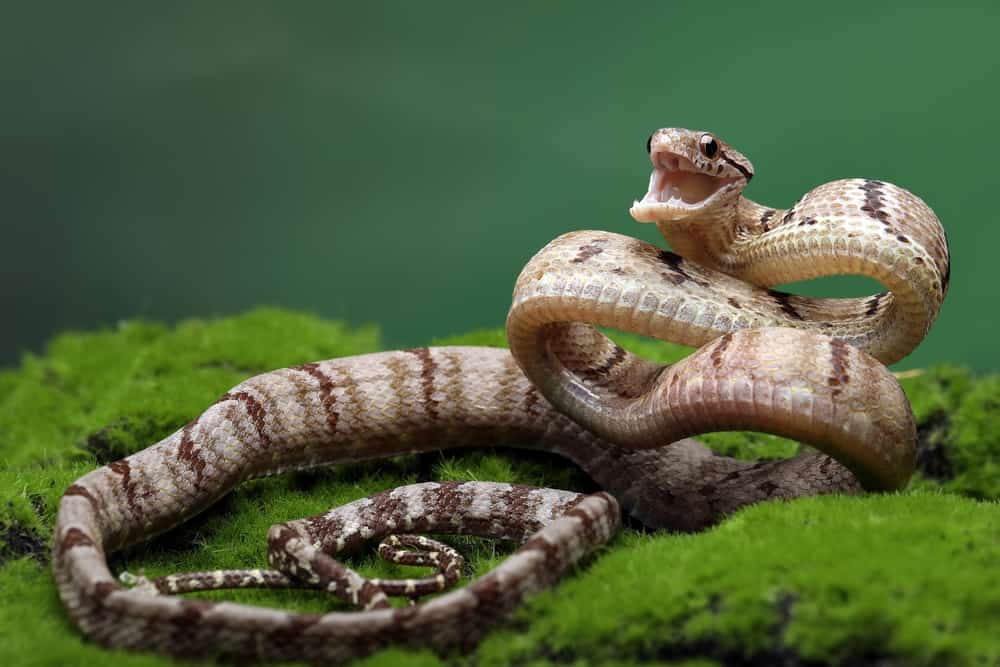
Dog-toothed cat snakes are mildly venomous snakes with rear fangs.
©Lauren Suryanata/Shutterstock.com
The dog-toothed cat snake (Boiga cynodon) has a large head that is distinctly bigger than its small neck. These large snakes can grow up to 78 inches in length with yellowish-brown, reddish-brown, or orange-brown bodies. Their bodies are slender and laterally compressed, with dark bands along their backs that are edged in white. There is also a broad, dark stripe behind each of the snake’s large eyes.
Dog-toothed cat snakes living in Peninsular Malaysia may also have dark mottling that makes them look almost entirely black.These snakes are native to Asia, where they live in the trees of lowland forests as well as on the forest floor. They have rear fangs but are only mildly venomous.
8. Arabian Horned Viper
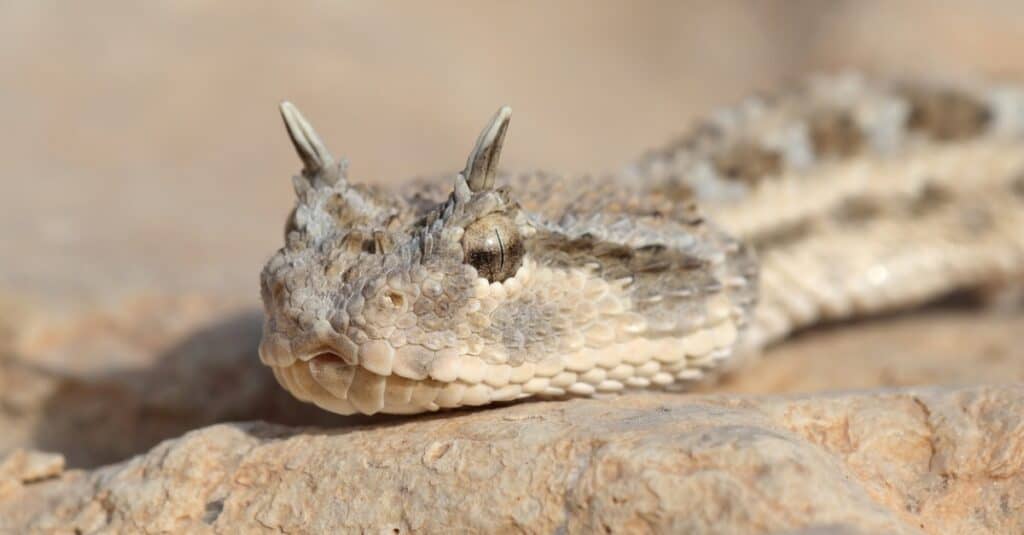
Bites from the Arabian horned viper require hospital treatment, though there have been no fatalities.
©iStock.com/bogdanhoria
The Arabian horned viper, or Gasperetti’s horned viper (Cerastes gasperettii), has a short body with a large head shaped like a flattened triangle. This snake only measures 12-24 inches, with keeled or ridged scales covering the length of its thickset body. Some Arabian horned vipers also have large, vertical horns above each eye.
During the day, the Arabian horned viper seeks shade under bushes or hides its body in the sand to keep it safe from the sun’s heat. Their tan, grey, orange, and pink scales help them blend into the sand. These venomous snakes hunt mostly at night and eat rodents, arthropods, and lizards. Arabian horned vipers live in the Arabian Peninsula and move by “sidewinding” across the desert sands.
7. Cottonmouth Snake
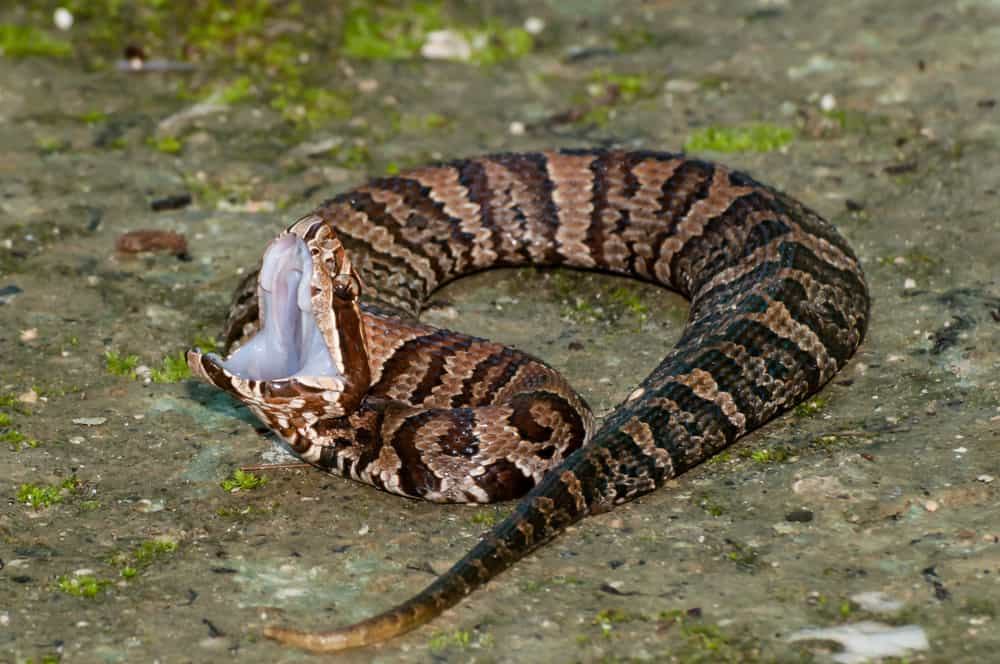
Cottonmouth snakes have thick, muscular bodies that can reach up to 6 feet long.
©Jay Ondreicka/Shutterstock.com
The cottonmouth snake (Agkistrodon piscivorus) is native to the southeastern United States. This semi-aquatic viper is an excellent swimmer and primarily eats frogs and fish. It often lives near shallow lakes and slow-moving bodies of water like streams and marshes. This is why cottonmouth snakes are also called water moccasins, swamp moccasins, swamp rattlers, and North American water vipers. These snakes generally reach 24-48 inches long, with some large individuals growing to around 6 feet in length.
These snakes have broad, bulky, triangular heads with blunt snouts and thin necks. Cottonmouth snakes have a powerful cytotoxic venom that destroys tissue. One reason their heads are so big is due to their large venom glands. When a cottonmouth snake feels threatened, it will often coil its body and throw its mouth open to display its large fangs and bright, white mouth. Cottonmouth snakes have dark, irregular, wavy crossbands with black edges running along the length of their bodies. These markings can be blackish, brown, tan, grey, or yellowish olive in color.
6. Wagler’s Palm Pit Viper
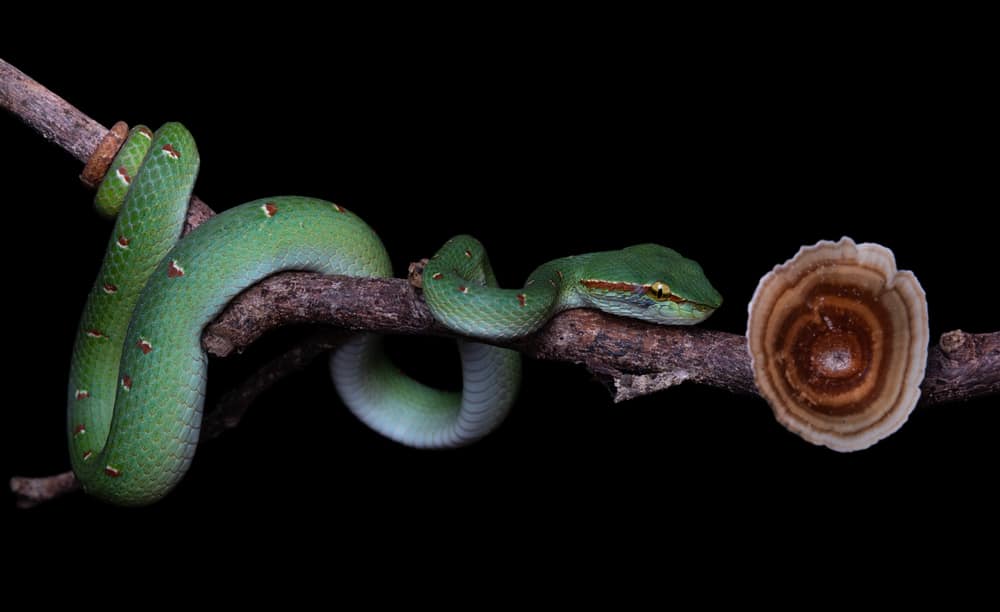
Wagler’s palm pit viper is one of the most common pit vipers in southeast Asia.
©Nenad Preradovic/Shutterstock.com
The Wagler’s palm pit viper (Tropidolaemus wagleri) has a distinctly large, triangular-shaped head. These venomous snakes live in southeastern Asia in lowland forests and mangroves. Sometimes they are referred to as “temple vipers” because they are common around Malaysia’s Temple of the Azure Cloud.
Wagler’s palm pit vipers are arboreal, spending most of their lives in mid-level tree canopies. These snakes come in a wide variety of colors and patterns. Some have bright green bodies with small red and cream spots or bars along their backs. Others have dark-colored bodies with pale yellow bands. Females can reach nearly 40 inches in length, while males can reach around 30 inches.
5. Eastern Hognose Snake
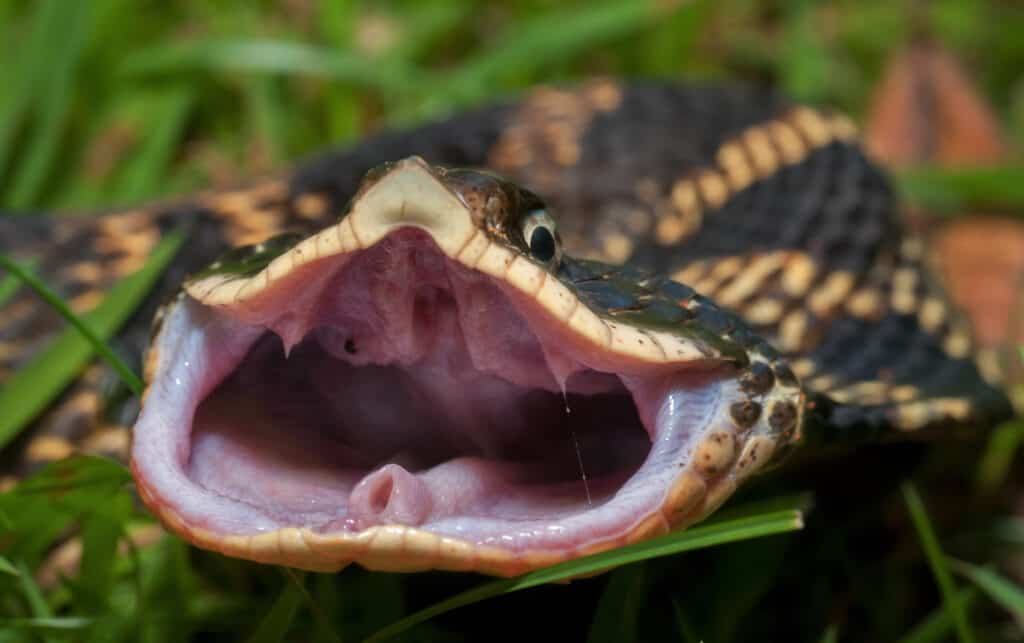
Eastern hognose snakes are known for eating toads.
©Mike Wilhelm/Shutterstock.com
At first glance, the eastern hognose snake (Heterodon platirhinos) appears to have a normally sized head. However, when this snake feels threatened it spreads its head and neck wide like a cobra, transforming it into a supersized cranium. Eastern hognose snakes live in the eastern half of the United States in fields, forests, prairies, woodlands, coastal areas, grasslands, and river valleys. They have amphibian-specific venom, so these rear-fanged snakes are considered harmless to humans.
They have a uniquely upturned snout that they use to burrow beneath loose sand and soil. Eastern hognose snakes almost exclusively eat amphibians. However, occasionally they may also eat salamanders, invertebrates, birds, and small mammals. These snakes have thick bodies and grow between 18-48 inches in length. Eastern hognose snakes generally have yellow, brown, olive, orange, or gray bodies with dark, rectangular patterns.
4. Copperhead Snake
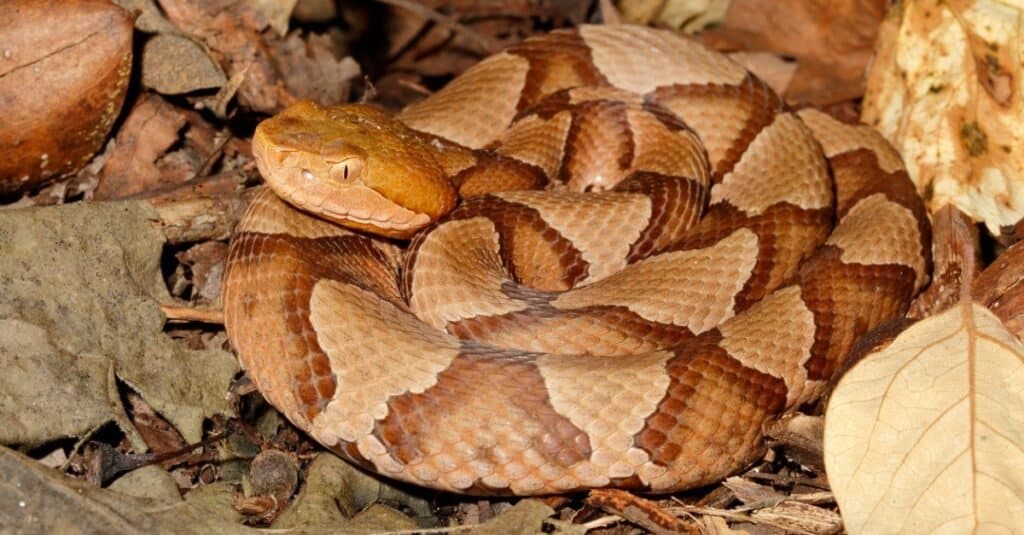
Copperhead snakes have broad, wedge-shaped heads of a coppery-red color.
©iStock.com/David Kenny
As its name suggests, the copperhead snake has a large copper-red head shaped like a broad triangle or arrowhead. These snakes have thick, muscular bodies covered in keeled or ridged scales and typically measure between 24-36 inches in length. These venomous snakes live in the United States and northern Mexico and can be found in many different types of habitats.
Copperhead snakes are often light brown, tan, salmon, or pinkish in color, with dark crossbands along the length of their bodies. These banded marks are shaped like an hourglass with brown or reddish-brown colors. Copperhead snakes are well known for these distinctive markings, which help distinguish them from many other species.
3. Blunt-Headed Tree Snake
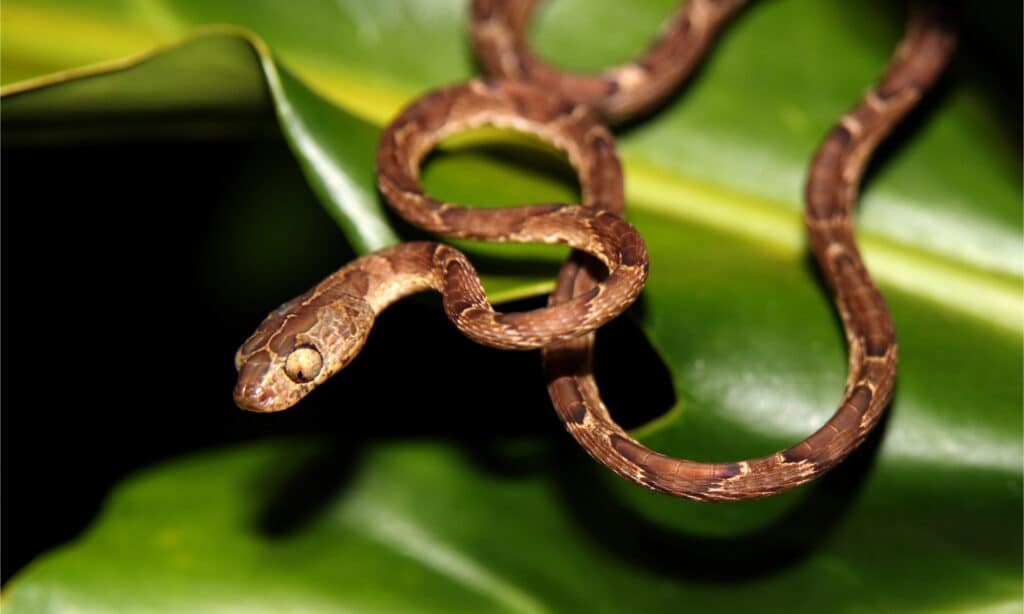
Blunt-headed tree snakes have vertical pupils that help them to make the most of the available light.
©Ryan M. Bolton/Shutterstock.com
The blunt-headed tree snake (Imantodes cenchoa) has an unusually large head in proportion to its extremely thin body. In addition, this snake has very large eyes that take up at least 25% of its head. Their eyes protrude from the sides of their heads, allowing them to see a wider range than many other snake species. Blunt-headed snakes are nocturnal, so these large eyes also help them to take in as much light as possible to see in the dark. These slender snakes are light brown with dark brown markings.
These are arboreal snakes that live in Central and South America, as well as Mexico. Young snakes may sometimes venture into dense vegetation closer to the ground, but the adults live almost exclusively in trees. Because their necks are so thin, blunt-headed tree snakes mainly eat small reptiles and amphibians such as dwarf geckos, anoles, and frogs. Although they are mildly venomous, these snakes are docile and do not typically bite humans.
2. King Cobra
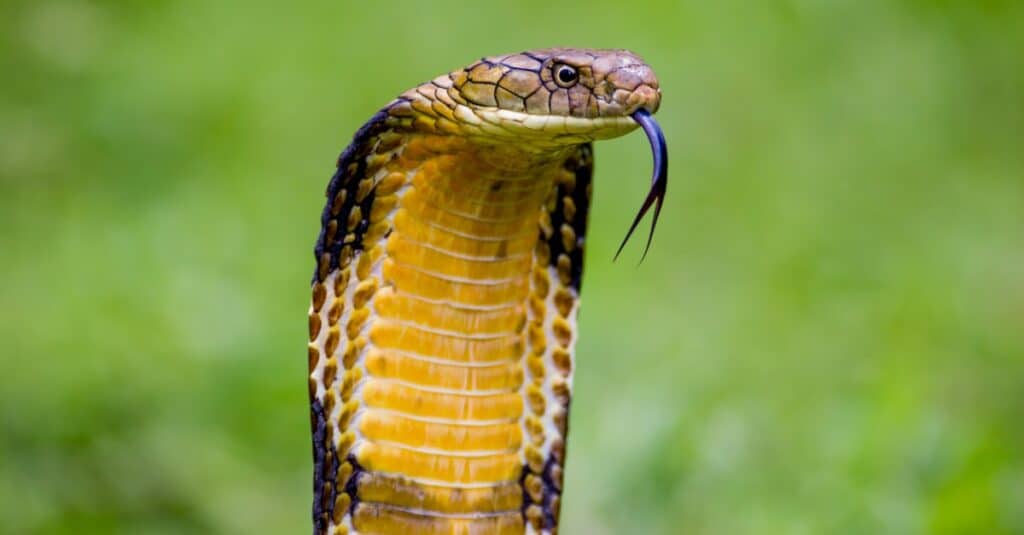
King cobras raise much of their lengthy bodies and “stand up” off the ground.
©iStock.com/takeo1775
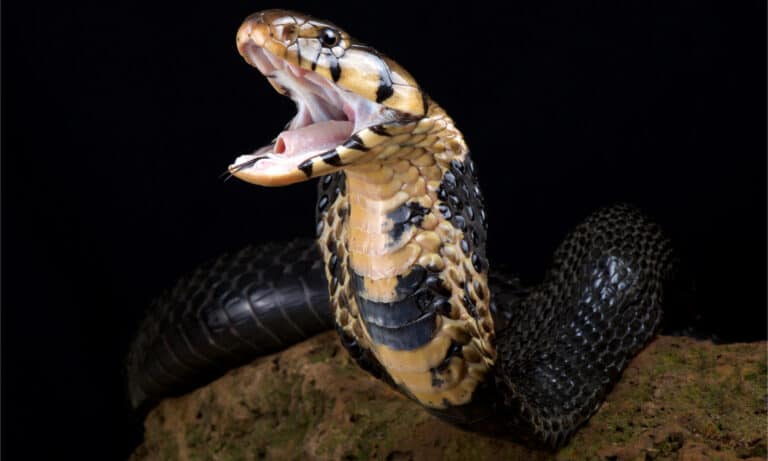
The king cobra (Ophiophagus hannah) is a large snake with a large, bulky head. They are called “king” because their diet consists of other snakes. This snake lives in Southeast Asia, southern China, and India. King cobras can be found in a variety of different habitats, from rainforests and mangrove swamps to grasslands. These snakes are typically between 10-13 feet in length but can grow to nearly 20 feet long. Their skin can be green, brown, yellow, or black, with pale crossbars and yellow throats.
King cobras are not only the longest venomous snakes in the world, but they also raise much of their lengthy bodies and “stand up” off the ground. When it feels threatened, a king cobra will hiss and flare out its hood to make it look larger and more intimidating. These snakes are extremely dangerous, with cytotoxic and neurotoxic venom that can kill a human within 30 minutes. Fortunately, king cobras are typically shy and avoid humans as much as they can.
1. Gaboon Viper
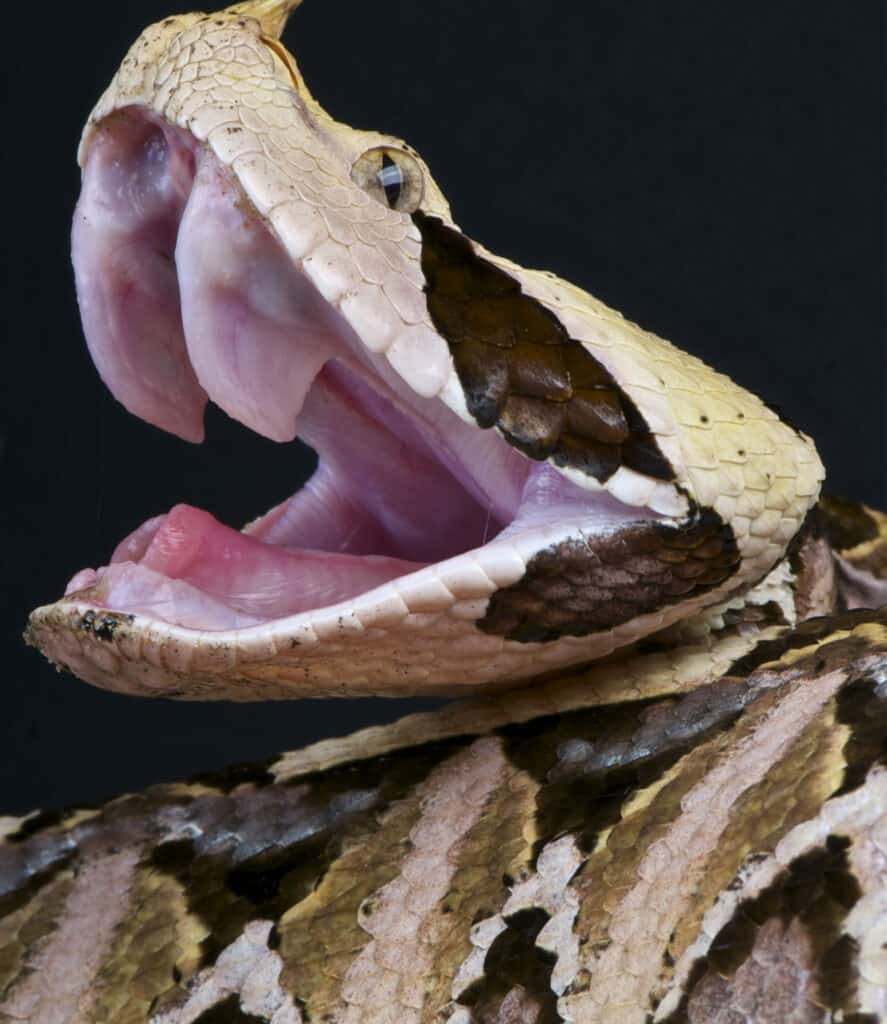
Gaboon vipers’ heads are the biggest of any snake species in the world, reaching up to 5 inches wide.
©reptiles4all/Shutterstock.com
The gaboon viper has the largest head of any snake species in the world, with some individuals’ heads measuring up to about 5 inches wide. These large snakes can grow between 48-84 inches in length and weigh more than 45 pounds. Gaboon vipers are the largest viper species in Africa and live in rainforests. These snakes have large fangs up to 2 inches long and can produce one of the largest quantities of venom per bite. Their venom is cytotoxic and can cause one of the most painful bites of any snake as well.
The colors and patterns on a gaboon viper provide the snake with excellent camouflage as it patiently waits among the leaves on the forest floor. The snake’s body is patterned with light and dark brown edged in purple and pink scales that form diamond markings and stripes along their backs. The gaboon viper has unique horns on the end of its snout that mimic a fallen leaf, further concealing it in the leaf litter. Although gaboon vipers are generally sluggish and non-aggressive, they can strike faster than almost any other venomous snake in the world.