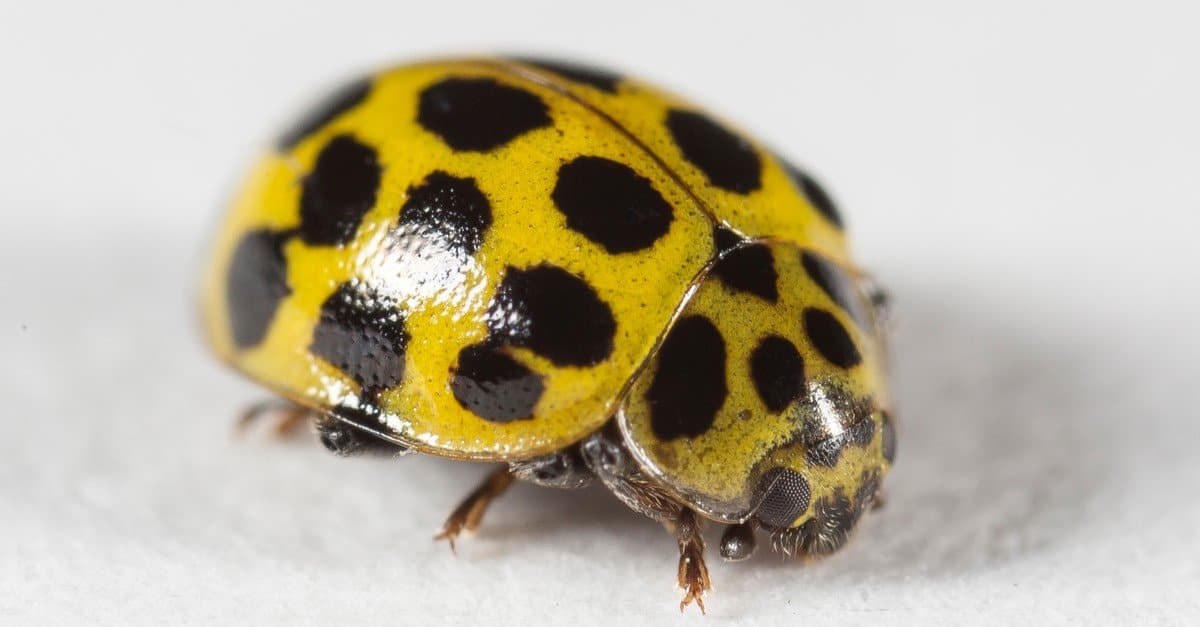

The squash beetle (Epilachna borealis) is an agricultural pest that naturally lives in the eastern United States. These insects are closely related to the southern squash lady beetle and the Mexican bean beetle, both of which look very similar. Some of their favorite habitats include gardens and farms. Using their sharp, piercing mouthparts, they feed mainly on the leaves of squash and pumpkin plants, which can cause some minor economic damage every season (though not as bad as many other pests). Most of this damage is done to younger plants; older plants generally have the power to resist them.
This article will cover some important facts about the identification, prevention, and treatment of a squash beetle infestation.
How to Identify the Squash Beetle
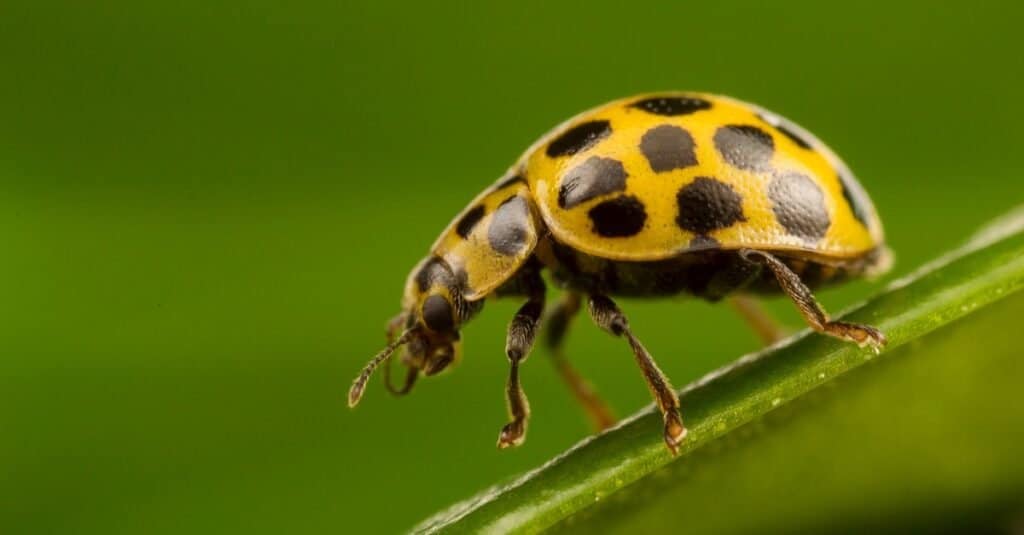
Squash beetles are easily mistaken for a ladybug, as their coloring is very similar.
©Huw Penson/Shutterstock.com
Squash beetles pass through four distinct life stages. After mating, the female lays masses of 30 to 50 bright yellow, bullet-shaped eggs on the underside of the leaf. This is so the larvae will have an immediate source of food to consume.
Within a few days, the larvae will begin to hatch from the eggs and then feed voraciously. The larvae of the squash beetle look like small yellow ovals with long, dark spines emerging from their backs. Once it has grown sufficiently, the larva will begin metamorphosis into an adult. During the pupal stage, it hangs immobilized from a secluded spot and secretes oily droplets at the tips of its hairs. This is to deter ants and other predators.
Once it has fully grown, the adult squash beetle is characterized by a yellow or orange oval-shaped body (measuring about half an inch in size) with a rounded back. It has seven large black spots on each wing casing and four smaller black spots on the neck area. When the wing cases are lifted up, the beetle is capable of full flight. The adult bug seeks out sheltered or secluded places to survive for the winter, including rocks, buildings, and plant debris. When they emerge in the spring, squash beetles find a suitable host plant near their original habitat. This is so they can mate and lay their eggs once again to begin the cycle anew. One generation is usually produced every year in the northern United States, but in the South, squash beetles can produce two generations annually.
Identification can be a little difficult from appearance alone. This is because the squash beetles are easy to mistake for other types of insects. One of the insects they most strongly resemble is the ladybug. The main difference is that the squash beetle is generally larger and covered in an orange or yellow shell rather than a red one. Squash beetles only infest squash-like plants, whereas ladybugs are not considered to be agricultural pests at all; instead, they feed on agricultural pests.
Another type of insect for which it’s commonly mistaken is the squash bug. However, squash beetles and squash bugs are not closely related at all. The squash bug has a flat gray-colored body like a stink bug, rather than the round yellow or orange appearance of the squash beetle. There is one significant similarity, though: they do feed on squash and pumpkins just like the squash beetle.
Where Can You Find Squash Beetles?
Perhaps the best means of identification is to look for the signs of an infestation on your plants. Squash beetles prefer habitats where their host plants are naturally found. Their diet consists solely of the leaves from squash, pumpkin, and even sometimes melons and cucumbers, all of which belong to the cucurbit plant family. The larvae feed on the leaf tissue between the veins, while the adults tend to consume the main stems. Both generally chew semi-circular trenches from one edge to the other. They’re also found consuming the rind of pumpkins and squashes later in the growing season. The affected areas may look thin and darkened, but they rarely wilt and die. The good news is that they’re not aggressive defoliators and therefore rarely need aggressive measures to get rid of them.
To identify a potential infestation as early as possible, you should begin checking young plants every day in the spring and summer (paying particular attention to the underside of the leaves) for signs of egg masses or mating adults. This should hopefully allow you to catch them before they can cause significant damage to your plants. If you wait too long, then the infestation may grow quickly out of control. These insects generally move from their wintering sites outward to nearby plants and spread from there.
How to Get Rid of Squash Beetles
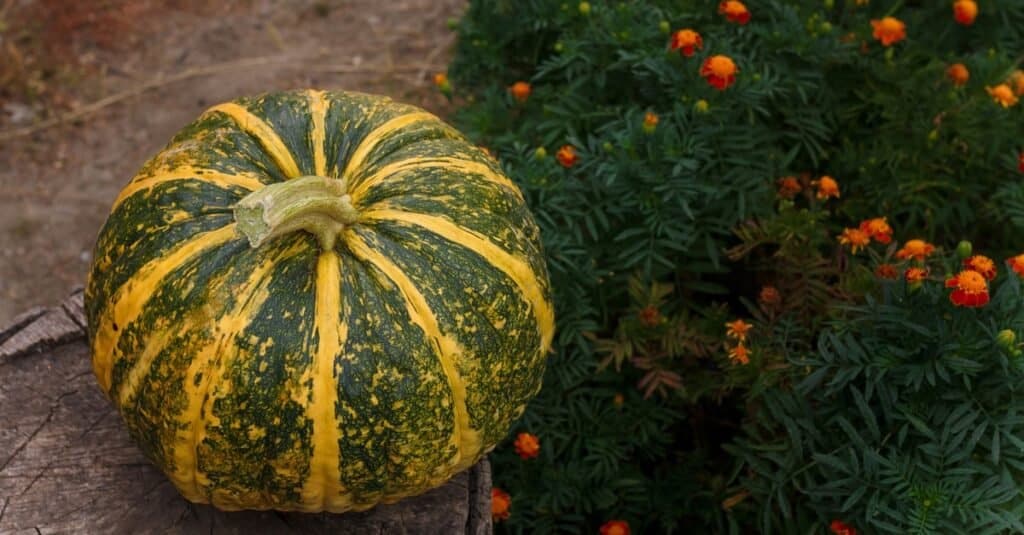
One way to deter squash beetles is to plant marigolds in your vegetable garden.
©Elena Seiryk/Shutterstock.com
Early detection is one of the most critical aspects of prevention. After your pumpkin and squash plants have grown, you should regularly check for signs of unprotected eggs attached to the underside of stems and leaves. Once you’ve found the eggs, you can easily detach them from the leaves and destroy them before they even have a chance to hatch. Larvae and adults are more mobile and generally harder to kill, but they are still vulnerable to most common pest control methods.
Squash beetles may take considerable time and effort to get rid of. As they like to hide under plant debris, one of the most important steps is to properly clean up any debris lying on the ground to prevent them from easily hiding. Once the harvest season has been completed, you can work the soil again. It’s important to remove any leftover foliage to deprive the larvae of a food source and prevent the new adults from naturally building up sufficient reserves for the winter. By the time autumn arrives, it might be too late to stop the previous infestation, but it can help to prevent another one during the next year.
Dish Soap
Another excellent option is to collect the insects by hand and drop them into a bucket with some water and 1 or 2 tablespoons of dish soap. Alternatively, simply use the curved part of a spoon to gently scrape the eggs off the leaves, and then place them into the soapy water. The dish soap is effective at killing them. However, this might be a time-consuming process as adults are hard to catch and have a tendency to scatter once disturbed.
While there have been reports of using dish soap to suffocate squash bugs, it’s essential to be cautious, as dish soap can potentially harm your plants.
Home-Made Solution
An alternative is to create a homemade solution consisting of a garlic clove, an onion, and cayenne, jalapeno, or habanero pepper mashed together and then covered with a quarter cup of water. After letting it sit for an hour, mix the solution with a tablespoon of dish soap and pour the liquid into a spray bottle. This solution should do some serious damage to squash beetles, but make sure to wear protective gloves and eye gear to prevent burning your skin and eyes.
Preventative Measures
Beyond these basic solutions, there are several other preventative measures you can take. You can place protective covers over the plants and vines until the blooming begins to prevent an infestation for as long as possible. Moreover, you might want to consider rotating crops every few years to prevent the insects from establishing a long-term foothold in your garden or field. However, this solution may not be practical for everyone for economic reasons.
Pesticides
If you’re still struggling to control an infestation, then you might want to use pesticides as a last resort. However, because squash beetles aren’t terribly destructive, it might be unnecessary in most cases. If you do plan to use chemicals, they should be applied early in the season and later in the day when flowers are closed to minimize harm to pollinators. It should be sprayed directly beneath the leaves with enough pressure to ensure it will penetrate deep beyond the surface. It’s a good idea to read up on some basic facts about the insecticide first. Always buy an EPA-approved insecticide and follow the instructions on the label to prevent wider contamination or damage to your plants. Some chemical ingredients are more effective against squash beetles than others, so choose accordingly.
No single solution is likely to be completely effective, so you may want to use several of these strategies simultaneously. Fortunately, many of these solutions will work on other agricultural pests, such as squash bugs.
What Are Some Plants That Repel the Squash Beetle?
There are several types of plants that repel squash beetles because of their smells or their natural oils, including catnip, marigold, radish, petunias, and nasturtiums. These plants should provide an organic way to deter them from consuming their normal diet without the use of dangerous chemicals. However, all of the plants that repel the squash beetles do take up plenty of space that could be reserved for other crops, so it might not be a good option if you need that extra crop space for economic reasons.