
The box turtle and the painted turtle are both turtles from the family Emydidae. Both painted turtles and box turtles are popular pets across the world. They have a similar appearance, with colorful shells, which can make telling them apart quite tricky. With that in mind, we’ll take a deeper look at those differences for you. Let’s get started!
Comparing a Box Turtle and a Painted Turtle

| Box Turtle | Painted Turtle | |
|---|---|---|
| Size | Length: 5 to 6 inches Weight: 0.5 lbs to 2 lbs | Length: 8 to 12 inches Weight: 0.6 lbs to 1.125 lbs |
| Appearance | Dark brown, black, or brown shell with yellow markings on top, four legs with five clawed toes on the front legs, and four clawed toes on each of the rear feet | Olive or black skin Red, yellow, or orange stripes on the tail, necks, and legs Wide and round shells; shells can be dark green, solid yellow, or orange plastrons. |
| Location and Habitat | Location: North America Habitat: meadows, forests, ponds, and streams. | Location: North America Habitat: ponds, marshes, and streams. |
| Behavior | Mostly solitary, they protect themselves against aggressors by retreating fully into shells. | They sometimes live in groups in ponds and streams; they enjoy sunbathing |
| Diet | Omnivorous; plants, vegetation, insects, and small fish. | Omnivorous; insects, small amphibians, fish, carrion, fruits, and flowers. |
| Predators and Threats | Raccoons, otters, foxes, dogs, snakes, birds of prey | Snakes, birds of prey, foxes, raccoons |
Key Differences Between a Box Turtle and a Painted Turtle
The truth is, box turtles and painted turtles are more similar than they are different, and that’s to be expected given that they are from the same family. However, the major differences between these two are in their size and appearance. Let’s explore these differences below.
Box Turtle vs. Painted Turtle: Size

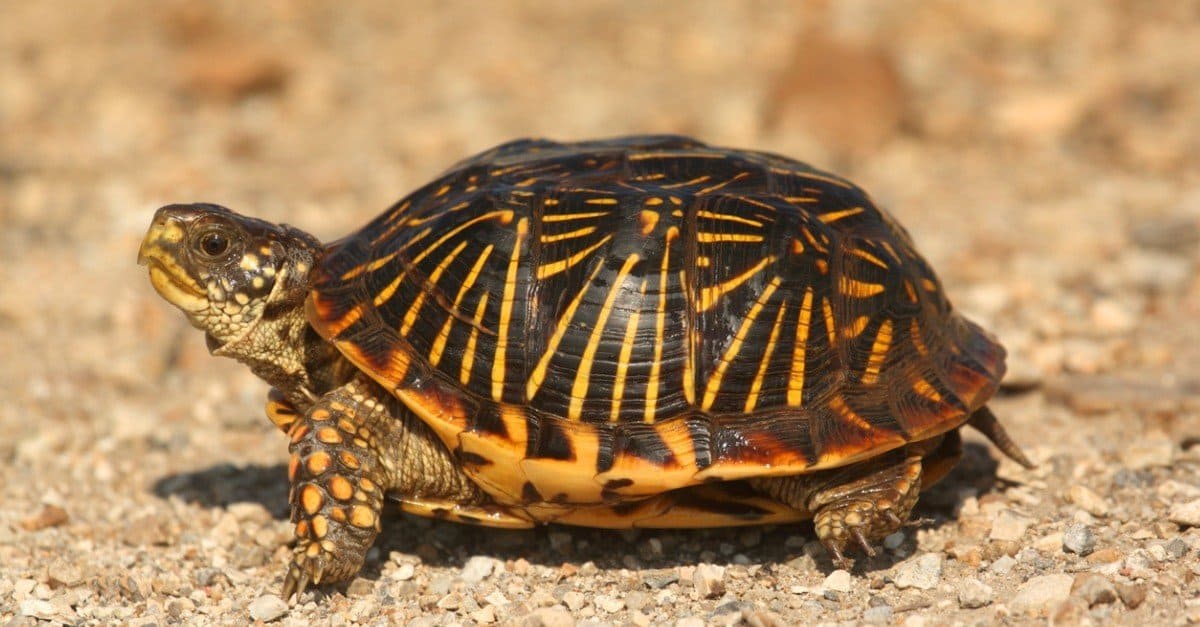
The box turtle weighs between 0.5 and 2 lbs, and their average length falls between 5 and 6 inches.
©iStock.com/Dan Rieck
Box turtles and painted turtles differ slightly in size, as we are about to see. Box turtles weigh between 0.5 and 2 pounds, and their average length falls between five and six inches. Painted turtles, however, have an average length of eight to 12 inches, and they weigh between 0.6 lbs and 1.125 lbs.
So, while the average base weight for box turtles and painted turtles is similar, their lengths are different, with the painted turtle being larger than the box turtle.
Box Turtle vs. Painted Turtle: Appearance

Painted turtles have shells with colors ranging from black to yellow and orange.
©KARI K/Shutterstock.com
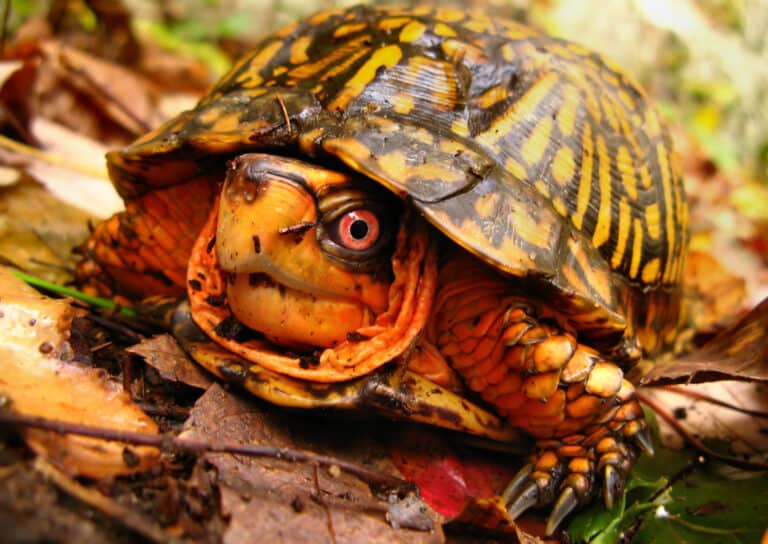
Box turtles and painted turtles may look the same at first glance, but they actually have certain distinctions in their appearance. Box turtles have a dark brown or black carapace with yellow markings on it. They also have four legs with clawed toes (five on each front leg and four on each rear leg) and domed shells that help them retreat quickly into their shells.
Painted turtles also have shells with colors ranging from black to yellow and orange. However, their legs, necks, and tails are striped with yellow, red, and orange markings.
Box Turtle vs. Painted Turtle: Location and Habitat
Painted turtles live all over North America, and their subspecies are grouped according to the regions they dwell in. For instance, we have the western painted turtles commonly found in Ontario and British Columbia, and the eastern painted turtles on the east coast.
Box turtles also live across North America, mostly in the central, southern, and eastern parts of the United States as well as Mexico.
Box turtles tend to inhabit ponds, streams, meadows, and woodlands. Painted turtles also generally prefer to live in slow-moving waters and also enjoy areas outside water like marshes, meadows, pastures, and other forested areas.
Box Turtle vs. Painted Turtle: Behavior

The box turtle is almost strictly solitary.
©Elizabeth Spencer/Shutterstock.com
Box turtles and painted turtles have similar behaviors, although there are some subtle differences. While both animals enjoy being alone, painted turtles can actually cohabitate with other turtles in aquatic habitats. Box turtles, on the other hand, are almost strictly solitary and typically interact only with mating partners or during nesting. However, they may occasionally gather in groups, especially in areas with plenty of food.
Both animals enjoy basking in the sun and would regularly do this to warm up their bodies. On the whole, it is safe to say box turtles and painted turtles have very similar behavioral traits.
Box Turtle vs. Painted Turtle: Diet
Box turtles and painted turtles are typically omnivorous, which means they would eat both plants and animals with the same level of enthusiasm. They have a similar diet comprising insects, small fish, plants, and vegetation.
We must mention that young box turtles and painted turtles have been noted to prefer insects and small amphibians, while the adults grow to be more welcoming of fruits, flowers, carrion, and water algae in their diet.
Box Turtle vs. Painted Turtle: Predators and Threats

Painted turtles are listed as “least concern,” owing to their abundant population.
©Jonathan Novack/Shutterstock.com
Box turtles and painted turtles also face similar kinds of predators and threats. They are often preyed upon by dogs, raccoons, birds, snakes, otters, foxes, and other such carnivores. While their protective shells help them a lot with defense and protection, some of these predators can crack the shells or reach in with their claws, injuring or killing the turtles in the process. The female turtles also suffer from mass pilfering of their eggs by other omnivores around the nest area. They are also jointly threatened by habitat loss caused by human-led constructions or land developments, and general environmental degradation.
Scientists and conservationists are worried about box turtles, which are why they are listed as vulnerable by the IUCN. Painted turtles, on the other hand, are listed as least concern owing to their abundant population, and the reported declines are not considered threatening just yet. However, conservationists are watching them closely.