
Quick Take
- The expedition nearly left empty-handed. The moment that changed everything came down to the final two days. See the final two days →
- Most extinct species lose that label due to population data, yet the black-naped pheasant-pigeon's case is surprisingly different. Discover why it lost extinct status →
- Being rediscovered after 140 years does not mean this bird is out of danger. In fact, its situation may be more precarious now than ever. See the population threats →
- A logging ban has existed for over two decades, yet the forests this bird depends on keep vanishing. The reason why is deeply uncomfortable. Explore the logging problem →
The unfortunate truth is that more than 200 species go extinct daily. While the reasons vary, the environmental pressures flora and fauna face today are pushing their existence to the brink. Therefore, when species once thought extinct are rediscovered, it is cause for celebration. This is what happened the moment a bird long assumed extinct was spotted, a rediscovery still lauded today.
How the Black-Naped Pheasant-Pigeon Was Rediscovered
Fergusson Island had been keeping a secret for decades. The Papua New Guinea island, of just over 500 square miles, was keeping an elusive bird both hidden and protected. Spotted only a few times by indigenous hunters on the island, with the last sightings in the 1990s, the black-naped pheasant-pigeon was believed to be extinct. This all changed when an expedition in 2022 proved the bird was still alive and well.
A group of researchers from Cornell University, led by Jordan Boersma, traveled to Fergusson Island. With the help of the indigenous community, researchers spoke with hunters who had observed the black-naped pheasant-pigeon in the wild. Initially, researchers had difficulty finding anyone who had seen the bird with dark plumage and brown wings after the 1990s. Their persistence paid off, as eventually, they were directed to an area where the black-naped pheasant-pigeon might be found.
After placing camera traps on Mount Kilkerran, the island’s tallest mountain, footage came back with nothing. But two days before the expedition was set to end, the black-naped pheasant-pigeon was officially documented for the first time in over 140 years.
Two years after this discovery, new footage from that expedition was released by the Cornell Lab of Ornithology. The video shows the moment when the footage revealed the black-naped pheasant-pigeon, known as the “auwo” by those living on the island. Both Boersma and local biologist Doka Nason literally jumped for joy and appeared astounded upon discovering the bird.
Why the Black-Naped Pheasant-Pigeon Was Believed Extinct
Unlike other animals that went extinct between the late 1800s and the early 1900s, the black-naped pheasant pigeon lacked population estimates prior to its disappearance. The assumed extinction was solely based on a lack of observation over an extended period.
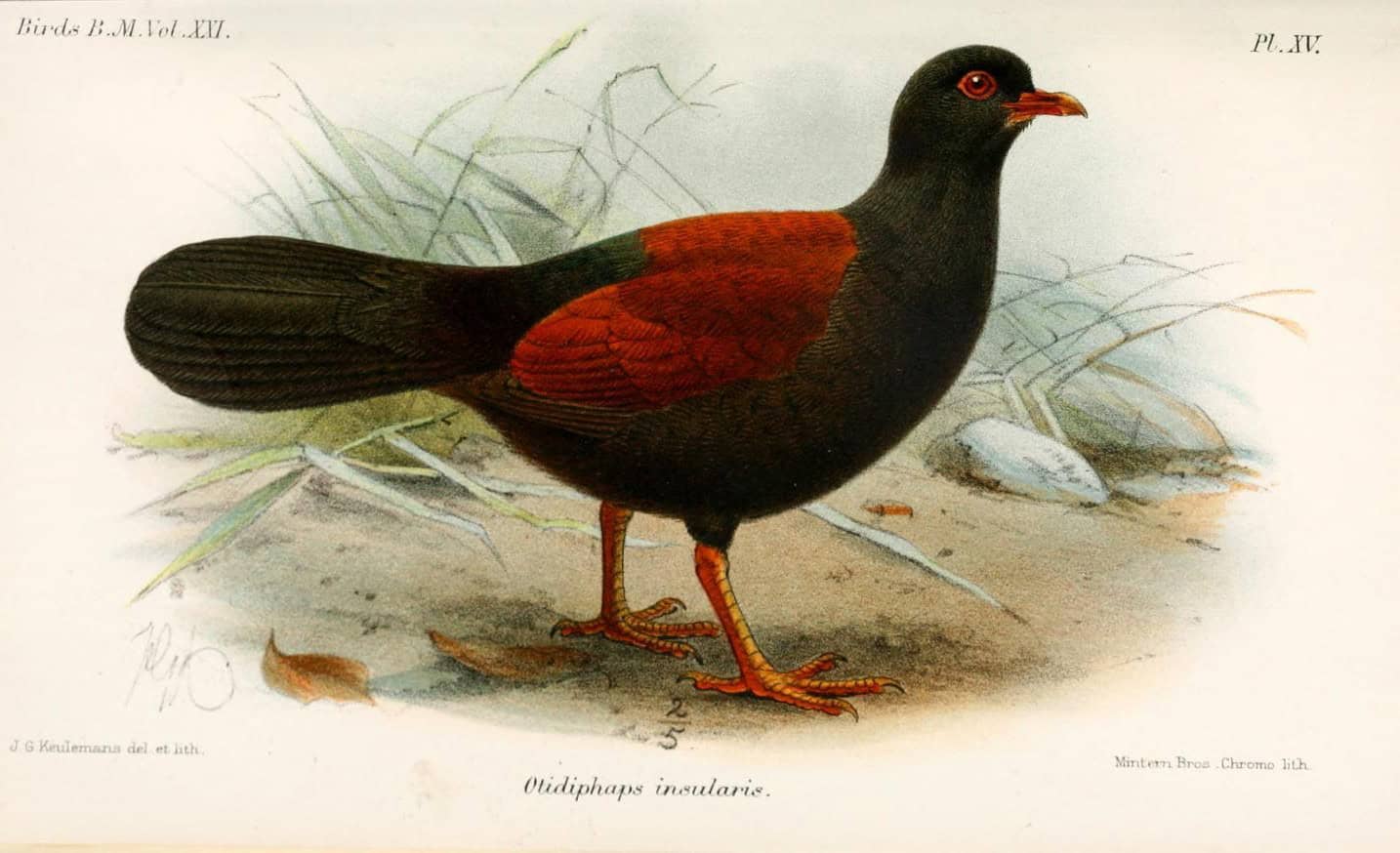
The only specimens of the black-naped pheasant-pigeon were collected in 1882. At that time, the birds were hard to locate due to their elusive nature and the dense forest habitat in which they lived. Throughout the following decades, only a handful of sightings were reported by indigenous hunters, none of which could be scientifically verified.
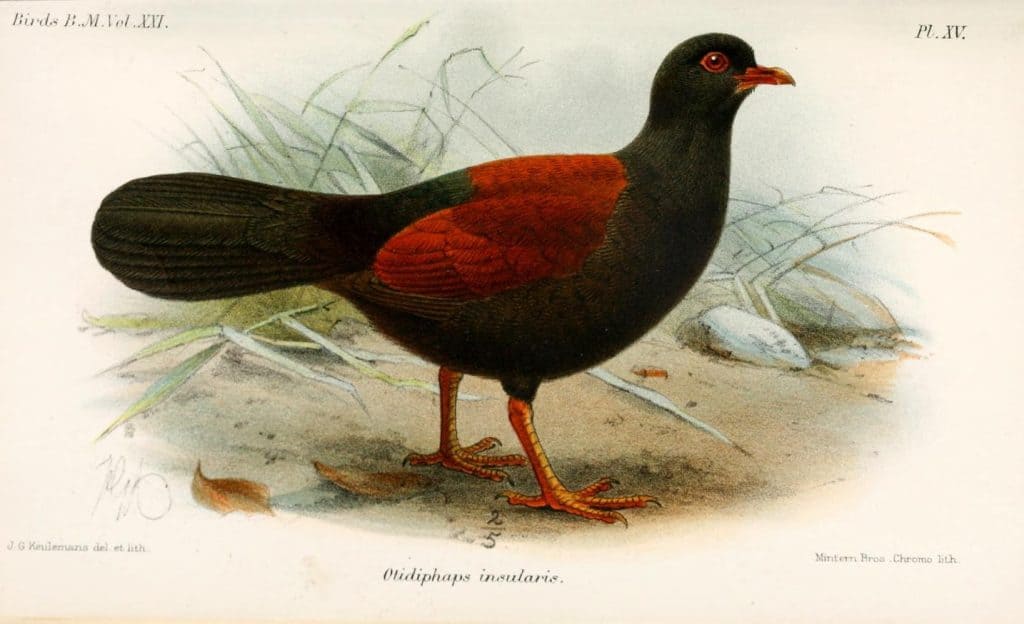
The last time Europeans saw the black-naped pheasant-pigeon was in 1882.
©John Gerrard Keulemans, Public domain, via Wikimedia Commons – Original / License
Up until 2022, the last known sightings of the birds were in the 1990s. It appeared that, over subsequent decades, the birds eventually went extinct. But the discovery of the black-naped pheasant-pigeon in camera-trap footage in 2022 proved the birds were still alive.
Black-Naped Pheasant-Pigeon Population is Decreasing
The rediscovery of the black-naped pheasant-pigeon does not indicate a large population on Fergusson Island. No official specimens were seen for 140 years, and their habitat has continued to decline.
Conservationists state that the black-naped pheasant-pigeon population is declining, based on several factors. The first of these concerns the island’s limited population.
There is no accurate population count for the birds. The best estimates put the black-naped pheasant-pigeon population between 50 and 249 individuals. It is believed that, rather than being scattered, the majority belong to a single population. This puts them at risk of being wiped out due to disease, predation, or other risk factors.
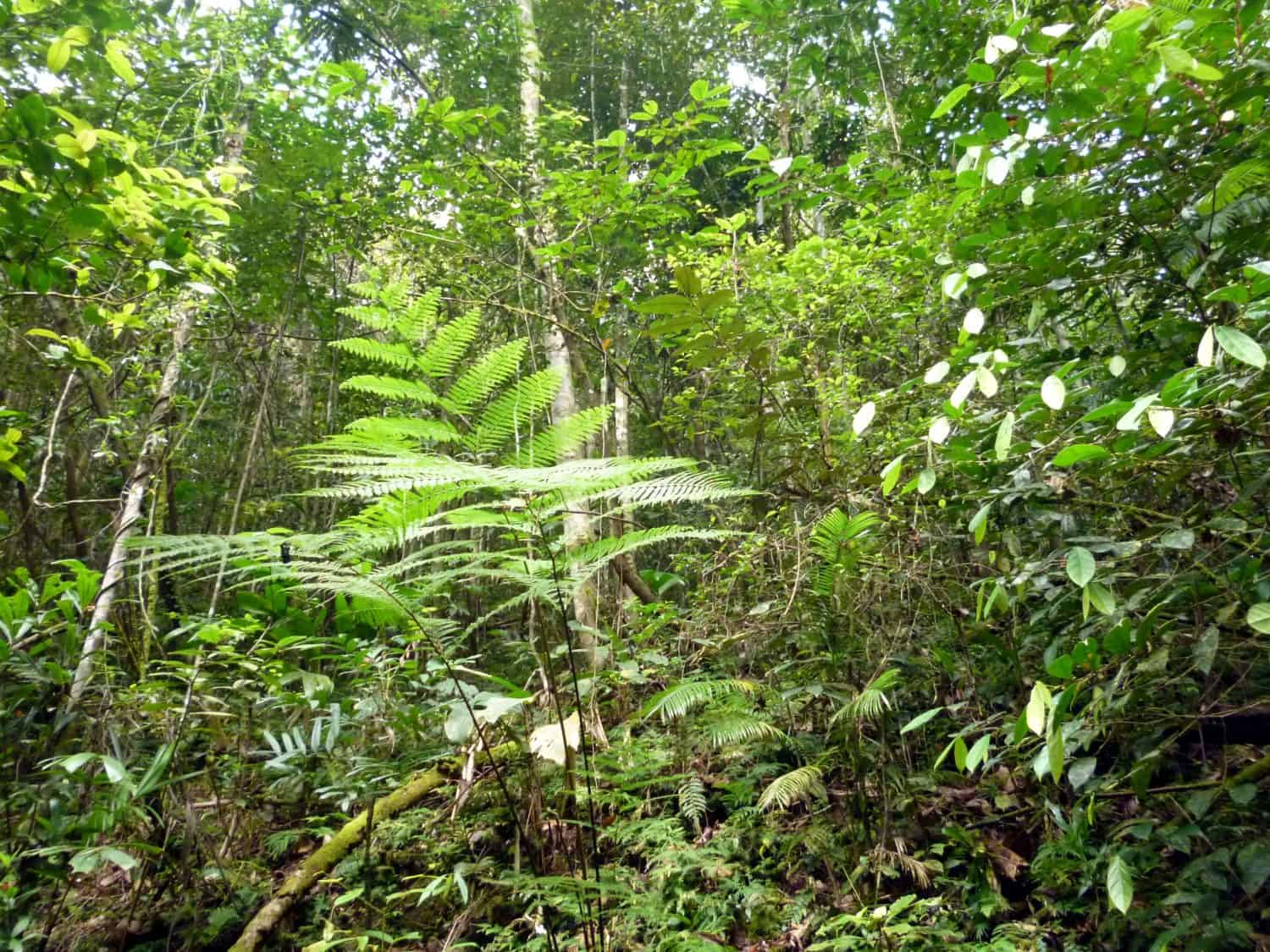
With their rainforest habitat decreasing, in addition to other environmental pressures, the black-naped pheasant-pigeon population is decreasing.
©Sebastian 22/Shutterstock.com
Additionally, the rainforest habitat required by the black-naped pheasant-pigeon continues to shrink. As their habitat decreases, there is less space for the birds to live, further increasing the population’s risk of extinction. This has already been observed in the lack of birds in regions where they traditionally lived.
Since 2022, there have not been any other sightings of the black-naped pheasant-pigeon. This alludes to a small population that is hard to detect. This generally equates to a small population in decline.
Finally, as forests are being exhausted of timber in places like Sumatra and Kalimantan, other sources of wood need to be found. This has led to the cutting down of the forests of Papua New Guinea.
More disturbing still is that, despite a ban on cutting down several tree species since 2001, 70% of the trees exported from Papua New Guinea are illegal. This has led to unsustainable logging practices that will only cause species, including the black-naped pheasant-pigeon, to suffer and even go extinct.
Can the Black-Naped Pheasant-Pigeon Be Conserved?
There is no current population count of the black-naped pheasant-pigeon. Therefore, it is unclear how many, if any, breeding pairs exist in Papua New Guinea. This is why the time for conservation is now to keep the black-naped pheasant-pigeon from going extinct.
To conserve the black-naped pheasant-pigeon, several immediate steps need to be taken. Those steps include:
- Creating and maintaining protected areas on Fergusson Island
- Reduce logging and create sustainable logging practices
- Restore fragmented rainforest habitats
- Include indigenous people in and create indigenous-led conservation efforts
- Stop poaching
The world was given a gift with the rediscovery of the black-naped pheasant-pigeon. What the rare birds need now are the tools and support to rebuild their population.