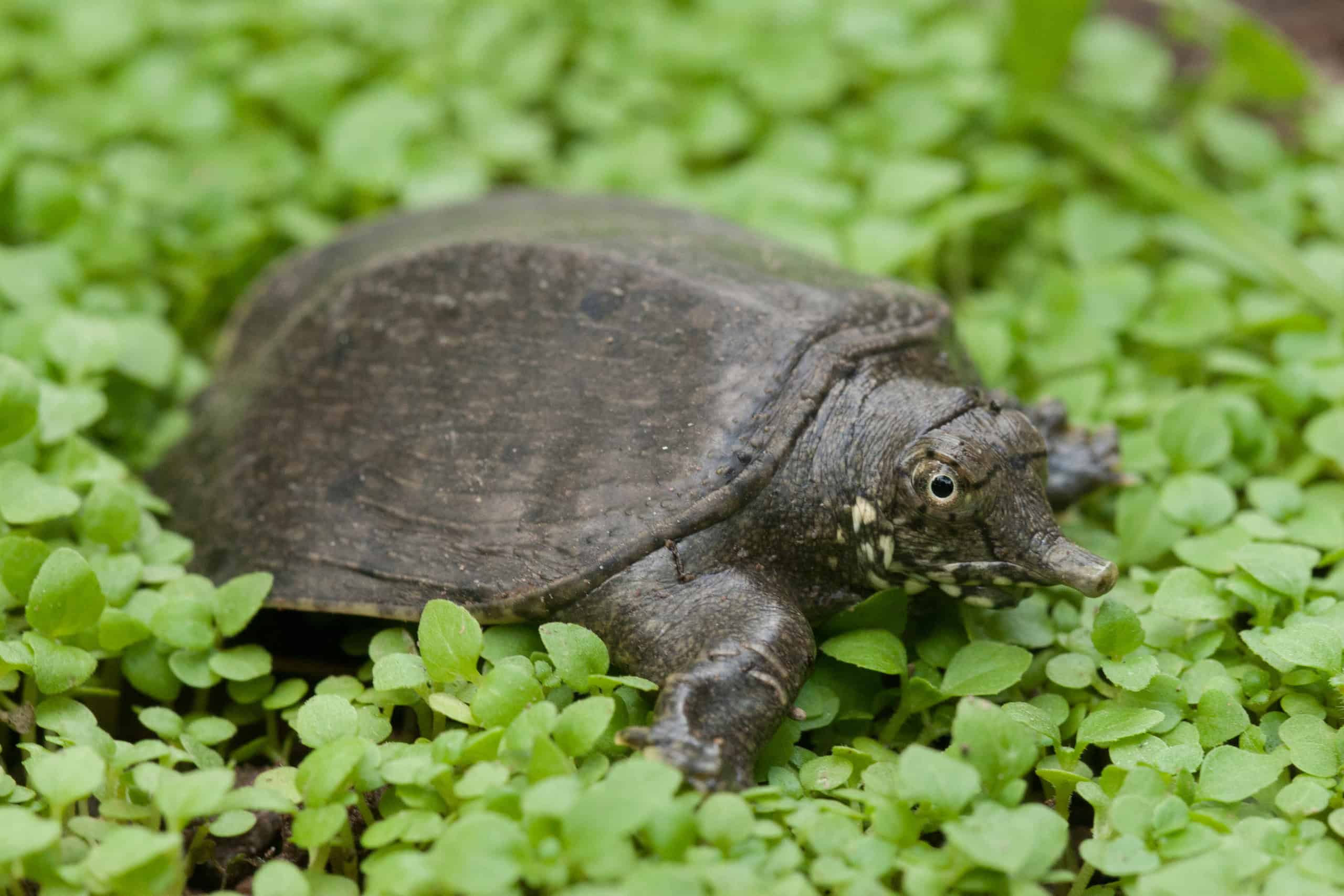

From a young age, the river turtle embarks on a tough journey; the chance of a turtle hatchling surviving to adulthood is small. Survival varies depending on turtle species and habitat, but for river turtles, the percentage of hatchlings that even make it through their first year is typically well under 50 percent. This low survivability stands in stark contrast to the chance of a human baby making it to adulthood, which is currently at about 96 percent (UN Inter-agency Group for Child Mortality Estimation, 2025). This article reviews the many natural and human-caused challenges faced by river turtles as they grow up.
At the Start
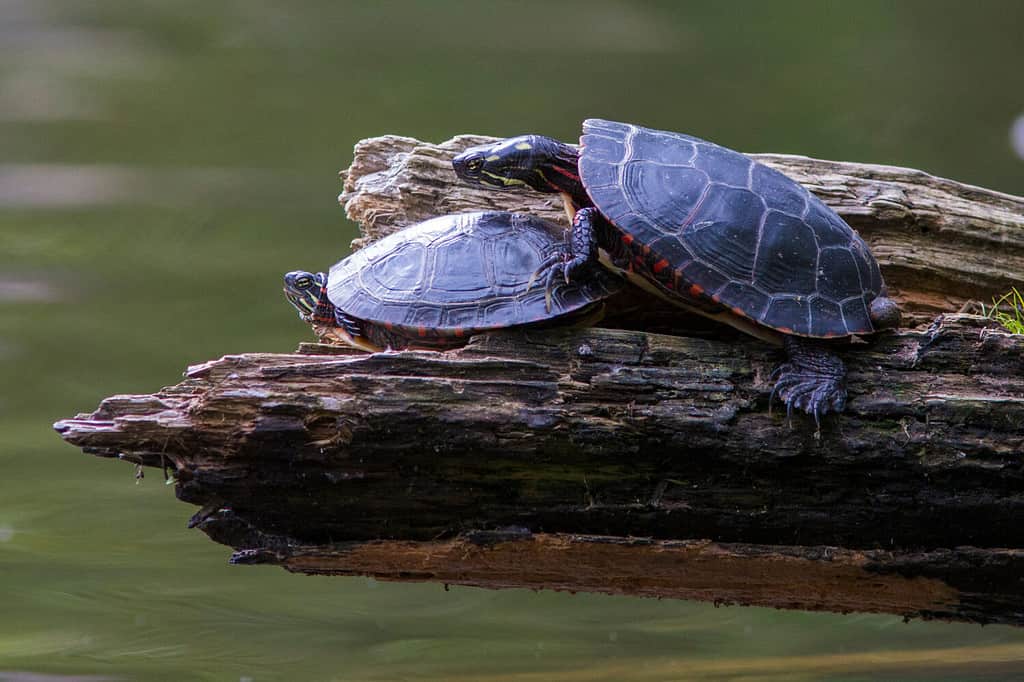
All turtles mate to reproduce. River turtles, such as these painted turtles, mate underwater.
©Mircea Costina/Shutterstock.com
Every turtle’s life begins inside the mother’s body. Turtles have internal fertilization, where the male mates with the female and sends sperm up toward her ovaries. Female turtles are known to hold onto sperm for as long as several years, waiting for the best environmental conditions to lay the eggs. Once a female unites the stored sperm with her eggs, the embryos start developing inside her body, protected by her hard shell.
River Predators
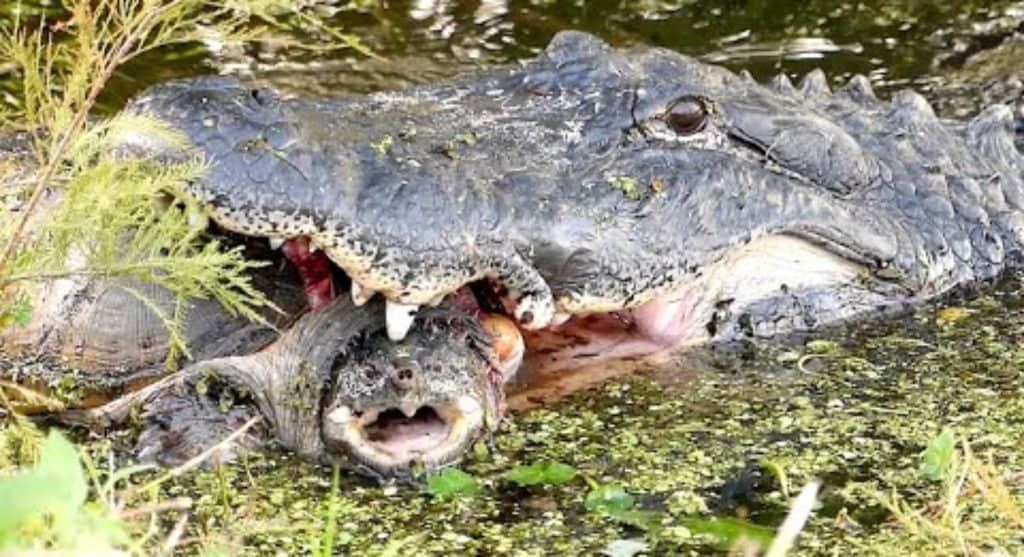
Snapping turtles, despite their strong bite defenses, may become prey to alligators.
© – Original
Despite their naturally protective armor, female river turtles who are “gravid” (carrying eggs) may face dangerous, aquatic predators. There are records of alligators eating gravid river turtles, eggs and all. Unfortunately, a gravid river turtle moves slower than a female without eggs, making her easier prey. River mammals, such as otters and mink, can chomp adult turtles, even snapping turtles. Additionally, aquatic turtles are regularly caught on fishing lines; even if they’re returned to the river, they may have suffered physical damage. The Canadian Herpetological Society describes how, “Some hooks get caught in the mouth of the turtle, which can make feeding difficult. Other hooks are swallowed and lodge in the throat or even the stomach, which can be fatal.”
Nesting Journey
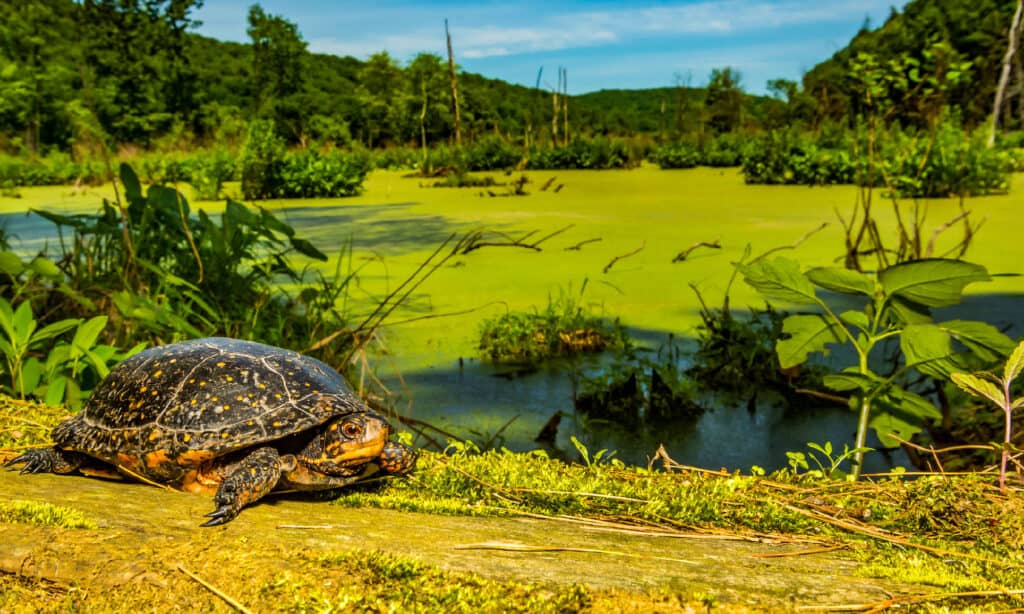
Spotted turtles, like all aquatic turtles, leave their waterways to nest on land.
©iStock.com/JasonOndreicka
When a river turtle heads onto land to lay her eggs, she encounters even higher risks. All turtles, even aquatic species, lay eggs on land. Once environmental conditions seem favorable for nesting, a female shells up her eggs and leaves her waterway. There’s evidence that rainfall is one of the factors that encourage the nesting event. The female lumbers onto land to look for a suitable nesting spot, often returning to the same general area year after year. While on land, her ancient swallowing mechanism prevents her from eating or drinking, making the terrestrial journey especially demanding.
Typically, female turtles leave the floodplain to nest in places less likely to end up underwater. But if a female errs by nesting too close to the river channel or flash flooding results from unusually high rainfall, nests may be submerged. Turtle eggs do not survive prolonged inundation in water, since they require oxygen. With climate change bringing more extreme storm events, and humans flooding riverbanks through engineered projects like reservoirs, riverine turtles lose reproductive output. Adjusting water levels when managing waterways, however, can boost turtle nest survival. A study in Environmental Management reported that once water levels in the Burnett River, Australia, were lowered during turtle nesting season, the number of flooded nests of endangered white-throated snapping turtles (Elseya albagula) dropped nearly to zero.
Obstacles Along the Way
©Ken Schulze/Shutterstock.com
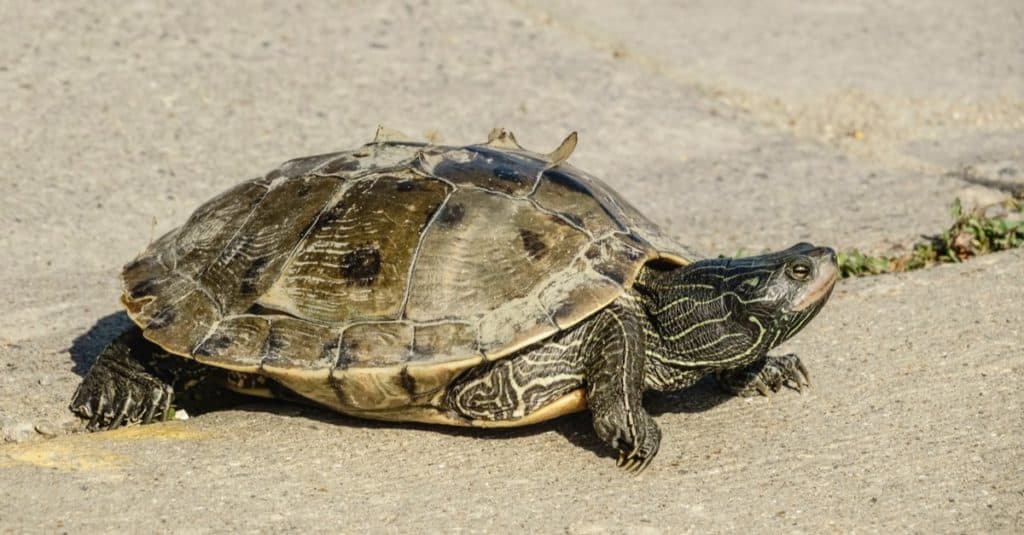
With humans making huge alterations to landscapes—from roads to fences to buildings and pavement—turtles are likely to encounter obstacles. Fences designed to keep feral pigs or dogs out of wetlands may inadvertently block turtles from accessing the upland nesting areas they need. A study published in Wildlife Biology looked at the impact of such “conservation fences” on aquatic turtles in northern Australia. The data showed turtles of multiple species were frequently trapped inside wetland fences. The researchers proposed a “simple and inexpensive design modification” that includes turtle gates.
Many studies have shown that the mortality of female turtles crossing roads to reach nesting sites is high enough to endanger their populations. Researchers in New York drove a 160 km highway circuit repeatedly over two years and noted road-kills of three freshwater turtle species (Chelydra serpentina, Chrysemys picta, Emydoidea blandingii). Their study, published in Biodiversity and Conservation, reported that turtle deaths were clustered on forested highways with high traffic close to waterways.
These “hotspots” where river turtles cross roads to nest can inform ways to protect them, such as wildlife crossings that encourage turtles and other animals to go under or over the roads. In Wisconsin, for example, a turtle tunnel under the roadway was shown to reduce mortality from nearly 60 aquatic turtles per year to about 10. As Biologist Pete Zani points out, “The turtles are crossing the highway because they’re trying to get to the river or to the pond or vice versa, and we built a road right in the middle of their path of travel.”
River Turtle Nests
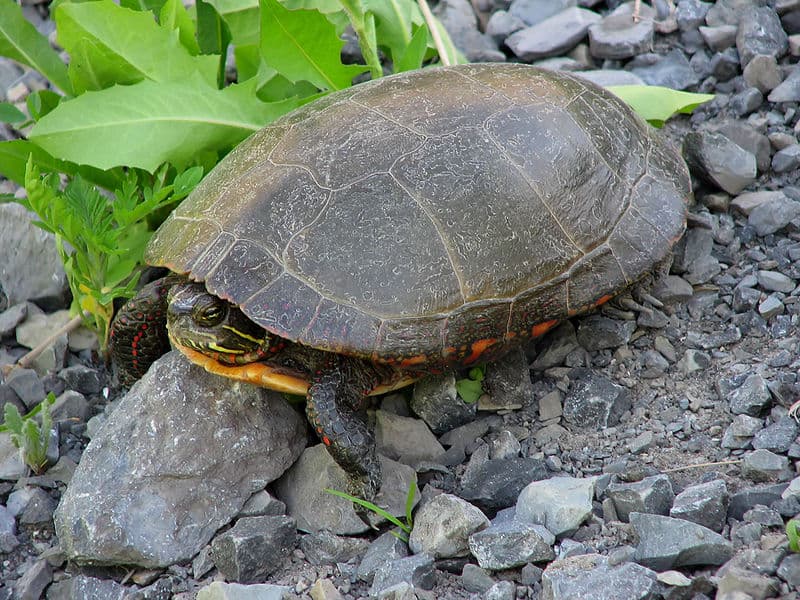
Female river turtles face dangers when they venture onto land to lay their eggs.
©D. Gordon E. Robertson / Creative Commons – Original
Gravid female turtles looking for nesting sites are magnets for terrestrial predators like raccoons, foxes, and dogs, which relish turtle eggs for their rich complement of proteins, fats, and minerals. Raccoons have been recorded casing out nesting areas, waiting for opportunities to gobble up eggs. If they sense danger while digging a nesting hole, female turtles may return to the river without laying. But once they begin the laborious process of dropping their eggs into the “cavity,” there’s no turning back. In a trancelike state, they lay the eggs. Afterwards, they move their rear ends in a swinging motion to cover the nesting hole with sand or soil.
Unlike sea turtles, which may lay more than a hundred eggs, a female river turtle, depending on her age and species, lays a maximum of two dozen eggs in the nesting cavity (except snapping turtles, which may lay as many as 60 eggs). As turtles age, their reproductive output increases. In contrast to mammals like us, they have no menopausal end to reproduction. Instead, as their bodies slowly increase in size throughout their lives, females produce more eggs. So, while a larger female is less vulnerable to predators, her nests offer a bigger bounty of eggs. That said, a study of painted turtles (Chrysemys picta) published in Biology Letters showed that the larger, better provisioned eggs of older females yield bigger hatchlings that have better chances of survival.
Nest Predators

Red foxes are among the most devastating predators of river turtle eggs.
©AngelaLouwe/Shutterstock.com
The percentage of river turtle nests that are victimized by predators before the eggs hatch is huge. A 2023 experimental study of the nests of European pond turtles (Emys orbicularis) in Hungary found that only 6% of nest eggs survived the first three weeks of the study. They were dug up and eaten by red foxes and, in one case, a European badger. A Pacific Conservation Biology review study of freshwater turtle nests in Australia and North America reported that “Nest predation rates for all predators, including foxes, averaged 70% across Australia and 76% for south-eastern Australia compared to 72% for North America.” This data reveals that most river turtles do not survive beyond the egg stage.
Hatchlings in the Nest
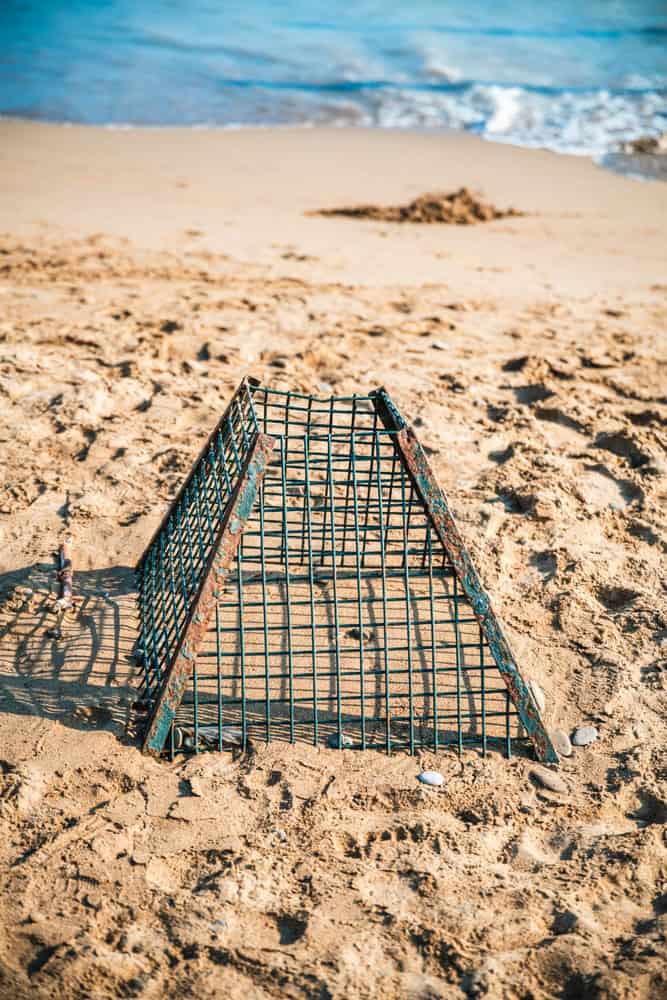
Cages like this one installed on a sea turtle nest are also used to protect eggs.
©Olga Ilina/Shutterstock.com
Once the eggs hatch, the hatchlings remain in the nest for days to months (depending on species and geographic location) before climbing to the surface. This behavior is thought to be an adaptation for emerging from the nest when conditions are favorable. Unfortunately, nests of live hatchlings may attract predators who can smell the eggshells, baby turtles, or urine that the mother turtle previously used to soften the soil. It’s even possible, though unknown, that some predators with acute hearing can home in on the sounds of hatchling turtles tapping from inside their eggs to break them open!
Turtles have not evolved to guard their nests. During the two to three months it takes for river turtle eggs to hatch, the safety of the nest relies on how well the female camouflages its location when she covers it up, along with a good measure of luck. From the time a turtle embryo is deposited in its eggshell into the ground, the developing turtle is on its own, relying only on nutrients provided by the egg.
To reduce predation on turtle nests, conservation programs track gravid females, flag their nests, and cover them with metal mesh protective cages until the hatchlings emerge. A program in Slovakia uses trained dogs to sniff out the nests so they can be protected. When hatchlings remain in their nests over the winter, protection may be required for months.
Getting to the River
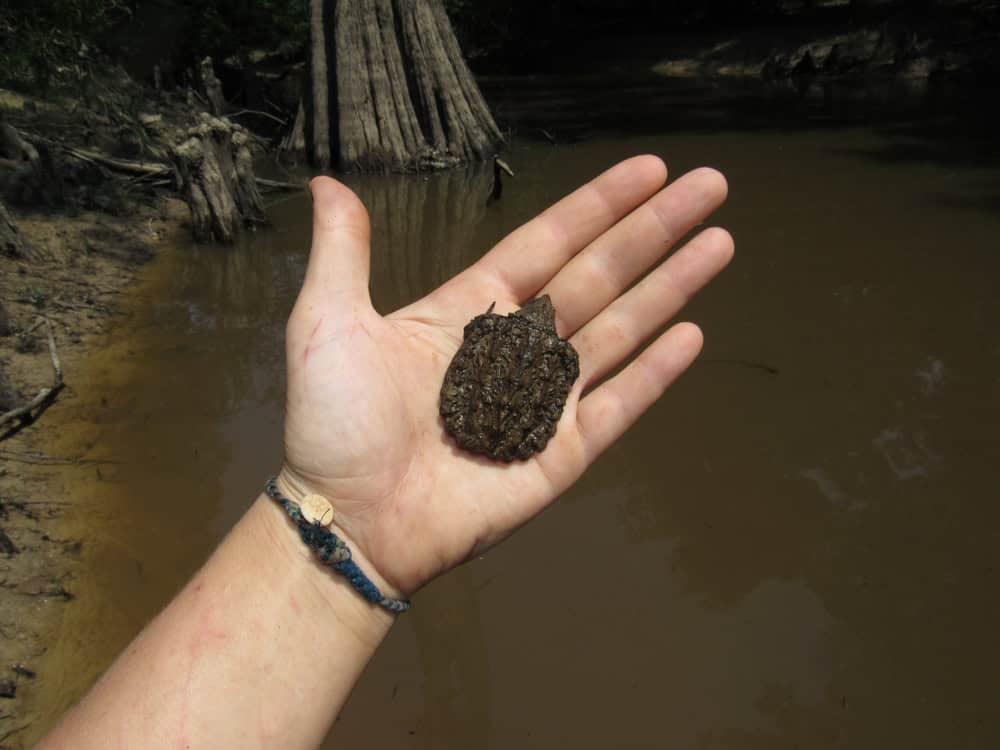
A hatchling turtle, like this tiny alligator snapping turtle, must walk from the nest to its waterway.
©Gabbie Berry/Shutterstock.com
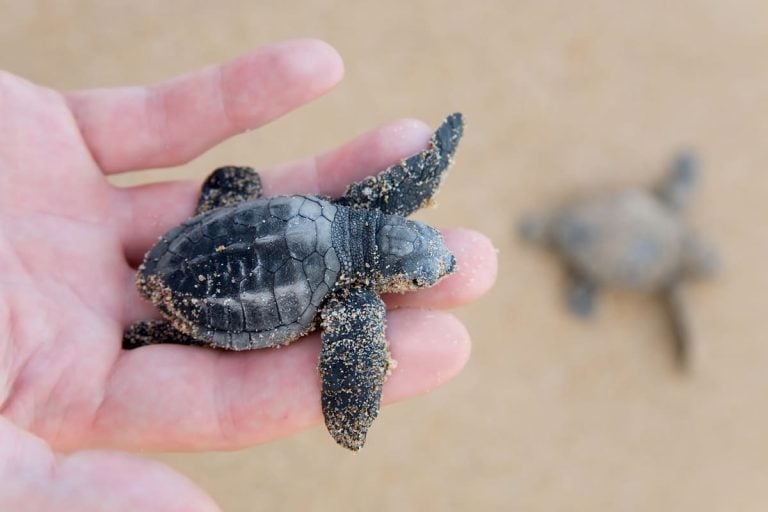
If river turtles survive the vulnerable egg stage, they face the challenge of walking from their nests to the closest waterway. The body of water could be anywhere from a dozen yards to 1.5 miles away from the nest, requiring the quarter-sized hatchling to travel in fits and spurts, holding still to blend into their surroundings whenever danger arises. A citizen scientist monitoring freshwater turtles near Albany, Australia, estimates that, “Out of the 10 to 15 eggs that a turtle will lay in the nest, if all of those turtles hatch, we may only end up with one turtle making it to Lake Seppings.” That’s a 7-10 percent survival rate, just for this stage of their journey.
A study published in Icthyology & Herpetology experimentally released 463 hatchling snapping turtles (Chelydra serpentina) and followed their journeys from nest to water. They found that if hatchlings reached the water more quickly, they were less dehydrated from the terrestrial journey. It appeared that at least some hatchlings waited for rainfall and mild temperatures before attempting the trip.
Hatchlings Afloat
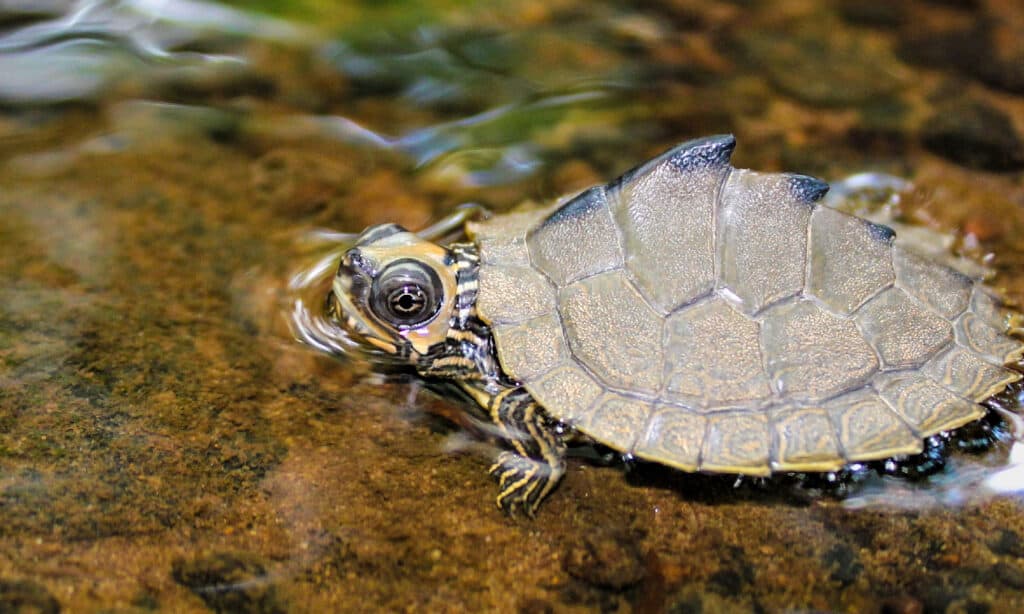
Aquatic turtle hatchlings–like this Alabama map turtle–are popular food for many predators.
©iStock.com/Tucker Heptinstall
When turtle hatchlings reach the waterway, they’re still quarter-sized and, therefore, tasty snacks for anything from a bullfrog to a carnivorous fish or a heron poking around in the shallows. But as aquatic turtles grow larger, their chances of survival gradually improve. Biologist Joshua Otten, author of a 2024 study of northern map turtles (Graptemys geographica), says, “I really think it was interesting to see that the 1- to 2-year-old turtles survived better than what I originally thought. It was about a 40% annual survival rate… If a turtle can at least hatch out of the egg and into where it would live as an adult, it has a pretty decent chance of surviving.”
Adult Survival
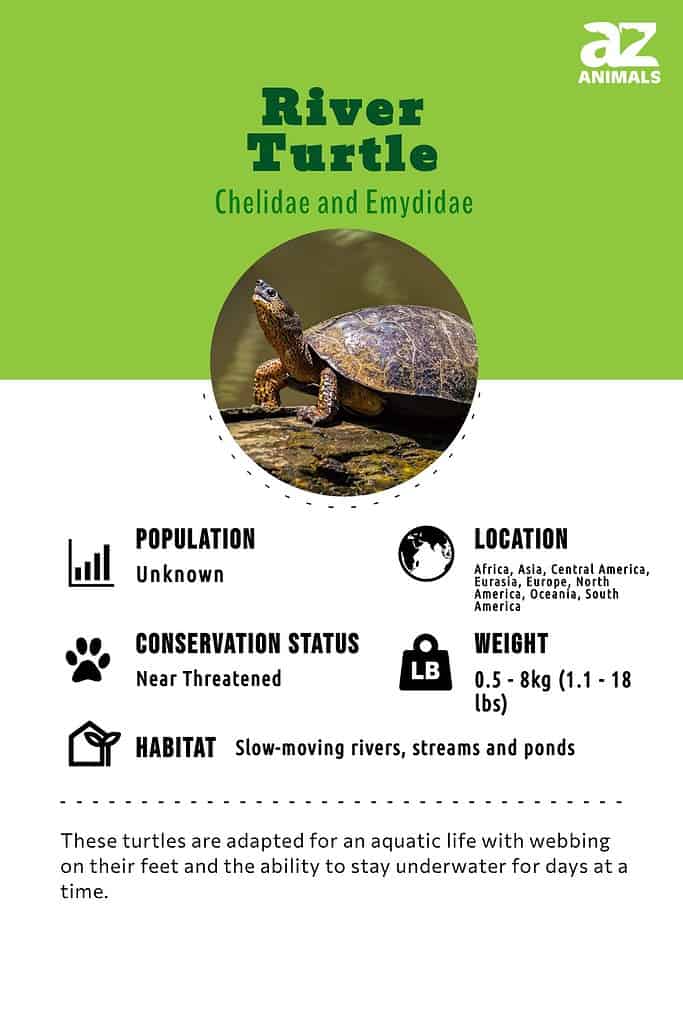
With their larger bodies and denser shells, adult turtles are much better protected than hatchlings. If they make it through the dangerous initial life stages, they might live from 25 years to more than 100 years, depending on the species. But adult turtles still face threats from fishing lines and large predators. Because turtles are popular in the pet trade, they are also subject to international poaching and trafficking. Between 1990 and 2010, more than 400,000 pond and river turtles (family Emydidae) were traded internationally.
Natural events, such as extreme weather, also impact adult river turtle survival. A study published in Global Ecology and Conservation looked at the impact of an extreme flood on the Baillaury River, France, on Mediterranean pond turtles (Mauremys leprosa). Because the event occurred during hibernation, adult turtles drowned, reducing the population by 16 percent. Within a few years, however, the population recovered in size, showing an ability to rebound in the long term.
All told, despite turtles’ unusual resilience and long lifespans, they’re subject to a variety of challenges. More than half of the approximately 360 turtle species (including both aquatic and terrestrial) are threatened with extinction. Minimizing human threats to river turtles is paramount to their continued presence on Earth.