
Quick Take
- Hermit crabs have a social trick for finding a better home that puts most human real-estate strategies to shame. Discover the vacancy chain →
- Scientists had a long-standing theory about how hermit crabs stay small enough for tight shells, but it turns out they were completely wrong. See the surprising findings →
- The way hermit crabs regulate their size challenges a fundamental assumption about how body mass works in every animal, including humans. Explore the biological implications →
Food, water, and shelter are necessities for survival for every animal. While many animals treat shelter as a temporary necessity, others rely on it so much that they literally wear it on their backs. There’s a chance you already guessed that animal: the hermit crab. This crustacean features a soft abdominal exoskeleton, which necessitates constant protection, but sometimes, shelter can be hard to come by. Scientists have long observed hermit crabs squeezing into shells that seem far too small to contain them. Now, a team of researchers has figured out how.
As illustrated in a new study, researchers from the Tufts University Department of Biology discovered that hermit crabs can regulate their growth to an impressive degree. Common sense would suggest that these crustaceans eat less to maintain a certain size to fit in small shells. However, the Tufts University researchers found that, instead, hermit crabs defecated more to ensure a proper fitting size. By excreting more nutrients instead of converting them into new tissue, hermit crabs can maintain a smaller body size to fit into tiny shelters. Let’s learn more about hermit crabs, and what this fascinating new research can tell us about growth regulation and adaptation.
Meet the Hermit Crab

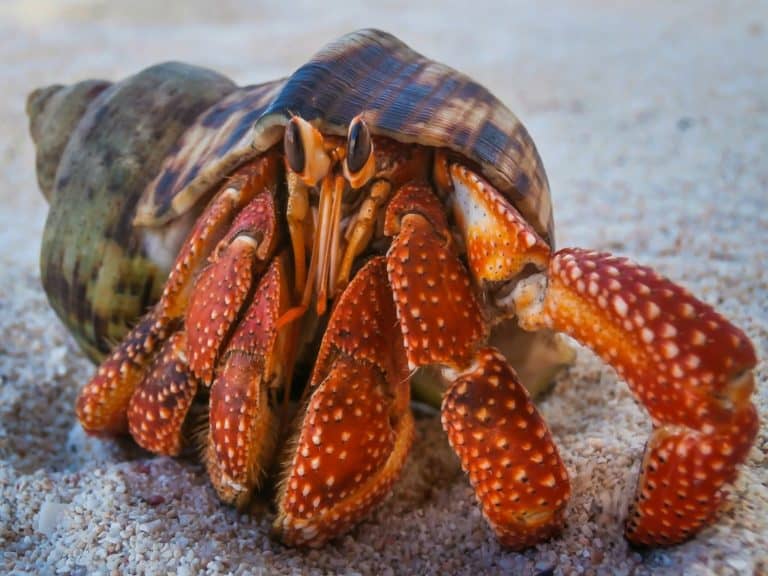
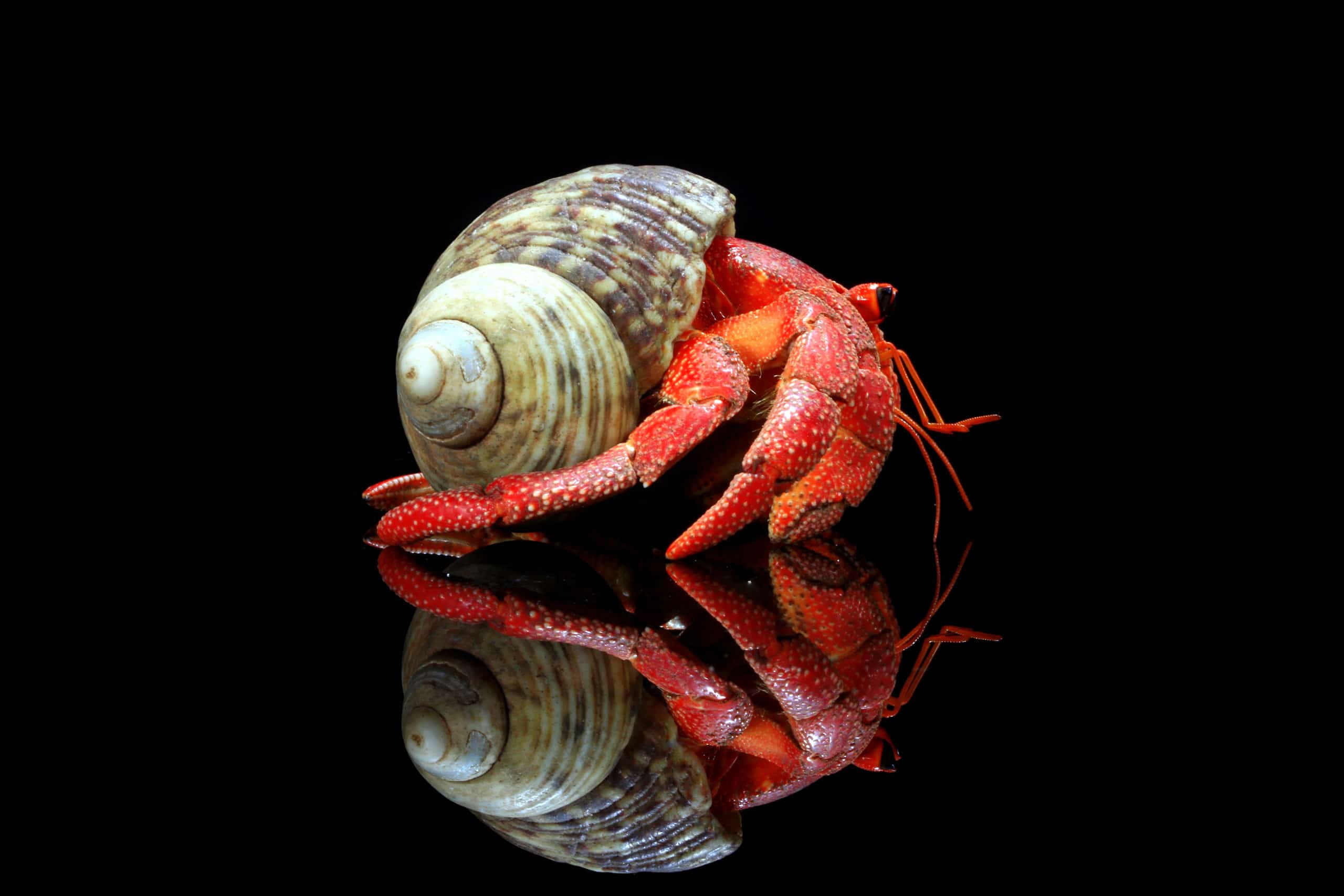
Hermit crabs are known to form what are called vacancy chains, whereby various crabs line up and swap shells until everyone finds the right size and shape.
©thomaslabriekl/Shutterstock.com
There are approximately 1,100 species of hermit crab, all of which are anomuran decapod crustaceans that belong to the superfamily Paguroidea. Most of these crabs have the key characteristic associated with hermit crabs, which is an asymmetric, soft abdominal exoskeleton. Lacking support or defense in their midsection, hermit crabs must constantly find and wear a shelter to protect themselves from threats. In this sense, they are scavengers; hermit crabs are not born with shells like most crabs, so they must find and repurpose discarded shells, often from sea snails.
Hermit crabs are generally characterized by soft tails that curve at the end and by having pincer claws of different sizes. One claw grows larger to function as an organic door, blocking the shell opening once its owner retracts inside. Hermit crabs also molt, so they shed their outer skin when they grow, which puts them on the lookout for larger shells. They are scavengers, using darkness and a keen sense of smell to locate carrion, organic matter, and fruit.
Despite their solitary reputation, hermit crabs can be quite gregarious and collaborative. They construct temporary social networks known as vacancy chains. These chains involve hermit crabs lining up together by size. Once the largest of the group finds a suitable shell, the other crabs of varying sizes swap shells until everyone gets a new house. However, hermit crabs don’t always have the luxury of participating in such cooperative shell exchanges. Sometimes, they must squeeze into shells that are smaller than ideal.
Slowing Down or Speeding Up?
Researchers at the Tufts University Department of Biology just released a paper detailing their findings regarding hermit crabs and their growth rates in relation to shell size. Published in a recent issue of the journal Invertebrate Biology, the study examined how certain hermit crabs adapt to restricted shelters. The researchers focused on long-wristed hermit crabs (Pagurus longicarpus). They compared growth rates, feeding rates, and defecation frequency between hermit crabs with good-sized shells and those with smaller-than-average shells.
Scientists previously assumed that hermit crabs would stop eating as much food if they needed to fit into snug shells. However, the researchers at Tufts University found the opposite to be true. Long-wristed hermit crabs ate at the same rate regardless of shell size, but those in smaller shells defecated significantly more. As Phil Starks, associate professor of biology and senior author on the study, explained in a statement to Phys.org, “For years, people observed the growth slowdown but couldn’t identify the mechanism. What we’re seeing is consistent with something subtle—the crabs appear to regulate growth by adjusting nutrient assimilation.”
Energy Emphasis
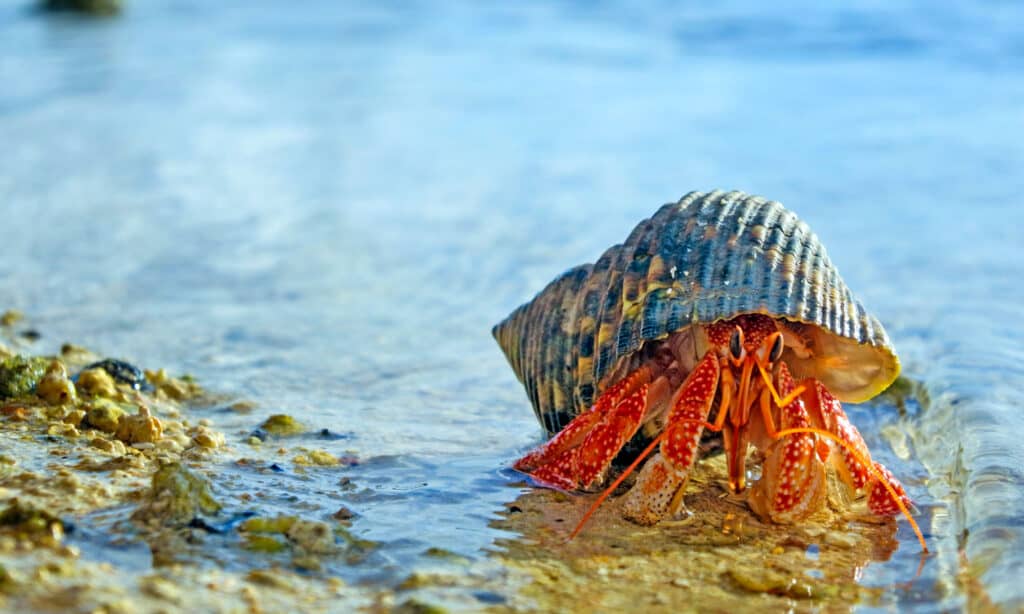
To fit in smaller shells, hermit crabs eat the same amount of food as usual but poop a lot more.
©iStock.com/chameleonseye
People hoping to lose weight fast might envy the hermit crab’s ability to control the energy transfer process. The study’s findings, however, reinforce the principles of growth as dictated by biology. A hermit crab squeezed into a small space controls its growth by changing how it processes energy internally. By simply defecating at a significantly greater rate than usual, hermit crabs can slim down for the smaller shelters.
As Professor Starks explained in a statement, the team’s findings point to a broader biological principle. He said, “Across animals—including humans—body mass isn’t determined solely by how much food is consumed. Growth regulation can occur at the level of nutrient assimilation, not just appetite. Intake and growth aren’t the same thing.”
Sometimes, it seems, finding a solution is less about adding than subtracting.