
Quick Take
- Most of the 14.4 million Americans who hunt act ethically and follow the rules.
- Hunting seasons prevent the devastation of animal populations.
- Certain states charge incredibly high fines for hunting out of season, with some trophy animals costing over $40,000 in restitution.
For nearly all of human existence, hunting has supported growing human populations. Hunting provides access to subsistence and food, and people have also used pelts, bones, and other parts of the animals they harvest for clothing, shelter, and tools. Today, millions of people across the globe call themselves hunters, including an estimated 14.4 million Americans.
People hunt for many reasons: sport, food, animal parts, and even land management and population control. While numerous ethical debates rage around hunting and its purpose, a closer look at hunting highlights several environmental, economic, and socially-conscious benefits. Although non-hunters may find the act of killing animals unsettling, hunting provides a significant number of jobs and plays an essential role in conservation efforts.
However, a crucial part of being an ethical hunter is following the rules and regulations set in place: around which animals can be hunted, when those animals can be hunted, and what weapons you can use to harvest them. Each state across the United States has its own hunting seasons. In fact, seasons may even range from region to region in the same state.
Whether you’re at home or traveling to hunt, you should never assume that you can simply walk into the woods and start hunting. If you are caught hunting out of season, also known as poaching, you can face serious problems. Rather than risking paying a significant amount (or, even worse, ending up in jail!), learn why hunting in season is necessary and what can happen if you don’t follow the laws of the land.
Why Do I Have to Hunt in Season?
Many hunters would love to hunt year-round. But hunting seasons exist for a reason: to prevent excess environmental harm. You might wonder exactly how hunting seasons support environmental health. First, and perhaps most importantly, hunting seasons protect animals during their more vulnerable periods, including nesting (for birds), mating, and raising their young.
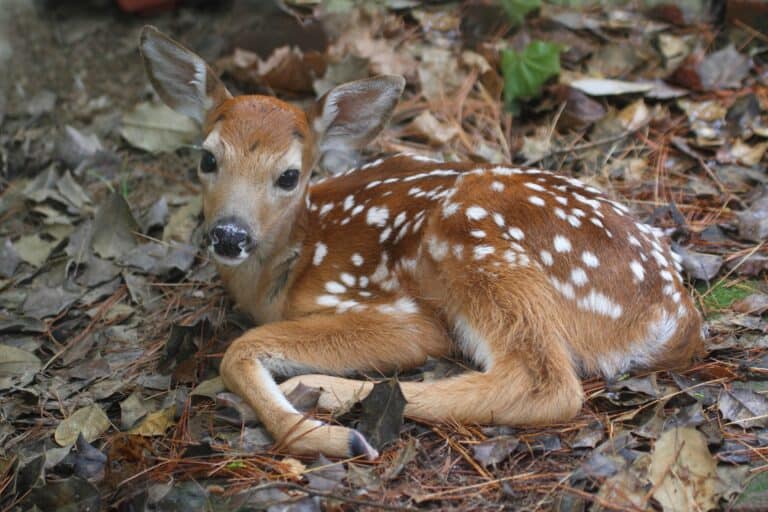
If you were to hunt deer, for example, during mating season, you might inadvertently disrupt their mating and breeding. As a result, there would be fewer deer having fawns, putting the population at increased risk. Now, suppose you hunted after the fawns had been born. The deaths of their parents might leave fawns to starve or make them more vulnerable to predation, further harming the population.
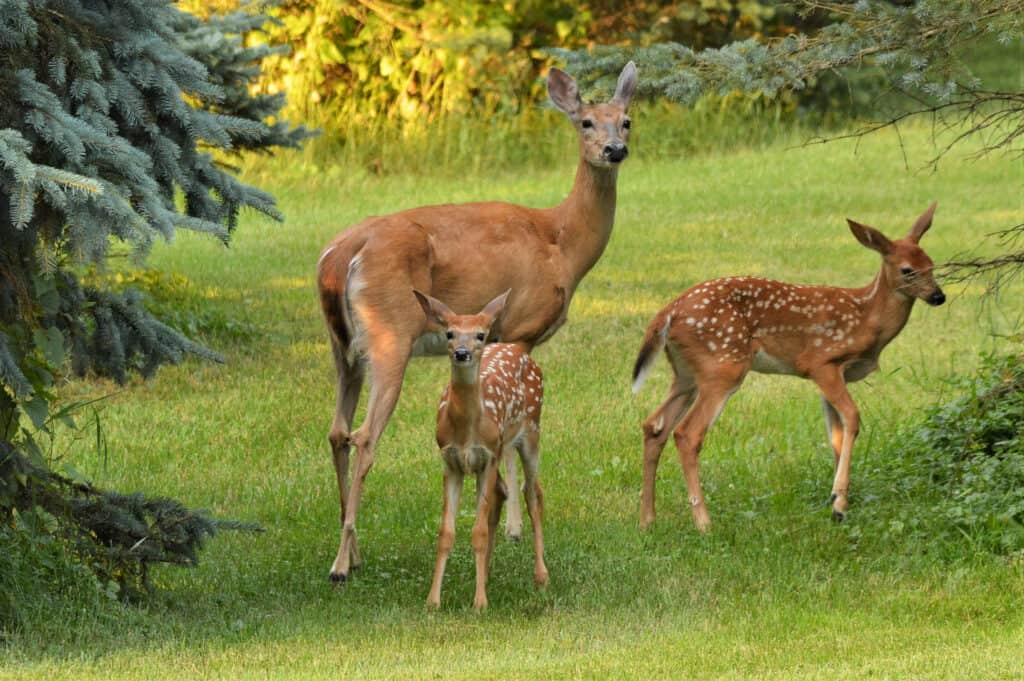
Fawns are usually weaned from their mother’s milk by ten weeks old, but fawns orphaned before that time could have a higher chance of death.
©Lester Graham/Shutterstock.com
Beyond deer, hunters should also be aware of regulations and seasons relating to migratory birds and waterfowl. Migratory bird hunting season is federally regulated, thanks to the Migratory Bird Treaty Act of 1918. This Act was designed to prevent bird populations from collapsing, especially after overhunting in the 1800s. To hunt waterfowl and migratory birds, you must have both a state hunting license and a Federal Duck Stamp. Penalties for violating the Migratory Bird Act Treaty are especially severe. Hunting without a Federal Duck Stamp, regardless of whether you’re in-season or not, can result in a misdemeanor, fines, and even imprisonment.
What If I’m On My Own Land?
You might be surprised to learn this. But you cannot hunt whenever you want, even on your own land. Even though certain states, like Kentucky, don’t require owners of farmland to have a license to hunt deer on private land, seasons are still in play. This is because states regulate both the wildlife and the hunting seasons.
Some exceptions exist. For example, if animals are damaging your land, some states will allow you to shoot them during the act of property damage, even if out of season, using a wildlife depredation permit. In some cases, certain animals may not require a permit for depredation. When shooting depredating animals, you often have to report the kill to the state wildlife agency.
However, different states have different rules, so you need to double-check your regional and state-level laws before assuming you have an exception.
Can I Be Fined for Hunting Out of Season?
No matter which state you’re located in, you will get fined if you’re caught hunting out of season. However, the amount you’ll be fined depends on several factors, including:
- Your state or locality
- Whether this is your first offense or a repeat offense
- The type of animal poached
- Whether the meat is wasted
For example, in Texas, illegal hunting (including hunting out of season) can carry anywhere from a $25 to a $4,000 fine, depending on the level of misdemeanor. If you kill a white-tailed or mule deer, pronghorn, or desert bighorn sheep and fail to collect the meat, your fine can range from $25 to $500. But if you waste a game bird or game animal, you’re looking at a Class A misdemeanor with a fine of $500 to $4,000.
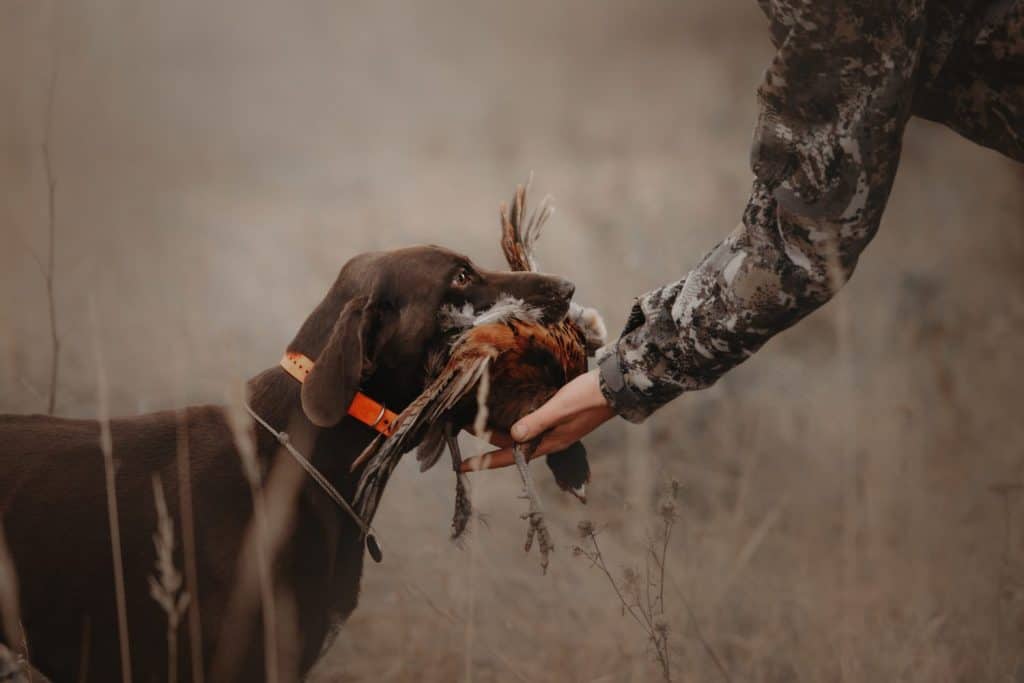
Many states are implementing systems that allow people to report those who are illegally poaching animals, including game birds.
©Ksenia Raykova/Shutterstock.com
In Colorado, fines vary. According to 2024 Revised Statute 33-6-120, “For each incident that is not related to the hunting or taking of a big game animal, the fine shall be equal to twice the cost of the most expensive license for such species, and ten license suspension points shall be assessed. For the hunting and taking of big game, fifteen license suspension points and a fine that is equal to twice the cost of the most expensive license for each species shall be assessed.”
Additional Restitution
Some states may also require you to pay restitution for animals killed. While fines are meant to penalize poaching, restitution is considered payment for the wildlife resources taken. If you’re in a state that asks for restitution, you will be required to pay both the fine and the restitution. Fines are usually capped at a specific amount, but restitution may change based on the animal’s species, your prior offenses (if any), and trophy status.
Poaching an antlered deer in Michigan, for example, can cost you serious money. In Michigan, restitution starts at $1,000 for any deer. For an antlered deer, add another $1,000. If the deer has eight to ten points, add $500 per point, totaling about $4,000 to $5,000. For deer with more than ten points, the cost increases to $750 per point. This means that hunting an antlered deer out of season could cost you $6,000 or more in restitution, in addition to any fines. In Utah, poaching a bighorn sheep has an even higher cost: $45,000.
License Suspensions
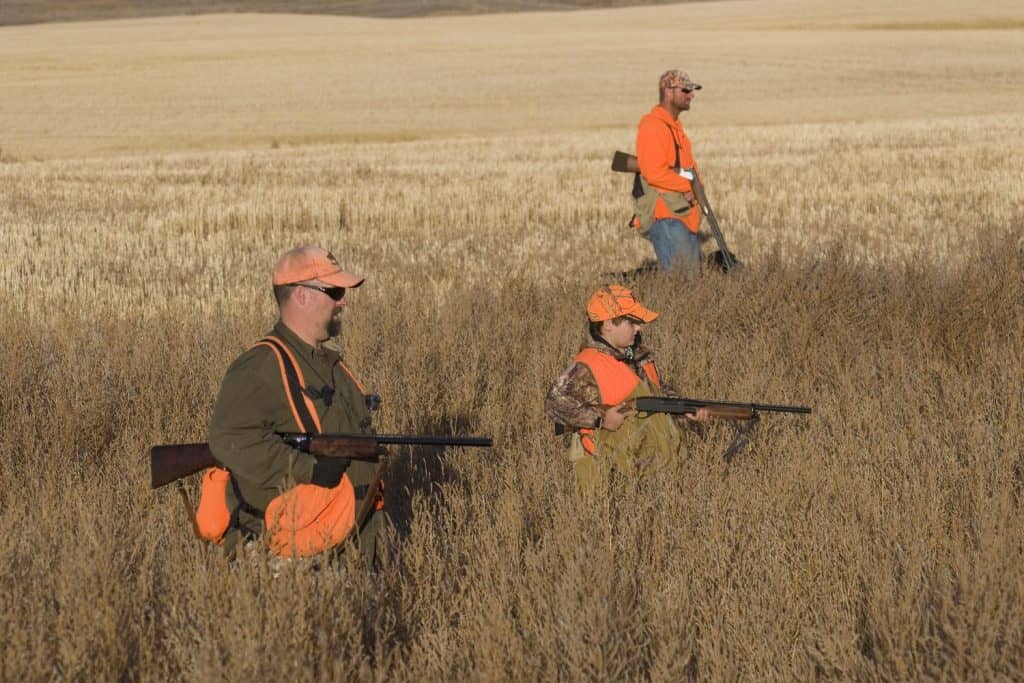
As a hunter, you’re required to have a state-specific license to hunt.
©Steve Oehlenschlager/Shutterstock.com
Hunting licenses are considered a privilege. That means if you’re caught hunting out of season, you could have your hunting license revoked.
Some states may suspend licenses based on a point system, like in Colorado. Colorado operates on a 20-point system. If you rack up 20 points over a five-year period, you must attend a license suspension hearing, which could result in fines and a suspended license. Typically, you could face up to a five-year suspension, but more serious hunting violations could result in a lifetime ban. South Carolina operates on a similar point system, though theirs is 18 points and a one-year hunting license suspension.
Other states, like Alabama, do not have a point system. However, you can still have your license suspended if convicted of a poaching offense. In Alabama specifically, you’d be looking at a three-year suspension from the date of conviction. If you’re caught hunting again, even in season, you can be assessed additional fees for not having a license.
A hunting license suspension in one state may also carry over to other states, thanks to the Interstate Wildlife Violator Compact (IWVC). Essentially, the IWVC was set up to protect wildlife across the country. 49 states have now joined the IWVC, and Hawaii is in the process of joining. If your license is suspended in your home state, and you want to hunt elsewhere, you must first check with the other state to see if you’re allowed to hunt there or if the suspension still applies.
Gear Confiscations
Your gear, from optics and weapons to the right clothing, is undoubtedly important for hunting. Hunting gear can also be quite specialized and, as a result, a significant financial investment. However, if you violate hunting laws, you risk having your gear confiscated, as the state considers it to have been used in the commission of a crime.
In Arkansas, the law states that your guns, traps, archery equipment, boats, vehicles, or other devices could be confiscated for violating the code and hunting out of season. If you’re convicted, Arkansas can even auction your gear, donating the funds to the Game Protection Fund. For Oregon, the money is donated to the Common School Fund. New Mexico, North Carolina, and Texas are just a few of the other states liable to confiscate your gear.
However, hunting out of season does not automatically mean your gear will be confiscated. That decision relies on additional factors, including prior violations.
Long-Term Consequences for Future Hunting Privileges

You’re unlikely to end up in jail for hunting out of season, but there are situations where this is possible.
©Gorodenkoff/Shutterstock.com
If you’ve received your first violation for hunting out of season, you may be concerned about the consequences. While you are likely to face penalties, the chances of going to jail are generally low. That being said, there are some groups or individuals who are more likely to end up in jail. These include:
- Repeat offenders
- People who poach protected or endangered species
- Trophy poachers
- People hunting with a suspended or revoked hunting license
- Night hunters, especially out of season
Typically, sentences run from under six months to about one year. However, if your poaching is considered a felony in your state, the jail sentence could be extended longer. Felony charges may also cause you to lose your hunting license for life. Ultimately, no matter how much you enjoy hunting, the potential negative consequences of hunting out of season are not worth the risk.