

Quick Take
- Letting your dog chase the cat 'just once' seems harmless, but a vet explains exactly why it isn't. Why chasing is harmful →
- The age window for a smooth cat-dog introduction is narrower than most owners realize, and missing it changes everything. See the ideal age windows →
- Punishing a growling cat or hissing dog feels like the right call, but it is actually one of the worst things you can do. Avoid punishing warning signals →
- Even after a successful introduction, most pet parents make one management assumption that puts both animals at risk. Ongoing management explained →
Cats and dogs have long been seen as mortal enemies. This misconception has led many to avoid having a canine and feline in the home at the same time. However, pet parents can have both animals living happily under the same roof. While certain dogs may never be suited to living with cats, properly introducing the animals is often key to successful cohabitation. We sought expert advice from an experienced veterinarian on the best way to introduce a dog and cat.
How to Successfully Introduce a Dog and Cat
Bringing a cat or dog into a home with an established canine or feline is a big decision and should not be taken lightly. A new dog or cat should not suddenly be thrust into an established pet’s environment. Instead, the two animals should go through the necessary steps to grow familiar with each other. Building this relationship takes time, patience, and energy, but it is necessary to create a peaceful home life for everyone involved.
According to Dr. Sara Ochoa, a small animal veterinarian with over 10 years of experience, the younger the animals are at the time of introduction, the easier it is to bring a cat and dog under one roof.

The younger the pets are at the time of introduction, the more easily a cat and a dog can form a relationship.
©Josep Suria/Shutterstock.com
“The smoothest introductions usually happen when at least one animal is still quite young,” Dr. Ochoa explains to A-Z Animals. “The ideal window is roughly eight to 16 weeks for puppies and eight to 14 weeks for kittens. A puppy under about six months or a kitten under about nine to 12 months generally adapts more easily to a new dog-or-cat friend than a fully mature adult.”
Even under ideal conditions, it will still take time for the dog and cat to adjust to sharing the same space. While there are loose time guidelines pet parents should follow, Dr. Ochoa states, “moving at the pace of the more nervous animal rather than the calendar” is more important.
“If things go smoothly, owners should plan on a minimum of five to seven days of structured introductions, and more realistically, two to four weeks before the dog and cat can relax together without close supervision,” Dr. Ochoa says. “Some sensitive or high-prey-drive pairs may need six to eight weeks or longer.”
What Are the Most Peaceful Cat and Dog Pairings?
When pairing a cat with a dog, some breeds are more accepting of an additional animal than others. More importantly, though, the temperament of both the dog and the cat needs to be considered before bringing them into the same home.
“Owners should choose pairings based on temperament, not just species or breed,” Dr. Ochoa explains. “Calm, social, low‑prey‑drive dogs and confident, dog‑savvy cats are far more likely to succeed than anxious or predatory individuals.”

Basset hounds are one of the breeds that are more accepting of cats.
©Fire-n/Shutterstock.com
Some of the dogs most often touted for having a temperament that meshes well with a cat in the home include:
- Basset hounds
- Beagles
- Bulldogs
- Collies
- Golden Retrievers
- Labrador Retrievers
- Papillions
- Pugs
This, of course, is not an exhaustive list, and each dog has its own personality. But if looking to bring a dog into a home with an existing cat, or a cat into a home with an existing dog, these breeds will adapt more easily.
Mistakes That Pet Parents Tend to Make When Introducing a Dog and Cat
No one will be perfect when introducing a cat and a dog. However, some mistakes are more common than others. Knowing what these mistakes are can save time and energy during introductions and keep both the cat and dog comfortable during what can be a very stressful situation.
“Some of the biggest mistakes,” Dr. Ochoa tells A-Z Animals, “are rushing things and skipping straight to face‑to‑face contact, letting the dog chase “just once,” and not giving the cat true vertical escape routes.”

Common mistakes when introducing a cat and a dog include rushing introductions, using punishment rather than rewards, and assuming friendly dogs understand cats’ body language.
©Oksana Shufrych/Shutterstock.com
Dr. Ochoa continues, saying, “People often punish growling or hissing instead of using distance and rewards, which can make fear worse.”
Finally, pet parents “assume a friendly dog automatically understands cats’ body language.” This is not the case, Dr. Ochoa states, and continued use of supervision in conjunction with “using a leash and barriers” is recommended “until both animals are consistently relaxed.”
When a Dog and Cat Relationship Will Not Work
No matter how hard some people try, certain dogs and cats will never gel. Does that mean they cannot live under the same roof? No. But it does mean they will have to stay permanently separated for their lifetimes.
“There absolutely are cases where a dog and cat should never be loose together, because the risk to the cat (or sometimes the dog) stays high despite careful training,” Dr. Ochoa states. “Choosing pairings based on temperament, not just species or breed—calm, social, low‑prey‑drive dogs and confident, dog‑savvy cats are far more likely to succeed than anxious or predatory individuals.”
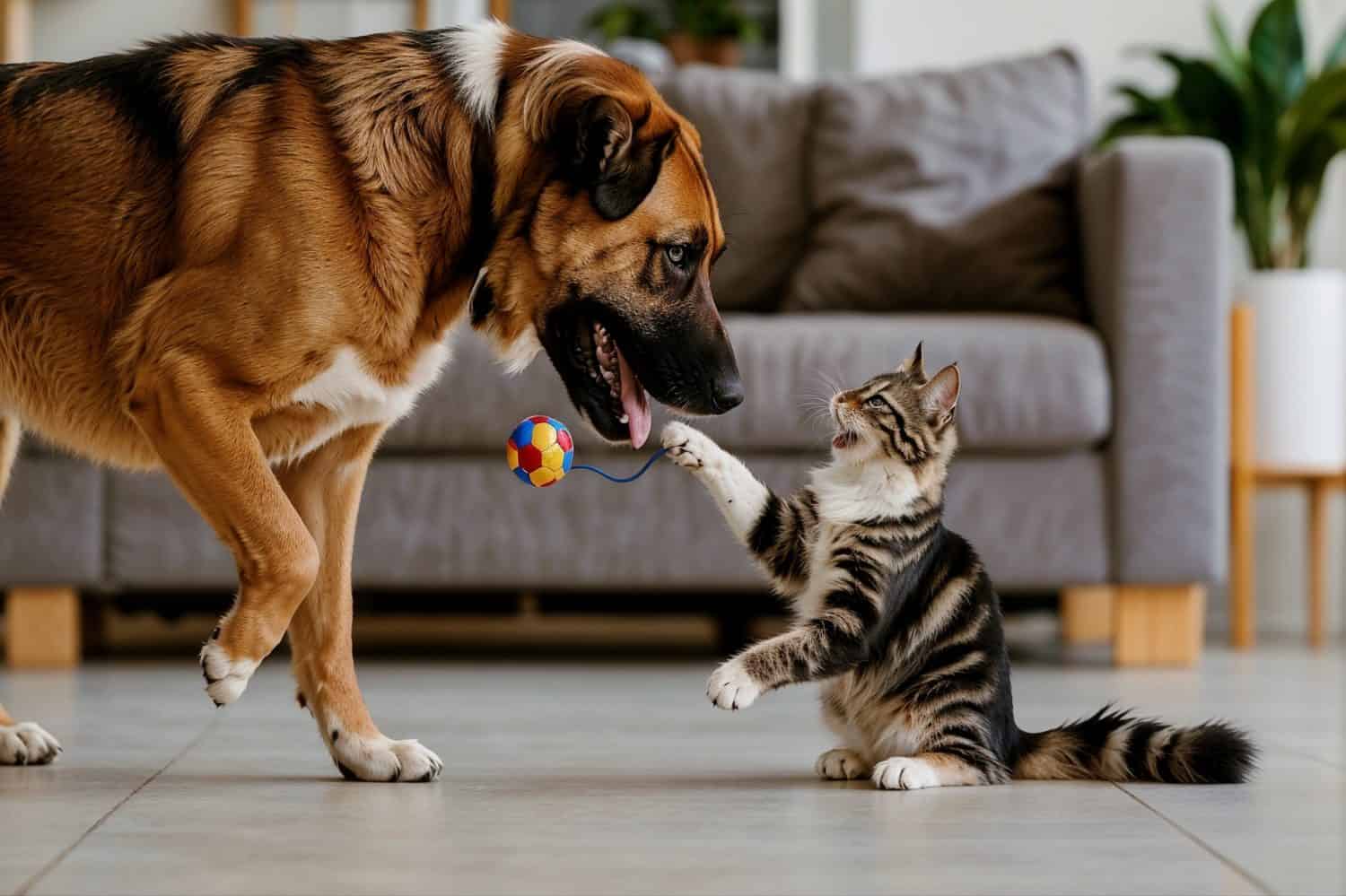
If a dog stalks or lunges at a cat, has grabbed a cat, the cat is fearful and hides, or if stress conditions are present for the dog or cat, it is a relationship that should not be pursued.
©Natureo/Shutterstock.com
These are some red flags that Dr. Ochoa says are indicators the cat and dog relationship will not be a positive one:
- The dog stares, stalks, or lunges at the cat even on leash and ignores food or cues
- The dog has actually grabbed or shaken a cat
- The cat is so fearful it hides constantly, will not eat, or soils outside the box
- Stress‑related health issues appear on the part of the dog or cat
In these cases, Dr. Ochoa says, “strict lifelong separation or rehoming is the welfare‑friendly choice” for the animals involved.
Never Assume That Once an Introduction is Made, Relationship Management Ends
After a dog and cat have been introduced, there is the assumption by some pet parents that the work is done and the relationship between the two no longer needs to be managed. This, however, is not the case. Dogs and cats have behavior and mood changes depending upon age and health, meaning that safe spaces need to be maintained and social cues need to be monitored.
“Owners should assume management is permanent,” Dr. Ochoa explains. “This includes baby gates, high perches, separate feeding and litter areas, and leashes for the dog whenever things feel ‘off.'”

After introductions, continue to allow each animal space to retreat for downtime, feeding, and toileting.
©Prystai/Shutterstock.com
To accomplish this, safe spaces should always be maintained, regardless of how well a dog and cat interact. This allows both to have neutral ground the other cannot invade and ensures anxiety-free feeding and toileting time.
Whether a dog and cat become best friends or simply ignore each other depends entirely on their personalities. To accomplish either takes time and patience. Do not rush the process. They will figure out their relationship at their own pace. Over time, and maybe after a bit of chaos, harmony will reign supreme in the house.