
Quick Take
- Scientists designed a surprisingly simple trick to catch cats in the act of recognizing someone, and the results flipped assumptions about feline intelligence. See the experiment design →
- Not all cats passed the test equally, and the reason why reveals something unexpected about the role your home plays in your cat's mind. House cats vs. café cats →
- Your cat may know more than just its own name, and science now has evidence of exactly how far that knowledge extends. Cats recognizing human names →
- One overlooked behavior cats display every day turned out to be the key to proving their hidden cognitive abilities. The revealing feline behavior →
Cats have often been called aloof, independent, even antisocial. Despite these labels, they’ve quietly become the world’s favorite pets, outnumbering dogs in places like France. Historically valued for their hunting skills, cats now share countless homes and shape daily life in subtle ways.
Only recently have scientists started to scratch beneath the surface of feline intelligence. As early as 2019, researchers confirmed that domestic cats can recognize their own names, challenging the long-standing belief that dogs alone respond to such verbal cues. But the question lingered: could cats do more? Could they understand words referring to others around them, their human families, or even fellow cats?
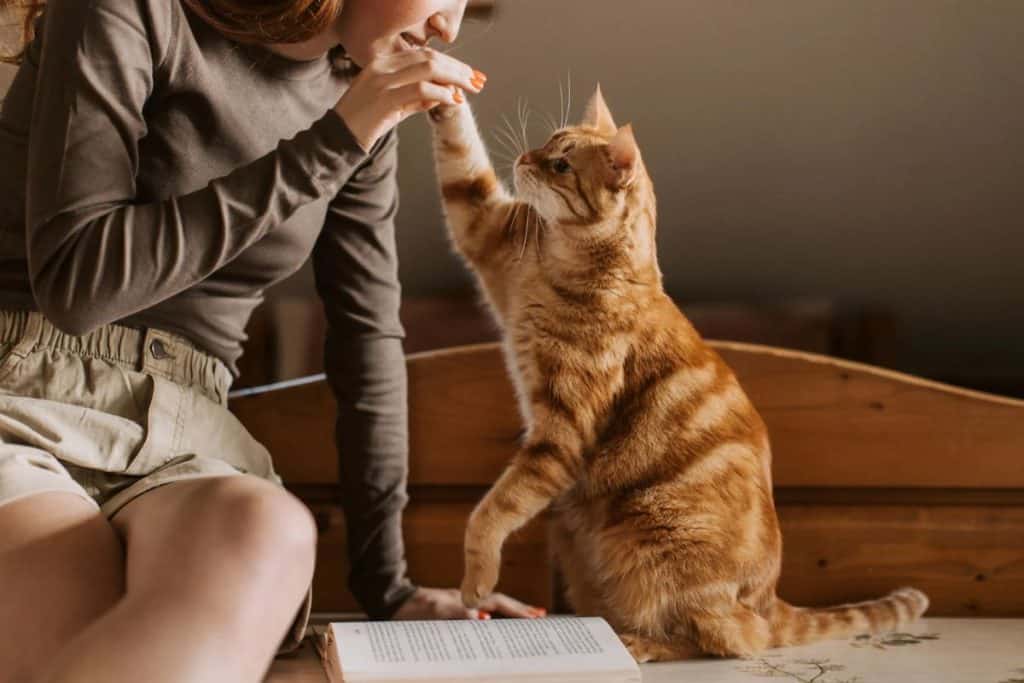
©Vlada Karpovich/ via Canva.com
Uncovering the Hidden Language of Cats
That was the puzzle that drove animal science researcher Saho Takagi and her team at Kyoto University. They wanted to know how deeply cats process language in their everyday lives, and whether they make mental associations between words and individuals. Their recent work, published in Scientific Reports, shed new light on the surprisingly complex cognition of cats.
Scientists know that some animals use vocalizations to refer to specific dangers, much like words carry meaning for humans. Chickadees, for example, alter their songs to signal distinct threats. Takagi’s team wondered if pet cats can use their humans’ words in similarly nuanced ways, especially since cats form close bonds and communicate with people in subtle, often overlooked forms.
A Real-World Test of Recognition
The Kyoto-based researchers designed two simple, but telling experiments. Their method harnessed the universal response to surprise. The premise: if an animal hears a name and then sees a matching face, all is as expected. But if the name doesn’t match the face, a moment of hesitation, a freeze or a fixed stare, can reveal how much the animal understands the mismatch.
Forty-eight cats took part. Twenty-nine lived in bustling cat cafés, where human visitors constantly mingle with many cats. The remaining nineteen were domestic house cats, living with at least two other feline companions.
©KDdesign_photo_video/Shutterstock.com
The first test paired the spoken name of a familiar cat with an image flashed on a monitor. Sometimes the name and cat-face matched; other times, they did not. For each cat, the researchers ran both scenarios, two congruent, two incongruent, while carefully observing reactions.
Results were telling. Domestic cats spent noticeably longer staring at the screen when the name and image didn’t match. They seemed to expect a specific friend to appear after hearing a name and grew visibly puzzled by the inconsistency. In contrast, cats from cafés didn’t show the same level of attention to the mismatch. Researchers linked this to environmental differences: house cats hear their names and those of fellow pets more often, in more stable settings. Café cats, surrounded by ever-changing groups of felines and people, rarely witness repeated, consistent name-face pairings.
Cats and the Names of Their People
The team continued with a second experiment, this time using humans. For this part, they focused on 26 cats from multi-person households. The setup was similar: a voice spoke the name of a person and then showed either that person’s face or another’s. When the face didn’t match the name, the cats hesitated, looking longer at the screen. This effect was stronger in homes where cats had lived with the family for longer periods or where there were more people, suggesting a richer association between words and household members built over time.
Saho Takagi and collaborators point out that these findings show that, without explicit training, cats can link not just their own name but also the names of close fellow felines and humans to corresponding faces. “This study provides evidence that cats associate the name of a companion and the corresponding face,” they write.
Rethinking Cat Intelligence
Research into feline learning and memory is just beginning to flourish. A 2020 study even demonstrated that cats can pick up behaviors simply by watching their humans. These discoveries chip away at the stereotype of the indifferent, unattached house cat.
Takagi and her colleagues plan to dive deeper, looking for the mechanisms by which cats memorize names and faces and how far their language comprehension might go. For now, one thing is clear: behind the quietly observant eyes of our cats, there’s a recognition and recall of the world, and us, in ways we never imagined.