
Quick Take
- Paedophryne amauensis, a frog found in Papua New Guinea, is one of the smallest vertebrates in the world.
- Researchers discovered the tiny frog in August 2009 by accident.
- Paedophryne amauensis lacks a tadpole stage but can jump up to 30 times its body length.
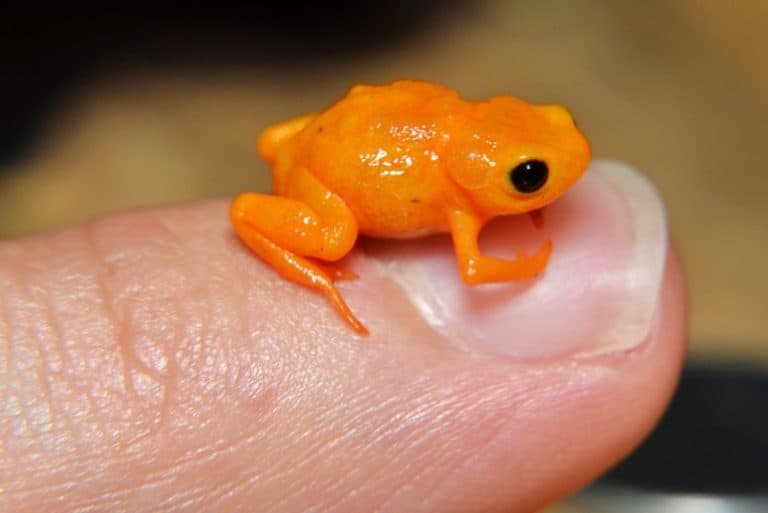
Deep within the dense foliage of Papua New Guinea lives the world’s smallest vertebrate. Meet Paedophryne amauensis, a terrestrial frog so small it’s nearly invisible to the naked eye. Not only do these miniature vertebrates represent the incredible specialization of evolution, but they also occupy such a small niche that they go unnoticed by predators, competitors, and humans alike.
First discovered back in 2009, these tic-tac-sized frogs rely on unique evolutionary adaptations to hide, go undetected, and remain efficient. Let’s learn more about these frogs and how they have carved out a life in one of the most biodiverse regions on the planet.
Contemporary Discovery
Louisiana State University herpetologist Christopher Austin and his PhD student Eric Rittmeyer discovered Paedophryne amauensis in August 2009 while exploring the biodiversity of Papua New Guinea. The researchers named the tiny amphibian after Amau village in the Central Province, near where it was found.
For years, these frogs were difficult to detect for several reasons, the most obvious being their incredibly small size. They are also easily camouflaged by the ample leaf litter that New Guinea rainforests provide. Additionally, they make calls that sound like insects. While out on a nocturnal mission, Austin and Rittmeyer triangulated the call from an unknown animal. That’s when they discovered the tiny frog by scooping up handfuls of leaf litter.
Impressive Attributes

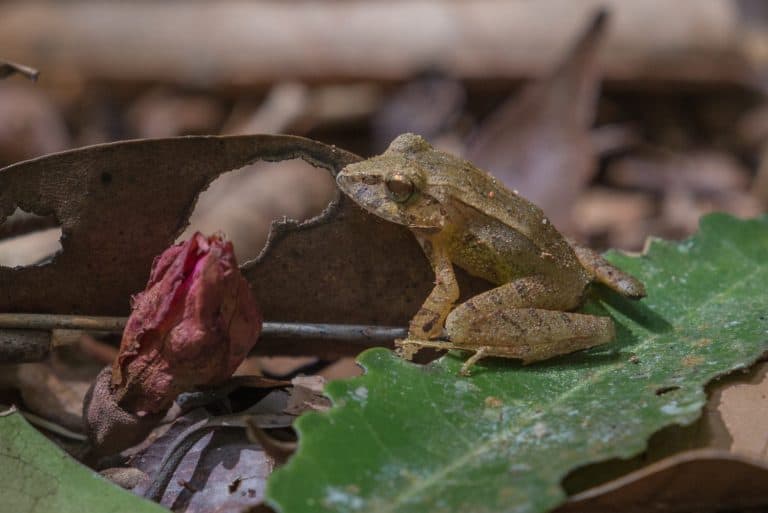
These little frogs live in the moist leaf litter produced by Papua New Guinea’s dense rainforests.
©JaleMFJ/Shutterstock.com
Perhaps it’s not surprising that these frogs are a recent discovery, as they only grow to about 0.30 inches long. That makes them one of the smallest vertebrates in the world, second only to the Brazilian flea toad. These frogs live on land and lack a tadpole stage. Instead, members of this tiny species hatch as miniatures of adults, featuring a reduced skeleton and seven presacral vertebrae.
Within the Papua New Guinea wilderness, these frogs go unnoticed even as they make extraordinary jumps. Indeed, when they aren’t feeding on small invertebrates at night, these frogs can leap up to thirty times their body length! If they don’t land close enough to their compatriots, these frogs emit insect-like calls between frequencies of 8400 and 9400 Hz.
Paedophryne amauensis is so small that most vertebrate predators cannot see it at all. These itty-bitty jumpers enjoy an existence under the radar of fearsome predators like birds and snakes. Besides avoiding curious researchers, these frogs need only focus on staying wet. They accomplish this by remaining in dense and moist leaf litter. Since this is a newly discovered species, time will only tell what else researchers will learn about these smallest of vertebrates.