
Quick Take
- One Texas spider has more toxic venom than the black widow, but it is actually less dangerous to humans. Can you guess which one? Brown widow venom explained →
- Texas has over 900 spider species, but only two groups are medically significant. Do you know which ones to actually watch out for? Meet the medically significant spiders →
- The Texas brown tarantula's bite isn't its most dangerous feature. Something else about this spider can actually hurt you. Tarantula's real hidden danger →
- One spider in this list builds a dedicated silk nursery and guards it until her young are ready, displaying a parenting strategy unlike anything else on this list. See the silk nursery builder →
Taxonomists have recorded 54,102 spider species worldwide, and experts estimate that another 50,000 species may still be awaiting discovery. Texas is home to more than 900 spider species, due to its diverse ecosystems, ranging from deserts to coastal swamps. Among others, the Lone Star State is home to jumping spiders, wolf spiders, and tarantulas. However, only two groups of spiders found in Texas, the widow spiders and recluse spiders, are considered medically significant to humans. Continue reading to learn about some of the more common spiders found in Texas.
Black Widow
The Southern black widow (Latrodectus mactans) and the Western black widow (L. hesperus) are the primary species of widow spiders found in Texas. Their geographic distribution spans the state, although the Southern black widow is more prominent in the humid Eastern part of Texas, while the Western black widow is found in West Texas.
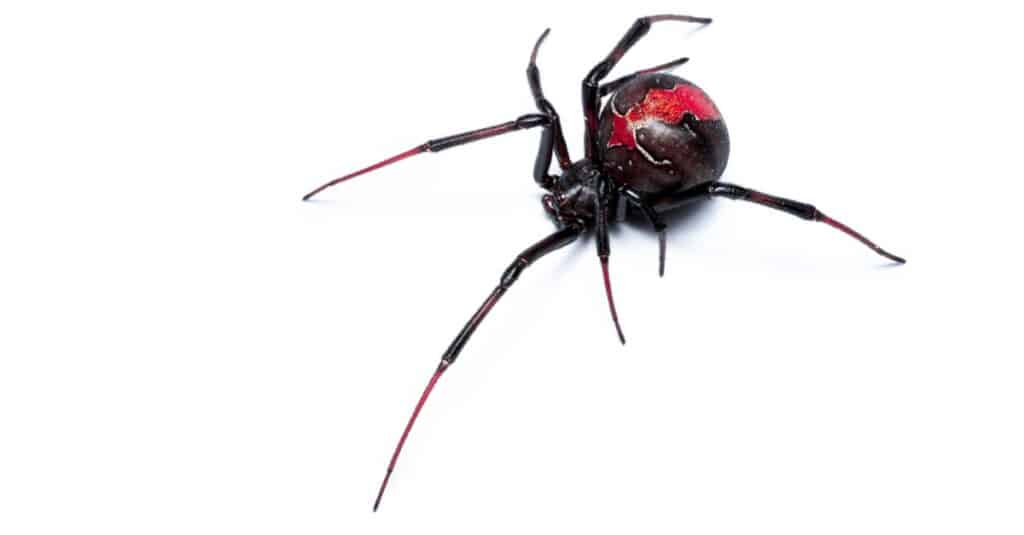
One of only two venomous spiders in Texas, black widows have a bright red hourglass shape on their abdomens.
©Steven Giles/Shutterstock.com
An adult female black widow’s body measures about 0.5 inches long, with a leg span of 1 to 1.5 inches. Adult males are noticeably smaller, measuring between 0.16 and 0.25 inches in body length, with a leg span of 0.5 inches.
Both species are timid, nocturnal spiders that nest close to the ground in dark, dry areas, such as woodpiles, meter boxes, rock walls, and hollow stumps. Although they are rarely found indoors, black widows occasionally nest inside garages, sheds, crawl spaces, and basements.
Brown Widow
The brown widow spider (Latrodectus geometricus) is an invasive species that has a widespread distribution across Texas, from major urban centers such as Dallas, Houston, and Austin to Western cities including Lubbock and El Paso.
Female brown widows have an average body length of 0.47 to 0.63 inches with an overall leg span of 1.5 to 2 inches. Adult males are significantly smaller, measuring just 0.24 to 0.31 inches in body length, with a leg span averaging 1 inch or less.
These spiders tend to nest outdoors in dark, secluded areas, meticulously constructing three-dimensional webs near man-made structures. They are frequently found hiding in the recessed spaces of patio furniture, under roof eaves, inside mailboxes, around fences, and in empty flowerpots.
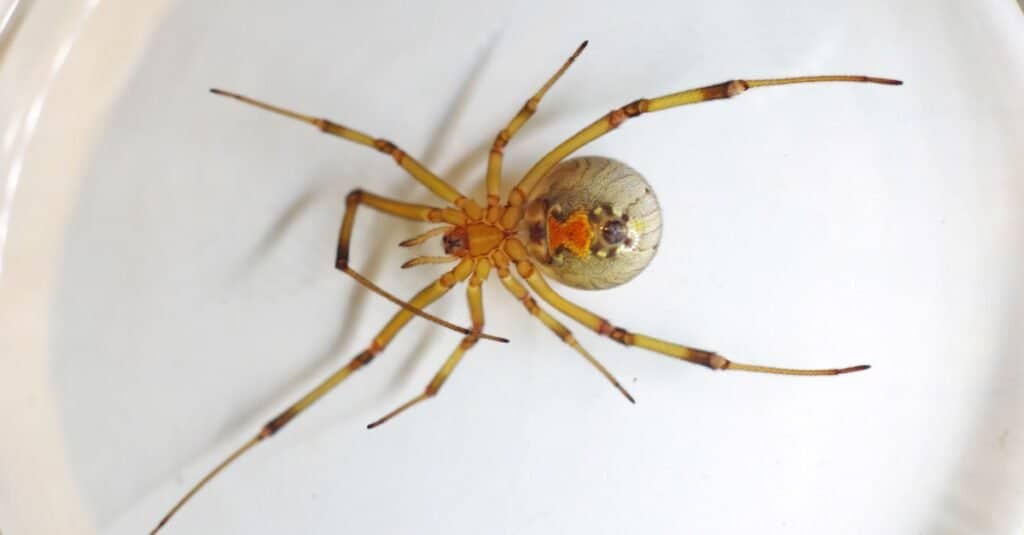
Brown widows have an orange hourglass shape marking.
©Decha Thapanya/Shutterstock.com
Although the venom of the brown widow spider is more toxic than that of the native black widow, brown widows are less harmful to humans because they inject a much smaller amount of venom. They are naturally timid, non-aggressive spiders that often opt to deliver venomless dry bites or play dead when threatened.
Brown Recluse
The brown recluse spider (Loxosceles reclusa), sometimes called a fiddleback spider, is recognized by the violin-shaped marking on its cephalothorax. Its body length typically ranges from 1/4 to 1/2 of an inch, with a leg span of between 1 and 1.5 inches. This species is distributed statewide across Texas, though it is more common in the Central, Northern, and Eastern regions of the state.
True to its name, the brown recluse spider nests in undisturbed, dark locations, frequently hiding indoors in closets, attics, basements, and inside stored shoes or clothing, as well as outdoors beneath rocks, woodpiles, and loose tree bark.
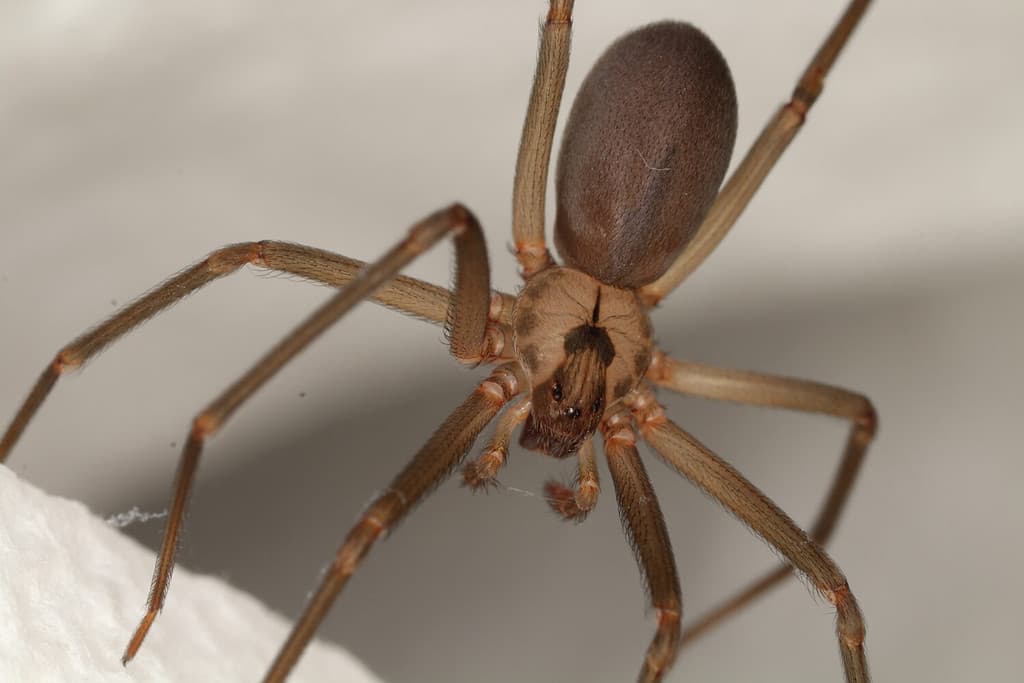
The brown recluse can be identified by the violin shape on its cephalothorax.
©Nick626/Shutterstock.com
The bite of a brown recluse spider is medically significant to humans, making it one of the few truly harmful spider species in North America. Its complex venom destroys cell membranes, breaks down blood vessels, and disrupts local blood supply, which, when left untreated, can result in necrosis, or tissue death.
Black-footed Yellow Sac Spider
The black-footed yellow sac spider (Cheiracanthium inclusum) is a small, pale yellow-to-beige spider with dark brown leg tips, jaws, and a faint orange-brown stripe running down its abdomen.
This species exhibits slight sexual dimorphism in size; females are typically between 1/4 and 3/8 inches in body length, with a leg span of up to one inch. Males are smaller, but not significantly so. Widespread throughout the state of Texas, these adaptable, nocturnal wandering hunters do not spin traditional capture webs. Instead, they use their silk to spin small, dense, translucent, tube-like sac retreats where they hide during the day, molt, and protect their eggs.
Black-footed yellow sac spiders tend to nest tucked away in shrubbery, grass, and rolled leaves, but they regularly venture indoors where they construct their sacs in crevices and upper corners where walls meet ceilings.
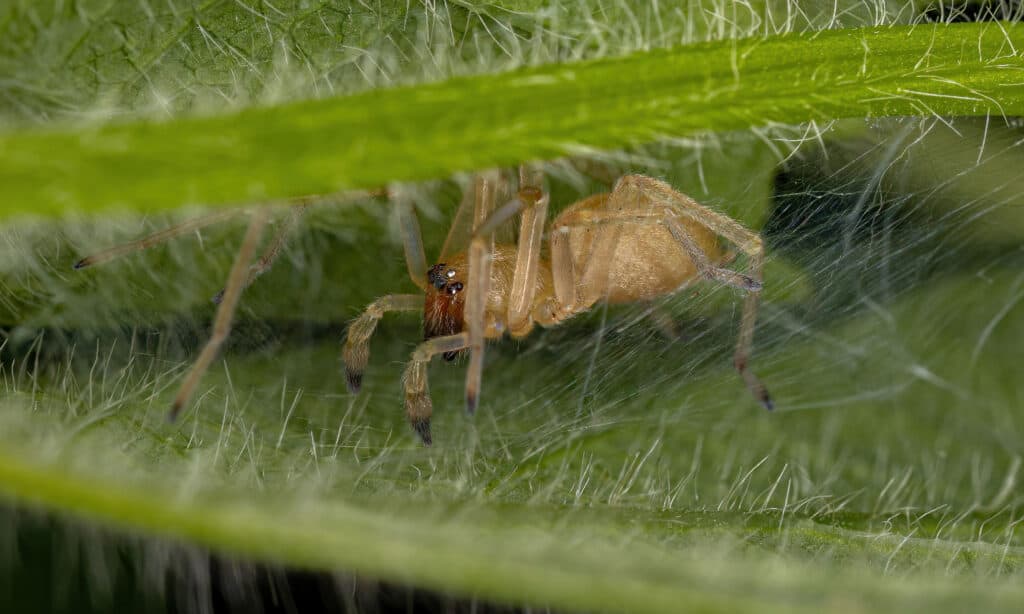
The black-footed yellow sac spider has black leg tips.
©iStock.com/ViniSouza128
The bite of the black-footed yellow sac spider is generally not considered medically significant to the average healthy adult. While their venom contains mild cytotoxins, it is designed to subdue small prey and rarely causes severe or long-lasting harm in humans.
Bold Jumping Spider
The bold jumping spider (Phidippus audax) is a common spider found throughout Texas. These spiders exhibit notable sexual dimorphism in size, with mature females typically measuring between 3/8 and 5/8 inches in body length, with a leg span between 3/4 and one inch. Males of the species are slightly smaller. Bold jumping spiders are recognized by their iridescent, metallic green or blue chelicerae (mouthparts) and a prominent white, yellow, or orange spot on the center of their abdomen.
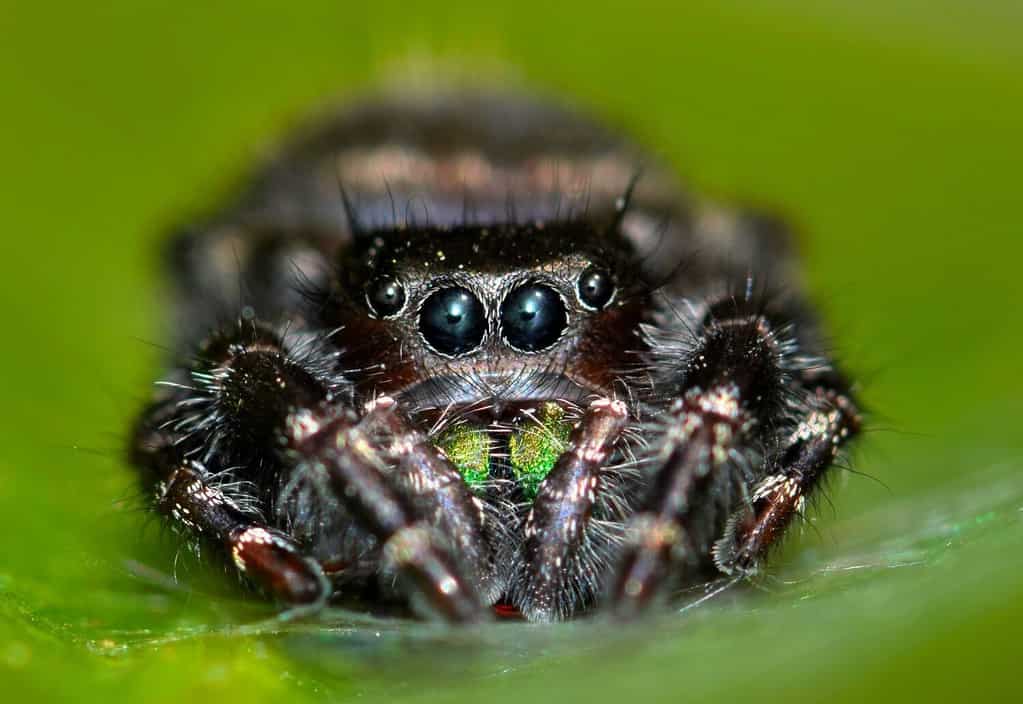
©Brett Hondow/Shutterstock.com
These spiders are present throughout the Lone Star State. These diurnal hunters spin small, thick silk tents to nest in, which they typically construct in protected, elevated crevices, such as window frames and doorways.
The bite of the bold jumping spider is not considered medically significant to humans. While they do have fangs and produce venom to subdue small insect prey, their venom is not highly toxic to humans.
Dark Fishing Spider
The dark fishing spider (Dolomedes tenebrosus) is one of North America’s largest true spiders. It exhibits significant sexual dimorphism, with adult females reaching a body length of 0.6 to 1 inch, which expands to an intimidating total leg span of between 3 and 4 inches. Adult males are much smaller, measuring roughly 0.25 to 0.5 inches in body length.
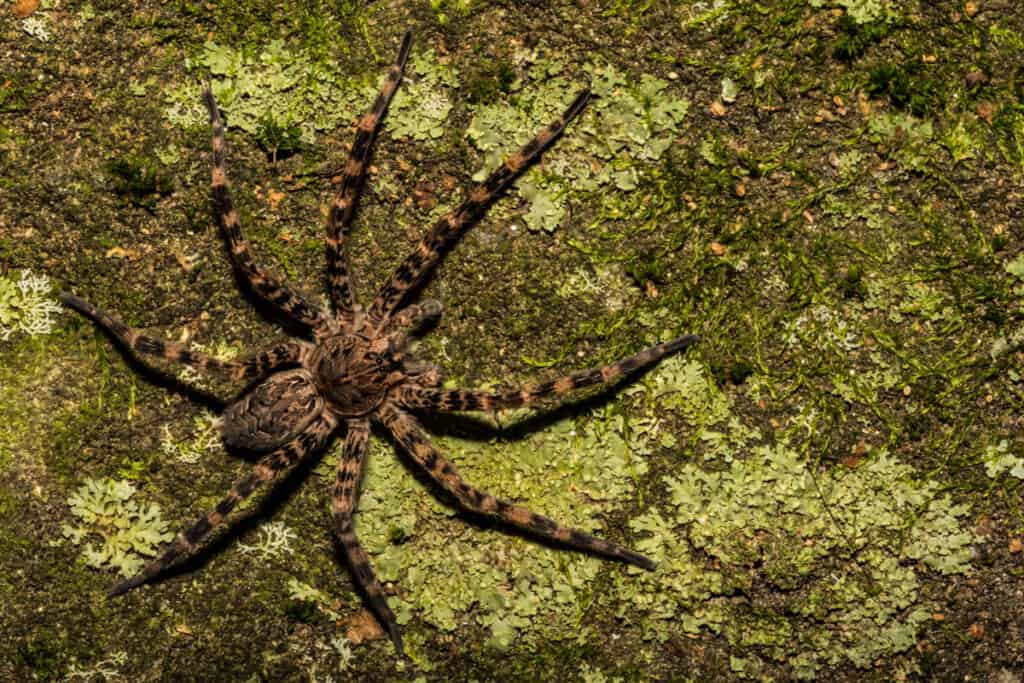
The dark fishing spider can run across the surface of water or dive into the water to catch prey
©iStock.com/JasonOndreicka
The dark fishing spider is highly terrestrial and is distributed primarily throughout the wooded environments of East Texas. Dark fishing spiders are nocturnal ambush hunters, although females build specialized nursery webs to protect their young. They tend to nest or seek shelter under loose tree bark, inside deep rock crevices, within hollow logs, and beneath wooden structures like docks or basements.
While they are venomous, the dark fishing spider’s venom is designed to subdue their prey. Their toxins are incredibly mild and completely harmless to humans.
Texas Brown Tarantula
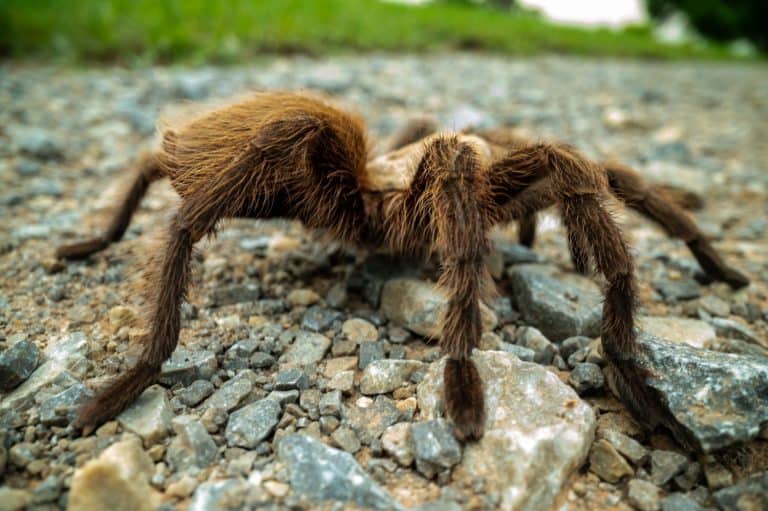
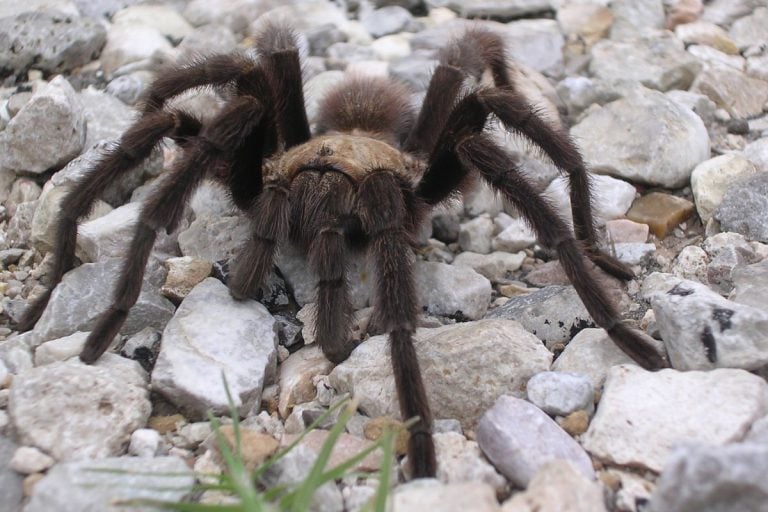
The Texas brown tarantula (Aphonopelma hentzi) is a heavy-bodied arachnid with a body length of approximately 2 inches and a leg span that can reach up to 5 inches. True to its name, the Texas brown tarantula is widely distributed throughout the state of Texas. However, it is especially prevalent in the arid, rocky environments of Central and West Texas.
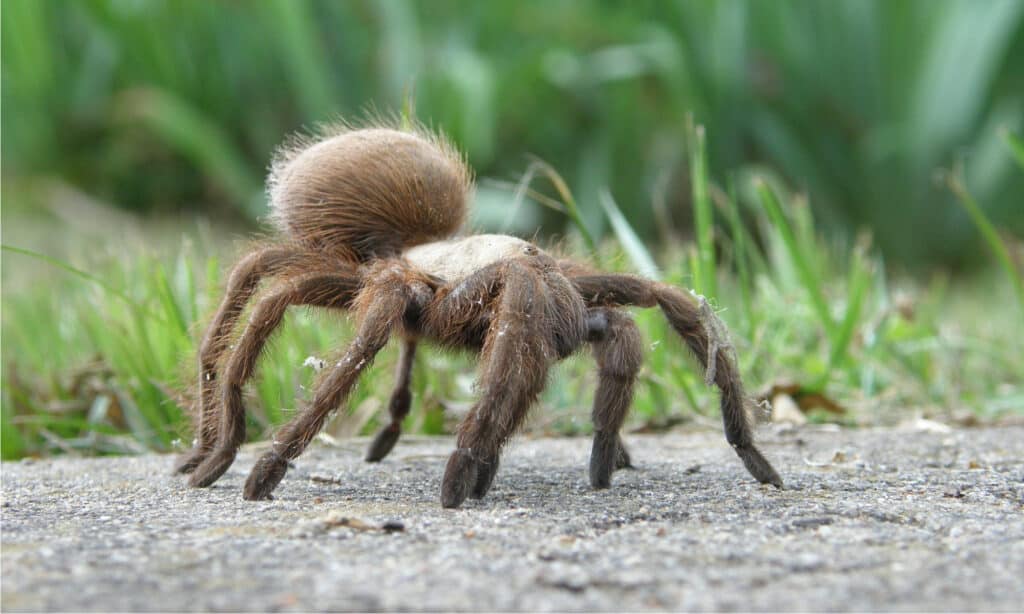
Texas brown tarantulas inhabit grasslands where they burrow underground.
©texas brown tarantula/Shutterstock.com
Texas brown tarantulas tend to nest underground, frequently burrowing into natural soil crevices, utilizing abandoned rodent dens, or sheltering under large rocks and logs.
The venom of the Texas brown tarantula is not medically significant to humans. A bite from this spider is generally considered harmless and is often compared to a mild bee or wasp sting.
A greater source of irritation for humans is actually their urticating hairs (setae), which they can flick from their abdomens when threatened; these hairs contain a mild irritant that can cause a localized rash and itching.
Desert Grass Spider
The desert grass spider (Agelenopsis aperta) is a medium-sized funnel-web weaver heavily adapted to arid environments. These spiders typically have a body length of approximately 0.5 to 0.7 inches, with females being slightly larger than males. Including their long legs, their total leg span ranges from about 1 to 1.75 inches.
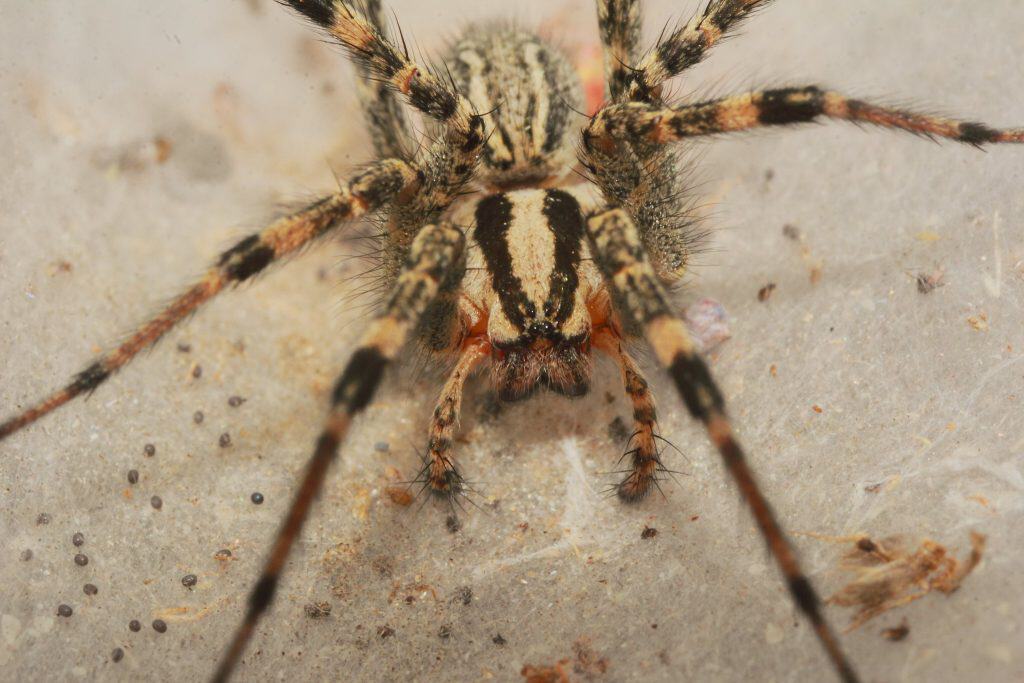
Like almost all spiders, desert grass spiders are technically venomous, but their venom is used for paralyzing small insect prey, not large mammals.
In Texas, their distribution is concentrated primarily across the arid and semi-arid Western, Southwestern, and Southern regions of the state, where they nest in low-lying vegetation, such as thorny desert shrubs, cacti, grass tufts, and rock crevices, in webs with a tubular funnel where they hide and wait to ambush prey.
The venom of the desert grass spider is not harmful to humans.
Nursery Web Spider
The nursery web spider (Pisaurina mira) is found throughout the Eastern half of Texas. Adult females have a body length of between 0.5 and 0.75 inches, and a leg span of approximately 3 inches. Nursery web spiders nest outdoors, as their nesting strategy integrates live plant matter.
When her eggs are close to hatching, the female nursery web spider constructs a protective silk nursery tent woven into the leaves of low shrubs, tall weeds, and high grasses, where she guards her egg sac and newly emerged spiderlings until their first molt.
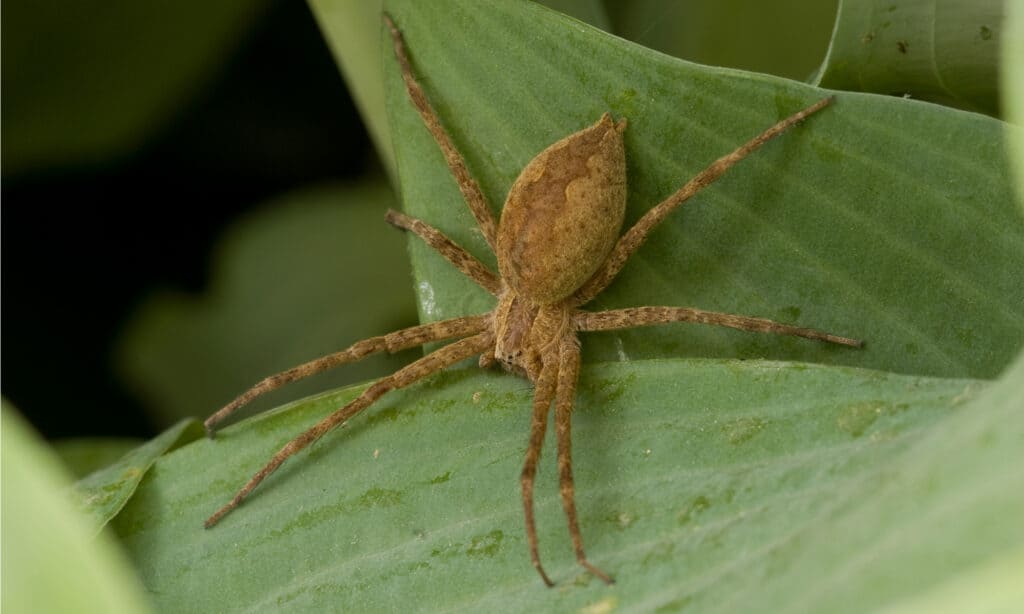
Nursery web spiders live in tall grass and shrubs.
©SDeming/Shutterstock.com
Nursery web spiders are not toxic or dangerous to humans, as their venom is not medically significant and is designed strictly to immobilize small insect prey.
Texas Wolf Spider
The Texas wolf spider (Hogna lenta), also called the field wolf spider, is a medium-to-large spider with a body length ranging from 0.5 to 1.5 inches, with females growing noticeably larger than males. When fully extended, their powerful, spiny legs create an impressive leg span of up to 4 inches.
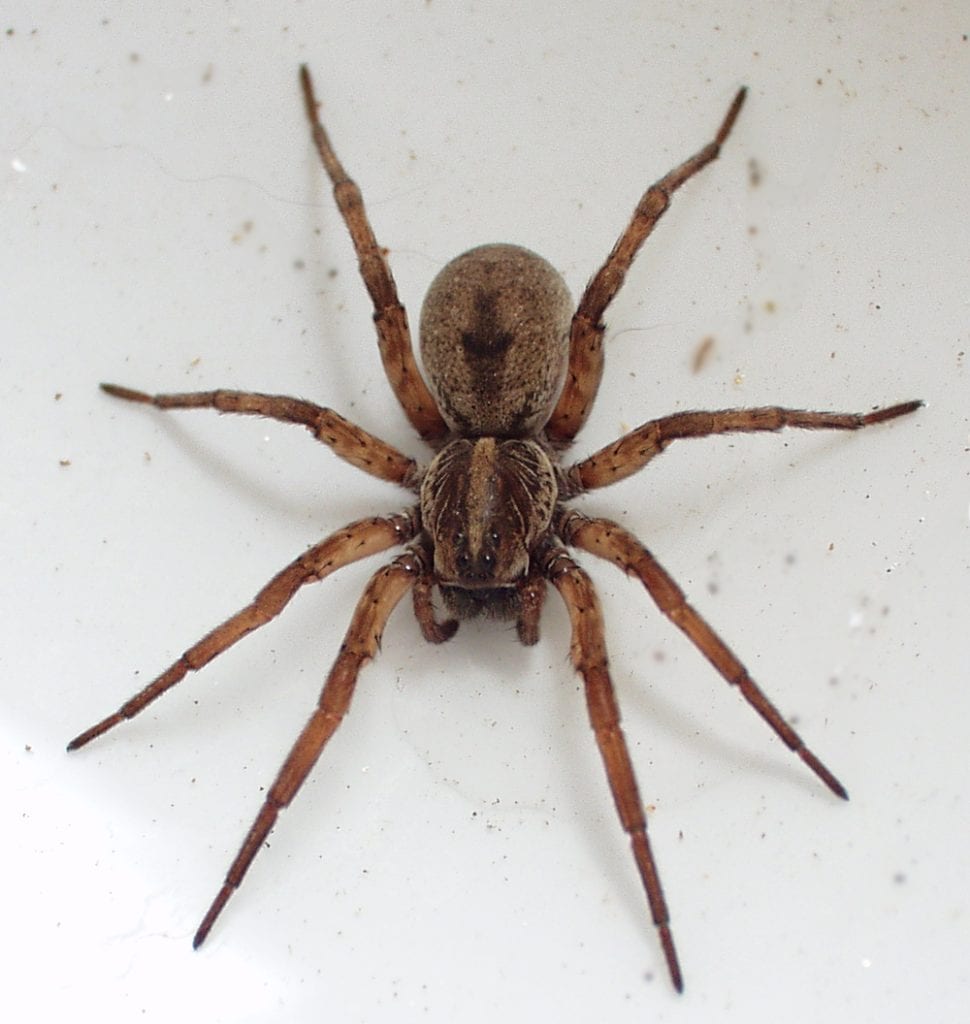
The Texas wolf spider can look intimidating with its stocky body and long legs.
Texas wolf spiders are found across the state, in prairies, grasslands, and arid or semi-arid scrublands. The Texas wolf spider nests at ground level in shallow burrows in sandy sediments, loose rocks, and leaf litter.
They are nocturnal ambush predators that consume small insects and invertebrates. The venom of the Texas wolf spider is not medically significant to humans. While they are large enough to pierce human skin if handled roughly or cornered, their venom is mild and designed to paralyze small insects.
Green Lynx Spider
The green lynx spider (Peucetia viridans) is a bright green spider found in fields, gardens, and low-growing vegetation throughout Texas. Female green lynx spiders are noticeably larger than males, with a body length ranging from 0.5 to 0.8 inches, and a total leg span of up to 3 inches.
The venom of the green lynx spider is not medically significant to humans, and their bite is often compared to a bee sting.
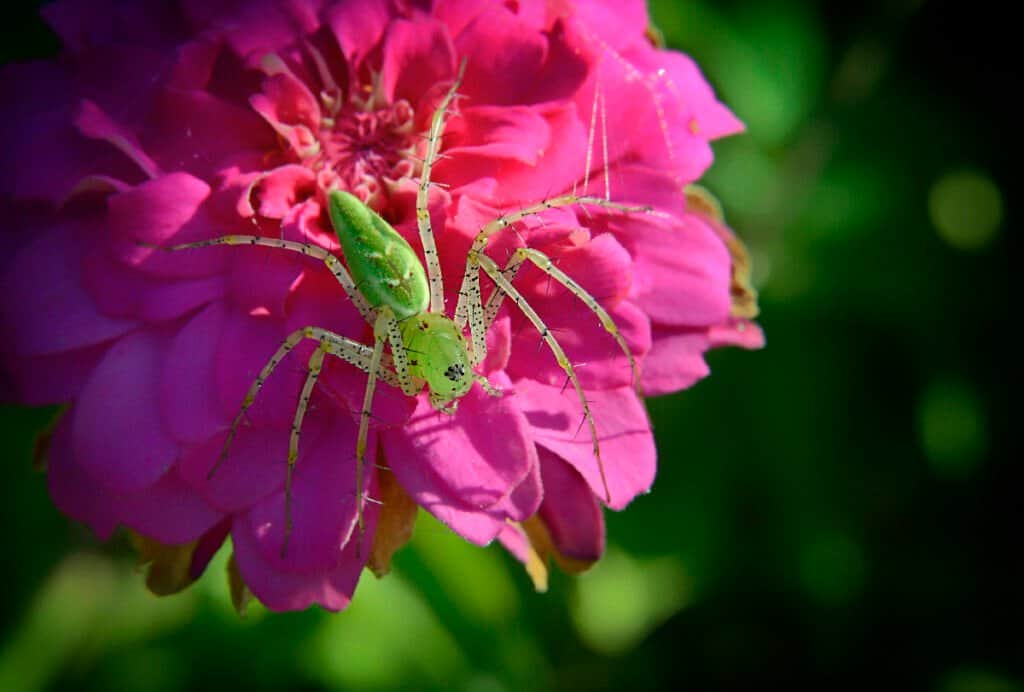
The green lynx spider blends with shrub-like plants.
©iStock.com/Lois_McCleary