
Quick Take
- Chinook salmon were brought to Michigan for a reason that had nothing to do with sport fishing, and in doing so accidentally created one of the state's most prized fisheries. Chinook introduction history →
- Two of these fish look nearly identical, and most anglers still mix them up despite the single field mark that separates them instantly. Spot the key difference →
- One fish on this list is considered a modest catch, but Michigan's record defies everything the average size suggests. Michigan's record walleye →
- One of Michigan's most abundant fish is technically an invasive species in half the state, a distinction made all the more surprising by the fact that its spread was entirely intentional. Bluegill's invasive status →
Summer fishing in Michigan provides ample access across Great Lakes coastal zones, quiet inland lakes, and winding river networks. The warm season brings peak aquatic activity, drawing anglers to shaded docks, shallow weed beds, and deep offshore waters for recreational and sport fishing. Continue reading to learn about five fish to catch in Michigan this summer.
Chinook Salmon
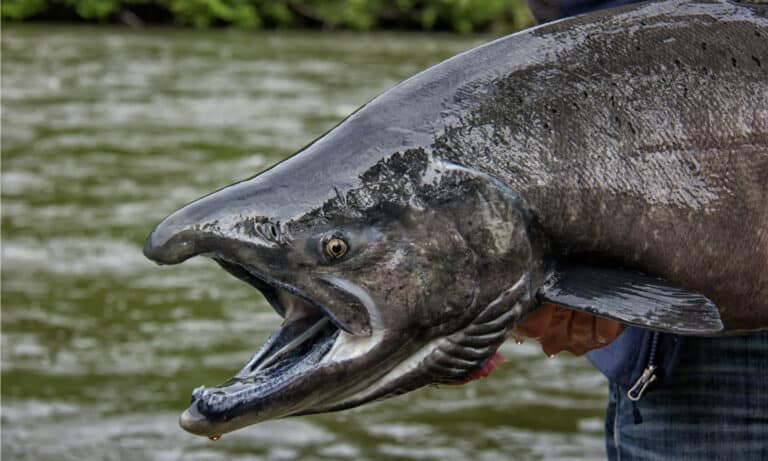
Fishing for Chinook salmon (Oncorhynchus tshawytscha) in Michigan peaks in July and August. These powerful sport fish have silver sides, dark spots on their backs and tails, and black gums. A mature Chinook salmon, on average, weighs between 15 and 25 pounds and is 32 to 40 inches long. Chinook salmon are typically found in the deep offshore waters of the Great Lakes. Michigan is bordered by four of them: Lake Michigan, Lake Huron, Lake Superior, and Lake Erie. The daily bag limit is 5 salmon per angler per day.
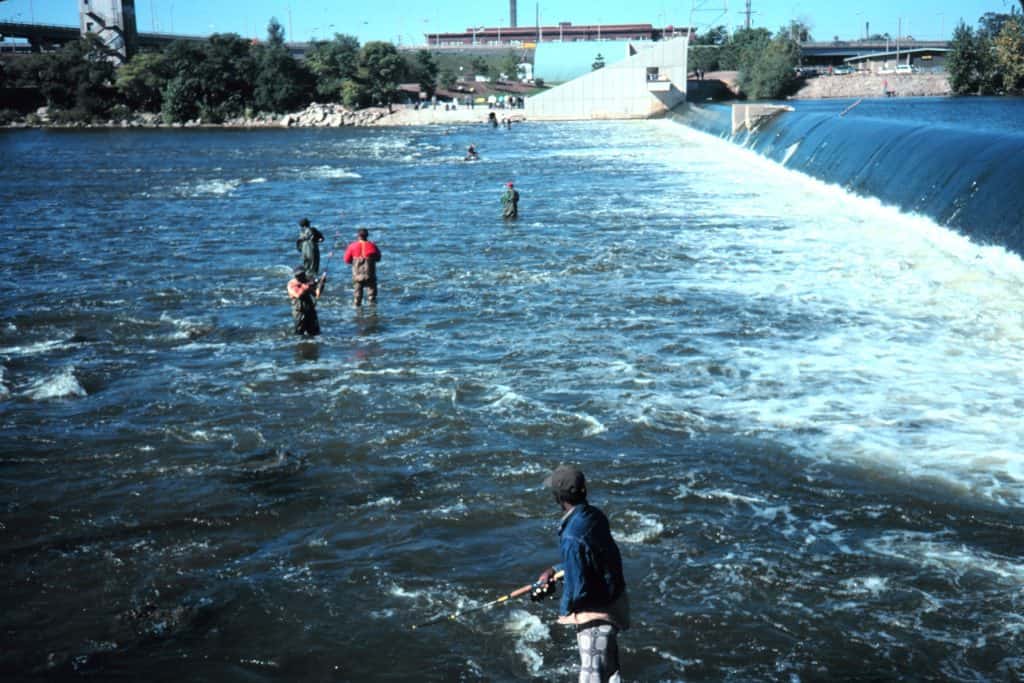
Angling for salmon in the Grand River below the 6th Street Dam in Grand Rapids, Michigan.
Chinook salmon were introduced into Michigan rivers in 1967 to control invasive alewives (Alosa pseudoharengus). These Pacific Northwest natives adapted incredibly well, transitioning from a strictly hatchery-supported species to a self-sustaining naturalized population.
Rather than migrating to the ocean, Michigan’s Chinook salmon are potamodromous, meaning they migrate entirely within freshwater systems. They spend their adult lives feeding in the open waters of the Great Lakes before returning to their natal freshwater tributaries in the autumn to spawn.
This successful transition has not only stabilized the local aquatic food web but has transformed Michigan’s river systems into world-class destinations for sport fishing.
Coho Salmon
Apart from their size and mouth pigmentation, coho salmon (Oncorhynchus kisutch) and Chinook salmon share remarkably similar life cycles, behaviors, and habitats in Michigan. A mature coho salmon, at 20-24 inches in length and weighing between 5 and 12 pounds, is approximately half the size of a mature Chinook. Chinook salmon have a black gum line, while coho salmon have a white gum line. Anglers typically cast their lines in the deep, cool waters of the Great Lakes for coho salmon, which are found in shallower water than Chinook salmon.
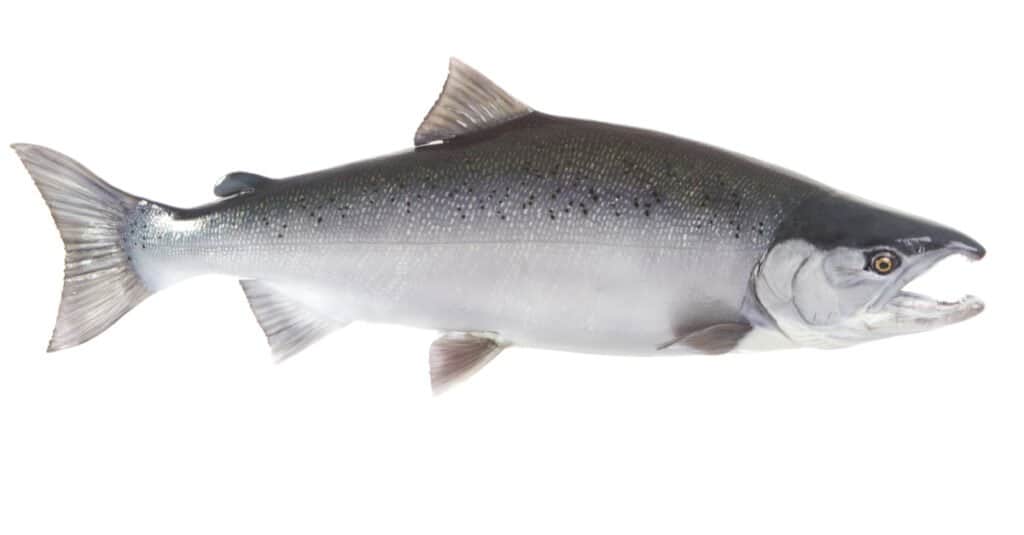
In their native distribution in the Pacific Northwest, both Chinook and coho salmon are anadromous, meaning that they are born in freshwater and transition to the open ocean to mature before returning to freshwater to spawn.
©Keith Publicover/Shutterstock.com
Like Chinook, coho salmon migrate from the open waters of the Great Lakes into Michigan’s river systems to complete their annual spawning run. Their migration draws thousands of anglers to Michigan’s riverbanks.
Steelhead Trout
Steelhead trout (Oncorhynchus mykiss) are often called Skamania in Michigan. They are sleek, silvery fish with small black spots and white mouths. Steelhead trout are typically between 24 and 30 inches long and weigh 5 to 10 pounds. They congregate in deep river holes or cooler lake waters. The general daily limit is 3, but it’s important to check specific river rules, as some rivers have restricted steelhead limits.
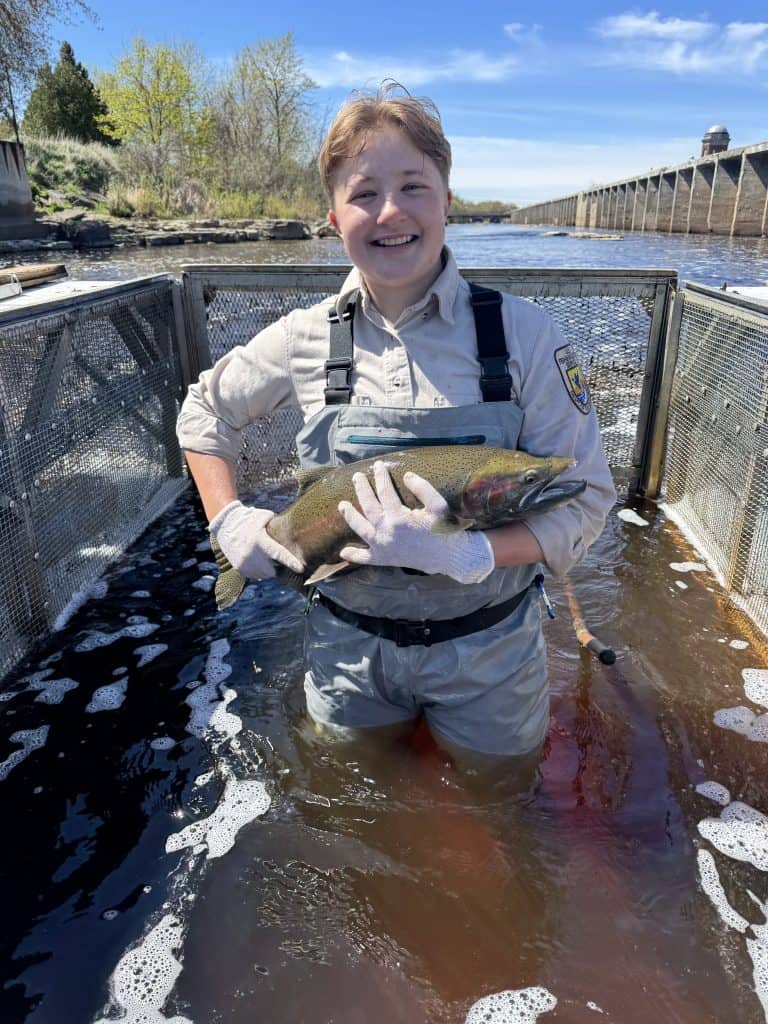
A biologist holds a steelhead trout captured in the Manistique River, Michigan.
©U.S. Fish and Wildlife Service – Midwest Region – Original / License
Steelhead trout are not native to the Great Lakes. They were introduced in 1876 when Western rainbow trout eggs from the Pacific coast were planted into the Au Sable River near Grayling, Michigan.
Walleye
During Michigan summers, walleye (Sander vitreus) shelter in deeper drop-offs, weed edges, and rocky reefs in lakes and rivers during the heat of the day and shallows at dawn and dusk. They are brassy-gold and olive with large eyes and a white-tipped lower tail lobe. Walleye are a smaller game fish, weighing between one and three pounds and measuring 14 to 20 inches in length.
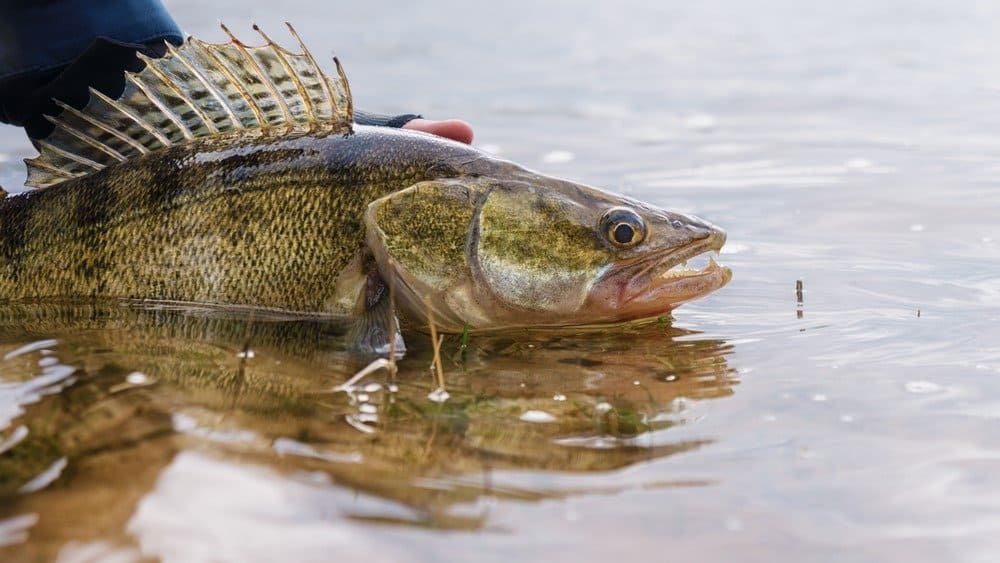
Walleye swim around sandbars, mudflats, and rocky points.
©wwwarjag/Shutterstock.com
Statewide, the daily bag limit for walleye is 5 fish per angler per day with a 15-inch minimum size. Although walleye are typically modest in size, Michigan’s record walleye, caught in 1951 by angler Ray Fadely, weighed an impressive 17.19 pounds and measured 35 inches long.
Bluegill
Bluegill (Lepomis macrochirus) are a popular panfish recognized by their deep olive to orange-brown coloration and a distinctive dark flap on their gill cover. These fish average 6 to 9 inches long and weigh under one pound.
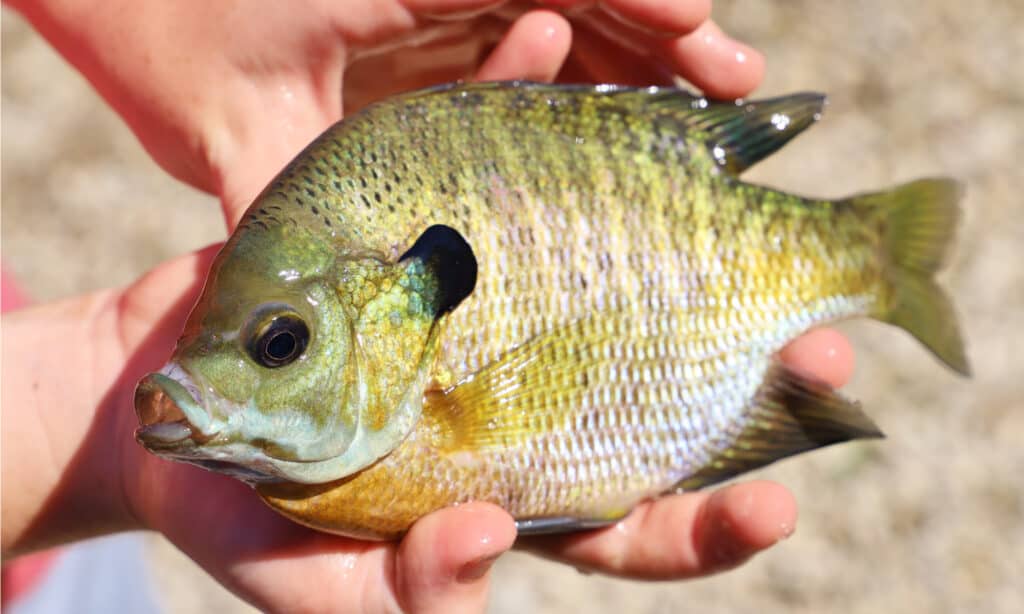
Bluegill are a type of summer panfish.
©Stacey Ann Alberts/Shutterstock.com
While early summer brings them to shallow gravel or sand flats to spawn, hot mid-to-late summer temperatures cause mature bluegills to retreat to deep weed lines, submerged logs, and drop-offs ranging from 15 to 35 feet deep. There is no statewide minimum size limit for harvest, but anglers are bound by a daily bag limit of 25 panfish in any combination per day.
Although bluegills are abundant and native to Michigan’s Lower Peninsula, they are not naturally native to the Upper Peninsula, where they were introduced through historical stocking.